
Table of Contents
Table of Contents
Searches for multi agent coordination logs kafka usually do not come from curiosity. They come from a team that has already moved past a demo. The agents are making tool calls, handing work to each other, asking retrieval systems for context, escalating to human review, and producing enough intermediate state that a normal application log no longer feels like the right system of record. The question is no longer whether Kafka can move events. The harder question is whether a Kafka-compatible streaming platform can preserve the coordination history of an AI system while staying operable under bursty, expensive, and heavily governed production workloads.
That coordination history has unusual pressure. It is part workflow journal, part audit trail, part replay input, and part debugging surface. If an agent chooses the wrong tool, retries a failed task, or hands a partial result to another agent, the platform team needs to know what happened in order, which component observed it, and whether downstream consumers have caught up. A multi-agent system without a durable coordination log becomes hard to reason about precisely when it starts doing useful work.
1Why Teams Search for multi agent coordination logs kafka
A multi-agent coordination log is not the same as a chat transcript. It records the operational facts that let independent agents cooperate: task creation, role assignment, tool invocation, state transition, checkpoint, retry, compensation, human approval, and final outcome. In an event-driven AI architecture, those records usually need to be consumed by multiple systems at the same time. The orchestration layer needs the next decision, observability needs latency and failure signals, governance needs a tamper-resistant trail, and analytics needs enough detail to improve prompts and routing rules.
Kafka is attractive here because its primitives already match the problem. A topic can represent a coordination stream. A partition can preserve ordering for a task, tenant, conversation, or agent group. A Consumer group can let workers process events in parallel while maintaining offset progress. Transactions and idempotent producers can reduce duplicate side effects when a coordinator writes to more than one topic. Kafka Connect can move coordination events into data lakes, warehouses, search indexes, or monitoring systems without making the agent runtime own every integration.
The design trap is assuming that the logical model is the whole architecture. A real time AI data pipeline often has uneven traffic: quiet periods, evaluation runs, product launches, incident-driven bursts, and long-tail replay when a team investigates an agent failure. The log must absorb spikes without forcing the team to overprovision storage and brokers for the worst hour of the month. It must retain enough history for audit and replay, but it must also support hot reads for active agent sessions. That mix pushes the storage and operations model into the foreground.
2The Production Constraint Behind the Problem
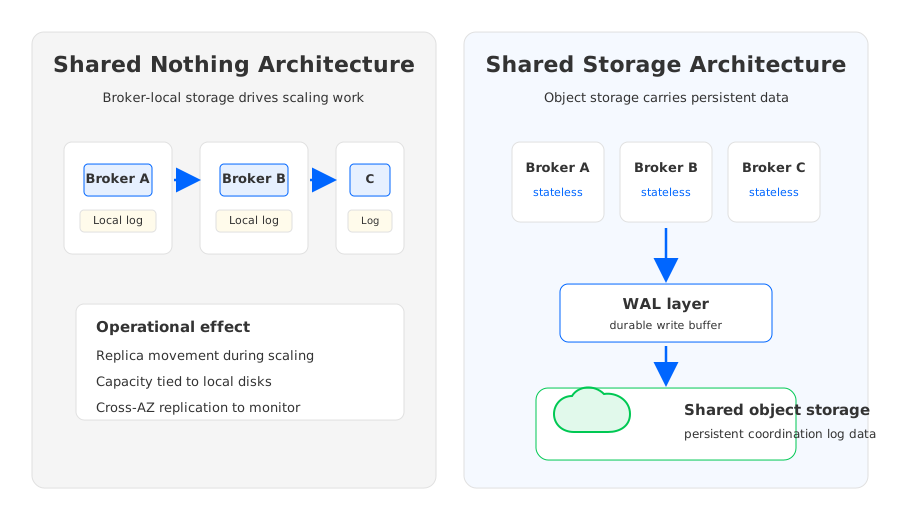
Traditional Kafka uses a Shared Nothing architecture. Each broker owns local storage, partitions are placed on broker disks, and durability is provided through replication across brokers. This model is proven and widely understood, but it converts coordination-log growth into broker-local capacity planning. More tasks create more records. Longer audit retention creates more stored bytes. More partitions create more placement and balancing work. If the AI workload grows unevenly across tenants or agent groups, the data placement layer starts to matter as much as the event schema.
The pressure shows up in four places:
- Broker-local storage becomes a workflow dependency. Coordination logs are supposed to outlive a failed worker, a restarted agent, or a model-serving incident. When partition data is tied to broker disks, recovery and scaling operations have to respect where the data already lives.
- Rebalancing moves data, not only ownership. Adding brokers for a burst is less helpful when the cluster must also migrate partition replicas before the added capacity becomes useful.
- Cross-AZ replication can become a material operating cost. Multi-AZ Kafka deployments protect availability by replicating data across Availability Zones, but that replication also creates network traffic that must be budgeted and monitored.
- Governance expands retention. AI teams often discover that debugging and compliance need more historical context than the original runtime estimate allowed.
Tiered Storage helps one part of this problem by moving older log segments into object storage while keeping the local hot tier. That is valuable when retention is the main pain point. It is less decisive when the problem is elasticity, because the broker still needs local storage for active data and the cluster still has to manage partition placement. For multi-agent coordination logs, the hot path and the audit path are connected. A failed task from 10 minutes ago may be a replay input, an observability signal, and an audit item at the same time.
3Architecture Options and Trade-offs
The first design decision is what the coordination log is allowed to become. If it is only a diagnostic stream, the platform can tolerate looser ordering, shorter retention, and simpler recovery. If it becomes the authoritative workflow journal, the same topic family now carries operational correctness. Consumers need clear offset ownership. Producers need idempotent write behavior. Schema changes need compatibility rules. Access control has to separate agent runtime data, platform telemetry, and human review artifacts.
Three architecture patterns usually appear:
| Pattern | Where it fits | Main trade-off |
|---|---|---|
| Application database plus async events | Small systems where the database remains the source of truth | Simple to start, but replay, fan-out, and cross-system ordering become harder as agents multiply |
| Traditional Kafka cluster | Teams that already run Kafka and need a durable event backbone | Mature ecosystem, but storage planning, reassignment time, and cross-AZ traffic stay on the platform team |
| Kafka-compatible shared storage platform | Teams that want Kafka APIs with a cloud-native storage model | Keeps the Kafka ecosystem while changing the broker operating model |
The table is not a product ranking. It is a way to keep the argument honest. A small agent workflow can be perfectly healthy with a database and a few queues. A mature Kafka team may prefer to extend its existing cluster if the workload is stable and governance boundaries are already solved. The shared storage option becomes more interesting when the coordination log has to scale elastically, keep long retention, and stay under customer-controlled deployment boundaries.
The event model matters as much as the platform choice. A practical coordination-log design usually separates command intent from observed fact. A task.requested event says that work should happen. A tool.call.started event records that an agent attempted a specific action. A tool.call.completed event records the result and metadata. A task.compensated event records that the system corrected or rolled back a previous path. This separation gives downstream consumers a stable audit trail without requiring every consumer to understand the full agent orchestration engine.
4Evaluation Checklist for Platform Teams
Once the coordination log becomes production infrastructure, the evaluation should move from feature comparison to failure behavior. Ask what happens when an agent run spikes, when a broker fails, when a tenant needs more retention, when a schema changes, and when a compliance team asks for a complete trail of one decision. The right platform is the one whose failure modes your team can operate repeatedly.
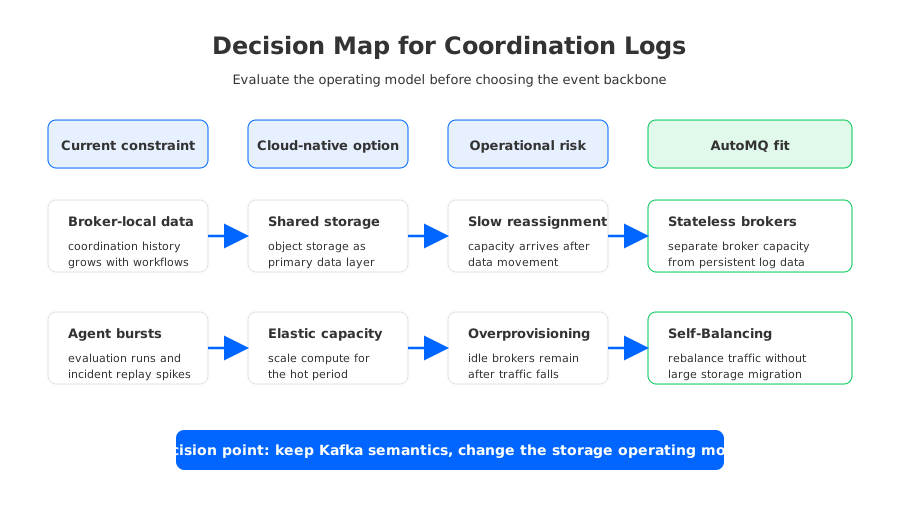
Use this checklist before committing to a platform or migration plan:
| Area | Question to answer | Why it matters for AI systems |
|---|---|---|
| Compatibility | Can existing Kafka clients, Connectors, and stream processors keep working? | Agent platforms evolve quickly; rewriting integrations creates avoidable migration risk |
| Ordering | What key determines partition ordering: task ID, tenant ID, conversation ID, or agent group? | The wrong key either breaks replay semantics or creates hot partitions |
| Retention | Which events must be retained for audit, replay, evaluation, or incident review? | Coordination logs often outlive the active workflow by weeks or months |
| Scaling | Can broker capacity change without long data movement windows? | Agent workloads spike around launches, incidents, and evaluation batches |
| Cost | Which costs grow with bytes, partitions, cross-AZ replication, and operational labor? | AI platform budgets are already exposed to model, GPU, and inference costs |
| Governance | Where does customer data live, and who controls the network boundary? | Agent logs may contain prompts, tool results, retrieved context, and policy decisions |
| Rollback | Can producers, consumers, and schemas be rolled back independently? | Multi-agent systems fail in partial states more often than linear pipelines |
Two details deserve more attention than they usually get. First, a coordination log should have an explicit compaction and retention strategy by event class. State-summary topics may use Log compaction, while audit topics usually keep append-only history. Second, observability should read from the same coordination stream that drives the system. Metrics alone can tell you that an agent is slow. The coordination log tells you where the delay entered the workflow.
5How AutoMQ Changes the Operating Model
If the platform requirement is Kafka compatibility plus a different storage model, AutoMQ is one answer to evaluate. It is a Kafka-compatible streaming platform built around Shared Storage architecture: brokers handle Kafka protocol and compute responsibilities, while persistent data is stored through S3Stream on shared object storage with a WAL (Write-Ahead Log) layer for durable writes. The important shift is not another event abstraction. It is that broker capacity and persistent log data are no longer coupled in the same way.
For multi-agent coordination logs, that shift changes several operating assumptions. Stateless brokers can be replaced or scaled with less dependence on broker-local data movement. Object-storage-backed durability makes long retention easier to reason about because the primary storage layer is not a fleet of local broker disks. Self-Balancing and seconds-level partition reassignment are relevant when an AI workload creates hot task families or uneven tenant demand. Zero cross-AZ traffic patterns are also relevant when the agent platform is deployed across zones and produces a steady stream of coordination events.
AutoMQ does not remove the need for good Kafka design. You still need partition keys that match ordering requirements. You still need schema discipline, Consumer group ownership, access control, and replay procedures. The difference is that the platform team can evaluate those concerns without also treating every capacity change as a storage migration project. That is the core architectural reason Shared Storage architecture belongs in a serious evaluation for cloud-native Kafka and event-driven AI systems.
Deployment boundaries are part of the same discussion. AutoMQ BYOC runs the control plane and data plane in the customer's cloud account and VPC, while AutoMQ Software is designed for customer-operated private environments. For teams whose coordination logs may include prompts, retrieved documents, tool outputs, and approval traces, that boundary is not a footnote. It is part of the architecture.
6Readiness Scorecard
The fastest way to make this concrete is to score the workload before choosing the platform. A team with low retention, stable traffic, and loose replay requirements may not need a different storage architecture. A team with high retention, bursty agents, strict audit needs, and multi-AZ deployment probably does.
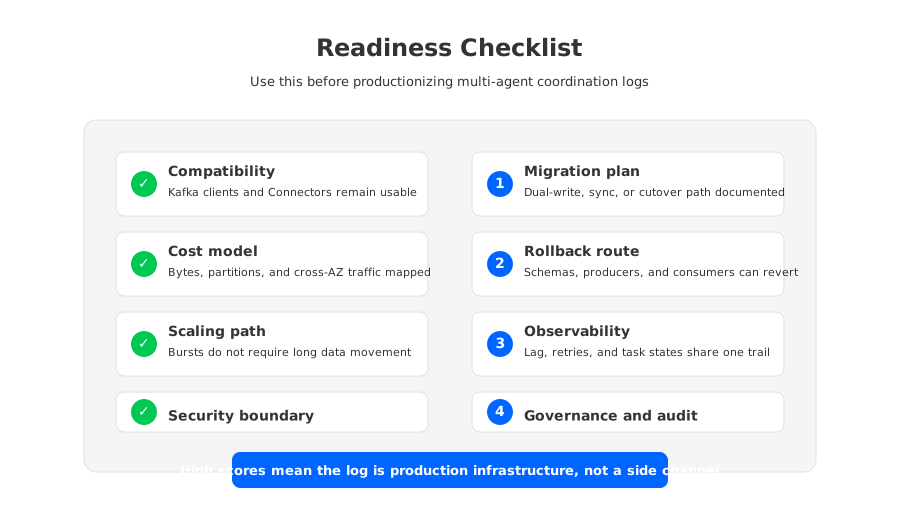
Give each line a score from 1 to 5:
| Dimension | 1 means | 5 means |
|---|---|---|
| Coordination criticality | Logs are mainly diagnostic | Logs are the workflow journal |
| Replay depth | Replay is rare and shallow | Replay is a normal debugging and recovery path |
| Traffic variance | Throughput is steady | Bursts are frequent and hard to predict |
| Retention pressure | Short-lived runtime traces | Long audit and evaluation history |
| Governance pressure | Low sensitivity metadata | Prompts, tool outputs, and approvals are regulated |
| Migration tolerance | Rewrites are acceptable | Kafka client and Connector compatibility are required |
If most scores are 4 or 5, design the coordination log as a first-class event system rather than a side channel. That means separate topics for intent and fact, explicit partitioning rules, compatibility-tested schemas, consumer lag alerts, and a documented replay process. It also means evaluating whether the broker storage model will keep up with the way the AI platform actually grows.
If your team is turning agent traces into production coordination logs, evaluate whether the storage model can grow with the workload before the workload forces the issue. You can start with the AutoMQ BYOC path at go.automq.com/home.
7FAQ
7.1Is Kafka a good fit for multi-agent coordination logs?
Kafka is a strong fit when the coordination log needs durable ordering, replay, fan-out, and integration with downstream systems. It is less necessary for a small agent workflow where a database transaction log and a queue are enough.
7.2Should every agent event go into the same topic?
Usually no. Separate topic families make retention, access control, and consumer ownership clearer. A common pattern is to split task lifecycle events, tool-call events, human approval events, and state-summary events.
7.3How should partition keys be chosen?
Choose the key based on the ordering guarantee that matters most. Task ID preserves order inside one task. Tenant ID simplifies tenant-level isolation but can create hot partitions. Conversation ID works for chat-like workflows but may be too narrow for long-running agent projects.
7.4Does Shared Storage architecture replace Kafka transactions or Consumer groups?
No. Shared Storage architecture changes how persistent log data is stored and how brokers operate. Kafka transactions, offsets, and Consumer groups still matter for application-level correctness.
7.5When should AutoMQ enter the evaluation?
Evaluate AutoMQ when the team wants Kafka-compatible APIs but sees operational friction from broker-local storage, long retention, cross-AZ traffic, or elastic scaling requirements. The stronger the need for customer-controlled deployment boundaries, the more important AutoMQ BYOC or AutoMQ Software becomes.


