
Table of Contents
Table of Contents
Teams do not search for online model inference events kafka because they need another diagram of a producer, a topic, and a consumer. They search for it when model serving has crossed the line from an application feature into a platform dependency. A fraud score, recommendation, moderation decision, routing choice, or agent action becomes an event that other systems need to inspect, replay, govern, and sometimes challenge. The hard part is no longer sending JSON through a broker; it is keeping inference fresh, traceable, and recoverable while the workload expands in bursts.
Kafka is a natural starting point because it already gives platform teams familiar primitives: topics, partitions, offsets, consumer groups, transactional producers, and a broad connector ecosystem. Those primitives matter for inference events because they let teams separate model serving from downstream audit, feature feedback, online learning, alerting, and warehouse ingestion. The trap is assuming that a Kafka-shaped API automatically gives you a production-ready inference event platform. Online inference stresses the parts of Kafka that are easiest to under-budget: broker-local storage, partition movement, hot key imbalance, cross-zone traffic, and operational ownership.
The useful design question is narrower: what should an event-driven AI architecture require from its streaming layer before the first high-volume model endpoint lands on it?
1Why Teams Search for online model inference events kafka
An online inference event is a record of a model decision made in the serving path. It usually includes a request identifier, model version, feature references or feature values, the prediction output, confidence or policy metadata, timing information, and enough context to join the decision back to user activity. Some teams also record prompt fragments, retrieval metadata, guardrail results, or agent tool calls, but the principle is the same: the event must support both live reaction and later reconstruction.
That dual use is why Kafka fits the search intent. A consumer group can process the same topic in parallel without every consumer seeing every partition, while offsets give each group an independent position in the log. One team can consume inference events to update a risk dashboard, another can write the same stream to object storage, and a third can feed a human-review workflow. When a serving bug appears, the offset history gives engineers a concrete boundary for replay and comparison instead of a vague incident window.
The pressure arrives when those inference streams become mixed-purpose infrastructure. The serving team cares about tail latency and backpressure. The ML platform team cares about model version lineage and feature freshness. The data engineering team cares about replay, schema evolution, and downstream delivery. Security and governance teams care about who can read sensitive payloads and where data physically resides. A streaming layer that looks fine for clickstream ingestion can feel tight once all of these teams attach their own consumers to the same inference event stream.
2The Production Constraint Behind the Problem
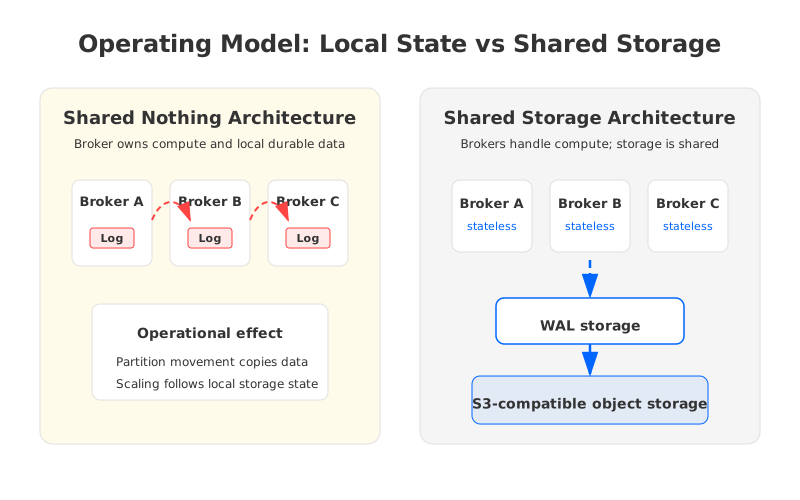
Traditional Apache Kafka runs as a Shared Nothing architecture: each broker owns local storage for the partitions it hosts, and durability is achieved through broker-level replication. This design is well understood and reliable, but it couples compute placement to data placement. If a partition moves, data may need to move. If throughput shifts, the cluster may need a rebalance. If retention grows, local disk or attached block storage must be planned ahead of demand. Online inference makes this coupling more visible because traffic is rarely smooth.
Inference traffic has a different shape from many analytical streams. A product launch, abuse campaign, promotion, market event, or agent workflow can multiply request volume quickly, then drop back to baseline. The event payload may also grow as teams add model explanations, prompt metadata, retrieved document identifiers, or policy evaluation fields. A platform team can over-provision brokers and disks for the peak, but that makes the idle periods expensive. It can run closer to the line, but then every burst becomes a capacity-management exercise.
3Architecture Options and Trade-Offs
The right architecture depends on what the event stream must prove. Some inference systems need low-latency fan-out for a few critical consumers. Others need replayable audit trails for regulated decisions. Agentic systems add another wrinkle: a single user action may produce a chain of retrieval, tool-use, policy, and model-output events, and the platform must reconstruct the chain after the fact. Kafka can support all of these patterns, but the platform design should make the trade-off explicit.
Here is a practical way to separate design choices before committing to a platform:
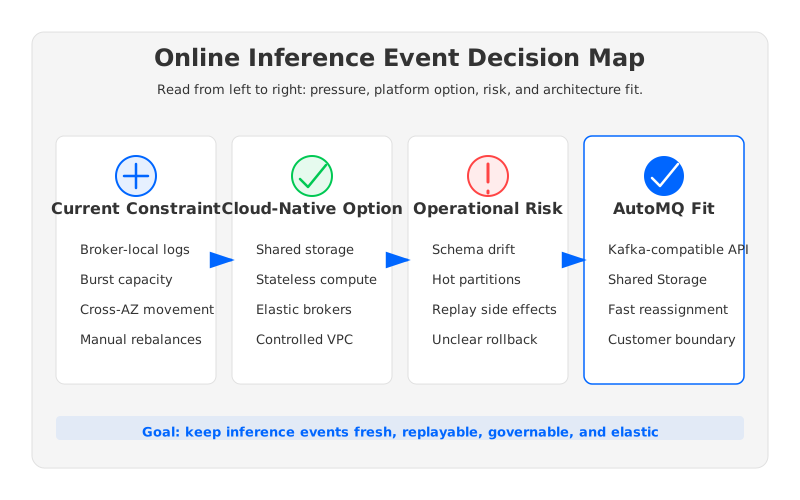
These patterns push the streaming platform toward a few clear requirements. It should be Kafka-compatible enough that existing producers, consumers, Connect workers, and operational tooling still work. It should scale broker capacity without turning every scaling event into a data relocation project. It should keep data governance boundaries clear, especially when model payloads include sensitive attributes. And it should make failure recovery boring: replace capacity, restore leadership, resume consumers, and keep offsets meaningful.
4Evaluation Checklist for Platform Teams
The evaluation should start with compatibility because online inference is rarely a greenfield system. Serving frameworks, feature stores, stream processors, lake sinks, observability tools, and incident workflows already expect Kafka semantics. If your target platform changes offset behavior, producer idempotence, transactions, client compatibility, or connector deployment patterns, the migration risk moves from infrastructure into application logic. That is where teams lose time.
After compatibility, evaluate the operational model. Ask what happens when the inference stream doubles for 30 minutes, when one tenant creates a hot key, when a broker fails during peak traffic, or when retention grows faster than forecast. A platform that requires long partition reassignments for routine elasticity can still work, but the team must budget people, automation, and maintenance windows around that fact. A platform that separates compute from durable storage changes the failure domain: broker capacity can be treated more like replaceable compute, while storage durability lives below the broker fleet.
The third dimension is cost, but cost should be decomposed before anyone argues about unit price. For inference events, Total Cost of Ownership (TCO) includes broker compute, primary storage, replication overhead, cross-AZ data transfer, connector capacity, observability, and the labor required to rebalance or recover the system. A lower storage line item does not help if a burst forces manual reassignments every week. A managed service bill can be worth paying if it reduces operational risk. The evaluation should compare the whole operating model, not a single resource SKU.
| Evaluation area | What to verify | Why it matters for inference events |
|---|---|---|
| Kafka compatibility | Producer, consumer, offset, transaction, and connector behavior | Keeps model-serving and downstream consumers from changing at the same time |
| Elasticity | How capacity is added, removed, and rebalanced | Handles bursty inference traffic without turning scaling into a data-movement project |
| Governance | Network boundary, data residency, access control, and auditability | Keeps sensitive model inputs and decisions inside approved environments |
| Recovery | Broker replacement, leadership movement, replay scope, and rollback path | Makes incidents recoverable without losing event history or consumer position |
| Cost model | Compute, storage, cross-AZ traffic, retention, and operator time | Avoids optimizing one line item while expanding another |
This checklist also prevents a common architecture mistake: selecting a streaming layer based on peak throughput alone. Throughput is necessary, but inference events are valuable because they can be trusted after the decision has passed. A platform that is fast but hard to replay, hard to govern, or hard to resize will become a constraint on the AI system around it.
5How AutoMQ Changes the Operating Model
The evaluation above leads to a specific architectural requirement: keep Kafka semantics at the API layer, but remove broker-local storage from the operational path where it creates scaling and recovery friction. AutoMQ is a Kafka-compatible, cloud-native streaming platform built around that idea. It preserves the Kafka protocol surface while replacing Kafka's broker-local log storage with S3Stream, a shared streaming storage layer backed by WAL (Write-Ahead Log) storage and S3-compatible object storage.
In AutoMQ's Shared Storage architecture, brokers become stateless brokers for the durable data path. A broker still handles Kafka protocol work, partition leadership, caching, and request processing, but persistent data is stored in shared storage rather than tied to that broker's local disk. The WAL layer absorbs writes for durability and recovery, while object storage serves as the primary long-term data location. That changes what happens during scaling: adding or replacing broker capacity does not require the same kind of local partition data movement that dominates a traditional broker-local design.
For online inference events, the practical benefit is operational room. A platform team can keep Kafka-compatible clients and ecosystem tools while reducing the amount of storage state attached to each broker. That matters when an AI product team ships a feature that creates an unexpected burst, or when an SRE team needs to isolate a slow node without planning a long data transfer. AutoMQ's Self-Balancing and seconds-level partition reassignment are designed around the same principle: rebalance traffic and ownership without treating every partition movement as a bulk copy of local logs.
The deployment boundary matters as much as the storage model. AutoMQ BYOC runs the control plane and data plane in the customer's cloud account and VPC (Virtual Private Cloud), while AutoMQ Software targets private data center environments. For inference events that may include user attributes, prompts, retrieved context, or policy outputs, this boundary gives platform teams a way to keep data paths inside environments they control. The cloud-native storage model should not come at the cost of unclear data ownership.
AutoMQ is not the answer to every streaming question. If a workload is small, stable, and already operated well, a conventional Kafka deployment may be enough. If the team only needs batch audit exports, a direct sink to object storage may be more appropriate than a streaming platform. AutoMQ becomes relevant when teams want Kafka-compatible behavior, burst-tolerant operations, object-storage-backed durability, and customer-controlled deployment boundaries in the same design.
6A Migration Path That Does Not Mix Every Risk
The safest migration plan avoids changing the model endpoint, event schema, and streaming platform in the same step. Start by defining the inference event envelope and validating it on the current Kafka-compatible platform. Add shadow consumers that verify offset behavior, schema evolution, and downstream latency. Then replicate a subset of topics into the target platform and compare consumer lag, replay behavior, and operational procedures under controlled load.
For open-source Kafka migrations, MirrorMaker2 can synchronize topics and consumer group progress, with the usual caveat that asynchronous replication can introduce duplicate consumption or reordering during cutover. AutoMQ commercial editions also provide Kafka Linking for migration scenarios that require byte-level message synchronization and offset consistency. The key is not the tool name; it is the rollback contract. Before moving serving traffic, decide which cluster is authoritative, which consumers can tolerate duplicates, and how replay output is isolated from production side effects.
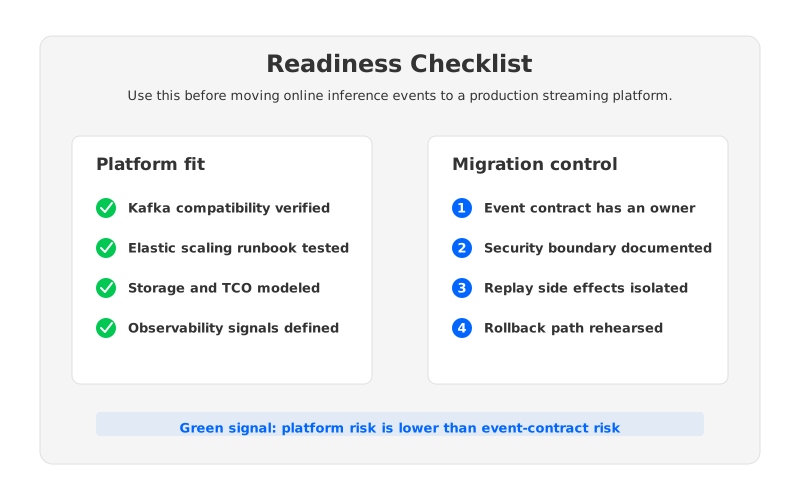
The readiness scorecard below is a simple way to decide whether a team is evaluating architecture or already ready to migrate:
| Readiness question | Green signal | Red signal |
|---|---|---|
| Event contract | Stable envelope and schema ownership exist | Model teams emit ad hoc payloads per endpoint |
| Consumer boundary | Live, audit, and batch consumers have separate SLOs | One downstream delay can backpressure the whole workflow |
| Replay plan | Replays use pinned model and feature versions | Replays call live external systems by default |
| Platform operations | Scaling, failure, and rollback have runbooks | Rebalance and recovery depend on tribal knowledge |
| Governance | Data residency and access paths are documented | Sensitive inference fields move through unclear networks |
If more than one red signal appears, fix the event design before arguing about infrastructure. A stronger streaming platform cannot rescue a weak contract between model serving and downstream consumers. If the event contract is sound and the remaining pain is elasticity, recovery, or operational overhead, the platform evaluation is worth accelerating.
If your team is evaluating Kafka-compatible infrastructure for AI serving events, compare your current runbooks against the readiness checklist above, then try AutoMQ in a controlled environment: start with AutoMQ BYOC.
7FAQ
7.1Should online inference events store full feature values or references?
Store the minimum data required for replay, audit, and debugging. Some systems need full feature snapshots for regulated decisions; others can store feature references plus model and feature-view versions. The important point is to make the choice explicit in the event contract.
7.2Is Kafka required for every real time AI data pipeline?
No. Kafka is a strong fit when multiple consumers need ordered, replayable, independent access to the same event stream. A direct request log, database outbox, or object-storage sink may be enough for simpler audit-only workflows.
7.3How should teams partition inference event topics?
Partition by the ordering boundary that matters operationally, such as account, user, device, or tenant, then test for hot keys. A conceptually clean key is not enough if it concentrates traffic during product or abuse spikes.
7.4Where does AutoMQ fit in an event driven AI architecture?
AutoMQ fits when teams want Kafka-compatible APIs with a cloud-native operating model: stateless brokers, Shared Storage architecture, object-storage-backed durability, customer-controlled deployment boundaries, and faster scaling or reassignment behavior.
7.5What is the first implementation step?
Define the event envelope and consumer ownership before changing infrastructure. Once the contract is stable, test platform behavior with shadow consumers, replay drills, and failure runbooks.
8References
- Apache Kafka 4.3 Documentation: Consumers
- Apache Kafka 4.3 Documentation: Message Delivery Semantics
- Apache Kafka 4.3 Documentation: KRaft
- Apache Kafka 4.3 Documentation: Kafka Connect
- AutoMQ Documentation: Compatibility with Apache Kafka
- AutoMQ Documentation: Shared Storage Architecture
- AutoMQ Documentation: WAL Storage
- AutoMQ Documentation: Migration Overview


