
Table of Contents
Table of Contents
Teams usually search for backfill safe stream processing kafka after something uncomfortable has already happened. A Flink job needs to replay six months of events, a data quality fix requires reprocessing a high-volume topic, or a lakehouse table must be rebuilt while production consumers keep running. The question is not whether Kafka can retain and replay data. It can. The harder question is whether the platform can absorb a large backfill without turning normal operations into a capacity, cost, and incident-management exercise.
Backfill safety is an operating property, not a single feature. It depends on offset management, live-traffic isolation, broker storage coupling, and the human steps needed when replay traffic changes the cluster. The useful test is blunt: can the team rerun historical computation while preserving production latency, consumer group progress, rollback paths, and cost control?
That test matters because backfills are no longer rare maintenance windows. They show up in schema corrections, model retraining, regulatory reconstruction, late-arriving data repair, CDC re-snapshots, and table-format compaction. Treating them as exceptional events pushes risk into the wrong place: the week when the business needs the corrected result, the data platform also has to improvise around broker disks, partition movement, and consumer lag.
1Why Teams Search for backfill safe stream processing kafka
Kafka gives stream processors a clean abstraction: records are ordered within partitions, consumers track positions with offsets, and a Consumer group can distribute work across members. That abstraction is why Kafka remains the default backbone for many real-time systems. A backfill stresses the same abstraction from the other direction. Instead of keeping up with the tail of the log, the processor intentionally reads old data at high speed, often from many partitions at once.
The first design mistake is mixing the backfill's progress with the production application's progress. If a replay job commits offsets into the same Consumer group used by the live service, the live service can skip records or move to the wrong position. Strong teams isolate backfills with separate group IDs, explicit starting offsets, and an output path that can be validated before it replaces production state.
The second mistake is assuming replay traffic is harmless because the data is already written. Historical reads still compete for disk, network, page cache, request handlers, and quota budgets. A small live stream can have a large retained history behind it, and replay can turn that history into sudden read pressure. When several teams do this at once, the issue becomes a platform scheduling problem.
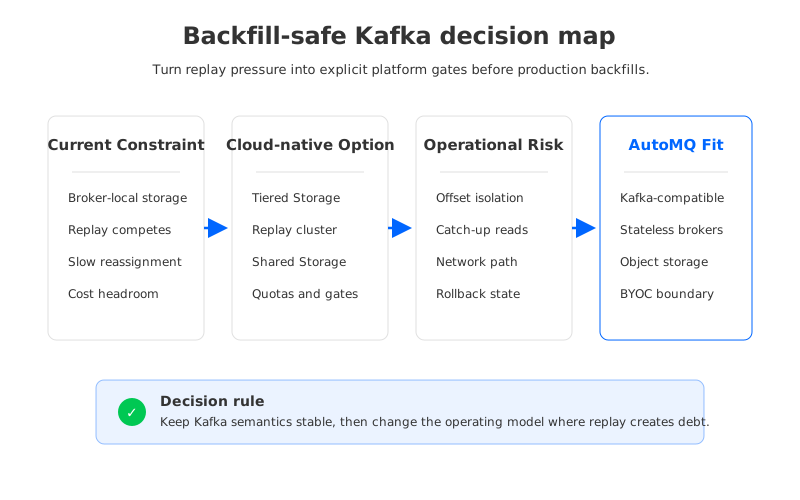
Backfill-safe design therefore has two layers. The application layer controls semantics: offset isolation, idempotent writes, transactional boundaries, checkpointing, output validation, and rollback. The platform layer controls physics: where retained bytes live, how replay reads hit storage, how brokers scale, and whether broker replacement copies data during the same window.
2The Production Constraint Behind the Problem
Traditional Kafka follows a Shared Nothing architecture. Each broker owns local storage for its partitions, and durability depends on replication across brokers. This model is coherent: it keeps recent reads local, gives the broker direct control over the log, and has served production systems for years. Backfills become painful when the same local-storage coupling defines capacity planning, recovery behavior, and scaling speed.
Consider a common sequence. A team extends topic retention so old data remains available for replay. That increases broker-local storage requirements or pushes the team toward Tiered Storage, where older segments move to remote storage while active log segments remain local. Then a backfill increases catch-up read pressure. If the cluster also needs more brokers, partition reassignment may move data while the replay job reads data. The backfill is logically a compute task, but the platform experiences it as a storage-placement event.
This is the hidden operational debt behind many replay plans:
- Capacity is reserved for an uncertain peak. The platform must leave headroom for live traffic, backfill reads, compaction, replication, and failure recovery.
- Local storage couples replay with broker maintenance. Replacing a broker, expanding storage, or rebalancing partitions can involve data movement that competes with catch-up reads.
- Cross-AZ traffic can surprise the bill owner. Multi-AZ Kafka protects availability, but replication and client routing can generate inter-zone traffic.
- Rollback planning gets muddy. If outputs and offsets are not separated from production state, the team may know how to start a backfill but not how to abandon it cleanly.
Tiered Storage improves part of this story by moving older log segments to object storage. It is practical when long retention is the main pressure. The trade-off is that it does not fully remove the broker-local operating model. The active log, partition leadership, reassignment behavior, and broker capacity planning still matter, so a backfill can remain entangled with local disks and cluster maintenance.
3Architecture Options and Trade-offs
A backfill-safe platform design starts by refusing a false binary. The choice is not "Kafka or not Kafka." It is whether the team wants to keep Kafka protocol semantics while changing the storage and operations model underneath.
| Option | What It Protects | Backfill Trade-off | Platform Question |
|---|---|---|---|
| Traditional Kafka with larger brokers | Familiar operations and local read speed | More reserved disk, slower elasticity, and larger failure domains | Can the team afford headroom for replay and recovery at the same time? |
| Kafka with Tiered Storage | Longer retention with object storage for older segments | Active broker-local storage and reassignment still matter | Does the workload mostly need retention relief, or does it need elastic replay isolation? |
| Separate replay cluster | Strong isolation from production traffic | More data movement, more governance work, and harder cutover | Can the team keep offsets, schemas, ACLs, and outputs consistent across clusters? |
| Kafka-compatible Shared Storage architecture | Durable data decoupled from broker-local disks | Requires validation of object storage, cache behavior, and compatibility | Can the team keep Kafka clients while changing the broker/storage boundary? |
Every option has a place. A small deployment with short replay windows may prefer larger brokers and strict scheduling. A regulated workload may require an isolated replay environment because audit boundaries matter more than infrastructure efficiency. A platform with long retention, many tenants, and frequent reprocessing should look harder at storage separation because the operating model, not the API, is the bottleneck.
For the stream-processing layer, the checklist is the same regardless of infrastructure. Use a dedicated Consumer group, capture starting offsets or timestamps, write to a separate output, make sinks idempotent or transactional where possible, and put replay jobs under quotas. These practices are the difference between controlled recomputation and a second incident.
The infrastructure checklist asks different questions. Where does historical data live? What happens when many partitions perform Catch-up Read at once? Can the cluster add compute without moving retained bytes? Does observability separate live tail latency from replay throughput, cache hit rate, object storage latency, and Consumer lag?
4Evaluation Checklist for Platform Teams
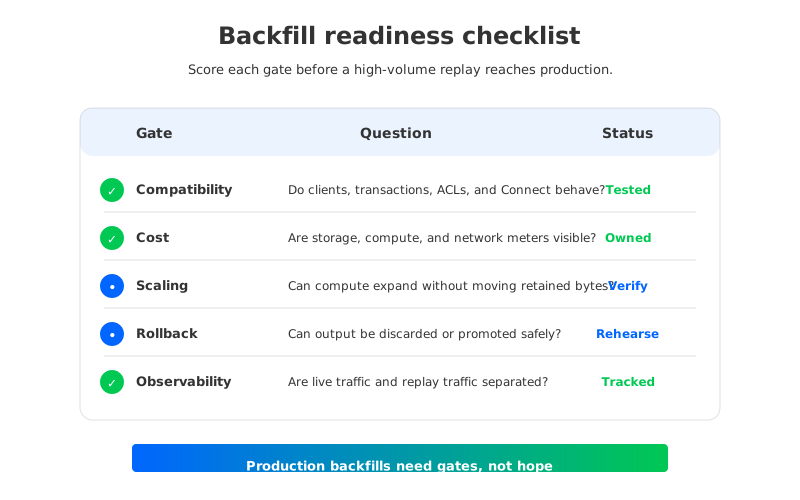
Backfill safety is easier to evaluate when each risk becomes a gate. The platform team should define these gates before the first production replay, not after the first one overloads a cluster.
| Gate | What to Verify | Failure Signal |
|---|---|---|
| Compatibility | Producers, Consumers, AdminClient operations, transactions, ACLs, quotas, Connect, and stream-processing connectors behave as expected | Backfill requires application rewrites or client-specific exceptions |
| Offset control | Replay groups, starting positions, checkpoints, and live Consumer groups are isolated | Live consumers skip, repeat, or inherit replay progress |
| Storage path | Retained data, cache, and remote reads are measured under replay load | Broker disks or object storage request paths saturate without warning |
| Cost boundary | Storage, network, PrivateLink or inter-zone traffic, and compute meters are visible | The replay succeeds technically but creates an unplanned bill |
| Governance | Topic ACLs, schema rules, data residency, and output promotion are documented | Replayed data lands in a location with weaker controls |
| Rollback | Output topics or tables can be discarded or promoted with a known procedure | The team can start a backfill faster than it can reverse one |
| Observability | Dashboards separate live traffic from backfill traffic | SREs see lag and latency but cannot tell which workload caused it |
This matrix often exposes a team-boundary problem. Stream-processing engineers can design clean checkpoint and sink behavior, but they usually do not own broker placement or cloud networking. SREs can protect cluster capacity, but they may not know which replay output is safe to promote. Backfill safety requires one runbook that crosses both groups.
The runbook should include a small rehearsal. Pick one representative topic, replay with production-like retention depth, measure live latency and Consumer lag, and validate output in a non-production namespace. If the rehearsal cannot show where the bottleneck appeared, the platform is not ready.
5How AutoMQ Changes the Operating Model
After those gates are clear, AutoMQ becomes relevant as a Kafka-compatible platform with a Shared Storage architecture. It does not give backfill jobs a new API. It keeps Kafka-facing clients and ecosystem tools in familiar territory while changing where durable stream data lives and how brokers participate in storage.
AutoMQ replaces Kafka's broker-local log storage with S3Stream, a storage layer built around WAL storage, S3-compatible object storage, and Data caching. Brokers become stateless because durable data is not tied to local disk. Scaling compute capacity, replacing brokers, and reassigning partitions no longer have to imply large movement of retained log data between broker disks.
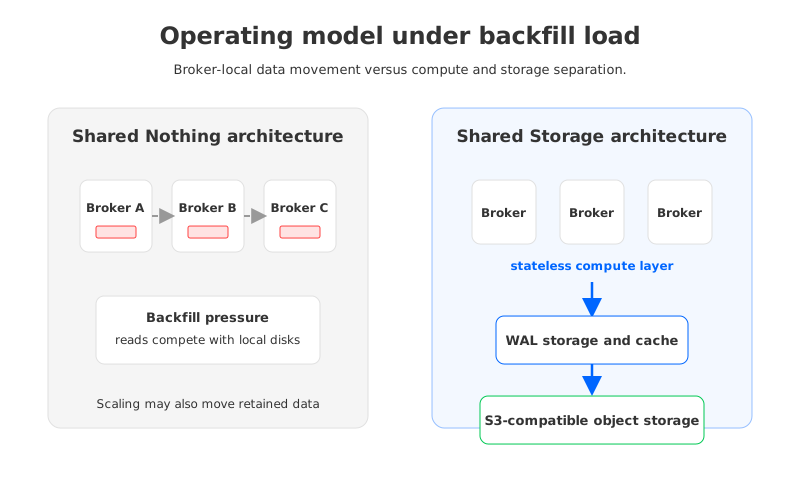
The design still has trade-offs worth testing. Object storage latency, WAL type, cache sizing, hot versus cold read behavior, and cloud-network placement all matter. AutoMQ Open Source uses S3 WAL, while AutoMQ BYOC and AutoMQ Software can use additional WAL storage types. A serious proof of concept should test both live tail traffic and historical Catch-up Read because a backfill exercises both paths.
The migration story matters as much as steady-state architecture. AutoMQ's Kafka compatibility reduces the application surface area, but compatibility should be treated as a test plan, not a slogan. Check clients, connectors, security settings, transactions, Consumer groups, monitoring, and automation. For teams moving from existing Kafka, AutoMQ Kafka Linking is designed around byte-level data synchronization and offset consistency, which helps when replay safety depends on preserving positions.
The more interesting outcome is organizational. With a Shared Storage architecture, the platform team can reason about durable history as a shared storage concern and broker count as a compute concern. Backfills become scheduled workloads with quotas, observability, and promotion gates, rather than one-off events that require everyone to keep a hand on the cluster.
6A Practical Readiness Scorecard
Before approving a production replay, score the workload with a simple rule: green means tested, yellow means designed but not tested, red means unknown. A red item should block high-volume or business-critical replay.
| Area | Green Criteria |
|---|---|
| Semantics | Replay uses isolated Consumer groups, defined starting positions, and validated output promotion. |
| Platform | Live tail traffic and Catch-up Read are measured together under load. |
| Storage | Retention growth and replay throughput are understood separately. |
| Cost | Storage, compute, and network meters have owners and alert thresholds. |
| Failure recovery | Broker replacement, stream processor restart, and output rollback are rehearsed. |
| Migration | Target platform compatibility is tested with real clients and operational tooling. |
This is also where teams should decide whether Table Topic or a lakehouse sink belongs in the design. If the goal is rebuilding analytical state, writing into Apache Iceberg through a managed stream-table path can reduce downstream pipeline work. If the goal is repairing an application-serving state store, a separate replay topic and controlled consumer promotion may be cleaner. The right target keeps validation and rollback obvious.
Backfill-safe Kafka design starts with the search query, but it ends with a runbook. Keep offsets isolated, make output promotion explicit, test replay against the real storage path, and choose an operating model that does not turn every historical read into broker-local debt. To evaluate the Shared Storage approach directly, review the AutoMQ architecture documentation or start a BYOC discussion through AutoMQ Cloud.
7FAQ
7.1What does backfill-safe stream processing mean in Kafka?
It means a replay or recomputation can run against retained Kafka data without corrupting live Consumer group progress, overwhelming production traffic, losing rollback control, or creating unbounded infrastructure cost. The design spans stream-processing semantics and Kafka platform operations.
7.2Should a Kafka backfill use the same Consumer group as production?
No. A replay should use a separate Consumer group or explicit offset assignment so it does not commit progress for the live application. Production consumers and replay consumers should have separate progress tracking, quotas, and output validation paths.
7.3Is Tiered Storage enough for backfill safety?
Tiered Storage can help with long retention because older segments can live in remote storage. It does not automatically solve replay isolation, offset safety, broker-local active storage, live traffic protection, or rollback. Treat it as one architecture option, not a complete backfill strategy.
7.4How does Shared Storage architecture help Kafka backfills?
Shared Storage architecture decouples durable stream data from broker-local disks. That can make scaling, broker replacement, and partition reassignment less dependent on moving retained bytes between brokers. Teams still need to test cache behavior, WAL storage, object storage latency, and workload quotas.
7.5When should a team evaluate AutoMQ for backfill-heavy workloads?
Evaluate AutoMQ when the team wants Kafka compatibility but current Kafka operations are constrained by local disks, slow partition movement, long retention, replay cost, or difficult scaling. The strongest evaluation uses real clients, real replay depth, and the same observability stack used in production.
8References
- Apache Kafka documentation: Consumers
- Apache Kafka documentation: Transactions and semantics
- Apache Kafka documentation: KRaft
- Apache Kafka documentation: Tiered Storage
- Apache Kafka documentation: Kafka Connect
- AutoMQ documentation: Compatibility with Apache Kafka
- AutoMQ documentation: Shared Storage architecture
- AutoMQ documentation: WAL storage
- AutoMQ documentation: Kafka Linking migration
- AutoMQ documentation: Table Topic


