
Table of Contents
Table of Contents
A search for call center intelligence events kafka usually starts after the first prototype has become operationally awkward. The team has voice transcripts, agent actions, CRM updates, sentiment scores, fraud signals, quality events, and routing decisions flowing through Kafka topics. The demo proved the architecture could move events. Production asks a harder question: can the platform absorb an unpredictable call surge, preserve replayable context, and keep sensitive customer data governed without permanently sizing Kafka for the worst hour of the month?
Call center intelligence is not a single event stream. It is a bundle of small, time-sensitive signals that arrive in uneven waves. A campaign can double inbound call volume, an outage can push customers into support channels, a model rollout can increase enrichment traffic, and a compliance investigation can trigger historical replay. Average throughput hides the stress because the workload is judged at the edges: the start of a burst, the slowest consumer group, the replay window, and the recovery path after a broker or zone problem.
The useful platform question is therefore not "Can Kafka handle call center events?" Apache Kafka is already a strong fit for durable streams, independent consumers, offsets, transactions, Kafka Connect, and replayable processing. The real question is whether the operating model lets teams scale traffic, storage, governance, and migration risk as separate concerns.
1Why teams search for call center intelligence events kafka
Call center intelligence pipelines tend to grow sideways. The first stream may contain call lifecycle events: call started, call transferred, call ended, disposition recorded. Then the contact center adds transcript chunks, agent assist prompts, customer sentiment, churn-risk scores, escalation flags, case updates, and supervisor analytics. Each addition has a rational owner, but the streaming layer becomes a shared production substrate instead of a project-specific integration bus.
Kafka fits this pattern because its model separates producers from consumers. A speech-to-text service can publish transcript events while multiple downstream systems consume them for real-time assist, quality monitoring, compliance retention, analytics, and training data preparation. Consumer groups let independent applications process the same topic at their own pace. Offsets make replay possible. Kafka Connect gives teams a standard way to integrate databases, warehouses, search systems, and SaaS applications around the event flow.
That flexibility creates the next problem. Once multiple teams depend on the same event backbone, the platform must handle more than message movement:
- Bursty arrival patterns. Call volume often follows campaigns, incidents, billing cycles, holidays, product launches, and service interruptions. The traffic curve is rarely flat enough for average-based planning.
- Fan-out pressure. Real-time assist, compliance monitoring, fraud scoring, analytics, and customer experience tools may all read the same events with different latency needs.
- Replay and retention. A support investigation may need the conversation path from weeks earlier, while a live agent-assist feature cares about the next few seconds.
- Data governance. Transcripts and call metadata can include sensitive information, so topic ownership, encryption, access control, auditability, and deployment boundaries must be explicit.
- Migration constraints. Existing producers, consumers, schemas, and operational dashboards are usually owned by different teams. A platform change that rewrites all clients becomes a program, not an infrastructure upgrade.
Those requirements mean the event stream has become important enough for platform-level evaluation.
2The production constraint behind the problem
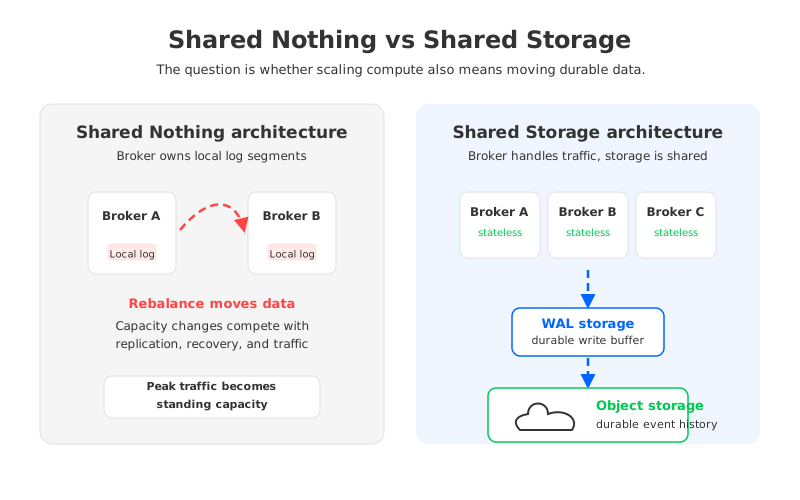
Traditional Kafka uses a Shared Nothing architecture. Each broker owns local log segments, partitions are assigned to brokers, and durability comes from replicated partition copies. This design is well understood and has served many production systems for years. It also binds compute, storage, and data placement together. When traffic grows, a broker fails, or a cluster needs rebalancing, the platform has to consider where the partition data lives, not only where request handling should run.
For call center intelligence workloads, that coupling turns temporary pressure into standing cost and caution. A contact center may need extra compute for two hours of peak call traffic, but local disks still carry retained history. A replay job may need historical reads, but scaling the broker fleet for replay can disturb the hot path. Operators may delay capacity changes because moving partition data during a surge competes with the workload that triggered scaling.
The cloud makes this more visible. Multi-AZ designs improve availability, but teams still need to understand replication paths, network routing, failure domains, and regional service behavior. The bill is not the only issue; the more important issue is whether the architecture lets the platform team act during the burst instead of after it.
This is where many teams misread the problem. They think they need a bigger Kafka cluster. Sometimes they do. More often, they need to know which part is under pressure: CPU, network, partition skew, WAL latency, consumer lag, retention, replay, or governance workflow.
3Architecture options and trade-offs
The first option is self-managed Apache Kafka. It gives platform teams the most control over broker configuration, topic policy, storage type, networking, authentication, upgrades, and observability. That control is valuable when the team has deep Kafka experience. The trade-off is owning the full stateful operating model: brokers, disks, replication, rebalancing, recovery, and capacity planning.
The second option is a managed Kafka service. This can remove a large amount of provisioning, patching, and fleet maintenance work. It may be the right choice when the team wants Kafka semantics but does not want to run brokers directly. The evaluation still needs to go deeper than "managed." Platform teams should test scaling behavior, quota limits, client compatibility, private networking, data residency, observability detail, and the shape of cost under bursty workloads.
The third option is a Kafka-compatible platform that changes the storage architecture underneath the Kafka API. In that model, the application-facing contract stays close to Kafka, but durable data is not treated as broker-local state in the same way. Tiered Storage can move older log segments to remote storage, which helps with retention pressure. It does not automatically make the broker fleet stateless for the active operating path.
A shared-storage design asks a different question: can durable event history live in object storage while brokers focus on request handling, caching, and coordination? If the answer is yes, platform teams can evaluate compute capacity, retained history, and recovery as related but less entangled dimensions. That is especially relevant for call center intelligence because the hot path and cold path are so different. Live agent assistance wants predictable tail reads and writes. Compliance review, QA scoring, and model improvement want replayable history. Treating both paths as the same broker-local capacity problem wastes engineering attention.
4Evaluation checklist for platform teams
Before choosing a platform, write down what the call center event backbone must preserve. The checklist should include Kafka behavior, operational elasticity, data control, and migration safety. A streaming platform can be technically impressive and still be the wrong fit if it breaks a client library, hides a lag signal, or forces sensitive conversation data through an unacceptable boundary.
| Dimension | Question to ask | Why it matters for call center intelligence |
|---|---|---|
| Kafka compatibility | Can existing producers, consumers, transactions, offsets, schemas, and Kafka Connect jobs keep expected behavior? | Contact center systems often have many owners. Client rewrites multiply coordination risk. |
| Burst elasticity | Can compute capacity change without waiting on large partition-data movement? | Call surges are temporary, but delayed scaling can create stale agent assistance and growing lag. |
| Retention and replay | Is historical data retained cost-effectively without forcing permanent broker overcapacity? | QA, compliance, analytics, and model improvement depend on replay beyond the live call window. |
| Governance | Are topic ownership, ACLs, encryption, audit logs, and deployment boundaries clear? | Transcript and customer-context events can contain sensitive data. |
| Failure recovery | What happens during broker, node pool, or zone failure while call traffic is elevated? | Recovery behavior observed during a surge is the one that matters to the business. |
| Migration safety | Can the team migrate topics and consumer progress with a rehearsed rollback path? | Call center systems are hard to freeze because they support live customer operations. |
| Observability | Can SREs see lag, client errors, partition skew, storage behavior, and routing anomalies together? | A delayed intelligence event is difficult to debug when every layer reports only partial health. |
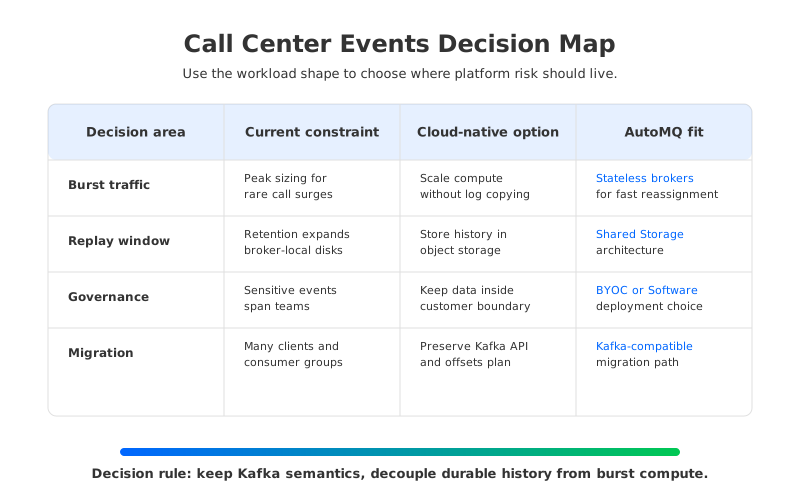
The table prevents a common evaluation mistake: treating the streaming platform as one line item. Application teams care about the Kafka API, SREs care about recovery, security cares about data boundaries, and finance cares about idle headroom. A platform choice is good only if those contracts can coexist.
5How AutoMQ changes the operating model
This is where AutoMQ enters the evaluation: as a Kafka-compatible streaming platform that changes the storage layer rather than asking teams to abandon Kafka semantics. AutoMQ uses Shared Storage architecture with stateless brokers and object-storage-backed durability. Producers, consumers, topics, partitions, and offsets remain familiar, while durable data moves away from broker-local disks.
The mechanism matters. AutoMQ replaces Kafka's local log storage layer with S3Stream, a streaming storage library that writes through WAL (Write-Ahead Log) storage and persists data to S3-compatible object storage. AutoMQ documentation describes the Shared Storage architecture, S3Stream, WAL storage, and S3 storage as the foundation for stateless broker behavior. In operational terms, broker replacement and partition reassignment become less dominated by copying retained log data between machines.
For call center intelligence, the effect is practical. The platform team can plan hot traffic, retained conversation history, and broker fleet size with clearer boundaries. Bursty writes still need enough compute and WAL capacity. Consumers still need correct group behavior, offset management, and lag alerts. But retained transcripts do not have to make every scale event behave like a storage migration.
Deployment boundaries are also part of the decision. AutoMQ BYOC is designed for customer-owned cloud environments, where the control plane and data plane run inside the customer's account and VPC. AutoMQ Software addresses private data center deployments. For teams dealing with customer conversations, regulated operational events, or strict data residency requirements, this boundary can be as important as the scaling model.
Migration should still be treated as an engineering project. AutoMQ's migration documentation describes Kafka Linking capabilities for data synchronization and consumer progress handling, but a call center platform should validate its own client versions, authentication modes, topic configuration, schema assumptions, replay windows, and rollback criteria. The right test is not whether a hello-world producer works; it is whether the highest-risk call flow can be moved, observed, and reversed under controlled conditions.
6A readiness scorecard before the next call surge
Capacity planning becomes more useful when it starts with readiness rather than fear. Use a simple 0-2 score in a joint review with platform engineering, application owners, SRE, security, and finance. A 0 means weak, 1 means partially covered, and 2 means documented, tested, and owned.
| Area | 0 | 1 | 2 |
|---|---|---|---|
| Event model | Producers publish ad hoc payloads | Core event types are documented | Schemas, ownership, and compatibility rules are enforced |
| Burst behavior | No replay of past call surges | Synthetic load tests exist | Tests use real traffic curves and failure scenarios |
| Consumer recovery | Lag is noticed after incidents | Lag alerts exist | Lag, replay, and consumer ownership runbooks are tested |
| Retention policy | Retention grows by request | Retention has topic-level policy | Retention has cost, compliance, and replay owners |
| Governance | Access is handled per project | ACLs and encryption are standardized | Audit, least privilege, and data boundaries are verified |
| Migration safety | No rollback plan | Cutover plan exists | Cutover and rollback are rehearsed with offsets |
| Observability | Broker metrics are isolated | Dashboards cover main services | Clients, brokers, storage, and routing are correlated |
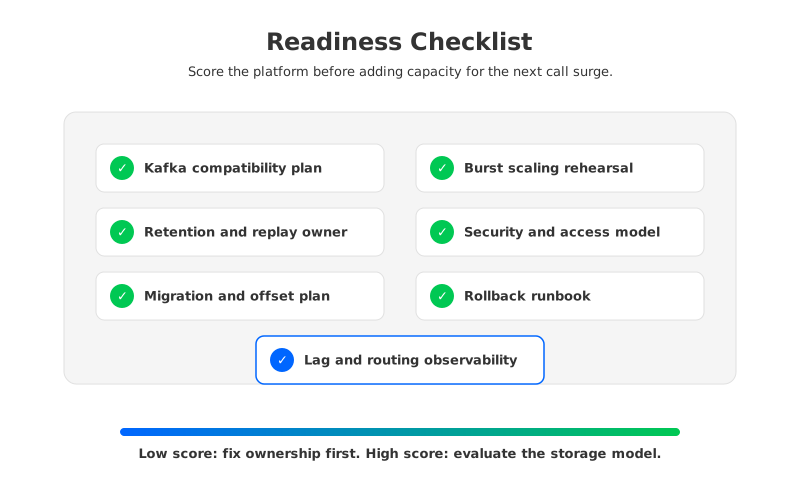
A low score does not automatically mean the team needs a new streaming platform. It may mean topic ownership, schema contracts, or consumer runbooks need attention first. Once operating discipline is in place, the architecture question becomes sharper: more broker-local capacity, or a Kafka-compatible model that separates durable history from burst compute?
For many call center intelligence systems, the answer will be staged modernization. Keep the Kafka contract applications understand. Validate compatibility. Move the storage and scaling model only where the current architecture creates recurring waste, delayed recovery, or migration risk.
7FAQ
7.1Is Kafka a good fit for call center intelligence events?
Yes. Kafka is a good fit when multiple systems need durable event streams, independent consumption, replay, and integration with stream processing or Kafka Connect. The scaling challenge appears when the call center event platform becomes shared infrastructure with bursty traffic, sensitive data, long replay windows, and many independent consumers.
7.2What makes these workloads bursty?
Call volume can spike during campaigns, outages, billing events, product launches, holidays, and service incidents. Enrichment services can also create bursts when models or routing workflows change output rate. Test peak shape, not only daily average throughput.
7.3Does Tiered Storage solve call center event retention?
Tiered Storage can help by moving older Kafka log segments to remote storage, which may reduce pressure from long retention. It does not automatically make brokers stateless for the active path. Teams should separately evaluate hot write latency, tail reads, reassignment behavior, failure recovery, and replay performance.
7.4When should a team evaluate AutoMQ?
Evaluate AutoMQ when the team wants Kafka-compatible behavior but the current operating model is constrained by broker-local storage, slow scaling workflows, retention-driven overcapacity, cross-AZ traffic planning, or customer-controlled deployment boundaries.
7.5What should be tested before migration?
Test producer cutover, consumer progress, offset expectations, schemas, authentication, topic configuration, replay behavior, observability, and rollback. Include one end-to-end flow that exercises transcript events, enrichment, routing, and downstream analytics.
8References
- Apache Kafka Documentation
- Apache Kafka Consumer Configuration
- Apache Kafka Transactions
- Apache Kafka KRaft
- Apache Kafka Tiered Storage
- Apache Kafka Connect
- AutoMQ Compatibility with Apache Kafka
- AutoMQ Shared Storage Architecture
- AutoMQ S3Stream Overview
- AutoMQ WAL Storage
- AutoMQ Migration Overview
- AWS Regions and Availability Zones
When your call center platform reserves capacity for rare surges, the next useful question is not "how many more brokers?" It is "which part of the event system actually needs to scale?" Start with AutoMQ BYOC.


