
Table of Contents
Table of Contents
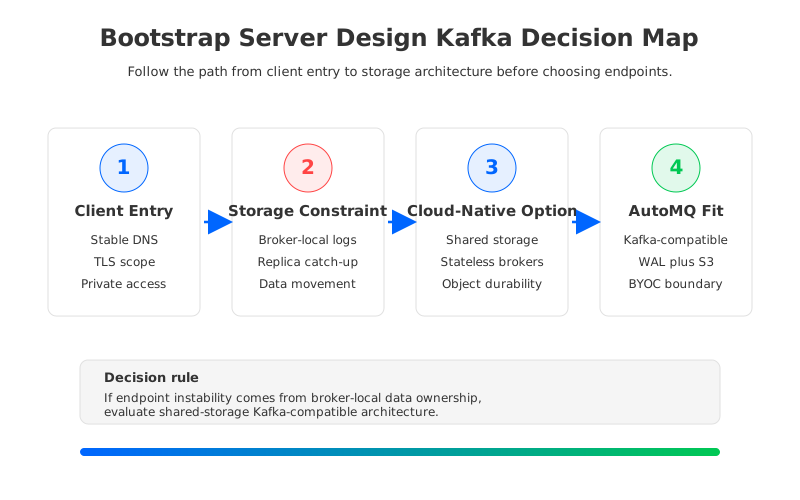
Searches for bootstrap server design kafka usually start with a small client configuration question and end in a larger architecture review. A platform team wants to know which broker addresses should go into bootstrap.servers, how many endpoints to expose, whether addresses should be public or private, and how clients behave when a broker disappears. The bootstrap list is only the front door. Behind it sits the real question: can the platform keep serving metadata, leaders, offsets, and retained data when brokers are replaced, scaled, patched, or isolated by a network event?
That is why bootstrap server design belongs in production architecture, not in a copy-paste snippet. A Kafka client needs one reachable bootstrap broker to discover cluster metadata, but a production platform has to decide what those reachable brokers represent. If each broker is also a long-lived owner of local log data, endpoint design inherits storage placement, leader placement, replica movement, and recovery behavior.
1Why teams search for bootstrap server design kafka
The phrase sounds narrow because Kafka exposes it as a client property. In Apache Kafka documentation, bootstrap.servers is the list of host and port pairs used for the initial connection to a Kafka cluster. After that contact, the client fetches metadata and talks to the broker leaders that own the relevant partitions. The bootstrap list is not a complete routing table.
Production teams care because the initial connection is where several responsibilities meet: DNS, TLS certificates, PrivateLink or private networking, listener configuration, advertised listeners, client retry behavior, and regional failover. The client setting becomes shorthand for a bigger platform contract: applications should keep finding the cluster as brokers change underneath them.
The common design review usually lands on a few questions:
- How many bootstrap endpoints should clients receive, and are they stable across broker replacement?
- Are bootstrap endpoints tied to individual brokers, a load balancer, a private service endpoint, or a per-zone access pattern?
- What happens to clients when a bootstrap broker is healthy but its local partition replicas are catching up?
- Can the team scale the cluster without forcing a long client rollout or a risky advertised-listener change?
- Does the endpoint design match the security boundary, such as a customer VPC, private subnet, or cross-account access model?
Those questions are not solved by adding more hostnames. More hostnames can improve initial reachability, but clients eventually route to partition leaders. If the leader lives on a stateful broker with local storage, the platform still has to manage data movement, disk pressure, and recovery.
2The production constraint behind the problem
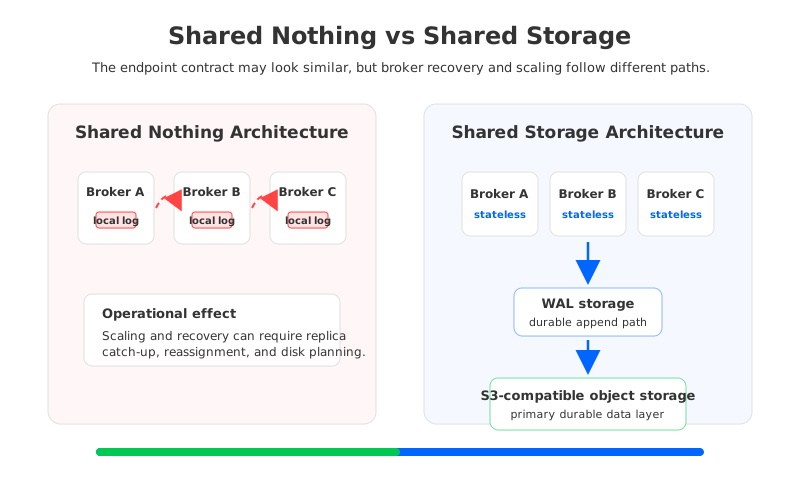
Traditional Kafka was designed around a Shared Nothing architecture. Each broker stores local log segments, owns partition replicas, and participates in replication with other brokers. That model is proven and still fits many workloads. It gives operators direct control over disks, broker sizing, rack awareness, replica placement, and failure domains.
The constraint appears when the cluster becomes elastic, multi-zone, or retention-heavy. If a broker is both a compute endpoint and a storage owner, replacing it is not only a compute event. It may require replica catch-up, partition reassignment, disk rebalancing, and network transfer. Scaling out adds capacity, but the cluster has to move enough leadership and replica data to use that capacity.
The same coupling affects failure recovery. A broker can come back online, but its replicas may be behind. A replacement node can join, but it starts without the local log data that made the old node useful. A zone can be reachable, but cross-zone replication and client routing may still consume network capacity. Cloud providers publish separate pricing and networking rules for data transfer, private access, and storage services, so endpoint and data path plans belong together.
Tiered Storage changes part of this picture, but it does not erase the bootstrap design problem. Apache Kafka Tiered Storage moves older log segments to remote storage while the local tier still serves the active log. That can help long retention and disk pressure. It does not make brokers stateless in the active write path or remove leader placement, local hot data, and partition movement from scaling or recovery.
3Architecture options and trade-offs
The cleanest way to evaluate bootstrap server design is to separate the client-facing contract from the storage architecture behind it. Endpoint stability is one layer; broker statefulness is another. A design can have stable DNS and still be operationally heavy if every infrastructure change causes large data movement. Another design can expose Kafka-compatible endpoints while moving durable data away from broker-local disks.
| Option | What clients see | What operators still manage | Where it fits |
|---|---|---|---|
| Self-managed Kafka with broker endpoints | Broker hostnames or load-balanced entry points | Local disks, replicas, reassignments, listeners, certificates, and client rollout discipline | Teams that want full control and already run Kafka operations well |
| Managed Kafka service | Provider-managed bootstrap endpoints | Service limits, networking model, storage sizing, quotas, and migration boundaries | Teams prioritizing managed operations over infrastructure control |
| Kafka with Tiered Storage | Kafka endpoints with a local and remote storage tier | Active local tier, leader placement, remote read behavior, and tiering configuration | Retention-heavy workloads where active hot data still fits the local model |
| Kafka-compatible Shared Storage architecture | Kafka-compatible endpoints over stateless serving nodes | Object storage, WAL storage, cache behavior, governance, and workload validation | Teams that want Kafka compatibility but less broker-local data ownership |
This table is not a ranking. It is a filter. If the main risk is client compatibility, test producers, consumers, transactions, serializers, schema tooling, Kafka Connect, and offset behavior before storage economics. If the main risk is cloud cost, map physical data paths before assuming managed operations will lower the bill. If the main risk is recovery, rehearse broker loss, zone impairment, scale-out, scale-in, and rollback.
Stop asking whether the bootstrap list is "right" in isolation. Ask what happens after the client uses it: metadata points to leaders, leaders sit on brokers, and brokers either own durable local data or they do not. That chain is the real bootstrap architecture.
4Evaluation checklist for platform teams
A useful bootstrap review should produce decisions that application teams can follow without learning the whole storage system. It should also give SREs enough detail to test failure behavior. The checklist below ties endpoint choices to recovery, governance, and cost boundaries.
| Area | Question to answer | Evidence to collect |
|---|---|---|
| Compatibility | Do existing clients, Consumer groups, offset commits, idempotent producers, transactions, and Connect jobs behave as expected? | Client matrix, integration tests, protocol/version notes, and rollback tests |
| Endpoint stability | Can clients keep using the same bootstrap contract during broker replacement, scaling, and certificate rotation? | DNS or service design, listener plan, certificate scope, and retry settings |
| Storage coupling | Does broker replacement require moving retained partition data before capacity is usable again? | Reassignment tests, catch-up duration, disk saturation metrics, and recovery runbooks |
| Cost model | Which paths create storage, request, data transfer, or private endpoint charges? | Cloud pricing pages, traffic diagrams, and measured per-path throughput |
| Security boundary | Do bootstrap endpoints, data paths, control paths, and object storage remain inside the intended account, VPC, or private environment? | IAM policies, network routes, audit logs, and encryption settings |
| Observability | Can the team distinguish bootstrap reachability, metadata errors, leader movement, storage latency, and consumer lag? | Broker metrics, client metrics, logs, tracing, and alert definitions |
| Migration and rollback | Can the team move traffic, preserve offsets where required, and reverse the change without rewriting applications? | Migration rehearsal, dual-write policy, offset validation, and cutover checklist |
This checklist usually exposes the weak part of the design. Sometimes it is a DNS pattern that makes certificate rotation risky, a network design that sends clients through the wrong zone, or a governance rule that requires private access to every data path. Other times it is architectural: broker-local storage turns routine operations into data movement projects.
5How AutoMQ changes the operating model
Once the evaluation reaches that storage boundary, AutoMQ becomes relevant as a Kafka-compatible cloud-native streaming platform built around Shared Storage architecture. It keeps the Kafka-facing contract while moving durable stream data away from broker-local storage. AutoMQ Brokers act as stateless serving, routing, caching, and coordination nodes.
The storage path is the important change. AutoMQ uses S3Stream as the shared streaming storage layer. Writes go through WAL storage for durable append handling and are then uploaded to S3-compatible object storage. Brokers can cache hot data and serve Kafka requests, but acknowledged records are not dependent on a broker's local disk as the durable source of truth.
For bootstrap server design, this shifts the practical questions. The platform still needs stable endpoints, advertised listeners, TLS, private networking, and client retry settings. What changes is the blast radius of broker replacement and scaling. If a broker is replaced, the system does not need to reconstruct a large local log before the replacement can serve traffic. If capacity changes, balancing moves closer to metadata, leadership, traffic, and cache warming rather than bulk disk-to-disk copying.
That distinction matters for cloud governance. AutoMQ BYOC runs in the customer's cloud environment, and AutoMQ Software runs in a customer-managed private environment. In those models, the data plane and the storage resources can stay under the customer's control while the Kafka-compatible surface remains familiar to application teams. For organizations that treat network boundaries, IAM, audit logs, and regional placement as first-class requirements, this is part of the architecture decision rather than an operational footnote.
AutoMQ is not the answer to every bootstrap design review. If your existing Kafka clusters are stable, the workload is predictable, local-disk operations are mature, and the team is comfortable with the cost profile, changing the storage architecture may not be the highest-value project. The stronger case appears when the same symptoms repeat: long reassignments, slow broker replacement, storage-driven over-provisioning, cross-zone traffic surprises, or migration plans that copy data only to inherit the same local-storage constraints.
6A readiness scorecard
Before changing a production streaming platform, score the current design against the failure and operating events that actually happen in your environment. Use "green" only when the answer has been tested, not when the architecture diagram looks plausible.
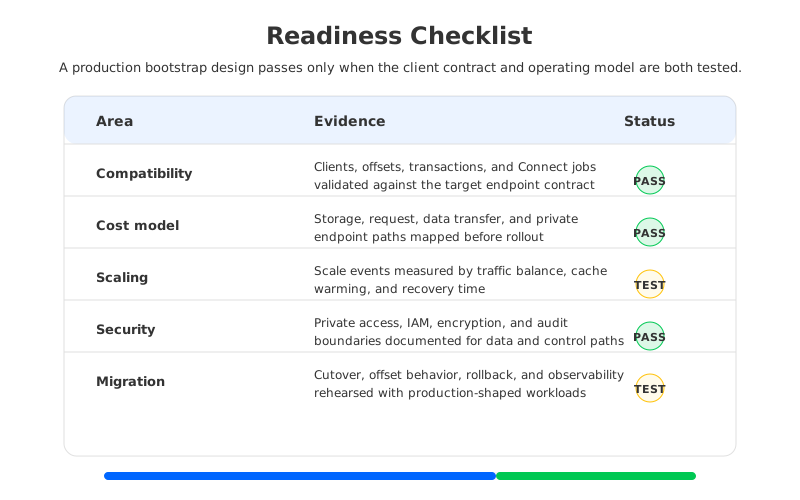
| Readiness area | Green signal | Red signal |
|---|---|---|
| Client contract | Applications use a documented endpoint pattern and tested retry settings | Each team copies a different bootstrap list from an old runbook |
| Broker lifecycle | Broker replacement is rehearsed and bounded | Replacement waits on large replica catch-up or manual reassignment |
| Scaling | Scale events are measured by traffic redistribution and cache behavior | Scale events are dominated by partition data movement |
| Cost visibility | Data transfer, storage, request, and private endpoint charges are mapped | The bill is understood only after traffic grows |
| Governance | Data paths and control paths match the intended account and network boundary | Private access, IAM, and audit ownership are ambiguous |
| Migration | Offset behavior, producer cutover, and rollback are tested | The plan assumes record copying is the whole migration |
The scorecard should make the next step clear. If most red signals sit in the client contract and network layer, fix the endpoint design before changing the platform. If most red signals sit in broker lifecycle, scaling, and storage coupling, the team should evaluate whether a Kafka-compatible Shared Storage architecture removes the root constraint. That evaluation should use the same producers, consumers, Consumer groups, transactions, Connect jobs, retention policies, and observability tools that production uses.
Returning to the original search, bootstrap server design kafka is not only about how many addresses to put in a property file. It is about whether the first broker a client reaches leads to a system that can survive routine cloud operations without turning every change into a data movement event. If that is the pressure your team is feeling, review the AutoMQ architecture overview and use the AutoMQ BYOC entry point to test the model against your own bootstrap, networking, storage, and migration requirements.
7FAQ
7.1Is bootstrap.servers a load balancer?
No. In Apache Kafka, bootstrap.servers is the initial list of host and port pairs a client uses to discover cluster metadata. After metadata discovery, the client connects to the brokers that lead the partitions it needs. Some deployments place a load balancer or private endpoint in front of bootstrap access, but that is an infrastructure pattern rather than the Kafka property itself.
7.2How many bootstrap servers should a Kafka client use?
Use enough independent endpoints that a client can discover metadata during broker maintenance or failure. The exact number depends on your networking pattern, DNS design, and broker exposure model. The harder question is whether those endpoints remain stable when brokers are replaced, certificates rotate, or zones are impaired.
7.3Does Tiered Storage make Kafka brokers stateless?
No. Tiered Storage can move older log segments to remote storage, which helps retention and local disk pressure. The active local tier, leader placement, and broker-owned hot data still matter. A Shared Storage architecture changes the model more deeply by moving durable stream data away from broker-local disks.
7.4When should AutoMQ enter the evaluation?
Evaluate AutoMQ when Kafka compatibility is required but broker-local storage is the repeated source of operational risk. Typical signals include slow partition reassignment, storage-driven capacity planning, long broker recovery, high cross-zone data movement, or a migration goal that includes changing the operating model, not only changing the endpoint.
8References
- Apache Kafka documentation: producer
bootstrap.servers - Apache Kafka documentation: consumers and Consumer groups
- Apache Kafka documentation: guarantees and transactions
- Apache Kafka documentation: KRaft
- Apache Kafka documentation: Tiered Storage
- AutoMQ documentation: architecture overview
- AutoMQ documentation: S3Stream shared streaming storage
- AutoMQ documentation: WAL storage
- AWS EC2 pricing: data transfer
- AWS S3 pricing
- AWS PrivateLink pricing


