
Table of Contents
Table of Contents
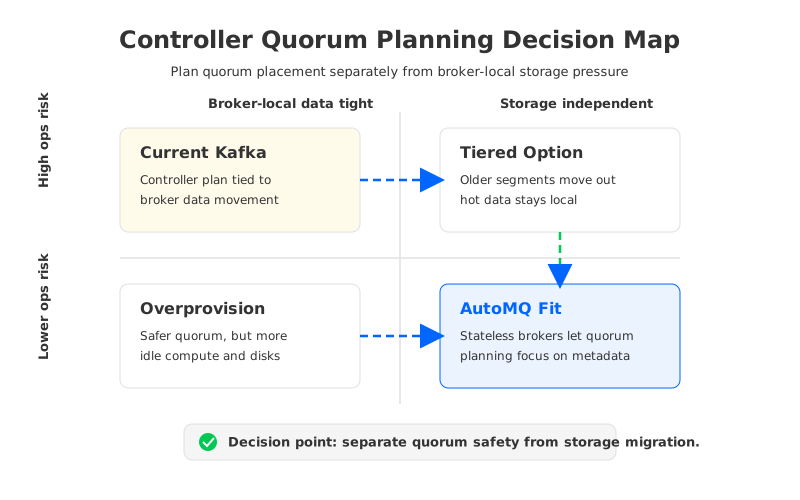
Teams usually search for controller quorum planning kafka when a cluster decision has stopped being a cluster decision. A platform team may be planning a KRaft migration, replacing aging ZooKeeper-based infrastructure, moving Kafka across Availability Zones (AZs), or making controller placement fit a stricter recovery model. The search sounds narrow, but the pressure behind it is wide: how do you keep Kafka metadata safe while brokers, disks, zones, and cost models keep changing?
The controller quorum is not where records live. In KRaft mode, Kafka uses a metadata quorum to manage cluster metadata and controller election, while brokers still handle client traffic and partition leadership. That separation is healthy, but it does not erase operational coupling. If broker-local storage makes every scaling, replacement, and balancing event expensive, controller quorum planning inherits pressure from work it does not directly own.
The practical question is not "How many controllers should we run?" on its own. The better question is: what else must change safely when the quorum is healthy? A good controller quorum design protects metadata availability, but a production Kafka platform also has to absorb broker failures, partition movement, retention growth, client compatibility, governance boundaries, and migration rollback.
1Why Teams Search for controller quorum planning kafka
Controller quorum planning becomes urgent when Kafka moves from a stable cluster into an infrastructure transition. KRaft removes ZooKeeper from the metadata path, so teams must decide how to place controllers, size quorum nodes, isolate failure domains, and plan upgrades. The Apache Kafka documentation describes KRaft as Kafka's metadata quorum architecture, and that alone is enough to trigger a review of controller roles, broker roles, listeners, and operational runbooks.
Search intent usually falls into four patterns. The first is migration: a team wants to move from ZooKeeper mode to KRaft and needs a production-safe checklist. The second is topology design: controllers need to span zones without creating fragile latency or failure assumptions. The third is capacity governance: the platform team wants to know whether controller nodes should be dedicated or colocated with brokers. The fourth is architecture evaluation: the team is deciding whether the next Kafka-compatible platform should keep broker-local disks at the center of the operating model.
Those patterns share the same hidden fear. Metadata quorum failure can make a cluster unable to make progress, but an unhealthy storage model can make every ordinary operation feel like a failure drill. When broker replacement requires careful partition movement, when scale-out requires data rebalancing, and when retention growth means more local volume planning, the controller quorum is only one part of the real design problem.
This is why controller planning belongs in a broader platform review. A quorum can be technically correct and still sit inside an architecture that is hard to operate. The quorum protects the control path; the storage architecture determines how disruptive the data path becomes when the control path makes decisions.
2The Production Constraint Behind the Problem
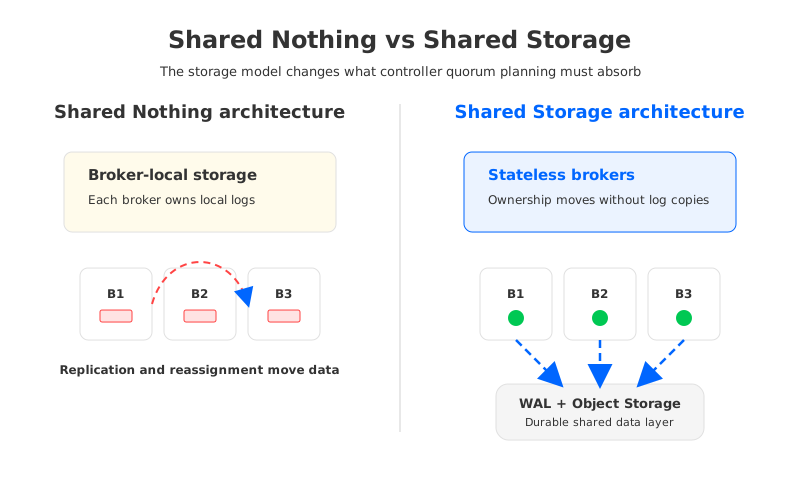
Traditional Kafka follows a Shared Nothing architecture. Each broker owns local persistent logs, and replication across brokers provides durability for partition data. This model made strong sense in data center environments where local disks were the natural persistence layer and intra-cluster replication was a reasonable cost. In cloud environments, the same design ties durability, placement, scaling, and cost to broker-local storage.
That coupling shows up in controller quorum planning because the controller is responsible for metadata decisions that often lead to storage-heavy work. A controller can assign partition leadership, track brokers, and coordinate cluster state, but the physical data still sits on broker-attached volumes. If a broker leaves, joins, or changes capacity, the platform must reason about where data is, how much must move, how long it will take, and whether client traffic will suffer during the operation.
For platform teams, the sharp edges are familiar:
- Failure-domain design gets crowded. Controllers, brokers, disks, and replicas all need placement rules. The clean mental model of "three controllers across three zones" becomes entangled with broker storage and partition replica placement.
- Capacity planning becomes defensive. Teams provision extra broker capacity because moving data under pressure is risky. That idle headroom may be rational, but it is still a tax on the platform.
- Recovery planning expands beyond metadata. A healthy controller quorum can elect and coordinate, yet a broker-local storage failure still requires data recovery, replica catch-up, and reassignment work.
- Cloud networking costs become part of architecture. Cross-zone replication and partition movement can create recurring data transfer charges depending on the cloud provider and topology.
Tiered Storage changes part of this equation, but not all of it. Apache Kafka's Tiered Storage moves older log segments to remote storage while retaining the local log as the active write and read layer for hot data. That can help retention economics and recovery behavior for older data, but it does not make brokers stateless. Controller quorum planning still has to live with a hot data path anchored to broker-local storage.
3Architecture Options and Trade-Offs
The first option is to keep a conventional Kafka architecture and tune the operational model around it. This is a valid path when teams have mature Kafka operations, predictable workloads, and automation that already handles broker replacement, partition reassignment, and capacity buffers. The trade-off is that the platform remains storage-coupled. Controller quorum planning can be improved, but it cannot remove the data movement that follows broker-local state.
The second option is to adopt Tiered Storage for retention-heavy workloads. This is useful when the main problem is the cost or manageability of long retention. It can reduce pressure on local disks for older data and make historical reads less dependent on broker volumes. The trade-off is architectural: hot partitions still require local broker storage, and active workload placement still needs careful broker capacity management.
The third option is to evaluate a Kafka-compatible platform with a Shared Storage architecture. In this model, brokers keep Kafka protocol and request-handling responsibilities, while durable data is stored in shared object storage through a storage layer designed for streaming. The controller can still coordinate metadata and leadership, but broker replacement no longer implies copying the broker's persistent log from one local disk to another.
These options are not interchangeable. They answer different questions.
| Architecture path | Best fit | Main trade-off |
|---|---|---|
| Conventional Kafka with tuned operations | Stable workloads and experienced Kafka teams | Keeps broker-local storage and data movement in the operating model |
| Kafka Tiered Storage | Long retention with pressure on local disks | Hot data still depends on broker-local storage |
| Kafka-compatible Shared Storage architecture | Elastic cloud operations and faster broker replacement | Requires validating the storage layer, WAL behavior, and migration process |
The important distinction is between reducing local storage pressure and removing broker-local persistence from the critical path. Tiering helps with retention. Shared storage changes the operating model. Controller quorum planning benefits most from the second change because the quorum's decisions no longer trigger the same storage-bound consequences.
4Evaluation Checklist for Platform Teams
Before choosing an architecture, evaluate controller quorum planning as a platform boundary rather than a single Kafka configuration task. The checklist below is intentionally neutral. It applies whether you run Apache Kafka yourself, use a managed service, or evaluate a Kafka-compatible alternative.
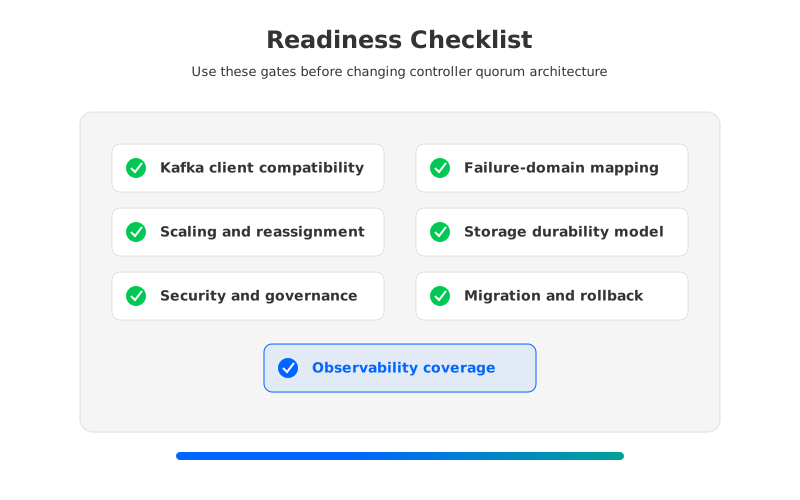
Start with compatibility. Kafka clients, Connect workers, stream processing jobs, Schema Registry integrations, transactions, idempotent producers, consumer groups, offsets, and admin tooling all create migration risk. A platform that claims compatibility must be tested against your actual client versions, security settings, operational scripts, and failure runbooks.
Then review failure domains. A controller quorum should not be placed in a way that lets one zone, host class, network segment, or maintenance action remove a majority. That part is straightforward in principle. The harder part is making sure broker recovery does not violate the same design goal by forcing emergency data movement across zones or leaving too little capacity after a failure.
Cost belongs in the same review, but it should not be reduced to storage price alone. A Kafka platform consumes compute, local or remote storage, network transfer, observability, operational time, and reserved capacity. If broker-local storage forces overprovisioning or cross-zone replication, those costs belong beside the quorum topology decision because they shape what the team can afford to run safely.
Security and governance also matter. Controller nodes, brokers, object storage, IAM policies, encryption settings, audit logs, and network paths need a clear ownership model. In regulated environments, the strongest architecture is the one that keeps customer data boundaries obvious. A clever quorum topology is not enough if the data path crosses accounts, networks, or services that the security team cannot review.
Finally, plan migration and rollback as first-class design inputs. A good readiness review should answer these questions before a production cutover:
- Which client applications will validate protocol compatibility?
- How will consumer offsets and transactional workloads be verified?
- What metrics prove that controller quorum health, broker health, and storage health are all acceptable?
- What is the rollback path if the candidate architecture works for metadata but fails an application-level assumption?
- Who owns the operational decision when quorum health and data path health disagree?
The last question is uncomfortable, which is why it is useful. Controller quorum planning often fails as a people-and-process problem before it fails as a configuration problem.
5How AutoMQ Changes the Operating Model
After the neutral evaluation, the architecture requirement becomes clearer: keep Kafka semantics and ecosystem compatibility, but stop making broker-local disks the center of durability and recovery. AutoMQ is a Kafka-compatible cloud-native streaming platform built around that requirement. It uses a Shared Storage architecture, stateless brokers, WAL (Write-Ahead Log) storage, and S3-compatible object storage to change what happens when brokers scale, fail, or move.
In AutoMQ, brokers still serve Kafka clients and preserve the Kafka API surface, but persistent data is not tied to broker-local logs. S3Stream provides the streaming storage layer. Writes are first made durable through WAL storage, then data is uploaded and organized in S3 storage. The WAL is not the long-term source of truth; it is the low-latency durability and recovery layer that lets the system acknowledge writes while object storage provides the shared durable data layer.
This matters for controller quorum planning because broker changes become less storage-heavy. If a broker is replaced, the platform is not waiting for a large local log to be copied into the replacement broker before the architecture can recover. Ownership, leadership, cache warm-up, and traffic routing still need coordination, but durable data already lives outside the broker. The controller and scheduling layer can focus more on metadata, traffic, and health, instead of treating every broker lifecycle event as a storage migration.
The difference is also visible in scaling. Traditional Kafka scaling often requires partition reassignment that moves data between brokers. AutoMQ's stateless brokers and Shared Storage architecture allow partition reassignment and broker scaling to avoid the same local-data-copy bottleneck. That does not remove the need for careful testing, but it changes the risk profile from "how long will data movement take?" to "how do we validate traffic, cache behavior, and application compatibility?"
For deployment governance, AutoMQ BYOC and AutoMQ Software keep control and data boundaries explicit. In AutoMQ BYOC, the control plane and data plane run inside the customer's cloud account or VPC, while customer message data remains in customer-controlled storage. AutoMQ Software follows the same principle for private environments. That boundary is relevant to controller quorum planning because metadata, management operations, and message data should be reviewed as separate flows, not blurred into one vendor-operated black box.
AutoMQ is not the right answer to every controller quorum question. If your workload is stable, your Kafka automation is mature, and broker-local storage costs are acceptable, a tuned Apache Kafka deployment can remain a rational choice. AutoMQ becomes compelling when the harder requirement is elastic operation: replacing brokers without local-log recovery work, scaling compute without proportional storage movement, reducing cross-zone data-copy pressure, and keeping Kafka compatibility while changing the storage foundation.
6FAQ
6.1Is controller quorum planning the same as broker capacity planning?
No. Controller quorum planning focuses on metadata availability, election safety, and failure-domain placement. Broker capacity planning focuses on client traffic, partition leadership, storage, and network throughput. They interact in production because controller decisions often trigger broker lifecycle events, but they should be designed and tested as separate concerns.
6.2Does KRaft remove the need to think about storage architecture?
No. KRaft removes ZooKeeper from Kafka's metadata management path and uses Kafka's own metadata quorum. It does not by itself make brokers stateless or remove broker-local log storage. Storage architecture still determines how scaling, recovery, reassignment, and retention behave.
6.3Does Tiered Storage make Kafka brokers stateless?
No. Tiered Storage moves older log segments to remote storage, but brokers still keep active local logs for hot data. It is valuable for retention-heavy workloads, but it is different from a Shared Storage architecture where durable data is designed to live outside broker-local persistence.
6.4What should be tested before changing controller quorum architecture?
Test controller failure, broker failure, zone failure, client reconnect behavior, transactional workloads, consumer group stability, offset continuity, observability coverage, and rollback. The test should include the data path, not only the metadata quorum, because application impact usually appears where metadata decisions meet broker and storage behavior.
6.5Where does AutoMQ fit in the decision?
AutoMQ fits when a team wants Kafka-compatible streaming without making broker-local storage the operational center of the platform. Its Shared Storage architecture, stateless brokers, and object-storage-backed durability change how scaling and recovery are planned while preserving Kafka client compatibility.
7Closing the Planning Loop
The original search was about controller quorum planning kafka, but the production decision is larger than quorum size. Controller safety is necessary. It is not sufficient when broker-local storage still dictates how painful every infrastructure change becomes.
If your next Kafka platform review includes KRaft, cross-zone placement, broker replacement, or cloud cost governance, use the checklist above as a design gate before choosing the operating model. To evaluate AutoMQ as a Kafka-compatible Shared Storage architecture, start with the AutoMQ GitHub repository or review the architecture documentation linked below.


