
Table of Contents
Table of Contents
Searching for partition metadata growth kafka is usually not an academic exercise. It tends to happen after a platform team has added tenants, topics, partitions, retention, or consumer groups for months and then notices that routine operations have become slower to reason about. The cluster still works, but every topology change carries more operational weight: controller metadata grows, partition placement becomes harder to balance, broker disk headroom gets tighter, and a repair window that once felt routine starts competing with business traffic.
That is the real problem behind partition metadata growth in Kafka. The metadata itself is only one surface area. The harder question is whether your streaming architecture lets the team change the shape of the cluster without turning every partition decision into a local storage decision.
1Why Teams Search for partition metadata growth kafka
Kafka makes partitioning look deceptively simple at design time. A topic has partitions; partitions provide parallelism; producers write records; consumers read offsets; and a Consumer group spreads work across members. That model is one reason Kafka became the default streaming substrate for so many teams. It gives application owners a clear unit of scale.
The stress appears when that unit of scale becomes a unit of operations. Each additional partition adds placement, leadership, replication, retention, metrics, ACL, quota, and recovery considerations. Apache Kafka's own documentation describes partitions, leaders, followers, replication, Consumer groups, offsets, and KRaft metadata as core parts of the system, not optional bookkeeping. When the partition count grows across many tenants and services, the cluster is not only carrying more records. It is carrying more decisions.
Three patterns usually trigger the search:
- Tenant and topic sprawl. Platform teams give every service team its own topics, naming rules, retention policy, and access boundary. This improves ownership, but it also multiplies metadata and operational review work.
- Parallelism as a default answer. Teams add partitions to increase throughput or reduce Consumer lag. That can be valid, but partition count often survives long after the original workload shape changes.
- Longer retention and replay expectations. More teams expect Kafka to serve historical replay, audit, and machine learning feature pipelines. Retention turns partition placement into a storage capacity problem, not only a throughput problem.
The first useful move is to separate metadata growth from data growth. Metadata growth asks how many logical objects the cluster must coordinate. Data growth asks how much durable stream data the platform must store, move, and serve. Traditional Kafka ties those two questions together more tightly than many teams expect.
2The Production Constraint Behind the Problem
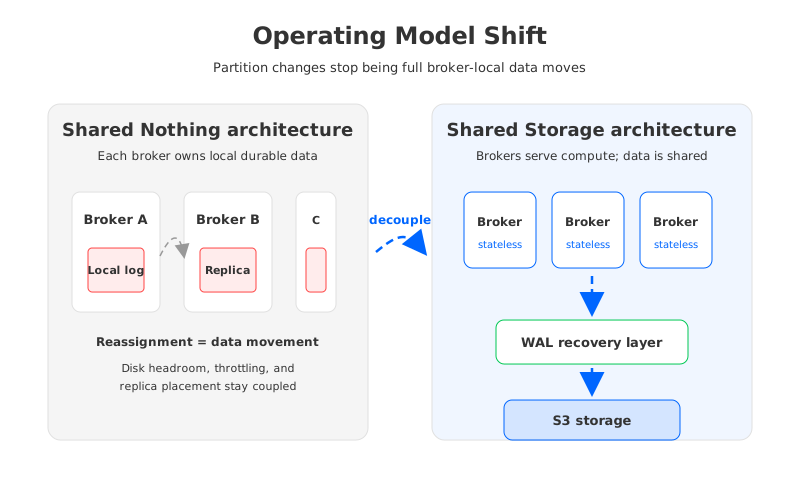
Traditional Kafka uses a Shared Nothing architecture. Each broker owns local storage, and each Partition replica is placed on specific brokers. A Partition leader handles reads and writes, while followers replicate data to maintain durability and availability. This design is practical and well understood, but it means that partition planning is also broker-local storage planning.
That coupling matters during three common operations. When a team expands the cluster, partitions may need to be reassigned so added brokers receive work. When a broker is unhealthy, replicas and leadership have to move around the remaining fleet. When retention grows, the storage footprint remains attached to broker capacity, even if compute demand and storage demand are moving at different rates. None of these are exotic failure modes. They are standard production maintenance.
Apache Kafka supports partition reassignment and cluster expansion workflows, and KRaft removed the need for ZooKeeper by keeping metadata inside Kafka's own controller quorum. Those are important advances. They do not, by themselves, remove the physical coupling between a partition's durable data and the broker-local storage that hosts it.
Tiered Storage changes part of this equation by moving older log segments to remote storage while keeping the active local log on brokers. That can help with long retention and historical reads, but it still leaves the hot write path, local disk sizing, leadership, and reassignment behavior connected to broker-local storage. For a team trying to reduce the operational blast radius of partition metadata growth, Tiered Storage is a useful option, not the same thing as a Diskless architecture.
The practical lesson is uncomfortable: a partition metadata problem can become a storage mobility problem. If every partition change implies data movement, disk headroom checks, rebalance throttling, and cross-zone replication review, the team will eventually treat partition creation as a scarce infrastructure event. That is the opposite of what a shared platform is supposed to provide.
3Architecture Options and Trade-Offs
There is no universal answer to partition metadata growth in Kafka. The right architecture depends on whether the team is fighting coordination overhead, storage cost, recovery time, cloud networking exposure, or governance boundaries. Treating those as one problem leads to blunt advice like "use fewer partitions," which may be correct for one workload and wrong for another.
The decision map below keeps the evaluation concrete. It starts with the production constraint, not the vendor category.
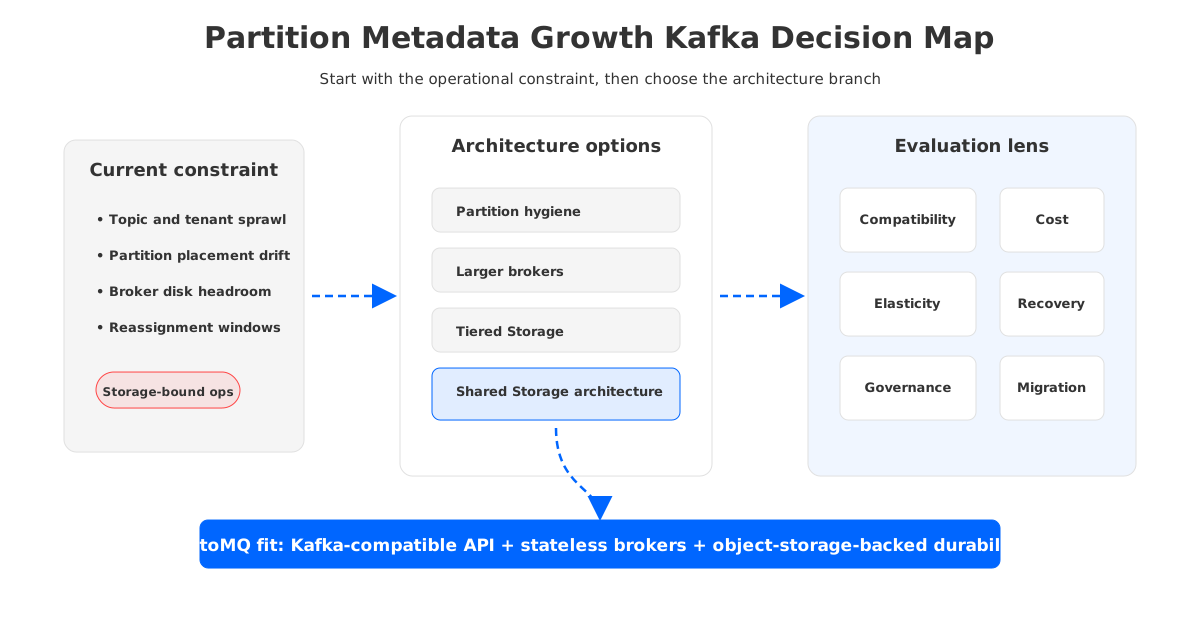
| Option | What It Improves | What It Does Not Remove | Best Fit |
|---|---|---|---|
| Partition hygiene | Reduces avoidable metadata, idle partitions, and noisy metrics. | Broker-local storage coupling remains. | Teams with uncontrolled topic or tenant sprawl. |
| Larger brokers | Adds disk, CPU, and network headroom per node. | Failure domains grow, and scaling stays coarse. | Stable workloads with predictable growth. |
| Tiered Storage | Moves older log data to remote storage for retention. | Active local log and broker-local operational constraints remain. | Long-retention workloads with manageable hot data. |
| Managed Kafka | Reduces infrastructure ownership. | Architecture constraints may still surface through quotas, pricing, and migration limits. | Teams that want operational delegation. |
| Shared Storage architecture | Separates durable stream data from broker-local disks. | Requires careful compatibility, WAL, security, and migration review. | Teams needing Kafka compatibility with elastic operations. |
The table is not a ranking. Partition hygiene is still worth doing. Larger brokers can be the right answer when the workload is stable and the operations team wants fewer moving parts. Managed services can reduce day-to-day labor. The important distinction is whether the option changes the storage architecture or only changes who operates it.
For platform teams, the evaluation should be strict in seven areas:
- Compatibility. Verify client versions, Producer and Consumer behavior, transactions, idempotence, ACLs, quotas, Kafka Connect, Schema Registry, and observability integrations.
- Elasticity. Test whether scaling brokers changes only compute capacity or also triggers large data movement.
- Recovery. Measure what happens when a broker, Availability Zone, or controller role fails under load.
- Cost allocation. Separate compute, storage, cross-zone traffic, object storage operations, and managed service fees.
- Governance. Confirm where the data plane runs, who owns cloud resources, how credentials are scoped, and how audit trails are collected.
- Migration. Require a plan for records, offsets, Consumer groups, topic configs, ACLs, schemas, and rollback.
- Observability. Track metadata growth, partition leadership, request latency, remote storage behavior, cache hit rates, and rebalance events as first-class signals.
This is where partition metadata growth becomes an architecture decision. If the workload only needs cleanup, governance and partition review may be enough. If the workload keeps adding tenants, retention, replay, and elastic capacity requirements, the team needs to evaluate whether the storage model can keep up with the logical model.
4How AutoMQ Changes the Operating Model
After that neutral evaluation, AutoMQ fits a specific branch of the decision tree: Kafka-compatible streaming where the team wants to keep Kafka APIs while changing the storage architecture underneath. AutoMQ uses Shared Storage architecture, S3Stream, WAL (Write-Ahead Log), S3 storage, and stateless brokers so durable stream data is no longer anchored to broker-local disks.
The write path is the key idea. An AutoMQ Broker receives Kafka protocol requests, writes data durably through the WAL layer, acknowledges the client according to the configured durability path, and then organizes data into S3 storage. WAL is a persistent write buffer and recovery layer; S3 storage is the primary long-term storage layer. That distinction matters because it avoids the common misunderstanding that object storage alone must serve every low-latency write.
Once durable data lives in shared storage, broker replacement and partition reassignment become different operations. The controller still has to coordinate ownership, leadership, and metadata. Clients still interact through Kafka semantics. But the cluster does not need to copy a partition's full durable log from one broker-local disk to another to change where compute runs. The operational center of gravity shifts from "move data" to "move traffic and ownership."
For partition metadata growth, this changes the questions platform teams ask:
- Can we add compute capacity without provisioning long-lived disk capacity at the same time?
- Can partition placement react to traffic imbalance without scheduling a large storage migration?
- Can long retention grow in object storage while brokers remain sized mainly for compute, cache, WAL, and network?
- Can the data plane remain in our own cloud account or private environment while the platform still exposes familiar Kafka behavior?
AutoMQ is not a replacement for partition design discipline. A team can still create too many tiny topics, over-partition low-volume workloads, or ignore Consumer group behavior. Shared Storage architecture changes the penalty curve. Poor partition hygiene remains a governance problem, but it no longer has to become a broker-local data movement problem every time the platform reshapes capacity.
5Evaluation Checklist for Platform Teams
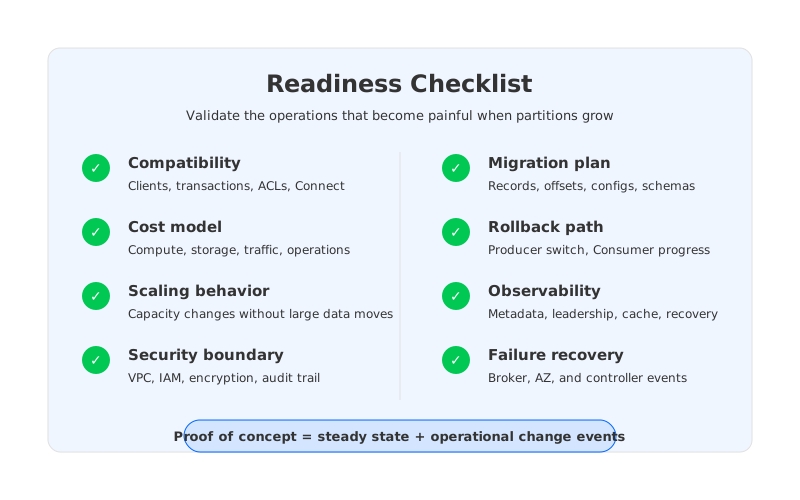
Use the checklist below before changing architecture. It keeps the conversation grounded in production readiness rather than abstract preference.
| Check | Question to Answer | Evidence to Collect |
|---|---|---|
| Partition inventory | Which topics are over-partitioned, idle, or tenant-generated? | Topic catalog, partition count, traffic per partition. |
| Metadata pressure | Which controller and broker metrics move with partition growth? | KRaft/controller metrics, request latency, leadership churn. |
| Storage coupling | What operations require data movement between brokers? | Reassignment plans, throttling rules, disk utilization history. |
| Retention economics | Which workloads need replay versus short-lived buffering? | Retention policies, read patterns, object storage assumptions. |
| Failure recovery | How long does broker replacement take under real load? | Recovery tests, leader movement, Consumer impact. |
| Migration boundary | What must move besides records? | Offsets, ACLs, schemas, configs, apps, rollback path. |
| Ownership model | Where do control plane and data plane resources run? | VPC, IAM, audit, encryption, and compliance review. |
The checklist also prevents a common mistake: evaluating a platform by a happy-path benchmark alone. Throughput matters, but partition metadata growth hurts most during operations: expansion, recovery, tenant onboarding, retention changes, and incident response. A useful proof of concept should include those events.
6A Practical Migration Path
A migration driven by partition metadata growth should start with measurement, not a target platform. Build an inventory of topics, partitions, leaders, retention, Producer clients, Consumer groups, ACLs, quotas, connectors, schemas, and service dependencies. Then classify workloads into three groups: keep and clean up, migrate as-is, or redesign before migration. This avoids moving avoidable complexity into a replacement environment.
The proof of concept should use a workload that represents the pressure you are trying to remove. If the pain is reassignment duration, test broker scale-out and broker replacement. If the pain is retention cost, test hot reads and Catch-up Read behavior across the retention window. If the pain is governance, test deployment boundaries, cloud permissions, network paths, audit logs, and operational access.
For teams evaluating AutoMQ, the most relevant tests are not only "can my clients connect?" They are "can the platform preserve Kafka behavior while making capacity changes less storage-bound?" That means testing Producer and Consumer compatibility, Consumer group progress, offset handling, Kafka Connect dependencies, observability pipelines, and rollback expectations alongside scaling and recovery scenarios.
7FAQ
7.1Is partition metadata growth the same as having too much data in Kafka?
No. Metadata growth is about the number of logical objects and coordination decisions: topics, partitions, leaders, Consumer groups, offsets, configurations, and placement state. Data growth is about bytes stored and served. Traditional Kafka often makes the two problems interact because partitions and their durable data are tied to broker-local storage.
7.2Does KRaft solve partition metadata growth?
KRaft removes the ZooKeeper dependency and moves Kafka metadata management into Kafka's own controller quorum. It improves Kafka's metadata architecture, but it does not automatically remove broker-local storage coupling for partition data. Teams still need to evaluate partition count, controller load, reassignment behavior, and broker storage capacity.
7.3Does Tiered Storage make Kafka diskless?
No. Tiered Storage moves older log segments to remote storage while the active log remains local to brokers. It can improve long-retention economics, but it is different from a Shared Storage architecture where durable stream data is designed around shared object storage and stateless brokers.
7.4When should a team evaluate AutoMQ?
Evaluate AutoMQ when you need Kafka compatibility, expect partition and retention growth, want to reduce broker-local storage constraints, and prefer a deployment model where the data plane stays under customer-controlled boundaries such as AutoMQ BYOC or AutoMQ Software.
7.5What should be tested first?
Test the operation that hurts most in production: scale-out, broker replacement, retention growth, Consumer catch-up, migration rollback, or tenant onboarding. A useful evaluation proves how the platform behaves during change, not only how it behaves during a steady-state throughput test.
8References
- Apache Kafka Documentation
- Apache Kafka KRaft configuration
- Apache Kafka replication design
- Apache Kafka cluster expansion operations
- Apache Kafka Tiered Storage
- AutoMQ architecture overview
- AutoMQ S3Stream overview
The next useful step is to bring your real partition inventory to the architecture review. If you want to test a Kafka-compatible, shared-storage path against your own workload, start with the AutoMQ GitHub project and validate scaling, recovery, and migration behavior with production-like topics.


