
Table of Contents
Table of Contents
Teams searching for kafka retention object storage usually have a production problem, not a storage hobby. The problem may be broker disks filling faster than the platform team can rebalance partitions. It may be a compliance requirement that keeps event history online for months. It may be an AI or analytics workload that needs a longer replay window without turning the Kafka cluster into a storage appliance. Or it may be a FinOps review where the object storage line item looks much more flexible than broker-attached disks.
The tempting shortcut is to ask, "Can we put Kafka retention in S3?" That question is too narrow. Kafka retention is not only where old bytes are stored. It is also how producers get acknowledged, how consumers fetch by offset, how broker failures recover, how partitions move, how deletion and compaction behave, and how the operations team proves the system still meets its service-level objectives.
Object storage changes the retention design only when the architecture changes the ownership of retained data. A traditional broker-local Kafka cluster, a Kafka cluster with tiered storage, and a Kafka-compatible shared-storage platform can all involve object storage, but they place different responsibilities on brokers, metadata, remote storage, cache, and write-ahead logging. Those differences are what architects should evaluate.
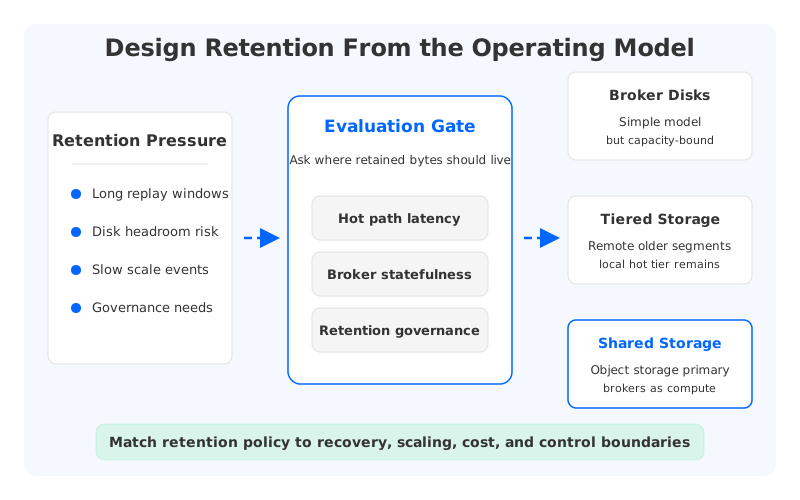
1Why Kafka Retention Becomes an Architecture Decision
Kafka's original operating model is intentionally direct: partitions are logs, logs are split into segments, and brokers store those segments locally for the partitions they host. Replication distributes copies across brokers so the cluster can survive failures. Retention policies then decide how long data remains available, commonly by time, size, or compaction policy.
That model is still a strong default when the retained working set is moderate and traffic is predictable. It keeps the hot path close to local storage, makes the broker's role easy to reason about, and fits the mental model many Kafka operators already use. The trouble starts when retention becomes large enough to dominate cluster design. At that point, storage capacity, broker count, replication traffic, and recovery windows begin to move together.
A retention change can force a broker capacity change. A broker capacity change can trigger partition movement. Partition movement can compete with production traffic. Longer replay windows can increase the amount of data that must be protected, monitored, and governed. The platform team is no longer tuning one topic-level setting; it is managing the consequences of treating every broker as both compute and durable storage.
Object storage enters the discussion because it separates storage capacity from broker instances. It also brings infrastructure controls that many organizations already use for data lakes: bucket policy, encryption, lifecycle rules, audit logging, replication policy, and clear ownership boundaries. But the presence of object storage does not automatically make Kafka elastic or simpler to operate. The design has to state which responsibilities move out of the broker and which stay in the broker.
2Three Retention Patterns Teams Compare
The first pattern is classic broker-local retention. Retained data lives on broker-local disks or attached block volumes. The upside is simplicity and the highest familiarity for Kafka operators. The downside is coupling: retention, replica placement, broker capacity, and reassignment are one system. This works well when the retained volume is bounded, the cluster is stable, and the team values a conservative operational model.
The second pattern is Kafka tiered storage. Apache Kafka's tiered storage documentation describes a local tier on broker disks and a remote tier for completed log segments in external storage such as HDFS or S3. Topic settings such as remote.storage.enable, local.retention.ms, local.retention.bytes, retention.ms, and retention.bytes control the local and total retention windows. This is useful when the cluster needs long retention but most consumers read near the tail.
Tiered storage changes the cost and capacity profile of older data. It does not make brokers stateless. Active segments and the hot path remain local. The broker still has to participate in leadership, local retention, page cache behavior, replica management, and client fetch behavior. If the main problem is old segments consuming too much broker disk, tiered storage is a focused answer. If the main problem is broker statefulness during scaling or replacement, it may not go far enough.
The third pattern is shared-storage or diskless Kafka architecture. In this model, object storage or another shared durable service is part of the primary retention design, not only a remote archive for completed segments. Brokers still serve the Kafka protocol and remain in the read/write path, but retained user data is no longer owned permanently by the broker-local disk. A write-ahead log, metadata layer, object layout, cache strategy, and recovery protocol become central design elements.
This pattern is a bigger architecture decision. It can reduce the operational weight of scaling and broker replacement because compute is less tightly bound to retained data. It also creates new evaluation work: object request patterns, cache hit behavior, WAL durability, metadata consistency, and remote-read performance must be validated under real workload shapes.
3What Moves When Retention Moves to Object Storage
The phrase "Kafka retention on object storage" hides several separate responsibilities. A sound design should identify each one explicitly.
The write acknowledgement boundary is first. Producers care about when a record is accepted and durable enough to acknowledge. In broker-local Kafka, this is shaped by the leader log and replica acknowledgement settings. In a shared-storage architecture, the system must define the durable boundary through a WAL, storage service, or equivalent mechanism. Without a clear answer here, "object storage retention" is only an archival story.
The fetch path is second. Kafka consumers fetch by topic, partition, and offset. If older data moves remote, the platform still has to locate records, preserve ordering expectations, and serve historical reads without turning every fetch into inefficient object operations. This is where segment layout, index metadata, caching, and batching matter. A design that stores data remotely but cannot serve delayed consumers predictably is not production-ready.
The recovery model is third. When a broker disappears, does the replacement need to reconstruct local retained logs, or can it resume ownership using shared metadata and durable storage? The answer determines whether object storage is lowering recovery risk or only reducing cold-storage cost.
The governance model is fourth. Once retained data lives in object storage, bucket ownership, encryption keys, lifecycle policies, access logs, replication settings, and deletion controls become part of the Kafka platform's operating surface. That is an advantage if it is designed intentionally. It is a liability if streaming and security teams do not agree on who owns those controls.
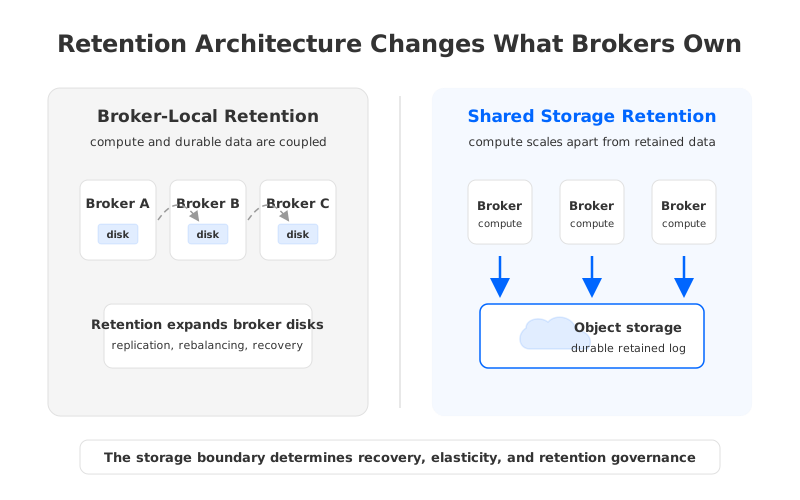
4Evaluation Checklist for Platform Teams
Start with compatibility. Kafka retention is valuable because applications can replay through the same Kafka APIs they already use. Validate the clients and tools that matter to your environment: producers, consumers, Kafka Streams applications, Connect jobs, transaction behavior, ACLs, quotas, monitoring, backup procedures, and incident playbooks. A basic produce-and-consume test is not enough.
Then separate the hot path from the retained path. Most Kafka traffic reads near the tail, but some workloads periodically replay old data for backfills, ML feature regeneration, audits, or recovery. The architecture should explain which reads are served from broker cache, which require remote access, how remote indexes are maintained, and how the system behaves when several teams replay history at the same time.
Model the cost in columns rather than as a single storage price. Include broker compute, local or attached storage, object storage capacity, object requests, retrieval patterns, cross-zone or cross-region transfer, replica traffic, duplicate capacity during maintenance, and engineering time spent on rebalancing or recovery. Object storage often looks attractive per retained byte, but Kafka cost changes only if the architecture also changes the expensive behavior around those bytes.
Review operational failure modes. What happens if a broker dies during heavy produce traffic? What if object storage has elevated latency? What if the metadata path is slow? What if consumers request old offsets during a maintenance window? What if a lifecycle rule is misconfigured? Retention architecture should be tested around uncomfortable events, not only steady-state throughput.
Finally, define migration and rollback. For existing Kafka estates, the safe migration unit is usually a topic group, workload domain, or application slice, not the whole company cluster. Keep offset validation, dual-write or mirror strategy, consumer cutover, observability parity, and rollback criteria visible. Retention redesign is infrastructure surgery; the checklist should make the recovery path boring.
5Where AutoMQ Changes the Operating Model
After the neutral evaluation, AutoMQ becomes relevant as one example of a Kafka-compatible, cloud-native shared-storage approach. The important point is not that AutoMQ "uses object storage." Tiered storage does that too. The important point is that AutoMQ keeps the Kafka protocol surface while replacing the broker-local storage layer with S3Stream shared streaming storage.
AutoMQ's public documentation describes S3 as the actual storage location for data in S3Stream, while the WAL is used for write acceleration and fault recovery. Its compatibility documentation also explains that AutoMQ keeps the Apache Kafka computing layer and changes the storage layer, so existing Kafka clients and ecosystem tools can remain the application boundary. That combination is why AutoMQ fits the shared-storage category: brokers act more like elastic compute over a durable storage foundation rather than permanent owners of retained logs.
This changes the questions platform teams ask. Instead of asking only how many broker disks are needed for a retention window, teams can ask how much broker compute is needed for current traffic, how the WAL should be configured for the latency profile, how object storage should be governed, and how retention policy maps to object layout and lifecycle controls. The decision still requires workload testing, but the operating model is different.
AutoMQ is not the right answer for every retention problem. If a stable Kafka cluster only needs to move old completed segments out of local disks, Apache Kafka tiered storage may be the more incremental path. If the pain is slow broker replacement, over-provisioning for spikes, partition data movement, or the desire to align Kafka retention with cloud object storage governance, a shared-storage Kafka-compatible system deserves a closer look.
6A Production Readiness Checklist
Use this checklist before approving any Kafka retention object storage design:
| Area | Question to answer | Evidence to collect |
|---|---|---|
| Kafka semantics | Do critical clients, transactions, offsets, compaction, ACLs, and tools behave as expected? | Workload-level compatibility tests |
| Write durability | What must happen before a produce request is acknowledged? | WAL design, failure tests, durability assumptions |
| Read path | How are tail reads, delayed reads, and large replays served? | Latency profile, cache behavior, remote-read tests |
| Retention policy | How do time, size, compaction, lifecycle, and deletion interact? | Topic policy matrix and deletion test |
| Cost | Are broker, storage, request, retrieval, and network costs modeled separately? | TCO model tied to traffic shape |
| Governance | Who owns buckets, keys, lifecycle rules, audit logs, and access boundaries? | Security and platform control review |
| Migration | Can you cut over and roll back per workload domain? | Runbook, offset validation, observability parity |
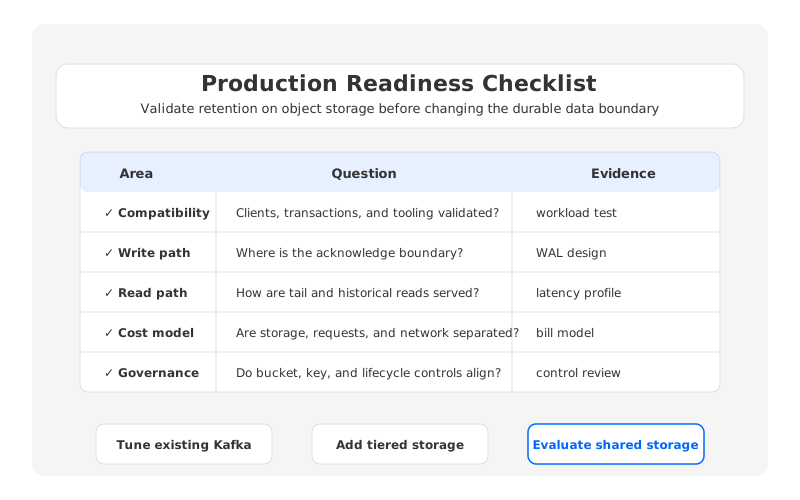
The checklist usually reveals which path fits. Tune broker-local Kafka when the retained set is manageable and operational risk is low. Add tiered storage when old data is the main pressure and the hot broker model is otherwise acceptable. Evaluate shared storage when the retention problem is really a broker-state problem in disguise.
7Decision Table
| Situation | Likely starting point | Why |
|---|---|---|
| Stable cluster, modest retention, strict latency sensitivity | Broker-local Kafka | Familiar model, fewer moving parts |
| Long replay window, rare historical reads, stable broker footprint | Kafka tiered storage | Remote completed segments reduce local disk pressure |
| Bursty traffic, slow scale-in, recurring reassignment pain | Shared-storage Kafka-compatible platform | Retained data is less coupled to broker instances |
| Strong cloud data governance requirements | Tiered or shared storage, depending on hot-path needs | Object storage controls become part of retention design |
| Large migration risk and limited platform bandwidth | Incremental topic-level approach | Compatibility and rollback matter more than architecture purity |
Retention should not be designed from a storage SKU outward. It should be designed from application semantics, failure recovery, operational elasticity, and governance boundaries inward. Object storage is powerful when it supports those goals. It is a distraction when it is treated as a cheaper place to put bytes without changing the operational model that made retention painful in the first place.
8References
- Apache Kafka documentation
- Apache Kafka tiered storage documentation
- KIP-405: Kafka Tiered Storage
- AWS S3 data protection and durability
- AWS S3 pricing
- AutoMQ compatibility with Apache Kafka
- AutoMQ S3 storage architecture
- AutoMQ WAL storage
- AutoMQ pricing calculator
9FAQ
9.1Is Kafka retention on object storage the same as tiered storage?
No. Kafka tiered storage keeps a local broker tier and moves completed log segments to remote storage. A shared-storage or diskless architecture uses object storage as part of the primary durable data model. Both can use object storage, but they change broker responsibilities in different ways.
9.2When should I use Kafka tiered storage?
Use tiered storage when the primary pressure is long retention of older segments and most consumers read near the tail. It is an incremental way to reduce local broker disk pressure while preserving the classic Kafka hot path.
9.3When should I evaluate shared-storage Kafka?
Evaluate shared storage when the retention problem is coupled with slow scaling, broker replacement, partition data movement, or over-provisioning. In those cases, the durable ownership model may matter more than the price of stored bytes.
9.4Does object storage make Kafka less expensive?
It can, but only after a workload-specific model. Include object capacity, requests, retrieval, network transfer, broker compute, replica behavior, and operational headroom. A lower storage unit price does not automatically lower the Kafka platform cost.
9.5How does AutoMQ fit into Kafka retention object storage design?
AutoMQ fits as a Kafka-compatible shared-storage option. It keeps the Kafka protocol and ecosystem boundary while using S3Stream, WAL, and object storage to separate retained data from broker-local disks. That makes it relevant when teams want cloud-native retention and more elastic broker operations without rewriting Kafka clients.


