
Table of Contents
Table of Contents
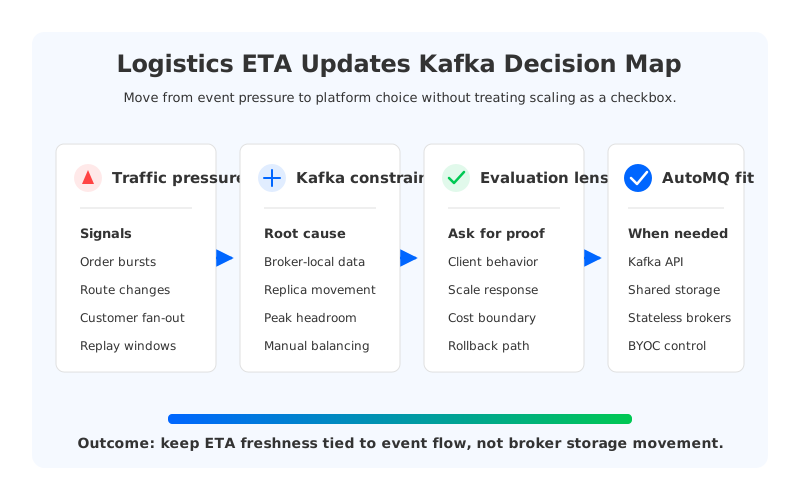
Searches for logistics eta updates kafka usually come from teams that have already discovered the uncomfortable part of real-time logistics: the ETA is not one event. It is a chain of order placement, dispatch, pickup, location pings, traffic changes, route recalculation, exception handling, customer notification, warehouse coordination, and downstream analytics. Each update may be small, but the total workload becomes spiky because delivery networks do not move at a steady average rate.
That spike is what makes the architecture question harder than "Can Kafka carry the events?" Apache Kafka is a strong fit for ordered event streams, offset-based replay, consumer groups, and integration through Kafka Connect. The problem appears when an ETA pipeline becomes customer-facing and bursty at the same time. A lunch rush, weather incident, port delay, promotion window, or carrier API recovery can push a calm cluster into a short period where freshness beats average throughput.
The useful design question is specific: can your Kafka-compatible platform absorb bursts, preserve replay, and recover from operational changes without turning every scaling event into a storage project?
1Why teams search for logistics eta updates kafka
Logistics ETA systems have an awkward shape. They need the event model of Kafka, but the business signal is a continuously revised prediction. A package might receive a promised delivery window at checkout, a carrier scan at pickup, a route adjustment after a traffic incident, a driver location update every few seconds, and a customer notification when the confidence band changes. None of these events is large on its own. The pressure comes from fan-out and timing.
The same event may feed multiple consumer groups: customer notifications, support tooling, warehouse labor planning, route optimization, billing adjustments, service-level reporting, and machine learning feature pipelines. Some consumers need the latest ETA. Others need the full history to explain why a promise changed. During a disruption, both patterns intensify. Operators want live dashboards, customer channels need fresh messages, and analytics teams may replay the incident window for root-cause analysis.
This is where a clean Kafka topic design can still run into platform limits. Good keys, compacted status topics, idempotent producers, and careful consumer group planning reduce application-level disorder. They do not remove the infrastructure question. If the platform was sized for average traffic, the burst creates headroom pressure. If it was sized for peak traffic, idle capacity becomes standing cost. If retained data is broker-local, scaling can require moving the history the team is trying to keep available.
2The production constraint behind the problem
Traditional Kafka uses a Shared Nothing architecture. Each broker owns local storage, and partitions are distributed across brokers. Replication through leader and follower replicas protects durability and availability, while consumers track progress through offsets. This model is understandable and proven, but it ties compute lifecycle to local log ownership. When a broker is added, removed, replaced, or rebalanced, the platform must consider where partition data lives.
That coupling matters in ETA workloads because bursts are not random noise. They arrive when the business already needs fresh answers. If a storm delays a regional route network, producers may emit more location, exception, and recalculation events. Consumers may also read more aggressively because customer service, alerting, and analytics systems are watching the same incident. The cluster needs extra capacity, but partition movement competes with the workload for network, disk, and operational attention.
Tiered Storage can help with retention cost by moving older log segments to remote storage. It is a valid option when the main pain is long history on local disks. It does not fully turn brokers into disposable compute, because the active log and broker ownership model still matter. For a logistics platform, that distinction is practical. A retained history of route decisions may live for audit and model training, while the active ETA stream still needs stable low-latency writes and predictable consumer progress.
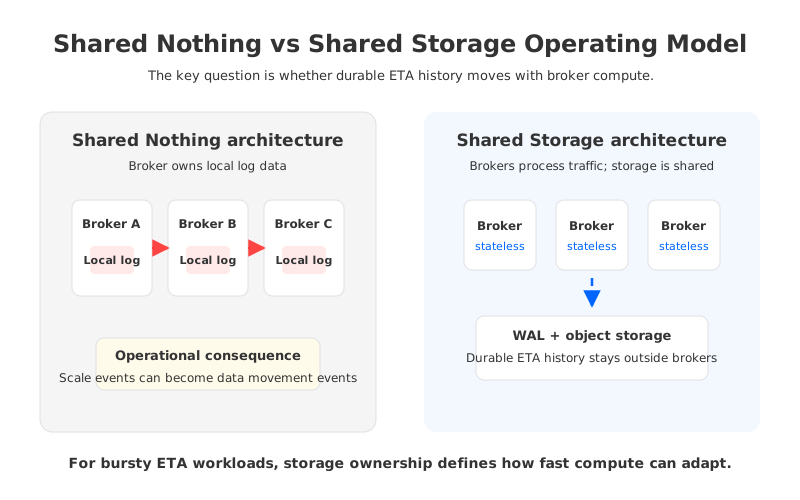
The production constraint is not "Kafka cannot do ETA." Kafka can model this domain well. The constraint is that the operational model must match the shape of the workload: bursty writes, high fan-out reads, replayable history, and failure recovery under time pressure.
3Architecture options and trade-offs
Platform teams usually have three broad options. Staying with a self-managed Kafka cluster gives maximum control over broker configuration, topic layout, security posture, and upgrade timing. It also means the team owns capacity planning, partition balancing, disk management, failure drills, and client behavior during maintenance. This can be the right answer when the team has strong Kafka operations maturity and the workload is predictable enough to plan.
A managed Kafka service moves much of the infrastructure operation to a provider. That reduces day-to-day broker management, but it does not automatically remove the sizing question. Teams still need to understand how throughput, storage, private networking, retention, partitions, and availability policies become billable or operational constraints. A service can be excellent for reducing toil while still requiring peak planning if scaling is bounded by broker-local data placement or service-specific limits.
A Kafka-compatible platform with Shared Storage architecture changes the evaluation. In this model, durable stream data is stored in shared object storage and brokers focus on protocol handling, request processing, caching, and scheduling. The platform still has to prove compatibility, latency behavior, durability, and migration safety. The architectural promise is different: compute capacity can change with less dependency on full retained-log movement between broker disks.
The trade-off is not one-dimensional. Teams should compare options across the behaviors that show up during an ETA incident:
| Evaluation area | What to verify | Why it matters for ETA updates |
|---|---|---|
| Kafka compatibility | Producer, consumer, transactions, Kafka Connect, Schema Registry, and client versions | ETA systems often reuse existing Kafka applications and connectors. |
| Burst response | Time from capacity signal to usable capacity | A five-minute ETA freshness problem cannot wait for a long rebalance window. |
| Retention and replay | Cost and performance for incident replay windows | Support and analytics teams need history, not only the latest status. |
| Network boundary | Cross-zone data movement, private access, and cloud-account ownership | Logistics data may be sensitive and region-bound. |
| Operational recovery | Broker replacement, partition reassignment, and rollback procedures | Failures often happen during the same windows as business pressure. |
| Governance | Topic ownership, schema rules, access control, audit logs, and environment separation | ETA data touches customer experience, operations, and finance. |
This table prevents a common mistake: treating "Kafka for ETA" as a library decision. The application design matters, but the platform decision determines whether the application remains stable when the fleet becomes noisy.
4Evaluation checklist for platform teams
Start with the data contract. The primary event key should match the entity whose order you need to preserve, such as shipment ID, order ID, route ID, or stop ID. A route-level key can simplify dispatch computation, while an order-level key can simplify customer notification. The wrong key creates hotspots or makes downstream joins harder. This is not a platform feature; it is the first place where domain modeling determines Kafka behavior.
Then separate status from history. Many ETA systems need a compacted topic for the latest known delivery promise and an append-only topic for the full chain of decisions. The latest-status topic helps customer-facing services answer quickly. The history topic supports replay, debugging, audit, and model improvement. Keeping both streams explicit avoids forcing every consumer to reconstruct state from scratch.
Consumer groups deserve the same discipline. Notification services, route optimization, support dashboards, and feature pipelines should not share a group unless they truly divide the same work. They usually need independent progress, independent retry policies, and different lag budgets. Apache Kafka's consumer group model is powerful because each group can track offsets independently; the design risk is hiding unlike workloads behind one operational label.
For production readiness, run the checklist before choosing a platform:
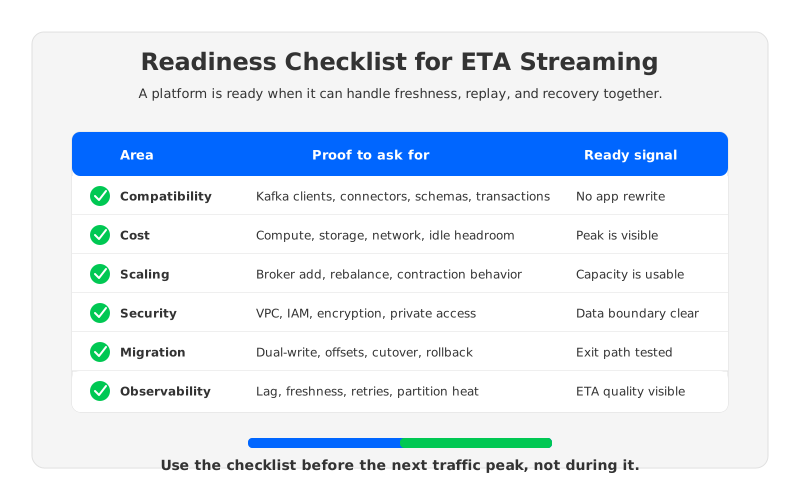
- Compatibility: Can existing clients, connectors, serializers, and transactional patterns run without application rewrite? Validate the exact client versions and libraries used by dispatch, notification, and analytics services.
- Cost boundary: Does the model expose compute, storage, network, and idle headroom separately? ETA workloads often look small by average throughput and expensive by peak sizing.
- Scaling behavior: When producers spike, how long does it take for extra capacity to become useful? Include broker startup, partition reassignment, cache warmup, and client recovery in the test.
- Security and governance: Can the platform run inside the required cloud account, network boundary, and region? ETA data can reveal customer behavior, driver movement, and operational exceptions.
- Migration and rollback: Can topics, offsets, and consumers be moved in phases? A cutover plan without rollback is a hope, not a migration plan.
- Observability: Can operators see lag, freshness, retry storms, partition heat, and notification delay as separate signals? A green broker dashboard can still hide stale ETAs.
The most useful validation pattern is an incident rehearsal. Replay a peak window, delay one upstream feed, restart consumers, add capacity, and validate that customer-facing freshness recovers. If the platform cannot make capacity useful during a rehearsal, it will not become more cooperative during a live route disruption.
5How AutoMQ changes the operating model
After the evaluation framework is clear, AutoMQ becomes relevant as an architectural answer rather than a brand shortcut. AutoMQ is a Kafka-compatible streaming platform that replaces Kafka's broker-local storage layer with S3Stream and a Shared Storage architecture. Brokers remain compatible with Kafka clients and ecosystem tools, while durable stream data is stored through shared storage rather than being permanently owned by a broker disk.
That design changes the operational shape of ETA platforms. In a broker-local model, scaling and recovery decisions have to account for retained bytes on individual brokers. In AutoMQ's model, brokers are stateless for persistent data, and WAL (Write-Ahead Log) storage handles durable write acknowledgement before data is uploaded to object storage. The result is not magic capacity. It is a cleaner boundary: brokers can be treated more like compute, while object storage carries the durable history.
For logistics ETA updates, that boundary maps to three practical outcomes. First, capacity changes are less entangled with moving retained logs between brokers. Second, long replay windows can be designed around object-storage-backed durability instead of growing broker-local disks for every retained stream. Third, customer-owned deployment models such as AutoMQ BYOC and AutoMQ Software let teams keep control over cloud accounts, VPC (Virtual Private Cloud) boundaries, and operational policies while preserving Kafka-compatible APIs.
AutoMQ also provides features that matter when traffic distribution changes during the day. Self-Balancing monitors cluster traffic and can continuously redistribute partitions. Seconds-level partition reassignment reduces the operational delay between identifying a hotspot and moving ownership. These capabilities are useful for ETA systems because hotspots often come from business geography: one region, carrier, warehouse, route, or marketplace can dominate traffic for a short period.
The migration conversation should stay pragmatic. A team should not replace a stable Kafka platform because a diagram looks cleaner. It should evaluate AutoMQ when broker-local storage has become the limiting factor for burst response, retention cost, partition movement, or cloud-account deployment control. The proof should come from a workload rehearsal using real topic shapes, real consumers, real replay windows, and a rollback plan.
6A practical readiness scorecard
A useful scorecard gives platform teams a way to say "not yet" without blocking progress forever. Score each area from 1 to 5, where 1 means unknown and 5 means tested under representative load. Compatibility, scaling, security, migration, observability, and cost transparency should all be scored separately. A high average score with one weak area is still a risk if that area is rollback or freshness monitoring.
The scorecard should also separate application readiness from platform readiness. Application teams own event keys, idempotency, schema evolution, consumer retry behavior, and user-facing fallback rules. Platform teams own broker capacity, storage, network boundaries, access control, observability, and upgrade policy. Logistics ETA systems fail when those boundaries are blurred. A consumer retry storm should not be diagnosed as a storage problem, and a partition movement bottleneck should not be hidden behind application tuning.
If you are designing logistics ETA updates on Kafka, the architecture goal is not to remove complexity. It is to put each kind of complexity where the right team can manage it. Keep ordering and idempotency in the application contract. Keep replay and consumer progress in Kafka semantics. Keep scaling and recovery in a platform model that can adapt during the same window when ETA freshness matters.
If broker-local storage is the part making your ETA pipeline hard to scale, test AutoMQ with a representative workload and migration plan: start an AutoMQ evaluation.
7FAQ
7.1Is Kafka a good fit for logistics ETA updates?
Yes, Kafka is a strong fit when ETA updates need ordered event streams, replay, independent consumer groups, and integration with downstream systems. The design work is in topic keys, status-versus-history separation, consumer group boundaries, and platform scaling behavior.
7.2Should an ETA system use one topic or several topics?
Most production designs use several topics. A compacted latest-status topic can serve customer-facing reads, while append-only history topics preserve the event trail for replay, audit, analytics, and model training. The exact split depends on ordering requirements and consumer ownership.
7.3Does Tiered Storage solve bursty ETA workloads?
Tiered Storage can reduce pressure from long retention by moving older segments to remote storage. It does not by itself make brokers stateless or remove active-log ownership from the scaling path. Teams should test whether their main problem is retention cost, burst response, partition movement, or all three.
7.4When should a team evaluate AutoMQ for ETA workloads?
Evaluate AutoMQ when the Kafka API is the right interface but broker-local storage makes scaling, recovery, retention, or cloud-account control difficult. The strongest signal is a rehearsal where capacity changes or partition movement cannot keep up with ETA freshness requirements.


