
Table of Contents
Table of Contents
Teams rarely search for pii protection event streams kafka because they are starting from a blank architecture diagram. They search for it after the streaming platform has become the place where customer identifiers, account attributes, consent state, device fingerprints, and business events move faster than the governance process around them. A warehouse team can often quarantine a table, rescan a partition, or change downstream grants before many users touch the data. A Kafka platform has a different problem: the record may already be retained, replayable, copied into derived topics, and consumed by several independent applications.
That pressure changes the design question. PII protection in event streams is not only a masking library, a schema rule, or a security ticket. It is an operating model for the streaming data plane: who may publish sensitive fields, how contracts are enforced, where retained records live, how replay behaves after policy changes, and whether the platform can scale without turning sensitive data movement into an operational side effect. The best architecture keeps Kafka's useful semantics while making governance boundaries easier to reason about under production load.
1Why PII Protection Belongs in the Data Plane
PII usually enters Kafka through ordinary application work: checkout events, support activity, mobile telemetry, and customer 360 updates. None of these events looks suspicious in isolation, and that is the point: sensitive data often arrives as part of valid business events, not as an obviously separate data feed.
Kafka makes those events powerful because it decouples producers from consumers. A producer writes once, while fraud systems, analytics jobs, enrichment services, lakehouse pipelines, and audit tools each consume at their own pace. Consumer groups maintain their own offsets, so one application can fall behind without blocking another. Retention makes replay possible, and transactions can help applications coordinate writes across partitions when they need atomic behavior. These properties are why Kafka is so useful for regulated workflows.
The same properties make PII protection harder. Once a field is written to a retained topic, the platform must consider live consumers, historical replay, derived topics, connector sinks, failed jobs, and operator access. Governance becomes a runtime concern because the data is already in motion.
2The Production Constraint Behind the Problem
The first failure mode is treating PII as a schema-only issue. Schema contracts are necessary because events are APIs between teams. They define required fields, compatibility rules, ownership metadata, and prohibited changes. They also give reviewers a clean place to ask whether an added field is a direct identifier, an indirect identifier, a token, or a derived signal. Without that contract layer, PII decisions scatter across code reviews and tribal knowledge.
But contracts do not store records, move partitions, assign ACLs, encrypt disks, manage connectors, or recover failed brokers. Those responsibilities sit in the platform. A production design needs controls across four layers:
- Contract layer: schema compatibility, field classification, ownership, and review workflow before added sensitive fields reach a topic.
- Access layer: authentication, Kafka ACLs, topic naming boundaries, Consumer group permissions, and separation between application access and operator access.
- Storage layer: retention, compaction, encryption at rest, backup behavior, object storage policy, and deletion or minimization rules for retained records.
- Operations layer: scaling, reassignment, broker recovery, connector isolation, audit evidence, and rollback after a policy or schema mistake.
The layers are connected. If a policy change requires replaying old events through a redaction processor, Consumer group offsets matter. If a connector exports records to a lake or search index, its runtime identity and network path matter. If a broker failure triggers large data movement across Availability Zones, the incident response plan must account for where sensitive records travel and who can observe the process.
3Why Traditional Kafka Operations Amplify Governance Work
Traditional Apache Kafka uses a Shared Nothing architecture: each broker owns local storage, and partition replicas are placed across brokers for durability and availability. This design is proven and flexible. It also means broker operations are data operations. Scaling out, replacing failed nodes, changing replica placement, or rebalancing hot partitions can involve copying retained log segments between machines.
For infrastructure planning, that means capacity reservations, disk sizing, replication traffic, and reassignment windows. For PII protection, it adds a governance dimension. Sensitive records are not only stored in topics; they are also present in broker-local logs, replica copies, snapshots, and operational workflows that move data around the cluster. Even with encryption and ACLs, the platform team still has to explain the lifecycle of retained sensitive data during operational change.
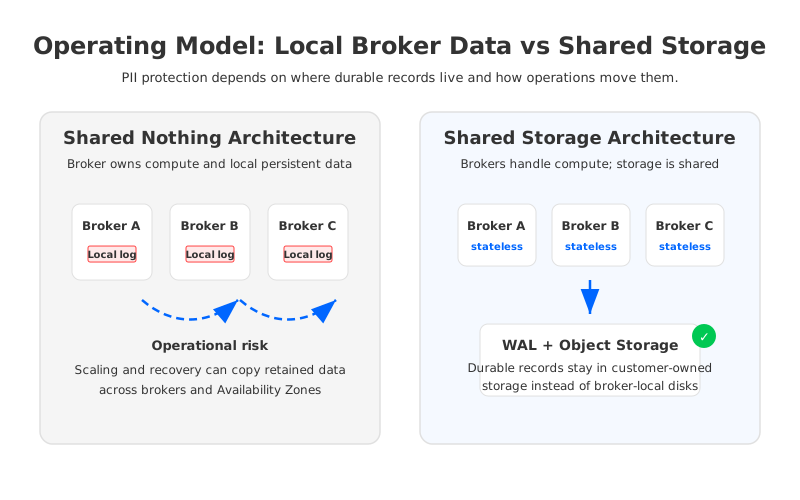
Tiered Storage can help long-retention economics by moving older segments to remote storage, but it does not make the hot storage path disappear. The broker still owns a local log for active data, and operations still depend on how local and remote tiers interact. If the goal is only lower retention cost, tiering can be useful. If the goal is to simplify the operational boundary of sensitive data, evaluate whether broker-local persistence remains part of the critical path.
This is where many governance projects stall. Security wants fewer places where sensitive records can land. Data platform teams want replay, independent consumers, and compatibility with the Kafka ecosystem. Application teams want to keep publishing business events without waiting weeks for every schema change. The answer is not to remove Kafka semantics; it is to make those semantics governable as a platform.
4Architecture Options and Trade-Offs
A useful evaluation starts with neutral options, not a product shortlist. Most teams combine several controls because no single layer solves the whole problem.
| Option | What it protects | Where it falls short |
|---|---|---|
| Producer-side minimization | Stops unnecessary fields before they enter Kafka | Requires strong application discipline and review coverage |
| Schema contracts | Makes sensitive field changes visible and reviewable | Does not control storage, access, replay, or connector behavior |
| Stream processing redaction | Creates masked or tokenized derived topics | Raw topics still need retention, access, and rollback rules |
| Kafka ACLs and authentication | Restricts which principals can read, write, or administer resources | Poor topic design can still over-broaden access |
| Encryption and network isolation | Protects data at rest and in transit | Does not decide who should publish or consume each field |
| Shared Storage architecture | Reduces broker-local data ownership and data-copy operations | Still needs contracts, ACLs, monitoring, and migration planning |
The table reveals a practical point: PII protection is not a feature checkbox. It is a composition of policy design and platform behavior. A team that masks events but leaves broad read permissions on raw topics has not solved the problem. A team that enforces contracts but cannot trace connector exports has not solved it either. The architecture has to hold together when mistakes happen.
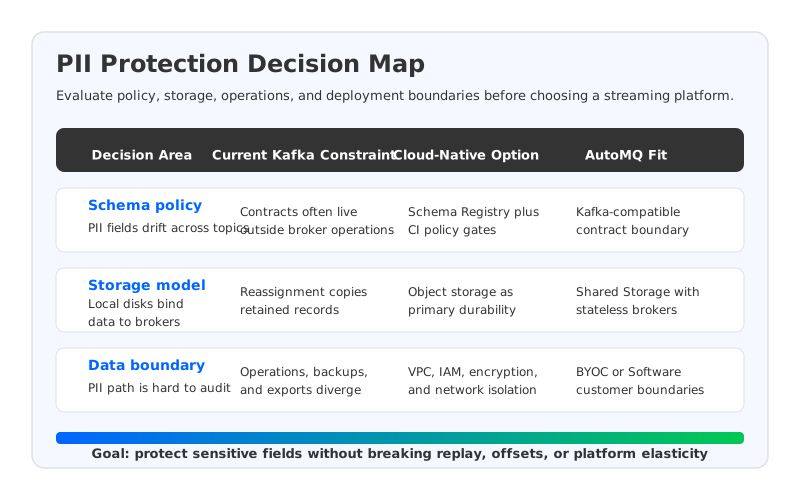
The decision map should start with the data boundary. Which cloud account, VPC, Kubernetes cluster, object storage bucket, key policy, and network path will carry business records? Then move to Kafka semantics: clients, Connect workers, Streams applications, transactions, offset reset procedures, and admin tools. Only after those questions are clear should the team compare cost and elasticity, because a lower-cost architecture that complicates compliance evidence is not actually lower cost for regulated teams.
5Evaluation Checklist for Platform Teams
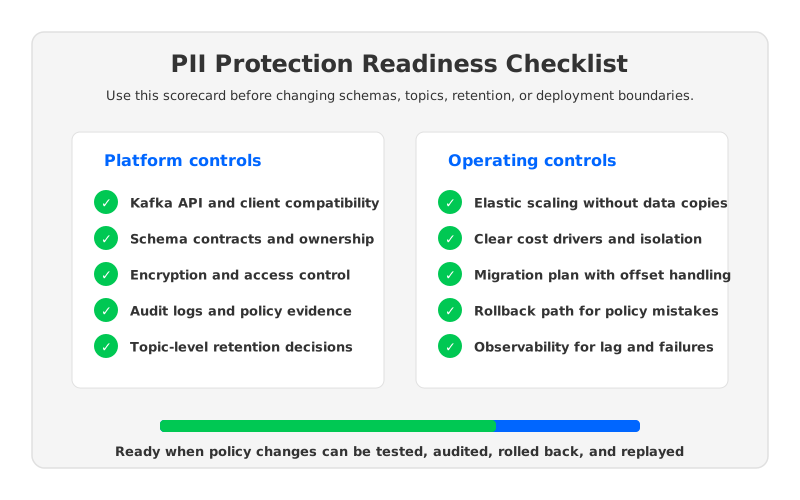
A platform team can turn the architecture discussion into a readiness review. The review should be specific enough that security, governance, and Kafka operators can sign off on the same document.
- Classify event fields before production. Define direct identifiers, quasi-identifiers, tokens, and derived sensitive signals. Add schema ownership so every field has an accountable team.
- Separate raw and governed topics. Keep raw topics tightly restricted, and publish masked, tokenized, or purpose-specific topics for broader consumers.
- Design ACLs around identities, not teams. Producers, consumers, Connect workers, stream processors, and operators should use distinct principals with narrow Topic and Consumer group permissions.
- Model replay explicitly. Decide what happens when a consumer resets offsets, when a redaction job reprocesses history, and when derived topics must be rebuilt.
- Treat connectors as data-plane workloads. A sink connector can become the path by which PII leaves Kafka. Its plugin isolation, credentials, network route, and destination permissions need the same review as application code.
- Tie retention to purpose. Long retention is valuable for audit and recovery, but every extra day extends the window in which sensitive records must be protected.
- Test rollback before enforcing policy. A bad schema rule or over-aggressive redaction change can break downstream systems. The rollback plan should include offsets, derived topics, and consumer lag.
These checks are intentionally operational. They force the team to discuss how policy behaves when Kafka behaves like Kafka: durable, replayable, distributed, and shared by many applications.
6How AutoMQ Changes the Operating Model
This is the point where AutoMQ becomes relevant: it is a Kafka-compatible, cloud-native streaming platform that keeps Kafka protocol semantics while replacing broker-local persistent storage with a Shared Storage architecture. AutoMQ Brokers are stateless. Durable data is written through S3Stream to WAL storage and S3-compatible object storage, with object storage as the primary storage layer. Broker replacement, scaling, and partition reassignment no longer require the same broker-local data movement that traditional Kafka operators plan around.
That does not remove the need for PII governance. It changes where the governance conversation happens. Instead of spreading durable data across broker disks as the primary persistence model, the team can evaluate customer-owned object storage, WAL storage type, cloud IAM, encryption configuration, VPC boundaries, and operational access as first-class parts of the data plane. For organizations evaluating AutoMQ BYOC, both the control plane and data plane run in the customer's own cloud account and VPC. For private data center environments, AutoMQ Software keeps the deployment inside the customer's environment. Those boundaries matter when security teams ask where records, metadata, logs, and management operations live.
AutoMQ also preserves the compatibility surface that governance programs depend on. Existing Kafka clients, Producer and Consumer APIs, Topic and Partition behavior, offsets, Consumer groups, Kafka Connect, and Kafka Streams remain part of the platform model. Teams can keep familiar controls such as Schema Registry patterns, Kafka ACLs, mTLS or SASL authentication, Connect worker review, and existing observability while evaluating a different storage model underneath.
The most important design benefit is not a slogan about cost. It is the reduction of unnecessary coupling. When compute capacity and durable storage are separated, scaling a broker fleet is less entangled with moving retained data. When object storage is the primary durability layer, retention planning can align more directly with bucket policy, encryption, access review, and regional controls. When brokers are stateless, incident response can focus more on leadership, traffic, cache warmup, and client behavior, and less on copying large local logs as the recovery path.
7A Migration Pattern That Keeps Governance Intact
PII protection projects often fail during migration because the team treats the target platform as the only change. In reality, migration is when old assumptions become visible. Topic naming may be inconsistent. ACLs may be broader than expected. Some consumers may rely on offset reset behavior that nobody documented. Connectors may write to destinations that were never reviewed by the governance team.
A safer migration pattern starts with inventory. List topics by sensitivity, retention, owner, producer identity, consumer identity, connector path, and replay requirement. Then run compatibility tests against the target platform using representative clients and admin workflows. Migrate low-sensitivity or well-understood topics first, validate lag and replay behavior, and only then move topics that carry direct identifiers or regulated attributes. If the organization needs parallel operation, define which system is authoritative at each stage and how offsets are handled during cutover.
AutoMQ Kafka Linking can be part of this evaluation for teams using AutoMQ commercial editions, especially when byte-level message synchronization and offset consistency are important to the migration plan. The governance point is broader than a tool choice: migration should preserve auditability. Every cutover should have a rollback condition, a validation window, and a record of which topics and principals changed.
8FAQ
8.1Is PII protection in Kafka mainly a schema problem?
No. Schema contracts are a necessary control because they make field-level changes visible before data reaches production topics. They do not replace ACLs, encryption, retention design, connector review, replay planning, or storage architecture decisions.
8.2Should teams put PII in Kafka at all?
Sometimes the right answer is to avoid publishing direct identifiers and use tokens, references, or purpose-specific derived events instead. When business workflows require sensitive fields in event streams, the platform needs explicit controls for access, retention, replay, and export paths.
8.3Does Shared Storage architecture eliminate compliance work?
No. Shared Storage architecture changes the operating model by reducing broker-local persistent data ownership and large data-copy operations during scaling or recovery. Compliance work still requires contracts, identity, ACLs, encryption, audit evidence, monitoring, and documented procedures.
8.4How should teams evaluate AutoMQ for regulated Kafka workloads?
Start with compatibility and boundary tests. Verify client behavior, Connect workloads, Schema Registry integration, authentication, ACLs, monitoring, retention, migration, and rollback. Then evaluate how AutoMQ BYOC or AutoMQ Software aligns with the organization's cloud account, VPC, storage, key management, and operational access requirements.
9Closing Thought
The search for pii protection event streams kafka usually begins when teams realize that governance cannot sit outside the streaming platform. Kafka's value comes from durable, replayable, shared event streams. PII protection has to work with those properties, not against them. If your next step is to evaluate a Kafka-compatible data plane with Shared Storage architecture and customer-controlled deployment boundaries, you can explore AutoMQ through the AutoMQ Cloud Console.


