
Table of Contents
Table of Contents
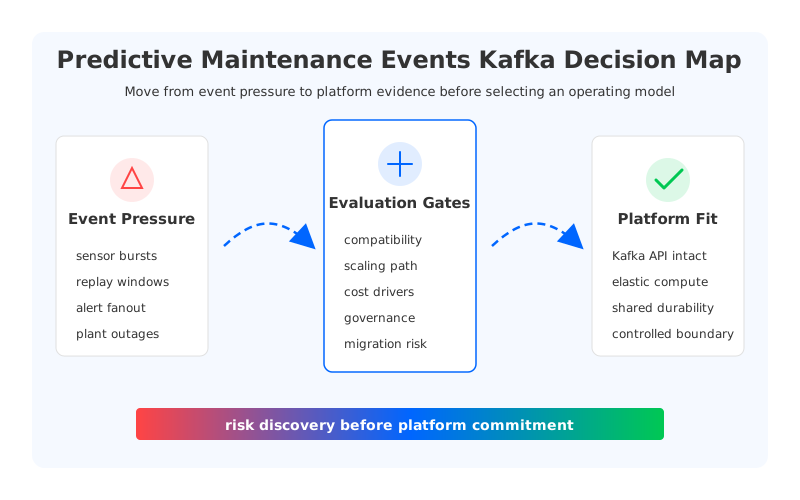
Teams search for predictive maintenance events kafka when the machine-learning model is no longer the hard part. The first demo may show that vibration, current draw, temperature, pressure, or acoustic signals can predict likely equipment failure. Production asks a less comfortable question: can the event platform absorb plant-level bursts, preserve replayable history, and route maintenance decisions fast enough for operations teams to trust the signal?
That question is not solved by naming Kafka as the transport layer. Apache Kafka gives teams the vocabulary they need: topics, partitions, offsets, consumer groups, transactions, retention, and a mature connector ecosystem. The design work begins when those mechanics meet physical operations. A maintenance event might be harmless sensor noise, a warning that needs enrichment, a downtime risk, a service-ticket trigger, a spare-parts signal, or a compliance record. Treating all of those as the same stream creates a pipeline that looks clean in diagrams and becomes fragile during burst windows.
The practical goal is to design predictive maintenance events as production contracts, then evaluate whether the Kafka-compatible platform underneath can keep those contracts under pressure.
1Why teams search for predictive maintenance events kafka
Predictive maintenance workloads differ from generic IoT ingestion because the value of an event changes with context. A motor vibration reading matters more when the asset is under load, when the same asset has a repair history, when similar assets show correlated behavior, or when the event arrives during a shift where maintenance staff can act. Kafka fits this pattern because it can retain ordered event logs, let multiple consumers read the same topic, and allow downstream systems to process events at their own pace.
The search usually appears after a pilot hits one of three boundaries. First, raw telemetry starts arriving in uneven bursts rather than neat intervals. A factory reconnect, a firmware rollout, or a temporary network fault can turn normal sensor volume into a replay and catch-up problem. Second, more teams want the same stream. The first consumer may score anomalies, while later consumers update dashboards, feed a data lake, open work orders, and audit safety events. Third, retention becomes operationally important. Engineers want to replay an incident window, data scientists want labeled history, and reliability teams want a durable record of what the model saw before a failure.
That workload shape changes the event design. A predictive maintenance event is not a JSON blob with a timestamp attached. It is an agreement about identity, ordering, replay, and ownership.
| Event design question | Why it matters in production | Kafka mechanism to validate |
|---|---|---|
| What is the event key? | Asset-level ordering depends on stable keying. | Partitioning and ordering |
| Which events are commands, facts, or alerts? | Consumers need to distinguish observations from decisions. | Topic boundaries and schemas |
| How long must events remain replayable? | Model audits and incident review need history. | Retention and remote storage behavior |
| What happens when consumers fall behind? | Maintenance workflows cannot starve live telemetry. | Consumer groups and lag handling |
| Which events require atomic writes? | Alert and work-order updates may cross topics. | Transactions and idempotent producers |
The table is deliberately about contracts rather than tooling. If the event contract is vague, platform features cannot compensate. If the contract is clear, the platform evaluation becomes concrete: prove how it behaves when bursts, replay, and operational fanout happen together.
2The production constraint behind the problem
Traditional Kafka deployments are often built around a Shared Nothing architecture. Each broker owns local log storage, partitions are assigned across brokers, and durability is achieved through replication among brokers. This model is proven, widely understood, and a good fit for many stable workloads. Predictive maintenance stresses it because the workload does not scale in one dimension.
The platform team might add brokers to handle a sensor burst, but broker capacity is tied to partition placement and local storage. The team might increase retention for incident replay, but retained bytes sit in the broker storage model. The team might add more consumers, but catch-up reads can compete with tailing reads when several downstream systems replay the same asset history. The first symptom is often not a hard outage. It is a cluster that keeps running while every operational change becomes slower, riskier, and harder to schedule.
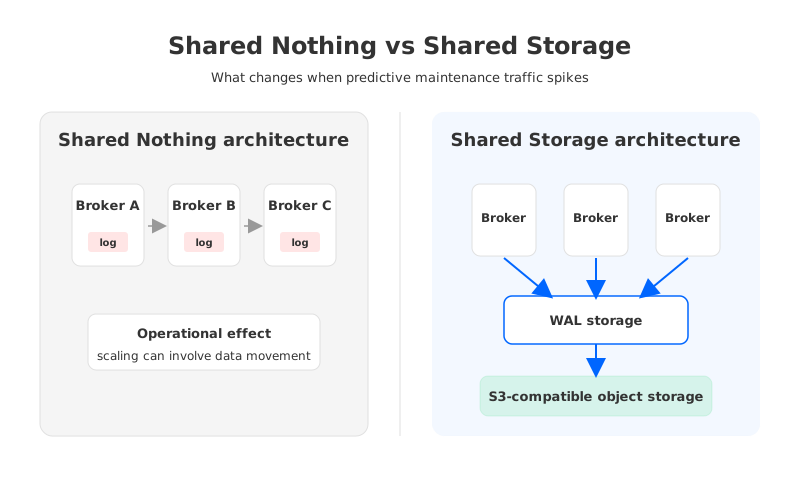
Tiered Storage can help with long-retention pressure by moving older log segments to remote storage while brokers continue to serve the active log. For a predictive maintenance estate where the main problem is historical retention, that may be enough. The trade-off is that active storage, broker lifecycle, leadership, fetch serving, and many operational behaviors still involve brokers. If the main pressure is bursty capacity and repeated replay, the evaluation should look deeper than archive cost.
The root constraint is coupling. When broker compute, durable storage, replication traffic, and recovery behavior move together, every maintenance surge becomes a multi-variable operations problem. That coupling is manageable at small scale, but it becomes expensive in attention when plant telemetry, asset history, alert fanout, and data science replay all converge on the same backbone.
3Architecture options and trade-offs
There is no single right platform shape for every predictive maintenance program. A small deployment with stable telemetry and short retention may stay on an existing Kafka cluster. A large industrial platform with many plants, long audit windows, and frequent burst events may need a different operating model. The useful evaluation starts by separating event semantics from infrastructure mechanics.
The neutral options usually look like this:
- Tune the current Kafka deployment. This can be the right first move when partitions, compression, retention, and consumer lag alerts are poorly configured. It protects existing operational knowledge and avoids migration risk, but it does not change broker-local storage coupling.
- Use Tiered Storage for older history. This can reduce pressure from long retention and incident replay windows. It is less compelling when the bottleneck is elastic serving capacity, hot partition movement, or frequent broker changes.
- Adopt a managed Kafka service. This can reduce operational ownership, especially for teams that want less infrastructure work. The evaluation still needs to test scaling behavior, network topology, retention cost, private connectivity, and governance boundaries.
- Evaluate a Kafka-compatible shared-storage platform. This keeps Kafka clients and semantics while changing where durable stream data lives. The trade-off moves from broker disks to object storage, WAL behavior, cache design, metadata management, and cloud-account integration.
A platform team should resist reducing this choice to a feature checklist. Predictive maintenance events are operationally sensitive because the expensive moment is the burst, not the average. A stream that is quiet between shifts and noisy during reconnects, inspections, or incident windows does not care that the monthly average looked harmless in planning. The architecture has to prove that added capacity becomes useful while the event is still relevant.
4Evaluation checklist for platform teams
The evaluation framework should start with compatibility because rewriting edge gateways, scoring services, data-lake sinks, and operational applications can consume the budget that should have gone into reliability. Apache Kafka clients and ecosystem components make this easier to test: use the same producers, consumers, connector patterns, and offset behavior you expect in production. Then move from compatibility into failure and cost behavior.
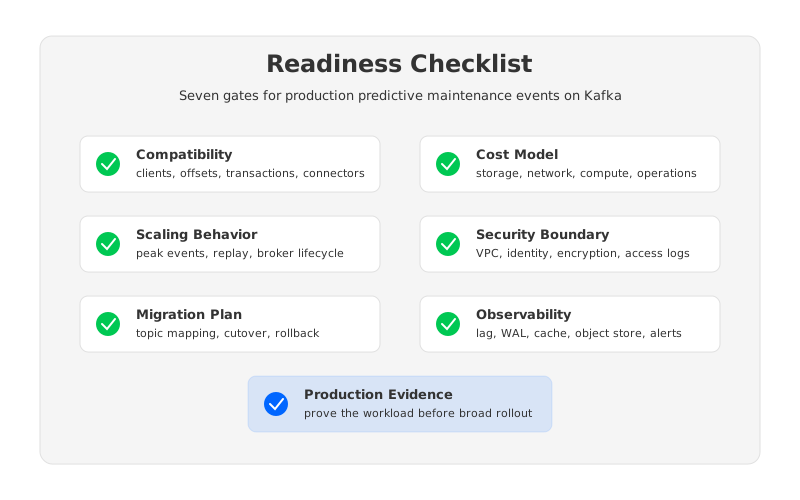
Use this checklist as a proof-of-concept gate, not as a procurement survey:
- Compatibility: Validate producer behavior, consumer groups, offsets, idempotent producers, transactions if needed, Kafka Connect integration, and monitoring conventions. Include at least one replay-heavy consumer and one latency-sensitive alert path.
- Cost model: Separate storage, compute, network transfer, private connectivity, connector runtime, and operations effort. Avoid blended numbers that hide which meter grows during a burst.
- Scaling behavior: Test peak ingestion, consumer catch-up, broker add/remove workflows, and partition reassignment behavior. The key question is when added capacity becomes useful to the workload.
- Security boundary: Confirm where data plane resources run, who owns the VPC or network boundary, how identity is handled, and how encryption and access logs are audited.
- Migration plan: Map topics, schemas, offsets, ACLs, retention policies, connectors, and rollback steps. A good migration plan has a boring rollback path.
- Observability: Track consumer lag, broker saturation, object storage behavior, WAL health where applicable, cache hit rates, connector lag, and alert delivery latency.
- Production evidence: Run the test with a realistic burst shape. Synthetic steady-state throughput can hide the behavior that matters most.
This order matters. If compatibility fails, nothing else is relevant. If compatibility passes but scaling behavior remains tied to slow data movement, the platform may still force peak planning. If scaling works but governance fails, the architecture may be unusable for regulated plant data. The checklist keeps those decisions separate enough to argue about them clearly.
5How AutoMQ changes the operating model
The architectural answer appears after the evaluation framework: reduce the coupling between broker compute and durable event history. AutoMQ is a Kafka-compatible, cloud-native streaming platform built around Shared Storage architecture. It preserves Kafka protocol and API compatibility while moving persistent stream storage into S3-compatible object storage through S3Stream, with WAL storage and data caching used in the write and read paths.
For predictive maintenance events, the important shift is operational. AutoMQ Brokers are stateless brokers: they process Kafka protocol traffic, serve reads and writes, participate in coordination, and cache data, but they are not the long-term home of partition data. Durable data lives in shared storage. That means broker replacement, scaling, and partition reassignment can be treated more like compute operations than storage migration projects.
This is not a claim that every maintenance pipeline should move platforms. It is a claim about fit. AutoMQ becomes interesting when a team wants Kafka-compatible behavior but is repeatedly constrained by broker-local storage, retained history, plant-level bursts, catch-up reads, multi-AZ traffic planning, or customer-controlled deployment boundaries. AutoMQ BYOC runs control plane and data plane components inside the customer's cloud environment, while AutoMQ Software targets private data-center deployments. Those boundaries matter when plant telemetry, asset records, and maintenance decisions must stay under customer governance.
The trade-offs should be tested directly. Object storage behavior, WAL type, cache sizing, network path, and observability all affect production results. A useful proof of concept should include the same event keys, schemas, retention windows, replay consumers, alert consumers, and failure drills the team expects after launch. The point is not to admire the architecture. The point is to see whether the operating model removes the bottleneck that made predictive maintenance events difficult to run on the existing platform.
6A practical event model for bursty maintenance streams
The event model should separate raw observations from operational decisions. Raw telemetry topics can be high volume and retention-heavy. Derived anomaly topics can be smaller but more sensitive to ordering and deduplication. Work-order or alert topics need stronger governance because they influence people and equipment. Keeping those boundaries explicit helps the platform team tune retention, partitions, schemas, and access control without turning every stream into a one-size-fits-all topic.
A pragmatic topic model often starts with four layers:
- Telemetry events: Sensor readings keyed by asset or asset component, with enough metadata to preserve ordering and support replay.
- State events: Enriched machine state, such as operating mode, load, location, maintenance window, and asset class.
- Risk events: Model output, anomaly scores, thresholds, and confidence metadata. These events should be explainable during incident review.
- Action events: Alerts, work-order triggers, suppressions, acknowledgments, and rollback signals.
This layout keeps the maintenance loop auditable. If a model raises an alert, engineers can replay the telemetry, state, and risk events that led to the action. If a consumer falls behind, the platform team can decide whether the lag affects dashboards, model training, or field operations. If a burst happens, capacity testing can focus on the layers that actually spike instead of treating the entire pipeline as one generic stream.
The same model also creates a cleaner migration path. Start with the topics that reveal the infrastructure constraint: high-retention telemetry, replay-heavy risk analysis, or alert fanout. Keep the event contract stable, mirror or migrate a narrow slice, verify offsets and consumer behavior, then expand. Predictive maintenance is too close to operations for heroic cutovers. The better pattern is measured evidence, small scope, and rollback that has already been tested.
7FAQ
7.1Is Kafka required for predictive maintenance events?
No. Predictive maintenance can be built with different messaging and streaming systems. Kafka is a strong fit when teams need ordered event logs, replay, consumer groups, mature connectors, and a broad ecosystem across edge, cloud, analytics, and operations.
7.2What is the most important Kafka design choice for predictive maintenance events?
Event key design is usually the first decision to validate. If events are keyed by asset, component, line, or site inconsistently, partition ordering and replay behavior become harder to reason about. Good schema design and topic boundaries matter next.
7.3When should a team evaluate shared storage for Kafka-compatible streaming?
Evaluate shared storage when retention, replay, bursty ingestion, broker lifecycle, or cross-zone replication planning becomes a recurring operational constraint. If the current cluster has stable traffic and short retention, tuning may be enough.
7.4Where does AutoMQ fit?
AutoMQ fits when a team wants Kafka-compatible clients and semantics, but also wants stateless brokers, object-storage-backed durability, elastic operations, and customer-controlled deployment boundaries through AutoMQ BYOC or AutoMQ Software.
If your predictive maintenance event pipeline is already exposing the limits of broker-local storage, replay-heavy consumers, or bursty plant telemetry, test the workload against a Kafka-compatible shared-storage model before the next rollout. Start an AutoMQ evaluation through the AutoMQ Cloud Console.


