
Table of Contents
Table of Contents
Teams search for schema drift prevention kafka when a schema problem has already escaped the design meeting. A producer added a nullable field that was not really optional. A CDC source renamed a column during a release. A sink connector accepted the event, but the downstream table, search index, or model feature pipeline interpreted it differently. Nobody wants to stop delivery for every schema change, but nobody wants a streaming platform where contracts are enforced only after bad records have already reached production.
The useful question is not whether Kafka can carry evolving data. It can. Apache Kafka gives teams ordered partitions, durable offsets, Consumer groups, transactions, Connect integrations, and replay. The harder question is where schema drift prevention belongs when Kafka becomes a shared production data plane instead of a transport queue owned by one application team. If every team implements its own compatibility checks, dead-letter policy, and rollback path, the platform becomes governed on paper and fragmented in practice.
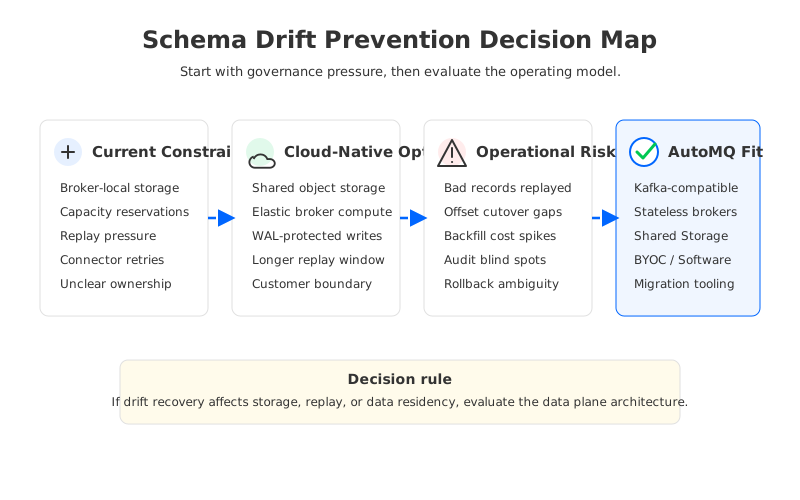
Schema drift prevention works best when it is designed into the streaming operating model: producer contracts, topic ownership, schema compatibility, replay rules, connector behavior, deployment boundaries, and broker scaling all need to fit together. Storage architecture matters because it determines how painful it is to recover, backfill, retain audit history, and migrate workloads after governance rules change.
1Why teams search for schema drift prevention kafka
Most schema drift incidents do not start with a dramatic outage. They start with a reasonable change that moves faster than the consumers that depend on it. A producer team sees a new business field and adds it. A database team changes a CDC source. A data science team backfills old events into a topic with a slightly different shape. The event stream keeps moving, which is exactly why the damage can spread before anyone has a clean blast-radius view.
In Kafka, drift has a particular shape because the log is durable and reusable. A broken event is not only a failed write. It can be replayed by a future consumer, copied by a connector, materialized into a table, or used as input to a model long after the original producer deployment is forgotten. Offsets help consumers track progress, but offsets do not say whether the value at that position still satisfies a contract. Consumer groups help teams scale consumption, but they also multiply the number of applications that can interpret the same field differently.
A production schema drift program usually has four jobs:
- Define contracts for topic keys, values, headers, ownership, and compatibility rules before producer changes reach production traffic.
- Keep enforcement close enough to the write path that bad records are rejected, quarantined, or labeled before they become replayable facts.
- Preserve enough history, offsets, and audit evidence to explain what changed, who approved it, and which consumers were exposed.
- Make recovery practical when the contract changes, including backfills, connector restarts, topic migrations, and rollback windows.
That last point is where governance becomes an infrastructure question. If the platform cannot replay safely, scale during backfills, or isolate regulated data inside the right network boundary, schema policy turns into manual incident work.
2The production constraint behind the problem
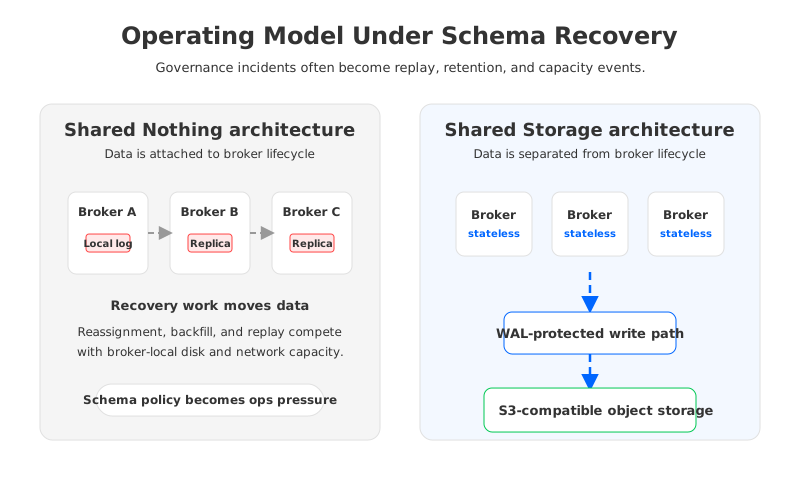
Traditional Kafka is built as a Shared Nothing architecture. Each broker owns local log segments, and reliability is achieved by replicating partition data across broker replicas. This design has served Kafka well for years, especially in environments where broker-local storage and network movement were acceptable operating assumptions. It also means that storage, capacity, and recovery decisions are tied to broker lifecycle.
Schema governance stresses that model in indirect ways. A compatibility rule may require longer retention so downstream teams can replay from a known-good offset. A drift incident may require a backfill while normal traffic continues. A migration from permissive schemas to stricter data contracts may require parallel topics, connector duplication, and temporary capacity. None of these actions is only a governance setting. They create storage pressure, broker-local disk pressure, partition movement, and sometimes cross-Availability Zone (AZ) traffic in cloud deployments.
Tiered Storage helps with part of the retention problem by moving older log data to remote storage, while the active write path still depends on local broker storage. That can be the right trade-off for clusters that need longer history without changing the active operating model. It is not the same thing as making brokers stateless. When governance requires frequent recovery drills, elastic backfills, or migration windows, platform teams should ask whether the active data plane can absorb those events without turning every policy change into a capacity project.
The cost dimension is also more subtle than the price of storage. Cloud teams need to model local disks, object storage, API requests, network paths, PrivateLink or similar private connectivity, cross-AZ transfer, and human operations. AWS documents pricing separately for EC2 data transfer, S3 storage and requests, and PrivateLink. That separation is a reminder: schema drift prevention may be a data governance goal, but the bill arrives through infrastructure meters.
3Architecture options and trade-offs
There are several reasonable ways to prevent schema drift in Kafka. The right answer depends on how much autonomy producer teams need, how strict the downstream systems are, and whether the platform team owns the data plane as a shared service.
| Option | Where enforcement happens | Good fit | Trade-off |
|---|---|---|---|
| Producer-side validation | Application code validates before producing | Strong domain ownership and fast local feedback | Policy can diverge across teams unless centrally reviewed |
| Schema registry and compatibility rules | Schemas are registered and checked against topic policy | Shared topics, typed events, and formal data contracts | Requires disciplined rollout and client integration |
| Connector-level handling | Source and sink connectors apply transforms, DLQs, and retries | Integration-heavy pipelines with known failure modes | Bad contracts may still enter Kafka unless the write path is governed |
| Stream processing gates | A processing job validates, enriches, or quarantines events | Complex rules that need context from other streams | Adds another runtime and recovery surface |
| Platform-level policy | Topic creation, retention, ACLs, audit, schema rules, and migration are governed together | Regulated or multi-team data platforms | Requires clear ownership between app, data, security, and platform teams |
The mistake is choosing one row and pretending the rest disappear. Producer validation is valuable because it catches mistakes early. Schema registry rules are valuable because they make compatibility visible and enforceable. Connector policies are valuable because many drift incidents appear at system boundaries. Platform policy is valuable because it turns scattered controls into an operating model. The architecture should make these layers reinforce each other instead of making each team rediscover the same failure modes.
For a Kafka-compatible platform, compatibility testing remains a first-class requirement. Teams should validate the producer and consumer client versions they use, idempotent and transactional producers if they depend on them, offset behavior during migration, Consumer group rebalance behavior, Connect connector semantics, and any schema registry integration in the deployment. Kafka compatibility is not only a protocol checkbox. It is the accumulated behavior that applications depend on during incidents.
4Evaluation checklist for platform teams
A practical evaluation starts with the governance target and works backward into infrastructure. If the target is "no incompatible records enter production topics," the platform needs one set of controls. If the target is "incompatible changes can be contained and replayed safely," the platform needs a broader recovery design. If the target is "regulated event history never leaves the customer-controlled environment," deployment boundaries become part of the schema drift plan.
Use this checklist before comparing products or writing a migration plan:
- Contract ownership: Every production topic needs an accountable owner, an allowed producer list, a compatibility mode, and a review path for breaking changes.
- Write-path enforcement: Decide whether incompatible events are rejected, quarantined, routed to a dead-letter topic, or accepted with explicit metadata. Silent acceptance is the worst default.
- Consumer exposure: Identify which Consumer groups, connectors, and stream jobs depend on each topic, and whether they can tolerate optional fields, renamed fields, removed fields, and type changes.
- Replay and retention: Validate that retention, object storage, and cache behavior support the backfill windows required by governance and compliance teams.
- Migration and rollback: Test offset preservation, topic mirroring, producer cutover, consumer restart behavior, and rollback while normal writes continue.
- Security and audit: Keep schema changes, ACL changes, connector changes, and topic lifecycle events visible to the teams that own compliance evidence.
- Cost and scaling: Model the infrastructure impact of drift recovery, not only steady-state traffic. Backfills and connector replays are where hidden costs show up.
The checklist is intentionally operational. Schema drift prevention is not complete when a schema is registered. It is complete when a controlled change can move through the platform without guessing which consumer will break, which connector will retry forever, or which cluster will run out of storage during replay.
5How AutoMQ changes the operating model
Once the evaluation reaches storage, scaling, and deployment boundaries, AutoMQ becomes relevant as a Kafka-compatible, cloud-native streaming platform built around Shared Storage architecture. AutoMQ keeps Kafka protocol compatibility while replacing broker-local durable storage with S3Stream, WAL storage, data caching, and S3-compatible object storage. The important point for schema drift prevention is not that storage is abstractly different. It is that durable data is no longer tied to the lifetime and capacity of individual brokers.
That changes the recovery model. In a traditional broker-local design, replay-heavy governance work can collide with disk sizing, partition reassignment, and broker replacement. In AutoMQ, stateless brokers handle the Kafka compute path while durable stream data lives in shared object storage. WAL storage protects the write path, and cached reads help serve hot and catch-up traffic. Platform teams still need to test latency, workload shape, and WAL type, but broker scaling and replacement are less dominated by moving retained partition data between local disks.
AutoMQ BYOC and AutoMQ Software also matter for governance teams because deployment boundaries are part of the control design. In AutoMQ BYOC, the control plane and data plane run in the customer's cloud account and VPC, and customer message data stays in customer-owned infrastructure. AutoMQ Software applies the same customer-controlled principle to private data center environments. For regulated teams, that boundary can be as important as the schema mechanism itself: contracts, audit records, network isolation, and data residency reviews can be evaluated inside the customer's environment rather than as an afterthought.
AutoMQ features should be evaluated as part of a full migration and governance plan. Kafka Linking can help migration teams copy topic data and coordinate consumer progress during a move to AutoMQ. Self-Balancing and seconds-level partition reassignment help reduce the operational drag of node changes and traffic redistribution. Table Topic can connect Kafka-compatible topics to Iceberg-style table workflows, where schema constraints and catalog ownership become especially visible. None of these replaces disciplined data contracts. They make the surrounding operating model more elastic and easier to govern.
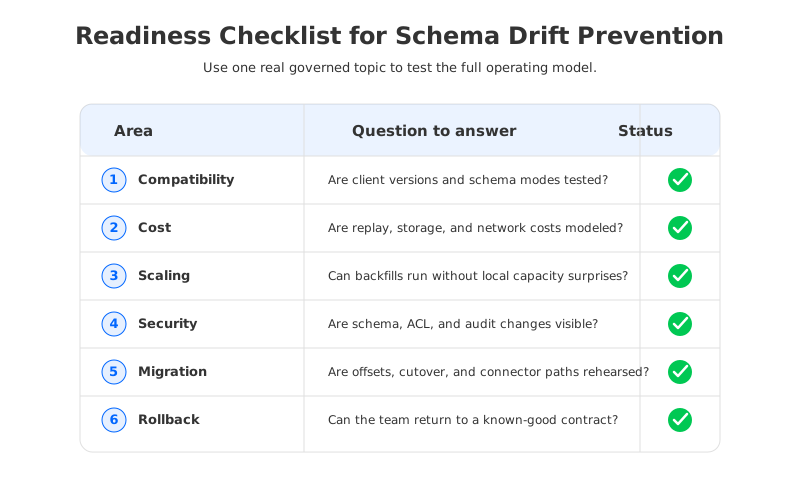
The cleanest way to test the fit is to run a readiness exercise against one high-value topic. Pick a topic with real consumers, a real schema evolution history, and at least one connector or table sink. Define an incompatible change, a quarantined record path, a replay window, and a rollback target. Then measure what the platform team must do across schema policy, offsets, retention, access control, observability, and capacity. That exercise will show whether your schema drift program is a document, a tool setting, or a production-grade streaming data plane.
6FAQ
6.1Is schema drift prevention only a schema registry problem?
No. A schema registry is a key control, but production prevention also includes topic ownership, client behavior, connector handling, retention, replay, migration, access control, and audit evidence. The registry defines and checks contracts; the platform determines whether those contracts can be operated safely.
6.2Does Kafka compatibility remove schema drift risk?
No. Kafka compatibility preserves client and protocol behavior, but schema drift is a data contract and operating model problem. Compatibility helps because teams can keep Kafka clients, offsets, Consumer groups, Connect workflows, and transactions familiar while improving governance around them.
6.3When should teams consider shared storage for schema governance?
Shared storage becomes attractive when governance work regularly requires long retention, replay, backfills, broker replacement, elastic scaling, or customer-controlled deployment boundaries. It is less about one schema feature and more about making recovery and migration less dependent on broker-local storage.
6.4What should be tested before migrating a governed Kafka workload?
Test producer and consumer client versions, schema compatibility modes, transactional or idempotent writes, offset preservation, Consumer group cutover, connector DLQs, ACLs, audit logs, backfill throughput, rollback steps, and observability. Use a real topic rather than a synthetic demo topic.
If schema drift prevention is forcing your Kafka team to rethink retention, replay, scaling, and customer-controlled deployment boundaries, evaluate AutoMQ with a real governed workload: start from the AutoMQ home path.
7References
- Apache Kafka documentation: consumers and Consumer groups
- Apache Kafka documentation: delivery semantics and transactions
- Apache Kafka documentation: KRaft
- Apache Kafka documentation: Kafka Connect
- Apache Kafka documentation: Tiered Storage
- AutoMQ documentation: compatibility with Apache Kafka
- AutoMQ documentation: architecture overview
- AutoMQ documentation: WAL storage
- AutoMQ documentation: Kafka Linking migration overview
- AutoMQ documentation: Table Topic overview
- AWS EC2 pricing: data transfer
- AWS PrivateLink pricing
- AWS S3 pricing


