
Table of Contents
Table of Contents
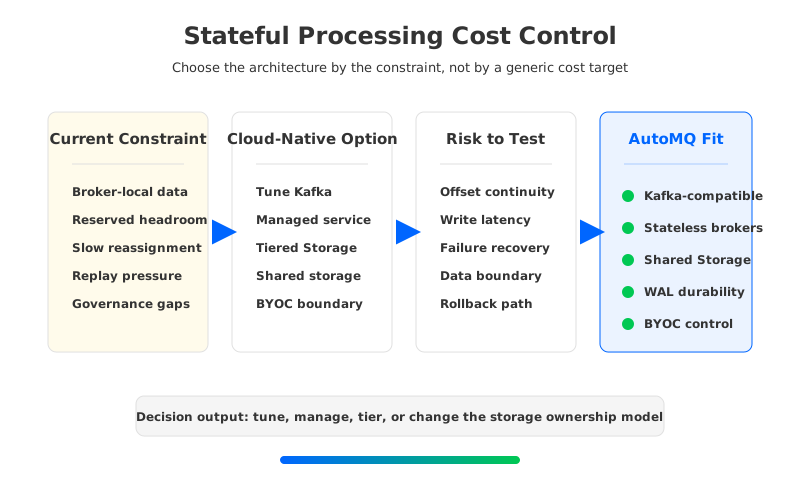
A search for stateful processing cost control kafka usually starts after the easy knobs have stopped working. The Flink jobs have already been tuned. Retention has already been debated. Topic counts, partition counts, checkpoint intervals, consumer lag, and broker disk usage are all on the dashboard, yet the bill and the on-call load still move in the wrong direction. The problem is no longer one expensive job. It is the way stateful processing pushes Kafka into the center of capacity, recovery, and governance decisions.
Stateful processors depend on Kafka for more than message transport. They use Kafka offsets as recovery positions, rely on retention for replay, and expect stable topic behavior when jobs restart from checkpoints. That makes Kafka the operational backstop for the processing layer. If the streaming foundation becomes costly to scale or risky to rebalance, every stateful job inherits that constraint.
The useful question is not whether Kafka can support stateful processing. It can, and the ecosystem around Apache Kafka includes consumer groups, transactions, Kafka Connect, Kafka Streams, and KRaft metadata management. The harder question is whether your Kafka operating model lets the processing layer grow without turning every cost-control project into a storage migration, capacity reservation, or cutover exercise.
1Why teams search for stateful processing cost control kafka
Stateful processing changes the cost conversation because the expensive part is often indirect. A stateless consumer can fall behind and catch up later if retention and downstream systems allow it. A stateful job has more coupling. It may need checkpoint alignment, transactional writes, ordered replay, and a clean mapping between source offsets and internal state. When a job reads from 200 partitions, writes derived tables, and must recover without duplicate side effects, Kafka stops being a generic queue and becomes part of the application's recovery contract.
That contract has several cost surfaces that do not show up in a single line item:
- Retention becomes insurance. Teams keep more Kafka history because replay is the recovery path for bad deployments, schema mistakes, and late-arriving corrections.
- Lag becomes a capacity signal. A consumer group that falls behind may force temporary broker headroom, faster disks, or stricter partition placement.
- Rebalancing becomes a change-control event. Moving partitions can affect network, disk, cache warmth, and failure risk, so teams delay changes until the cluster is already uncomfortable.
- Governance becomes operational. Access control, audit, schema policy, and data residency have to match the path used by processors, connectors, and lakehouse writers.
None of these points mean Kafka is the wrong foundation. They mean cost control has to be designed around the stateful processing contract, not bolted on after the workload has grown.
2The production constraint behind the problem
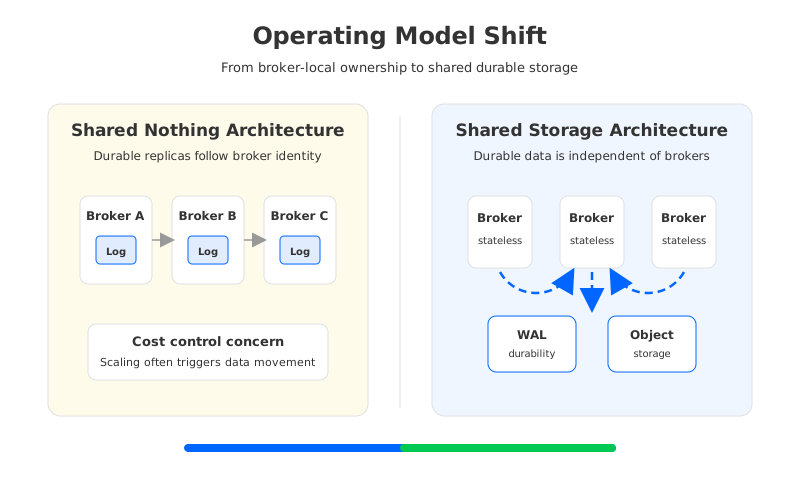
Traditional Kafka follows a Shared Nothing architecture. Each broker owns local log segments, and partition replicas are spread across brokers for durability and availability. The design is familiar and proven. It also means that storage, compute, and recovery are tied together at the broker boundary. A broker is not only CPU and memory. It is also a collection of local replicas, disk throughput, network replication, cache state, and failure-domain placement.
That coupling matters in cloud environments. When a stateful processing workload grows, the platform team often adds partitions, extends retention, or increases broker capacity. Each move can create more local data to place and protect. If the team later wants to shrink the cluster, replace nodes, change instance types, or rebalance hot partitions, the durable data has to follow the broker-local model. The technical work becomes data movement rather than compute scheduling.
This is where cost control starts to look like operational debt. You can reserve more broker capacity to keep rebalances rare, but then the cluster carries idle headroom. You can shorten retention, but then replay and correction windows shrink. You can push more data to object storage through Tiered Storage, but the active log and broker-local operational model still matter. You can use managed services to reduce maintenance work, but the bill may still reflect the same underlying coupling between throughput, storage, and network movement.
For stateful processing teams, the risk is not only cost. It is the loss of maneuverability. A platform that takes hours of careful work to rebalance teaches teams to avoid change. Once that habit forms, every added Flink job, stream-table join, or long-retention topic arrives with a hidden tax: it makes future changes harder.
3Architecture options and trade-offs
A practical architecture review starts by separating the processing engine from the streaming substrate. Flink, Kafka Streams, custom consumers, and table writers own application state and processing semantics. Kafka-compatible streaming owns topics, partitions, offsets, durability, replay, client compatibility, and operating boundaries. Cost control fails when those layers are blended into one vague goal such as "make streaming lower cost."
The table below is a neutral way to frame the choice before discussing any vendor or product.
| Option | What it improves | What remains difficult | Fit for stateful processing |
|---|---|---|---|
| Tune existing Kafka | Lowest migration risk; familiar tooling and semantics | Broker-local storage, reserved headroom, reassignment work, and disk operations remain | Good first step when waste comes from poor configuration |
| Managed Kafka service | Reduces infrastructure maintenance and patching burden | Cost shape and data boundary depend on service design; some broker-state constraints remain | Good when team capacity is the main constraint |
| Tiered Storage | Moves older log data to remote storage for long retention | Active segments and broker-local operations still matter | Useful when long retention dominates, not a full answer to broker statefulness |
| Kafka-compatible shared storage | Separates durable data from broker-local disks | Requires validation of latency path, compatibility, WAL design, cache behavior, and migration plan | Strong candidate when scaling, recovery, retention, and cloud cost are linked |
The point of the table is not to rank options. It is to force the team to name the bottleneck. If the problem is a few oversized topics, tune them. If the problem is patching, certificates, and routine cluster maintenance, a managed service may be the most direct fix. If the problem is that every scaling or recovery action is constrained by broker-local data, then the architecture itself deserves review.
4Evaluation checklist for platform teams
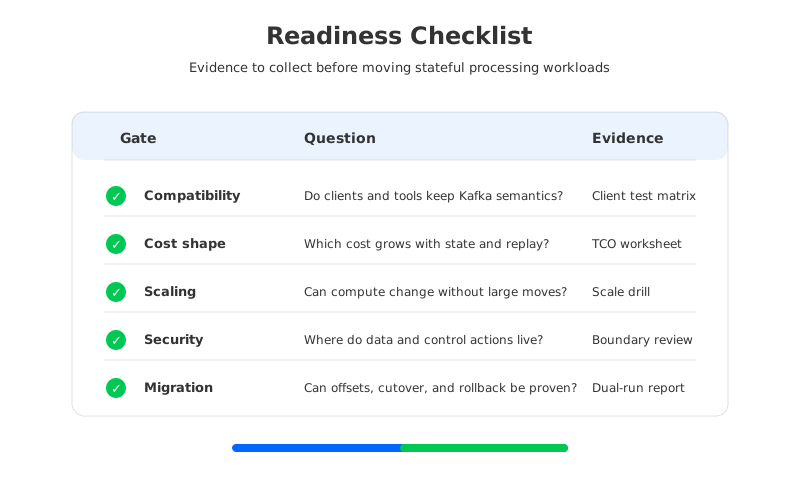
Once the bottleneck is clear, the evaluation should move from features to operating evidence. Stateful processing workloads are unforgiving because a small mismatch can show up only during restart, replay, or migration. The checklist should therefore test the boring paths, not only the happy path.
Use this sequence before committing a workload:
- Compatibility: Verify producers, consumers, Kafka Connect workers, Kafka Streams applications, schema tooling, transactions, idempotent producers, ACLs, and client versions against the target platform.
- Recovery: Run controlled failures for brokers, processors, connectors, and downstream sinks. Check offset behavior, replay time, duplicate handling, and consumer group stability.
- Cost shape: Split cost into compute, storage, network, operations, observability, migration, and idle headroom. Do not collapse them into a single monthly number too early.
- Elasticity: Test scale-out, scale-in, node replacement, partition movement, cache warm-up, and lag recovery under representative load.
- Governance: Confirm where data, metadata, logs, metrics, keys, and control-plane actions live. A Kafka-compatible API does not by itself answer data-boundary questions.
- Migration: Prove topic replication, offset continuity, producer cutover, rollback, and dual-run observability before moving business-critical processors.
This is also the moment to write down the anti-goals. If a workload needs the lowest possible tail latency for a short-retention hot path, a shared-storage design must prove itself with that workload rather than win on architecture alone. If the workload has long retention, bursty replay, frequent scaling, or strict customer-cloud data boundaries, a broker-local design should prove that its operational overhead is still acceptable.
5How AutoMQ changes the operating model
The evaluation framework points to a specific architecture requirement: durable Kafka data should not force every broker lifecycle event to become a data-placement project. AutoMQ fits this category as a Kafka-compatible cloud-native streaming platform built around Shared Storage architecture. It keeps the Kafka protocol and application-facing model while moving persistent data into S3-compatible object storage through S3Stream, WAL (Write-Ahead Log) storage, and data caching.
The important change is broker statefulness. In a broker-local model, a broker replacement has to respect the local replicas attached to that broker identity. In AutoMQ's model, AutoMQ Brokers are stateless at the durable storage layer. Brokers still handle Kafka protocol processing, partition leadership, scheduling, and cache behavior, but durable data is stored in shared object storage rather than owned by a local disk. That changes the cost-control playbook. Scaling compute no longer has to imply moving the full durable log through broker reassignment.
The WAL layer is the part that makes the design more than "Kafka writes to S3." AutoMQ uses WAL storage as the durable write path and object storage as the main data layer. AutoMQ Open Source uses S3 WAL, while AutoMQ commercial editions can use options such as Regional EBS WAL or NFS WAL depending on deployment requirements. That distinction matters because stateful processing teams care about write latency, recovery behavior, and failure domains. Treat WAL selection as an architecture decision, not a footnote.
AutoMQ's Self-Balancing and seconds-level partition reassignment also change how platform teams think about capacity. If durable data is already in shared storage, reassignment can focus more on metadata, ownership, leadership, and traffic distribution than on copying large local replicas. That does not remove the need to test workloads, but it reduces the reason teams avoid routine balancing work. For stateful processors, the practical benefit is a streaming substrate that can adapt around jobs instead of forcing every job to adapt around broker-local storage.
Deployment boundaries matter as much as storage mechanics. AutoMQ BYOC places the control plane and data plane in the customer's cloud account or VPC, and AutoMQ Software is designed for private environments. For teams with regulated stateful processing workloads, that boundary helps separate data path review from vendor service review. You still need to inspect IAM, network routes, telemetry, support access, and upgrade authority, but the architecture gives the security team concrete boundaries to evaluate.
Migration is where the theory has to meet offsets. AutoMQ's Kafka Linking is designed for migrations from Apache Kafka distributions with byte-to-byte replication, synchronized Consumer group progress, and producer switching support under documented conditions. That is relevant for stateful processing because offset continuity can be the difference between a controlled cutover and a replay incident. Even then, migration should be staged: start with non-critical topics, run processors in parallel, compare lag and outputs, rehearse rollback, and promote only when the operational evidence matches the plan.
6A decision scorecard that avoids vague cost claims
The best scorecard is specific enough that two engineers can fill it out and reach the same conclusion. Avoid scores like "good" or "bad." Use evidence the team can test or collect.
| Dimension | Question to answer | Evidence to collect |
|---|---|---|
| Stateful recovery | Can processors restart from expected offsets and rebuild state within the recovery target? | Failure drill logs, checkpoint recovery times, duplicate-write checks |
| Scaling | Can the platform add and remove compute without a large data-movement project? | Scale test, partition movement metrics, lag during rebalance |
| Retention economics | Does longer retention force proportional broker-local storage growth? | Storage model, retention policy, object storage usage, broker disk trend |
| Governance | Can reviewers trace data, metadata, metrics, and control actions? | Architecture diagram, IAM policy review, network path review |
| Migration risk | Can producers, consumers, and stateful jobs switch with validated offsets and rollback? | Dual-run results, offset comparison, rollback rehearsal |
This scorecard keeps cost control tied to engineering behavior. A lower storage bill is helpful, but the deeper win is a platform that lets the team change capacity, retention, and recovery posture without accumulating more operational debt. That is the real test for stateful processing: the architecture should make the next change less risky than the last one.
7FAQ
7.1Is stateful processing cost control mostly a Flink problem or a Kafka problem?
It is both. Flink or Kafka Streams owns processing state, checkpoints, joins, windows, and application logic. Kafka owns durable input, offsets, retention, replay, and consumer group behavior. Cost control breaks down when the processing team tunes jobs while the platform team carries an inflexible Kafka storage model underneath them.
7.2Does Apache Kafka Tiered Storage solve this problem?
Tiered Storage helps when historical retention is the dominant cost driver because older log data can move to remote storage. It does not make brokers fully stateless, and it does not remove every operational concern around active logs, partition placement, broker replacement, or reassignment. It should be evaluated as one option, not treated as a universal fix.
7.3When should a team evaluate AutoMQ for stateful processing workloads?
Evaluate AutoMQ when broker-local storage, long retention, replay, scaling, cross-AZ data movement, or customer-controlled deployment boundaries are part of the cost problem. Validate the exact workload, including client compatibility, latency, offset behavior, failure recovery, and migration steps.
7.4What is the safest first migration candidate?
Start with a workload that is important enough to be representative but not so critical that the first cutover carries unacceptable business risk. Good candidates have clear owners, measurable output, known consumer groups, replay tolerance, and a rollback plan.
If your next cost review is really a storage-ownership review, test the architecture instead of tuning around the symptoms. For a customer-controlled evaluation path, start with AutoMQ Cloud and run the scorecard above against one real stateful workload.
8References
- Apache Kafka Documentation
- Apache Kafka Consumer Groups
- Apache Kafka Message Delivery Semantics
- Apache Kafka KRaft
- Apache Kafka Connect
- Apache Kafka Tiered Storage
- AutoMQ Architecture Overview
- AutoMQ S3Stream Shared Streaming Storage
- AutoMQ Continuous Self-Balancing
- AutoMQ Migration with Kafka Linking


