
Table of Contents
Table of Contents
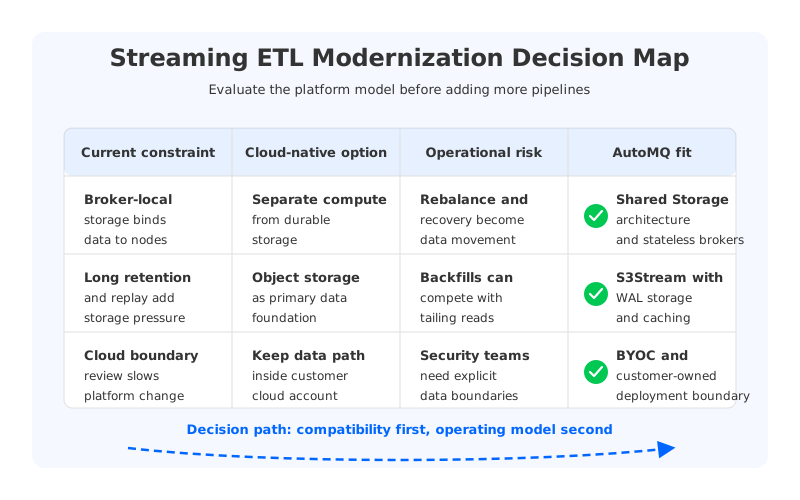
Teams rarely search for streaming etl modernization kafka because they lack a data pipeline. They search for it when the batch layer has become too slow, the real-time layer has grown around Kafka, and the operational model is starting to crack. The work is no longer only about moving records from source systems to analytics sinks. It is about keeping offsets stable, preserving ordering where it matters, containing cloud costs, and giving downstream teams fresh data without turning the platform team into a permanent broker-rebalancing crew.
That is the uncomfortable part of streaming ETL modernization with Kafka: the integration pattern can be elegant while the platform underneath accumulates debt. A source connector, a Kafka topic, a stream processor, and a sink connector look clean on a diagram. In production, each of those pieces adds retention pressure, partition-growth questions, consumer lag risk, schema governance, network exposure, and rollback paths. The right question is not "Should we use Kafka for streaming ETL?" The better question is whether the Kafka operating model can absorb the next wave of real-time workloads without making every capacity event a storage event.
1Why teams search for streaming etl modernization kafka
The search intent is usually practical. A data platform team has batch ETL jobs that still work, but they no longer match how the business consumes data. Fraud models need fresher features, lakehouse tables need continuous ingestion, dashboards cannot wait for the next hourly job, and product teams want event streams that feed multiple consumers instead of one point-to-point integration.
Kafka is a natural anchor for that shift because its core abstractions map well to streaming ETL. Topics provide durable event logs, partitions provide parallelism, offsets let consumers resume from known positions, and consumer groups let workers divide partitions while preserving per-partition order. Kafka Connect adds a standard runtime for source and sink integration, and transactions can help applications coordinate writes when exactly-once behavior is required.
The pressure starts when the same cluster has to serve too many roles at once:
- Real-time ingestion from databases, applications, SaaS sources, and CDC streams.
- Transformation fan-out into Flink, Spark, stream processors, alerting jobs, and feature pipelines.
- Lakehouse delivery into object storage, table formats, and query engines.
- Replay and backfill for audits, model retraining, incident recovery, and product analytics.
Each role has a different traffic shape. Tailing consumers care about low latency and steady throughput. Backfill jobs care about historical read bandwidth. Sink connectors care about retry behavior and delivery guarantees. Governance teams care about schema evolution, access, retention policy, and lineage. When those requirements land on one Kafka estate, modernization becomes a platform design problem rather than an integration project.
2The production constraint behind the problem
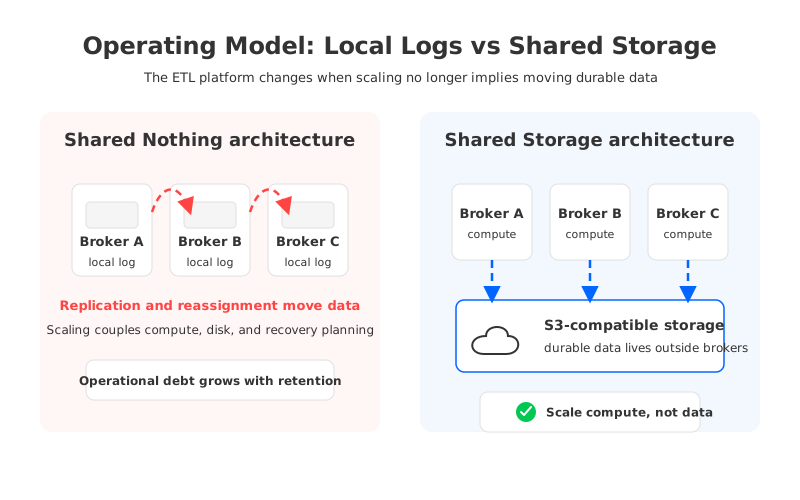
Partition reassignment is the clearest symptom. Adding brokers sounds like a compute scaling action, but in a Shared Nothing cluster it often means moving partition data so the new nodes can own their share. Longer retention makes that movement heavier, more partitions make the plan harder to reason about, and hot topics force manual intervention. A capacity fix can become a data-copy operation, so the team learns to overprovision rather than rebalance during business hours.
3Architecture options and trade-offs
Tiered Storage changes part of that equation by moving older log segments to remote storage while brokers keep recent data locally. It can reduce pressure from long retention and historical reads, especially when replay windows grow faster than write throughput. The trade-off is that brokers still remain stateful for the hot tier, leadership, local log management, and operational recovery. Tiered Storage helps the retention problem; it does not fully decouple compute scaling from broker-local storage.
A Kafka-compatible Shared Storage architecture takes a different route. Instead of treating object storage as a remote tier behind broker-local logs, it makes shared object storage the durable storage layer and keeps brokers focused on protocol handling, request routing, caching, and leadership. The design goal is not to change the Kafka API that applications see. It is to change what happens when a broker is added, removed, replaced, or rebalanced.
Use this decision frame before choosing a platform direction:
| Evaluation axis | Conventional Kafka focus | Shared Storage focus |
|---|---|---|
| Compatibility | Existing clients, Connect, transactions, consumer groups, and tooling must keep working. | Same requirement, with extra scrutiny on protocol semantics and migration behavior. |
| Scaling | Plan broker count around CPU, disk, network, partitions, and retention together. | Scale compute more independently because durable data is not bound to broker disks. |
| Retention | Longer retention increases local or tiered-storage planning complexity. | Object storage becomes the main durability layer for long-lived data. |
| Recovery | Broker loss may trigger replica recovery, reassignment, and data movement. | Broker replacement should mostly move ownership and traffic, not durable data. |
| Governance | Access, audit, schema policy, and topic lifecycle live above Kafka. | Same governance needs, plus clearer cloud-account and storage-boundary review. |
| Migration risk | Lowest architecture change, but existing operational debt remains. | Higher platform evaluation effort, with the chance to reduce recurring operations. |
The table deliberately does not pick a winner. Streaming ETL modernization is not a contest between a familiar stack and a shiny one. It is a question of which risks the team wants to own repeatedly. If the main pain is connector sprawl, a better Connect operating model may be enough. If the main pain is broker-local storage, rebalances, long retention, and cloud network exposure, the storage architecture deserves a deeper look.
4Evaluation checklist for platform teams
The third layer is governance. Streaming ETL often becomes a shared contract between application and analytics teams. That contract needs schemas, topic ownership, data classification, ACLs, service accounts, retention controls, and observability. The platform choice should make those controls easier to operate, not hide them behind an abstraction that security teams cannot inspect.
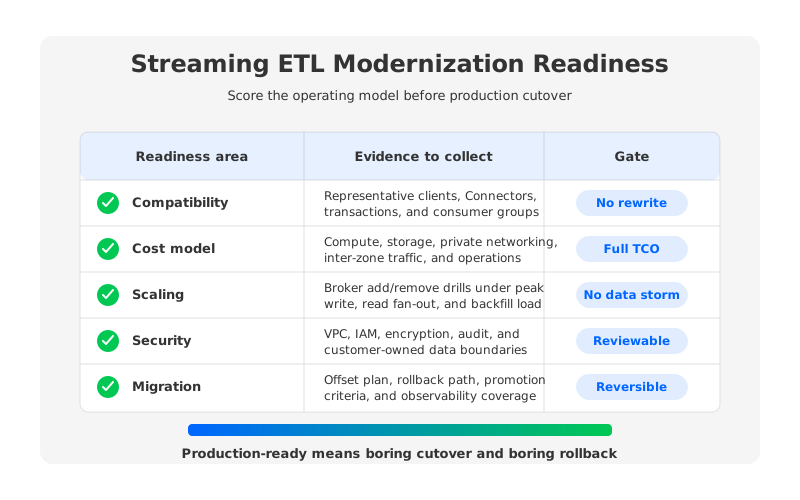
Here is a practical readiness scorecard:
| Question | Why it matters | Good evidence |
|---|---|---|
| Can clients move without code changes? | ETL modernization fails when application teams must rewrite producers and consumers. | Compatibility test with representative clients, Connectors, transactions, and consumer groups. |
| Can scaling avoid large data movement? | Streaming ETL traffic changes quickly when new sinks or backfills appear. | Broker add/remove drill with measured reassignment, lag, and recovery behavior. |
| Is historical replay isolated from hot traffic? | Backfills should not degrade tailing consumers. | Separate metrics for hot reads, catch-up reads, cache behavior, and object-storage access. |
| Are cloud boundaries explicit? | BYOC, VPC, IAM, encryption, and region controls affect compliance approval. | Architecture review showing where data, metadata, logs, and metrics flow. |
| Is rollback boring? | Cutover is only safe when offset and write-path behavior are understood. | Migration runbook with source-of-truth offsets, dual-run windows, and promotion criteria. |
| Does observability match the failure modes? | Broker-local disk alerts are not enough for object-storage-backed streaming. | Metrics for brokers, controllers, WAL storage, object storage, cache, Connect, and consumer lag. |
That last row is easy to underestimate. A platform can be technically compatible while still changing what operators must watch. Shared storage shifts attention from disk fullness and replica-copy progress toward object storage latency, WAL health, cache hit behavior, metadata, and traffic placement. A strong modernization plan names those changes before production cutover.
5How AutoMQ changes the operating model
Once the evaluation framework points to storage-coupled operations as the bottleneck, AutoMQ becomes relevant as a Kafka-compatible cloud-native streaming platform built around Shared Storage architecture. AutoMQ keeps Kafka protocol compatibility as the application-facing contract, while replacing broker-local durable storage with S3Stream, WAL storage, data caching, and S3-compatible object storage. The important shift is operational: brokers can be treated more like stateless compute nodes because durable data is not tied to their local disks.
This matters for streaming ETL because the workload is elastic by nature. A product launch may add write throughput. A downstream analytics team may start a large backfill. A retention policy may change because compliance wants longer replay. In a broker-local model, those changes often converge on the same question: which brokers have enough disk, CPU, and network to survive the next phase? In AutoMQ's model, durable data is written through WAL storage and stored in object storage, while brokers serve Kafka requests, cache hot data, and coordinate ownership through the metadata layer.
The WAL layer is the bridge that makes object storage practical for streaming writes. Object storage is durable and scalable, but raw object-store writes are not a drop-in replacement for Kafka's append path. AutoMQ uses WAL storage as a persistent write buffer and recovery layer, then uploads data to S3 storage in near real time. AutoMQ Open Source uses S3 WAL, while AutoMQ commercial editions can use additional WAL options depending on the deployment environment.
AutoMQ's BYOC model is also relevant to governance. In AutoMQ BYOC, the control plane and data plane run inside the customer's cloud account and VPC. Customer message data stays in the customer's environment. For teams modernizing streaming ETL under strict security review, that boundary can be as important as the storage architecture itself. A platform that changes Kafka operations but forces unclear data movement outside the customer account may create a different approval problem.
AutoMQ also connects to the lakehouse side of the modernization discussion. Table Topic is designed to write streaming data into Apache Iceberg tables, which can reduce external ETL components for some data lake ingestion paths. That does not remove the need for stream processing, schema policy, or quality checks. It gives platform teams another option: keep Kafka-compatible ingestion for applications, then reduce separate connector or job layers where direct table-oriented delivery fits.
The right way to evaluate AutoMQ is the same way you would evaluate any platform change: start with representative workloads, keep the migration plan explicit, and test failure behavior before production traffic moves. Kafka Linking can help migration paths where topic data and consumer progress need to be synchronized from an existing Kafka cluster, but the migration still needs ownership from application, SRE, data platform, and security teams. Compatibility lowers the switching cost; it does not remove the need for disciplined cutover.
6Migration and readiness scorecard
The final decision should fit into a scorecard that the whole platform team can sign. A streaming ETL modernization plan is ready when the team can answer five questions without hand-waving. What traffic shape are we designing for? Which Kafka semantics must be preserved? Which cost drivers are material in our cloud environment? What happens during broker failure, zone failure, and backfill pressure? How do we cut over and roll back without corrupting offsets or confusing downstream consumers?
Use a simple scoring model before any production migration:
| Area | Low readiness | Production-ready signal |
|---|---|---|
| Compatibility | Tested only with one happy-path producer and consumer. | Tested with real client versions, Connectors, transactions if used, ACLs, and consumer groups. |
| Capacity | Sized from average throughput. | Sized from peak writes, read fan-out, catch-up reads, retention, and migration overhead. |
| Cost | Focused on instance price. | Includes storage, inter-zone data paths, object storage calls, private connectivity, and operations. |
| Governance | Topic access handled after migration. | Ownership, schema policy, RBAC, audit, and data boundaries defined before cutover. |
| Recovery | Broker restart tested. | Broker loss, zone impairment, object-storage latency, and rollback drills tested. |
| Observability | Kafka broker metrics only. | End-to-end metrics from producers, brokers, WAL storage, object storage, Connect, stream processing, and consumers. |
This scorecard tends to expose the real answer. Some teams need better Kafka hygiene before they need a new architecture. Some need to split noisy workloads or fix schema governance first. Others are already paying the operational tax of broker-local storage, long retention, and recurring rebalances; for them, keeping Kafka compatibility while moving to Shared Storage architecture can change the economics of the entire streaming ETL platform.
If your team is evaluating Kafka-compatible streaming for cloud-native ETL modernization, the next useful step is to test the operating model rather than debate it in the abstract. Start with a workload that has real retention, real fan-out, and a realistic backfill. Then compare how each platform behaves when you add brokers, lose brokers, grow retention, and cut over consumers. For an AutoMQ evaluation path, use the AutoMQ Cloud entry point here: start an AutoMQ BYOC trial.
7FAQ
7.1Is Kafka still a good foundation for streaming ETL modernization?
Yes, when the team needs durable event logs, replay, consumer groups, connector ecosystems, and broad client support. The harder question is whether the current Kafka operating model fits the next workload phase. A conventional cluster can work well with disciplined operations, while a Kafka-compatible Shared Storage architecture may fit teams trying to reduce broker-local storage and reassignment debt.
7.2Does Tiered Storage solve the same problem as Shared Storage architecture?
Not completely. Tiered Storage moves older data to remote storage while brokers still manage local hot data. Shared Storage architecture changes the durable storage model more deeply by storing data in shared object storage and making brokers less dependent on local disks. The difference matters most during scaling, recovery, long retention, and backfill-heavy workloads.
7.3What should be tested before moving streaming ETL workloads?
Test client compatibility, consumer group behavior, offset handling, transaction behavior if used, Connector task behavior, peak write throughput, read fan-out, historical replay, security controls, failure recovery, and rollback. Do not rely only on a throughput benchmark; streaming ETL failures often appear at the boundary between processing, offsets, governance, and operations.
7.4Where does AutoMQ fit in a streaming ETL architecture?
AutoMQ fits as the Kafka-compatible streaming foundation beneath producers, consumers, Connectors, stream processors, and lakehouse ingestion paths. Its role is not to replace every ETL component. Its role is to change the Kafka operating model with Shared Storage architecture, stateless brokers, object-storage-backed durability, and customer-controlled deployment boundaries.


