
Table of Contents
Table of Contents
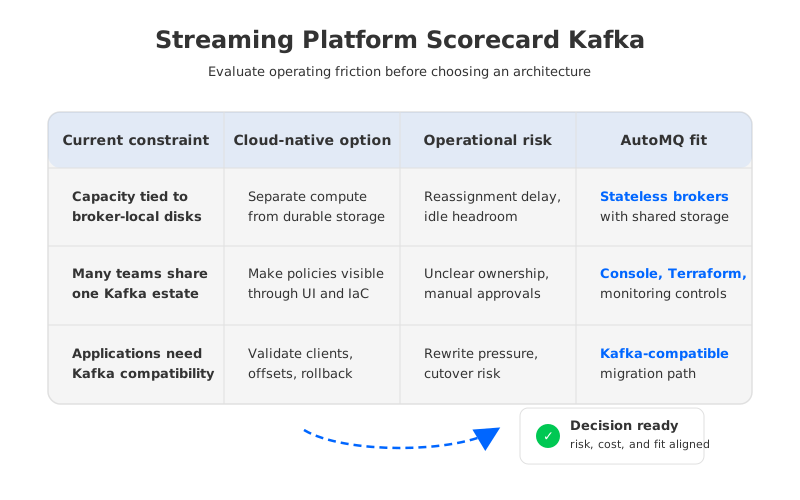
Teams rarely search for streaming platform scorecard kafka because they want another generic feature matrix. They search for it when the Kafka estate has become a shared production dependency and every change creates friction: developers wait for topics, SREs defend capacity buffers, finance asks why idle brokers still cost money, and security wants clearer answers about where data and control boundaries sit.
That is a developer experience problem, even when the symptoms look operational. If a team cannot scale without a long reassignment window, explain consumer lag ownership, or test rollback before migration, application delivery slows down. The useful scorecard is not a vendor checklist. It measures how much platform behavior helps or blocks teams building on Kafka.
The thesis is simple: a streaming platform scorecard for Kafka should start with developer experience metrics, then connect those metrics to architecture. Compatibility, cost, scaling, governance, recovery, and migration risk all become easier to evaluate when the scorecard asks what an application team can safely do without waiting for storage-heavy operations behind the scenes.
1Why teams search for streaming platform scorecard kafka
A Kafka platform usually begins as infrastructure owned by a small group of specialists. Over time it becomes a contract between many teams. Product teams depend on stable topics and schemas. Data engineering depends on replay and connector reliability. SREs depend on predictable failure behavior. Security depends on identity, audit, and network boundaries. Finance depends on a cost model that tracks usage instead of inherited overprovisioning.
The problem is that these groups often evaluate the platform through different lenses. Developers ask whether existing clients and tools still work. Operators ask how long scaling and broker recovery take. Architects ask whether data durability depends on broker-local disks, cloud volumes, object storage, or another persistence layer. A scorecard keeps those questions in one place so the decision does not collapse into a narrow debate about throughput or monthly bill.
Use developer experience as the organizing principle. A good platform scorecard should show whether teams can perform common work without opening a specialist-only runbook:
- Provisioning: Can teams create topics, access policies, service accounts, and connectors through clear workflows or infrastructure as code?
- Change safety: Can teams test producer and consumer behavior, offset handling, and rollback before moving production traffic?
- Operational visibility: Can developers see lag, throughput, errors, and saturation signals that explain application behavior?
- Elasticity: Can platform engineers scale compute capacity without turning every event into a storage migration project?
- Governance: Can security and compliance teams audit access, data location, and control boundaries without relying on tribal knowledge?
These are daily friction points that decide whether Kafka feels like a platform or a queue of tickets.
2The production constraint behind the problem
Apache Kafka® is built around durable logs, partitions, offsets, and Consumer group coordination. Those semantics are powerful because applications can replay data, share streams across teams, and process records independently. The same semantics also make the storage layer central to operations. When the broker owns local durable data, capacity, failure recovery, and scaling are tied to where partition replicas live.
In a traditional Shared Nothing architecture, every Broker manages its own local storage and relies on replication between brokers for durability. This model is well understood, mature, and still appropriate for many environments. The operational trade-off appears when cloud infrastructure changes faster than broker-local state can move. A compute node can be created quickly, but the partition history attached to a Broker may need reassignment, replication catch-up, and careful throttling before the cluster returns to balance.
That mismatch shapes the developer experience. Application teams do not directly ask for "partition reassignment," but they feel it when capacity changes are delayed. They do not ask for "broker-local disk ownership," but they feel it when a hot topic creates a long balancing effort. They do not ask about replication traffic, but they feel it when the platform team restricts topic growth because the cost and operational burden are hard to forecast.
The scorecard should turn that hidden constraint into explicit questions. If a platform promises elastic scaling, ask what happens to durable history during scale-out and scale-in. If it promises fast recovery, ask whether recovery means moving data, switching ownership, rebuilding replicas, or reading from shared durable storage.
3Architecture options and trade-offs
There is no useful scorecard without architectural context. Kafka-compatible platforms can preserve the same application-facing API while making different choices underneath. The application may still use familiar Producer, Consumer, Admin, Kafka Connect, and transaction patterns, but the operating model changes depending on how compute and storage are coupled.
Three architecture questions matter more than a long list of checkboxes:
- Where does durable stream data live? Broker-local disks and cloud volumes make data placement explicit but can make scaling and replacement heavier. Shared object storage changes that ownership model, but it needs a write path, cache strategy, and metadata model that preserve Kafka behavior.
- What happens during change? Scaling, broker replacement, topic growth, and retention changes are routine platform events. The scorecard should measure whether they require moving large amounts of data or mostly updating ownership, metadata, and traffic placement.
- How much of the platform contract is visible to application teams? Compatibility is not only wire protocol support. It includes client behavior, offset semantics, transaction expectations, operational metrics, connector handling, access control, and migration tooling.
This is where Tiered Storage is often misunderstood. Apache Kafka Tiered Storage can move older log segments to remote storage while keeping recent data local. That can help with retention economics and broker disk pressure, but it does not automatically make brokers stateless. The platform still needs to manage local hot data, leadership, replication, and the operational consequences of broker-owned state. A Shared Storage architecture is a deeper change: durable stream data is designed around shared storage from the beginning, with brokers acting more like compute nodes than disk owners.
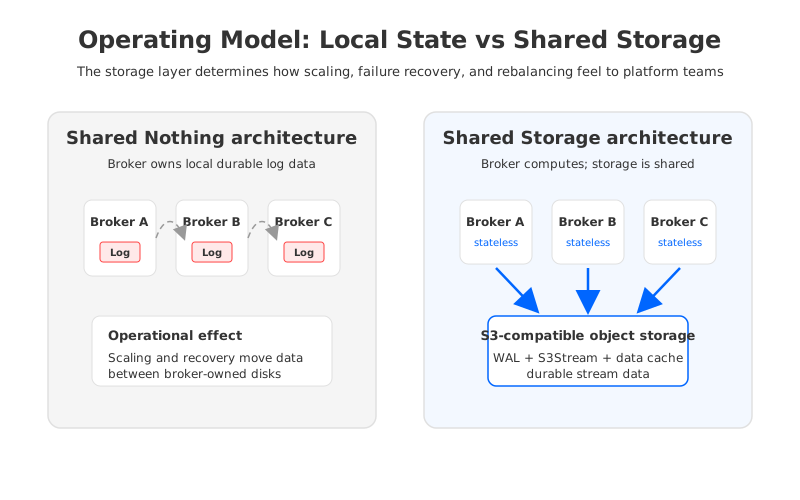
A scorecard should not treat either pattern as a universal answer. Local storage can be straightforward when workloads are steady and teams already operate Kafka well. Shared storage becomes more compelling when the estate has frequent scaling events, uneven topic growth, strict deployment boundaries, and pressure to reduce manual balancing work.
4Evaluation checklist for platform teams
The strongest scorecards use measurable release gates. A category like "developer experience" is too vague unless it maps to actions that teams perform during normal work and incidents. The following checklist works well because every row can be tested in a proof of concept, a migration rehearsal, or a production readiness review.
| Scorecard area | What to measure | Why it affects developer experience |
|---|---|---|
| Kafka compatibility | Client versions, Admin APIs, Consumer group behavior, offsets, transactions, and tool compatibility | Existing applications should not need a rewrite to adopt a different operating model |
| Provisioning workflow | Topic creation, quota changes, identities, ACLs, and Terraform support | Developers should request platform resources through repeatable workflows |
| Scaling behavior | Time to add or remove compute capacity, rebalance impact, and hot partition handling | Application teams feel scaling delays as launch risk or incident duration |
| Cost transparency | Compute, storage, inter-zone traffic, object storage requests, and operations effort | Finance and platform teams need a shared model rather than a monthly surprise |
| Governance boundary | VPC placement, IAM model, audit logs, encryption, and data ownership | Security teams need inspectable controls before the platform becomes critical |
| Failure recovery | Broker replacement, controller behavior, catch-up reads, and client impact | Incidents should have known failure modes and observable recovery signals |
| Migration safety | Dual writes or sync strategy, offset validation, rollback path, and cutover gates | Moving workloads should not depend on a one-way weekend event |
The table also exposes weak scorecards. A platform evaluation that only benchmarks produce throughput misses the work after first success. A cost review that ignores inter-zone traffic and people time misses operational reality. A governance review that stops at encryption misses who operates the control plane, where the data plane runs, and what crosses that boundary.
Score each category from 1 to 5 and require evidence for every score above 3: a client test, Terraform plan, documented rollback, dashboard, or recovery drill. The number matters less than the discipline.
5How AutoMQ changes the operating model
Once the neutral scorecard is in place, AutoMQ fits a specific evaluation pattern: a Kafka-compatible, cloud-native streaming platform that keeps Kafka protocol and ecosystem behavior while changing the storage architecture underneath. AutoMQ uses a Shared Storage architecture in which durable stream data is stored through S3Stream, WAL storage, data caching, and S3-compatible object storage. AutoMQ Brokers handle Kafka-facing compute, request processing, caching, scheduling, and Partition leadership rather than owning durable local log data as the primary persistence layer.
That change matters because it targets constraints the scorecard has already surfaced. Stateless brokers reduce routine platform work tied to broker-local data placement. Fast partition reassignment and Self-Balancing are easier to reason about when rebalancing is not primarily a large data-copy operation. For application teams, the outcome is fewer platform changes waiting behind storage movement.
AutoMQ also changes the boundary conversation. In AutoMQ BYOC, the control plane and data plane run in the customer's cloud account and VPC. In AutoMQ Software, they run in the customer's private environment. That deployment model helps teams evaluate governance, network placement, and data ownership without treating managed operations and customer control as mutually exclusive goals. The scorecard should still ask for evidence: IAM scope, audit trails, monitoring export, upgrade process, rollback, and who can access what.
The developer experience layer sits above that architecture. AutoMQ Console gives platform teams a management surface for instances, resources, monitoring, and workflows. Terraform support expresses repeatable changes through reviewable code. Kafka compatibility keeps existing clients, tools, and ecosystem patterns in scope. Kafka Linking can support migration planning where teams need message synchronization and offset consistency.
None of this removes the need for testing. A platform team should still run workload-specific checks for producer batching, consumer lag, transaction behavior, schema evolution, connector failure, cold reads, retention, and regional failure assumptions. The difference is that the scorecard can now separate two questions that are often tangled together: "Does the Kafka application contract hold?" and "Does the storage architecture make operations easier or harder for this workload?"
6A readiness scorecard you can run before selection
The final scorecard should be short enough to use in a real meeting. Start with seven gates and require one owner for each.
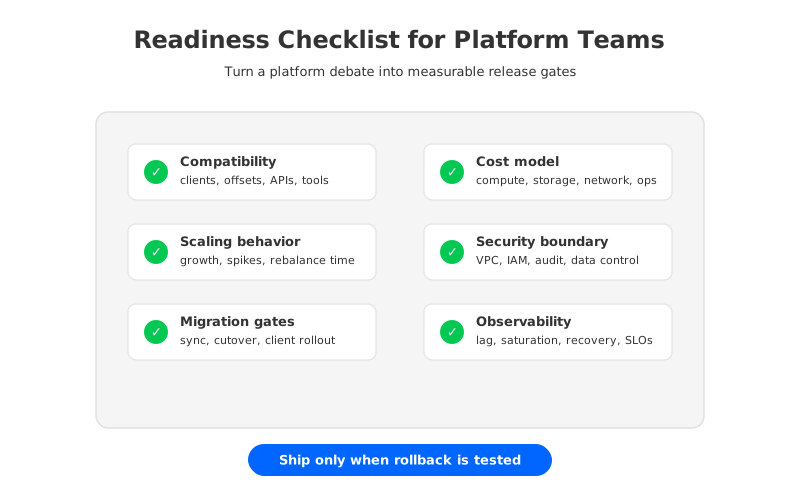
Use these gates before selecting or migrating a production workload:
- Compatibility gate: Run the actual client libraries, serializers, Admin API calls, Consumer group patterns, and transaction paths used by your applications. Do not accept compatibility as a slide-level claim.
- Cost gate: Model steady state and peak state separately. Include compute, storage, object storage requests, inter-zone traffic, support effort, and the cost of capacity buffers.
- Scaling gate: Test scale-out, scale-in, hot topic growth, and broker replacement. Record what moves: data, leadership, metadata, traffic, or all of them.
- Security gate: Confirm where the control plane and data plane run, which identities can act on each resource, and what audit records exist.
- Migration gate: Define sync, cutover, validation, and rollback before moving data. Offset handling should be tested, not assumed.
- Observability gate: Build dashboards for throughput, lag, broker health, storage path behavior, connector health, and recovery progress.
- Ownership gate: Decide which team owns each action after launch. A scorecard that ends at selection but ignores day-2 ownership is incomplete.
The scoring discussion should end with a decision record. Write down which architecture constraint is acceptable, which one is being removed, and which one still needs mitigation.
Back where the search began, streaming platform scorecard kafka is a request for operational clarity. Teams need to judge whether the next platform keeps Kafka's application contract while reducing friction around storage, scaling, governance, and migration. Use your own workloads as evidence and include the teams that will live with the decision. To explore AutoMQ in a customer-controlled Kafka-compatible architecture, talk to the AutoMQ team.
7FAQ
7.1What is a streaming platform scorecard for Kafka?
A streaming platform scorecard for Kafka is a structured evaluation framework for Kafka-compatible platforms. It compares compatibility, cost, scaling, governance, recovery, migration, observability, and team ownership so platform teams can make a decision based on production behavior rather than a feature list.
7.2Which developer experience metrics matter most for Kafka platform teams?
The most useful metrics are provisioning lead time, change failure rate, time to scale, recovery behavior, migration rollback readiness, dashboard coverage, and the number of platform tasks that require specialist-only intervention. These metrics connect application delivery directly to platform operations.
7.3Does Kafka compatibility only mean the Producer and Consumer APIs work?
No. API compatibility is necessary, but production compatibility also includes Admin APIs, Consumer group behavior, offsets, transactions, client versions, Kafka Connect patterns, monitoring expectations, security controls, and migration tooling.
7.4How is Shared Storage architecture different from Tiered Storage?
Tiered Storage moves older log segments to remote storage while brokers still manage local hot data and related operational responsibilities. Shared Storage architecture makes shared durable storage part of the primary design, allowing brokers to operate more like stateless compute nodes.
7.5When should AutoMQ be included in a Kafka platform scorecard?
Include AutoMQ when the evaluation requires Kafka compatibility, customer-controlled deployment boundaries, reduced broker-local storage coupling, elastic operations, and a clearer operating model for scaling, recovery, and migration.


