
Table of Contents
Table of Contents
Teams search for developer onboarding kafka when the first quickstart has stopped being the problem. The developer can already produce a record, consume from a topic, and reset an offset in a test cluster. The harder question is whether the same path can survive production ownership: service accounts, topic conventions, schema changes, consumer lag, incident response, cloud cost, and a migration plan that does not force every application team into a risky cutover window.
That is why onboarding should not be treated as a documentation task. For Kafka-compatible streaming platforms, onboarding is the contract between application teams and the platform team. Developers need a stable API and a clear path to ship event-driven features. Platform engineers need a system whose storage, scaling, governance, and recovery model will not turn every team request into a custom operations ticket. The practical goal is not to make Kafka look small. It is to make the production boundary explicit before teams build critical applications on top of it.
1Why Teams Search for developer onboarding kafka
The search usually starts with a symptom: a team wants a checklist, a starter template, or a set of best practices for Kafka onboarding. Those artifacts matter, but they hide the real decision. If the platform offers developers a topic request form while the operations team still handles capacity planning, partition placement, ACL drift, connector deployment, and broker replacement manually, then onboarding has moved work from one queue to another.
Production Kafka onboarding has two sides. The application contract covers producers, consumers, serialization, retry behavior, idempotence, transactions, and Consumer group ownership. The platform contract covers how topics are created, how access is granted, how retention is priced, how capacity scales, how failures are recovered, and how developers know when their own applications are the bottleneck. Apache Kafka gives teams a powerful shared log, but it does not remove the need to define these contracts. In fact, Kafka's strength as a shared infrastructure layer makes those contracts more important.
A developer onboarding path should answer questions that appear after the first successful demo:
- Can existing clients keep their behavior? Producers, Consumers, AdminClient tooling, Kafka Connect workers, and stream processing jobs often rely on Kafka semantics that are deeper than the wire protocol.
- Who owns the lifecycle of a topic? Naming, retention, partition count, compaction, ACLs, and schema policy need clear owners, or the platform becomes a shared folder with better throughput.
- What happens when demand changes? A launch, backfill, incident replay, or analytics consumer can change read and write pressure faster than a storage-bound cluster can rebalance.
- How does the team reverse a bad decision? Onboarding is incomplete when rollback, offset continuity, and cutover verification are not part of the design.
Those questions are not beginner questions. They are the point where a developer experience conversation becomes a platform architecture conversation.
2The Production Constraint Behind the Problem
Traditional Kafka uses a Shared Nothing architecture. Each broker owns local storage for its partitions, and durability is built through replication between brokers. This design made sense for the environment Kafka came from: machines with local disks, predictable cluster membership, and operators who expected storage and compute to scale together. In cloud environments, the same design can create friction because the developer-visible action, such as asking for longer retention or more partitions, becomes a broker-local storage and data movement problem for the platform team.
The constraint shows up in several places. Broker-local storage means capacity planning is tied to retained data, not only active throughput. Partition reassignment can involve copying data across brokers, so scaling is not merely adding compute. Multi-AZ durability can generate network traffic because replicas need to stay synchronized across fault domains. Tiered Storage helps by moving older log segments to object storage, but the primary write and serving path still depends on broker-local storage for hot data. For onboarding, that means a team request can carry hidden operational cost even when the developer API has not changed.
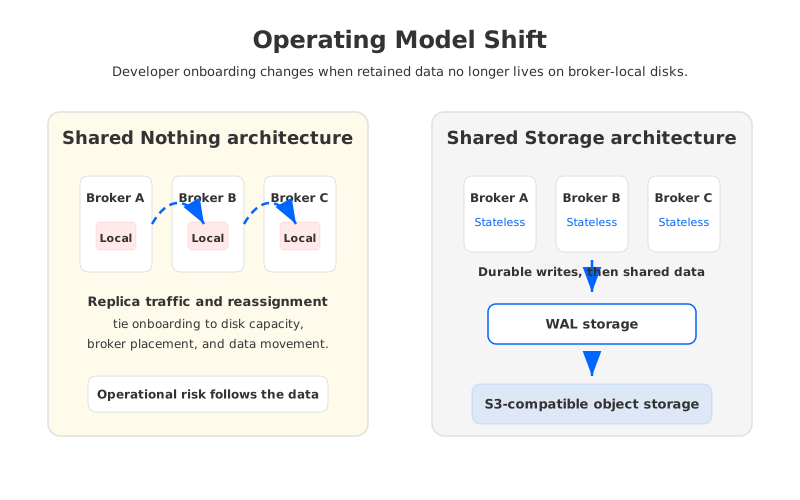
This is the architectural reason onboarding often feels harder than the API suggests. Kafka's client model is elegant: topics, partitions, offsets, Consumer groups, and records. The operating model behind that client model is less forgiving. If developers are encouraged to treat Kafka as self-service infrastructure, the platform must absorb the consequences of retention growth, replay behavior, and traffic imbalance. Otherwise, self-service turns into a thin UI over manual intervention.
3Architecture Options and Trade-Offs
There are several paths for a team that wants Kafka-compatible streaming. None should be chosen by habit. The right path depends on how strongly the organization depends on Kafka semantics, how much operational control it wants, and whether cloud cost is more visible through vendor invoices or customer-owned infrastructure.
| Option | Good fit | Onboarding risk |
|---|---|---|
| Self-managed Kafka | Teams that need full control over broker configuration, networking, and upgrade timing. | The onboarding surface includes nearly all operations work: storage, replication, reassignment, monitoring, upgrades, and incident response. |
| Cloud-provider managed Kafka | Teams that want to reduce infrastructure management while staying close to the Kafka ecosystem. | Developers still need clarity on quotas, storage growth, networking, version behavior, and which Kafka operations remain the team's responsibility. |
| Kafka endpoint on a broader messaging service | Teams that use Kafka clients mainly for ingestion into one cloud ecosystem. | Compatibility may be sufficient for basic clients but should be tested against AdminClient behavior, transactions, connectors, and stream processing assumptions. |
| Cloud-native Kafka-compatible platform | Teams that want Kafka semantics while changing the storage and operations model. | The platform team must verify compatibility, deployment boundaries, WAL choices, observability, and migration behavior before broad rollout. |
The table is useful because it separates client compatibility from operational compatibility. A platform can accept Kafka client traffic and still behave differently when developers use transactions, compacted topics, long retention, large fanout, or connector-driven pipelines. The onboarding plan needs to test the behaviors the organization actually uses, not the minimum produce-and-consume path.
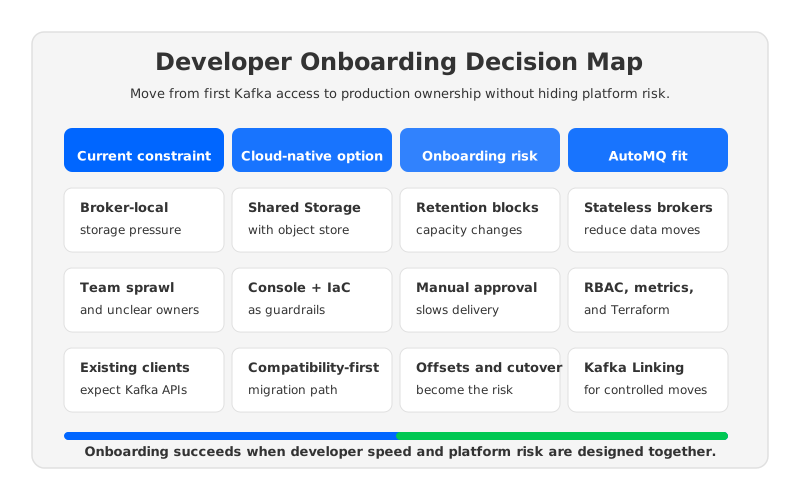
The most important trade-off is where state lives. In a broker-local model, retained data is part of broker capacity. In a shared-storage model, durable stream data moves into object storage while brokers handle compute, protocol processing, cache, and leadership. That shift does not remove engineering choices. It moves them toward WAL durability, object storage behavior, metadata ownership, cache efficiency, and failover timing. For platform teams, that is usually a more direct set of questions than guessing how much broker disk will be needed after the next product launch.
4Evaluation Checklist for Platform Teams
An onboarding checklist should begin with compatibility, but it should not end there. Developers care about whether their code works. SREs care about whether the platform remains operable when several teams use it at the same time. FinOps teams care about whether retention and network behavior can be forecast. Security teams care about identity, audit, encryption, and customer data boundaries. A credible onboarding path needs to hold those concerns in one review instead of treating them as separate approvals.
Start with the application contract:
- Client and protocol behavior. Validate the client versions, APIs, transactions, idempotent producers, Consumer groups, offset reset behavior, AdminClient operations, and Kafka Connect usage that your teams rely on.
- Topic and schema ownership. Define who can create topics, change retention, add partitions, update ACLs, and approve schema changes. The rule should be visible to developers before production access is granted.
- Failure behavior. Test what happens when a broker fails, a consumer falls behind, a connector task restarts, or a backfill creates read pressure. Onboarding should include failure drills, not only happy-path examples.
- Migration and rollback. If the team is moving from an existing cluster, verify how offsets, topic configuration, producer cutover, consumer catch-up, and rollback will work.
Then test the platform contract. Ask how compute scales, how retained data is stored, what cross-AZ or dedicated connectivity costs can appear, how metrics are exposed, how upgrades are handled, and how access is audited. If a platform cannot explain these points clearly, developers will discover the answers later through incidents.
5How AutoMQ Changes the Operating Model
The neutral evaluation points above lead to a specific architectural requirement: keep Kafka compatibility at the application boundary, but reduce the amount of broker-local state that platform teams must operate. AutoMQ fits that category as a Kafka-compatible, cloud-native streaming platform built around Shared Storage architecture. It keeps Kafka protocol and semantic compatibility while replacing Kafka's local log storage layer with S3Stream, WAL storage, data caching, and S3-compatible object storage.
The onboarding impact is concrete. Developers can continue to reason in Kafka terms: Producer, Consumer, Topic, Partition, Offset, Consumer group, Kafka Connect, and Kafka Streams. Platform teams get a different operating model because AutoMQ Brokers are stateless with respect to retained stream data. Durable data is written through WAL storage and uploaded to object storage, so broker replacement, scaling, and partition reassignment no longer require moving the retained log in the same way a broker-local design does.
This matters for developer experience because many onboarding delays come from invisible platform work. A team asks for more throughput, and the platform team worries about partition movement. A team asks for longer retention, and the platform team worries about disk sizing. A team wants to add a connector, and the platform team worries about deployment isolation and network paths. AutoMQ does not make these questions disappear, but it changes the default answer from "open an operations project" to "check the control, storage, and observability contract."
Several AutoMQ capabilities map directly to onboarding friction:
- Kafka compatibility preserves the developer contract for existing Kafka clients and ecosystem components.
- AutoMQ Console and Terraform workflows help platform teams expose controlled self-service rather than ad hoc tickets.
- Self-Balancing and stateless brokers reduce the routine burden of traffic imbalance and broker changes.
- AutoMQ BYOC and AutoMQ Software keep control plane and data plane resources within customer-controlled deployment boundaries for teams with cloud-account, VPC, or data-center requirements.
- Kafka Linking gives migration projects a more controlled path for topic data, offsets, and cutover planning than a manual switch.
The WAL choice still deserves attention. AutoMQ Open Source uses S3 WAL, which is operationally compact and suitable for workloads that can tolerate object-storage-shaped latency. AutoMQ commercial editions can use additional WAL options such as Regional EBS WAL or NFS WAL when lower write latency is required. This is the kind of trade-off a platform team should expose during onboarding: not a vague "fast or slow" label, but a workload-based decision about latency, durability, cost, and deployment model.
6A Practical Onboarding Path
A production onboarding path should be staged. The first stage proves application compatibility. The second stage proves platform operations. The third stage proves migration and recovery. Skipping the order is tempting because it makes a pilot look shorter, but it also moves the most expensive questions to the end.
For application teams, begin with one service that represents the real contract: the same client library, authentication mode, serialization format, topic pattern, retry behavior, and Consumer group model used in production. Run produce, consume, rebalance, lag recovery, and offset reset tests. If the application uses transactions, compacted topics, Kafka Streams, or Kafka Connect, include those paths early. A platform that passes a toy workload but fails a connector or transaction edge case has not passed onboarding.
For platform teams, use the same test to verify operations. Measure the metrics developers will see during incidents: produce latency, consume lag, broker throughput, request errors, connector task status, storage behavior, and recovery signals. Confirm how the team will scale capacity, change retention, rotate credentials, audit access, and identify noisy tenants. The outcome should be a runbook that application teams can understand without becoming Kafka operators.
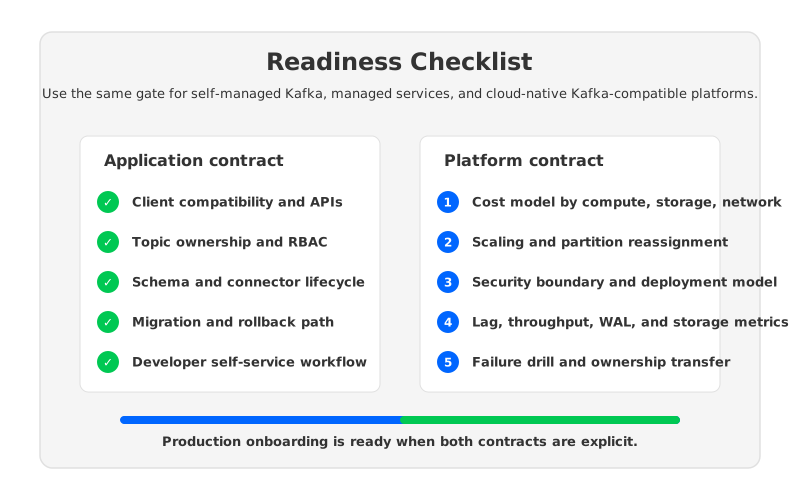
For migration, keep rollback visible. A clean onboarding path defines the source cluster, target platform, synchronization behavior, producer cutover, consumer offset verification, and rollback point before data moves. The most dangerous migration plan is one that treats cutover as a single calendar event. The safer plan treats cutover as a sequence of verified checkpoints: data is synchronized, consumers can resume, producers can switch, lag is understood, and the old path remains available until the target platform has earned production trust.
7FAQ
7.1What should a developer onboarding Kafka checklist include?
It should include client compatibility, topic ownership, access control, schema policy, Consumer group behavior, offset handling, observability, failure drills, migration steps, and rollback criteria. A checklist that stops at producing and consuming messages is useful for learning, but not enough for production onboarding.
7.2Is a Kafka-compatible platform the same as Apache Kafka?
No. A Kafka-compatible platform should preserve the Kafka client contract that applications rely on, but the storage, scaling, deployment, and operations model may differ. That is why teams should validate protocol behavior and operational behavior separately.
7.3When should teams consider Shared Storage architecture?
Shared Storage architecture is worth evaluating when broker-local storage creates friction around retention, scaling, partition reassignment, or cloud cost visibility. It is especially relevant when teams want Kafka-compatible behavior while reducing the operational coupling between retained data and broker capacity.
7.4How does AutoMQ fit developer onboarding?
AutoMQ fits when a team wants Kafka-compatible APIs with a cloud-native operating model. Its Shared Storage architecture, stateless brokers, Console, Terraform workflows, Self-Balancing, observability, and migration tooling can help platform teams expose a cleaner production path to developers.
7.5What is the first step for evaluating AutoMQ?
Start with a representative application workload and a platform checklist. Validate client behavior, topic configuration, metrics, scaling operations, and migration assumptions before expanding to more teams. To explore the platform, visit the AutoMQ getting-started path.


