
Table of Contents
Table of Contents
A search for developer topic workflow kafka usually starts after the platform team has already felt the pain. Developers want to create a topic, change retention, test a schema, reset a consumer group, or move a service from staging to production without filing a ticket for every small change. The platform team wants the same outcome, but it also has to protect cluster capacity, access boundaries, naming conventions, cost controls, and recovery paths.
The tension is not really about the topic creation command. Kafka already has admin APIs, CLIs, ACLs, quotas, consumer groups, and a long ecosystem of tools. The hard part is turning those primitives into a workflow that lets application teams move quickly without converting every topic into an untracked production liability.
1Why Teams Search for developer topic workflow kafka
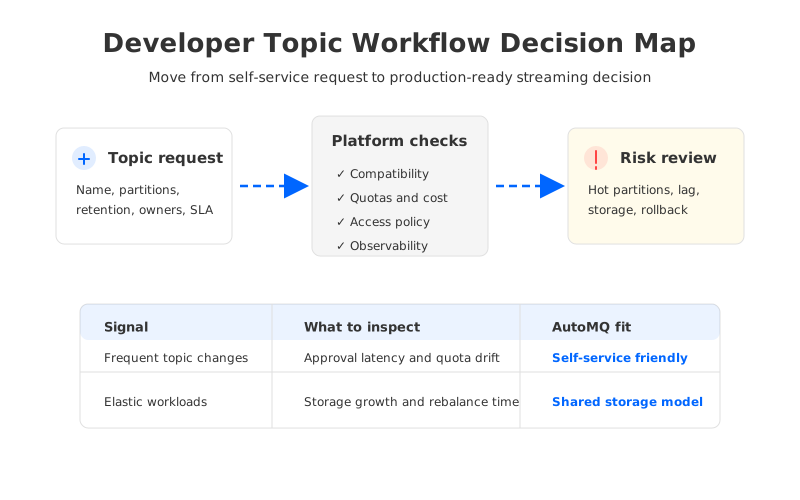
Topic workflows become visible when Kafka moves from a specialist-operated service to a shared internal platform. At a smaller scale, a Kafka administrator can review each topic request by hand. The request often fits inside a Slack thread: topic name, partition count, retention, expected throughput, owner, and whether the topic contains sensitive data. Once many product teams depend on the same streaming platform, that informal review path becomes slow and inconsistent.
The typical developer request is deceptively simple: "I need a topic for this service." Behind that request are decisions with production consequences. Partition count affects parallelism and file handles. Retention changes storage growth. Compaction changes recovery behavior. ACLs decide who can publish, consume, and administer the topic. Consumer group behavior determines whether a deployment can replay safely after a bug. Kafka Connect jobs add another boundary because a topic might be fed by a database CDC stream or drained into a warehouse.
The platform team is therefore designing a contract, not a form. A useful workflow has to answer four questions before the topic exists: who owns it, how it behaves under load, what it costs to retain, and how the system should recover.
2The Production Constraint Behind the Problem
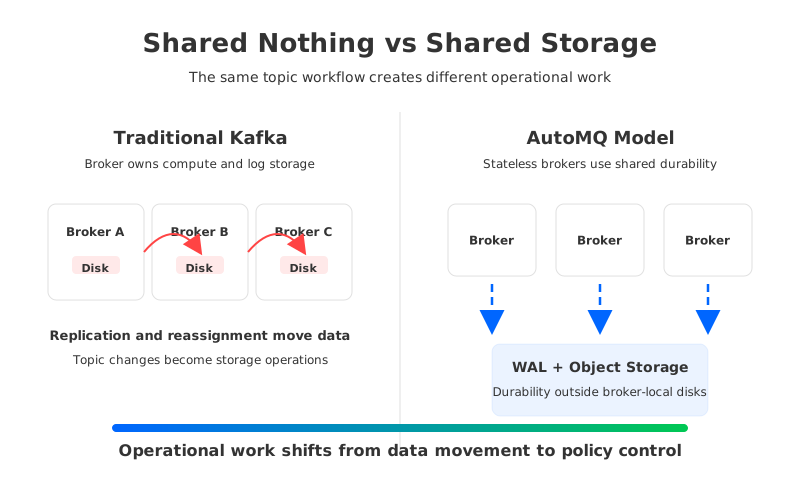
Traditional Kafka was built around a shared-nothing broker model. Each broker owns local log segments, replicas are assigned to brokers, and durability is achieved by replicating data across brokers. This model is well understood and proven, but it shapes every topic workflow. A new topic is not only metadata; it is also future disk growth, replica placement, network traffic, leader movement, and eventually partition reassignment.
That architectural fact is easy to hide from developers and hard to hide from SREs. When a self-service portal accepts a large retention setting, somebody has to know whether the cluster has enough storage headroom. When a team doubles partitions for parallelism, somebody has to know whether broker balance, controller load, and client behavior still look healthy. When a service with bursty traffic lands on a shared cluster, somebody has to decide whether quotas protect other tenants.
The constraint gets sharper in cloud environments because storage, network, and operational time are billed or constrained through separate systems. Broker-local storage usually needs to be provisioned before demand arrives. Cross-AZ replication can increase network cost. Scaling out compute can trigger partition movement rather than only adding CPU and network capacity.
3Architecture Options and Trade-Offs
A platform team usually has three practical options for developer-facing Kafka topic workflows. The first is to keep Kafka operations centralized and expose a request form. This is operationally conservative, but it does not scale well when teams expect infrastructure changes to follow the pace of application deployments. The second is to build a self-service layer over existing Kafka clusters with templates, policy checks, and GitOps. This improves consistency, but it inherits the cluster's underlying storage and scaling behavior. The third is to evaluate Kafka-compatible streaming infrastructure whose operating model reduces the amount of broker-local work behind each workflow action.
The trade-off is not "manual versus automated." It is "which risks are automated, and which risks are removed by architecture." A GitOps workflow can enforce naming rules, owner labels, retention limits, and ACL patterns. It cannot make broker-local disks independent from retention growth, remove catch-up read planning, or make a stateful broker behave like a stateless service.
Platform teams should separate workflow concerns into layers:
- The developer layer defines the request: topic intent, service ownership, environment, data classification, expected throughput, retention, compaction, and consumer behavior.
- The policy layer validates the request: naming, access, quotas, partition limits, allowed retention, required schema rules, and approval routing for sensitive data.
- The infrastructure layer absorbs the request: storage growth, broker placement, balancing, network path, observability, and recovery behavior.
- The migration layer handles change over time: data replication, client cutover, consumer offsets, rollback, and deletion after validation.
4Evaluation Checklist for Platform Teams
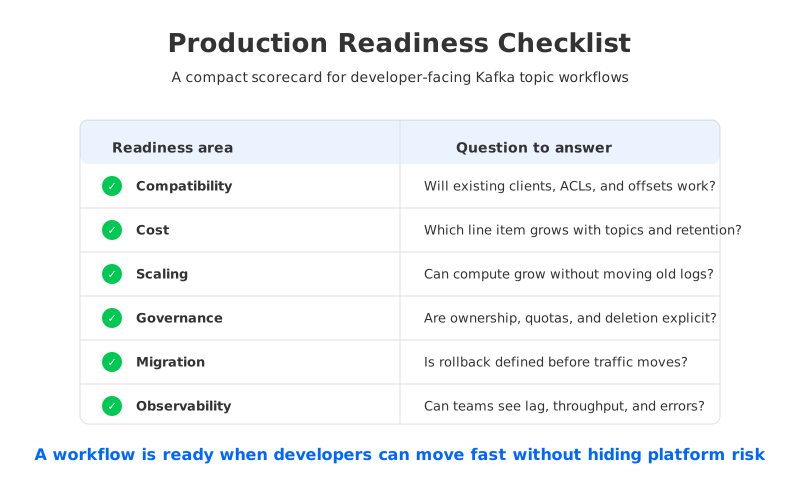
A strong topic workflow starts with compatibility because developer productivity depends on existing Kafka knowledge continuing to work. Kafka's official documentation covers the core primitives teams rely on, including producers, consumers, consumer groups, offsets, transactions, Kafka Connect, KRaft, and configuration behavior. A Kafka-compatible platform should preserve those semantics; otherwise, self-service becomes a migration project disguised as a workflow project.
Compatibility is only the first gate. The deeper evaluation is whether the workflow protects the production system without turning every request into a committee decision. A useful scorecard should inspect the request path, the runtime path, and the rollback path together.
| Evaluation area | What to ask | Why it matters |
|---|---|---|
| Kafka compatibility | Will current clients, ACLs, offsets, and consumer group behavior remain valid? | Developers should not rewrite applications to use a topic workflow. |
| Cost model | Which cost line grows with partitions, retention, replication, and cross-AZ traffic? | A self-service system can create cost faster than humans can review it. |
| Elasticity | Can compute capacity change without moving large volumes of historical log data? | Bursty workloads need capacity changes that do not create long rebalance windows. |
| Governance | Are ownership, deletion, data classification, and quota rules explicit? | Platform teams need traceability when a topic outlives its first service. |
| Recovery | Can the team replay, reset offsets, fail over, and roll back a bad deployment? | Topic workflows are part of incident response, not only provisioning. |
| Observability | Can developers see throughput, lag, errors, and policy violations? | Self-service without visibility only moves tickets from create-time to incident-time. |
The cost column deserves special attention in cloud deployments. AWS documents separate pricing surfaces for services such as S3 and PrivateLink, and every cloud has its own network and storage billing model. A platform workflow should expose the cost drivers developers can influence: retention, partition count, fan-out, connector frequency, and data locality.
5How AutoMQ Changes the Operating Model
Once the workflow has been evaluated in neutral terms, the architecture question becomes clearer. If the most expensive operational work comes from the broker owning both compute and durable log storage, then a useful platform should reduce that coupling while preserving Kafka semantics. AutoMQ fits into that category: it is a Kafka-compatible streaming platform that uses a shared storage architecture with object storage and stateless brokers.
That design changes the infrastructure layer behind a topic workflow. In a traditional broker-local model, scaling and balancing often mean moving data between brokers. In a shared storage model, durable data lives outside the broker's local disk, while brokers serve the Kafka protocol and handle compute-side work. AutoMQ's documentation describes S3Stream shared streaming storage, WAL storage options, stateless brokers, Kafka compatibility, and cross-zone traffic optimization as parts of that design.
The practical effect is not that governance disappears. Topic ownership, quotas, ACLs, retention, schemas, and observability still matter. The difference is that more workflow actions can be treated as policy decisions instead of data movement projects. When compute and storage scale independently, the platform team can design templates around application intent instead of constantly asking how much broker-local disk has already been consumed.
This matters for self-service because the platform's failure mode changes. In a tightly coupled system, a successful developer workflow can still produce slow operational debt: too much retained data on the wrong brokers, reassignments that compete with production traffic, or capacity reserved for peaks that rarely arrive. With shared storage and stateless brokers, the platform has a cleaner boundary between request policy and the capacity plane.
6A Practical Workflow Blueprint
A production-ready developer topic workflow can be built as a small platform product. It should have a request schema, a policy engine, an infrastructure adapter, and a feedback loop. The request schema captures the developer-facing contract. The policy engine decides which requests are safe by default and which require review. The feedback loop gives developers and platform engineers visibility after the topic is created.
The request should stay short enough that developers will use it, but strict enough that the platform can reason about it. A good schema includes service owner, environment, topic name, data class, expected write rate, expected read fan-out, retention, compaction setting, partition target, schema requirement, and deletion policy. The workflow can infer many defaults from service tier and environment. Production topics should carry stronger defaults than development topics because the blast radius is different.
The infrastructure adapter is where architecture shows through. On broker-local Kafka, the adapter may need to check disk headroom, partition balance, and expected reassignment impact before approving a request. On a shared storage architecture, those checks shift toward throughput, object storage configuration, WAL choice, and policy boundaries. The API exposed to developers may look similar, but the operational checks behind it become less dominated by local disk placement.
The feedback loop closes the workflow. Developers should be able to see whether producers are throttled, consumers are lagging, schemas are failing, or retention is growing faster than expected. Platform engineers should be able to find ownerless topics, unused topics, topics near policy limits, and topics with abnormal traffic. Without this loop, self-service becomes one-way provisioning.
7Migration and Rollback Readiness
Many platform teams introduce self-service while also migrating from one Kafka environment to another. That raises the bar because a topic workflow has to support both steady-state operations and cutover operations. Migration is not finished when a topic exists on the target platform. It is finished when producers, consumers, offsets, connectors, ACLs, observability, and rollback rules are all accounted for.
The minimum readiness checklist is straightforward:
- Producers have a cutover plan, including bootstrap server changes and a rollback window.
- Consumers have offset handling rules, including whether replay is acceptable.
- Connectors and CDC jobs have ownership, lag monitoring, and restart procedures.
- ACLs and service identities are generated or migrated consistently.
- Observability dashboards compare source and target throughput, lag, and errors.
- Deletion is delayed until rollback risk is closed and owners confirm the target path.
This is where Kafka compatibility matters again. The less application code changes, the more the migration can focus on infrastructure and operations. A Kafka-compatible target such as AutoMQ can reduce the application migration surface, but it does not remove the need for disciplined rollout. Compatibility lowers one class of risk; the workflow still has to manage human ownership and production timing.
8Decision Matrix: When the Workflow Is Ready
A developer topic workflow is ready when application teams can request common changes without waiting on a human operator, and platform teams can still enforce the rules that protect the shared system. That is a higher bar than "we have a portal." The workflow needs to make correct defaults easy, risky requests visible, and operational consequences measurable.
Use this decision matrix before rolling out self-service broadly:
| Signal | Green path | Review path |
|---|---|---|
| Topic purpose | Owner, service, and environment are known | Shared ownership or unclear lifecycle |
| Data sensitivity | Approved class with generated ACLs | Regulated data or unusual access pattern |
| Retention | Within standard template | Long retention or compaction with recovery impact |
| Traffic | Within quota and capacity profile | High fan-out, bursty writes, or hot partition risk |
| Migration | No client cutover required | Producer or consumer migration required |
| Recovery | Replay and offset behavior documented | Rollback depends on manual reconstruction |
For teams evaluating Kafka-compatible infrastructure as part of this work, AutoMQ is worth reviewing when the pain is tied to cloud elasticity, storage growth, cross-zone traffic, or operational effort around broker-local data. Start with the architecture overview and WAL storage documentation, then map those design choices against your own request schema and policy checks. A natural next step is to review the AutoMQ overview with your platform requirements in hand: Explore AutoMQ's Kafka-compatible architecture.
9References
- Apache Kafka Documentation: https://kafka.apache.org/documentation/
- Apache Kafka Consumer Configurations: https://kafka.apache.org/documentation/#consumerconfigs
- Apache Kafka Connect Documentation: https://kafka.apache.org/documentation/#connect
- Apache Kafka KRaft Documentation: https://kafka.apache.org/documentation/#kraft
- AWS Amazon S3 User Guide: https://docs.aws.amazon.com/AmazonS3/latest/userguide/Welcome.html
- AWS PrivateLink Pricing: https://aws.amazon.com/privatelink/pricing/
- AutoMQ Overview: https://docs.automq.com/automq/what-is-automq/overview?utm_source=blog&utm_medium=reference&utm_campaign=rpb-0123-developer-topic-workflows
- AutoMQ WAL Storage: https://docs.automq.com/automq/architecture/s3stream-shared-streaming-storage/wal-storage?utm_source=blog&utm_medium=reference&utm_campaign=rpb-0123-developer-topic-workflows
- AutoMQ Shared Storage Architecture Overview: https://docs.automq.com/automq/architecture/overview?utm_source=blog&utm_medium=reference&utm_campaign=rpb-0123-developer-topic-workflows
- AutoMQ Cross-Zone Traffic Overview: https://docs.automq.com/automq/eliminate-inter-zone-traffics/overview?utm_source=blog&utm_medium=reference&utm_campaign=rpb-0123-developer-topic-workflows
10FAQ
10.1What is a developer topic workflow in Kafka?
A developer topic workflow is the process that lets application teams request, create, modify, observe, and retire Kafka topics through approved platform rules. It usually includes naming, ownership, partitions, retention, ACLs, quotas, schema expectations, observability, and deletion policy.
10.2Is a self-service topic workflow only a UI problem?
No. A UI can improve the request path, but the hard work sits behind it. The workflow must validate policy, protect capacity, apply Kafka changes safely, expose metrics, and support recovery. The underlying Kafka architecture decides how much operational work each approved request creates.
10.3Why does broker-local storage matter for topic workflows?
Broker-local storage ties topic growth to disk placement, replica movement, and broker balance. When developers create topics or change retention, the platform team has to consider local storage headroom and reassignment impact. That coupling can limit how far self-service can go.
10.4How does shared storage help?
Shared storage moves durable log storage away from broker-local disks. In AutoMQ's model, stateless brokers serve Kafka-compatible workloads while WAL and object storage provide durability. That separation can make scaling, balancing, and topic growth less dependent on moving historical data between brokers.
10.5Should every topic request be fully automated?
No. Low-risk, standard requests should be automated with templates and guardrails. Requests involving sensitive data, unusual retention, high throughput, migration, or unclear ownership should move through a review path. Good self-service makes that distinction explicit.
10.6What should teams check before migrating topic workflows to a Kafka-compatible platform?
Check client compatibility, consumer group behavior, ACL mapping, offset handling, connector ownership, observability, rollback steps, data retention, and cost drivers. A Kafka-compatible platform can reduce application changes, but production migration still needs a controlled workflow.


