
Table of Contents
Table of Contents
Kafka platform teams are searching for diskless kafka because the old cost and operations model is under pressure. A classic Kafka broker is both a request-processing node and a durable storage node. That design made sense when disks were attached to machines, replication traffic stayed within a data center budget, and scaling meant adding machines that carried both CPU and storage. In cloud environments, those assumptions break in specific ways: durable block storage is expensive to overprovision, cross-zone replication can become a recurring network charge, and broker recovery can be tied to how much local data needs to move.
The phrase "diskless Kafka" does not mean Kafka without any disk behavior. It means broker-local disks stop being the primary durable home for user data. Disks may still exist for cache, metadata, temporary staging, logs, or the operating system. The buyer question is more precise: can a Kafka-compatible system keep the semantics platform teams rely on while moving durable log storage toward shared object storage?
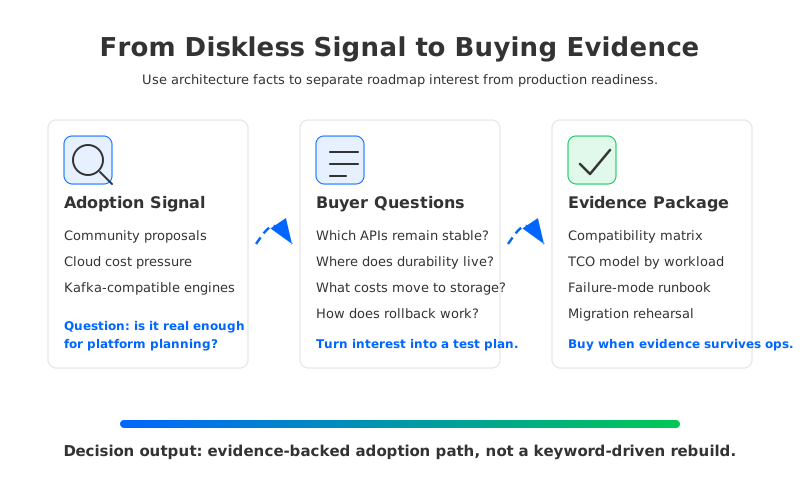
That question has moved from vendor positioning into mainstream Kafka architecture discussion. Apache Kafka KIP-1150, "Diskless Topics," is marked Accepted and describes a direction where topic data can be written through to remote storage while local broker storage becomes less central to durability. Acceptance of a KIP is not the same as a production feature being ready in every Kafka distribution, but it is strong evidence that the architectural pressure is real. Platform buyers should treat diskless Kafka as a decision category to evaluate, not as a single checkbox.
1Why Diskless Kafka Is a Buying Question
The first mistake is to frame diskless Kafka as a storage substitution: replace broker disks with object storage and call the project done. That hides the harder part. Kafka users care about ordering, offsets, consumer groups, idempotent producers, transactions, ACLs, observability, and operational predictability. Storage location matters because it changes the failure boundary behind those semantics, not because object storage is fashionable.
For buyers, the business case usually starts with one of four signals:
- Cloud network cost is no longer background noise. Multi-AZ Kafka designs replicate data across zones for durability and availability. On cloud providers that charge for cross-zone transfer, the write path can create a recurring line item before consumer traffic is counted.
- Local disk couples scaling decisions. A broker that owns durable log segments cannot be treated as a disposable compute unit. Rebalancing, replacement, and recovery all inherit the weight of the local data set.
- Retention growth punishes hot infrastructure. Teams often keep more data in Kafka for replay, audit, and pipeline recovery. Classic Kafka asks the broker fleet to carry that retention burden even when most data is not hot.
- Kafka-compatible alternatives changed the comparison set. Buyers are no longer choosing between self-managed Kafka and a hosted version of the same storage model. They are comparing the storage architecture itself.
That comparison is uncomfortable for platform teams because Kafka is rarely an isolated service. It sits behind fraud systems, CDC pipelines, Flink jobs, data lake ingestion, observability streams, and customer-facing workflows. A cost-saving architecture that breaks client compatibility or weakens operational control is not a saving. A diskless design earns attention when it changes cost and elasticity without forcing application teams to relearn the platform.
2Tiered Storage Is Related, but Not the Same Decision
Tiered Storage and diskless Kafka both involve remote storage, so they are often collapsed into one conversation. That shortcut causes bad architecture reviews. Tiered Storage moves older log segments away from broker-local disks after they are no longer active. It can reduce the cost of long retention and improve catch-up read behavior, but the active write path still depends on broker-local durable storage and replication.
Diskless Kafka changes the center of gravity. The durable write path is designed around shared storage, while broker disks become cache or short-lived staging rather than the system of record for user data. This distinction changes how teams evaluate broker replacement, partition movement, failure recovery, and cross-zone traffic. The same object storage bucket can appear in both designs, but the operational meaning is different.
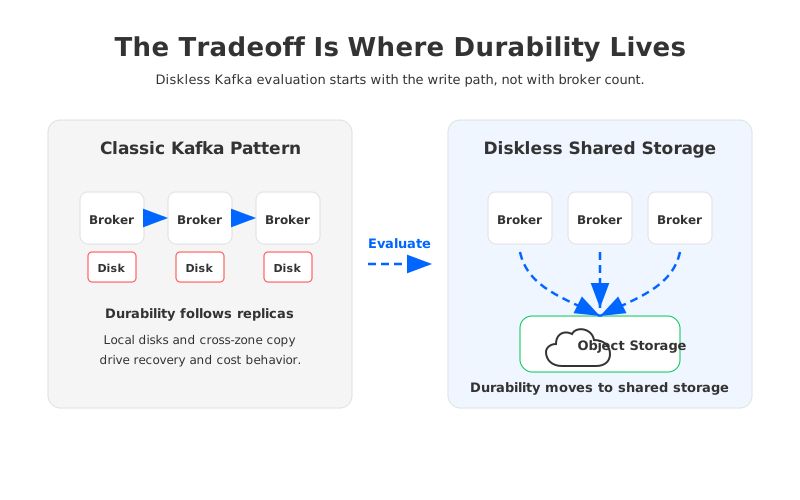
The tradeoff is latency and control. A diskless design must handle the latency profile of remote storage without pushing that latency directly onto every producer acknowledgment. It also needs a clear answer for metadata, batching, caching, compaction, and reads from lagging consumers. Buyers should ask where the system writes first, where it acknowledges durability, how it serves hot reads, and what happens when the broker that accepted a write disappears.
3What Counts as Adoption Evidence
Adoption evidence is not a slide that says "object storage-backed." It is a set of operational proofs that the platform can survive production conditions. For a Kafka buyer, the evidence should connect architecture to the behaviors the organization already depends on.
| Evidence area | What to ask for | Why it matters |
|---|---|---|
| Kafka semantics | Compatibility for producer acks, offsets, consumer groups, transactions, ACLs, and admin APIs | Application teams should not discover semantic gaps during migration. |
| Write durability | The exact path from produce request to durable storage and acknowledgment | The durability boundary is the heart of the diskless claim. |
| Read behavior | Tail reads, cache behavior, and catch-up reads from remote storage | Cost improvements can disappear if reads overload brokers or storage APIs. |
| Failure recovery | Broker loss, zone loss, object storage errors, and metadata recovery | The platform must be easier to operate under failure, not only lower cost at steady state. |
| Cost model | Compute, block storage, object storage, storage requests, and network transfer | A diskless design shifts costs; it does not remove the need for modeling. |
| Migration path | Dual running, topic movement, rollback, and client cutover | Buyers need a reversible path until workload evidence is complete. |
This table is intentionally evidence-oriented. A platform team does not need every workload to move at once. In many organizations, the first adoption target is a high-throughput topic with moderate latency requirements and expensive retention or replication behavior. The wrong first target is a low-latency control-plane topic whose risk profile dominates any infrastructure saving.
4Build the Cost Model Around Data Movement
Kafka cost discussions often start with broker instance type and storage size. Diskless Kafka forces the model to start with data movement. A write to a replicated Kafka topic can create multiple categories of infrastructure work: producer ingress, replication across brokers, local disk persistence, consumer reads, and background balancing. When replicas or clients cross zones, network pricing can become as important as storage pricing.
A better model separates the workload into five streams:
- Ingress volume: how much data producers write per second and how acknowledgments are configured.
- Replication or durability path: whether data is copied broker-to-broker, written to shared storage, or both during a transition period.
- Read fanout: how many consumer groups read the same data and whether they read locally, cross-zone, or from remote storage.
- Retention profile: how long data remains hot, warm, and rarely accessed.
- Operational churn: how often brokers scale, fail, rebalance, or catch up after maintenance.
This structure keeps the review honest. Object storage is often more cost-effective for durable retained data than block storage, but request patterns and read paths still matter. Network charges vary by provider and topology. Private connectivity, NAT, cross-region replication, and inter-zone routing can all change the result. The buyer should demand workload-specific numbers instead of accepting a universal percentage.
5The Production Readiness Scorecard
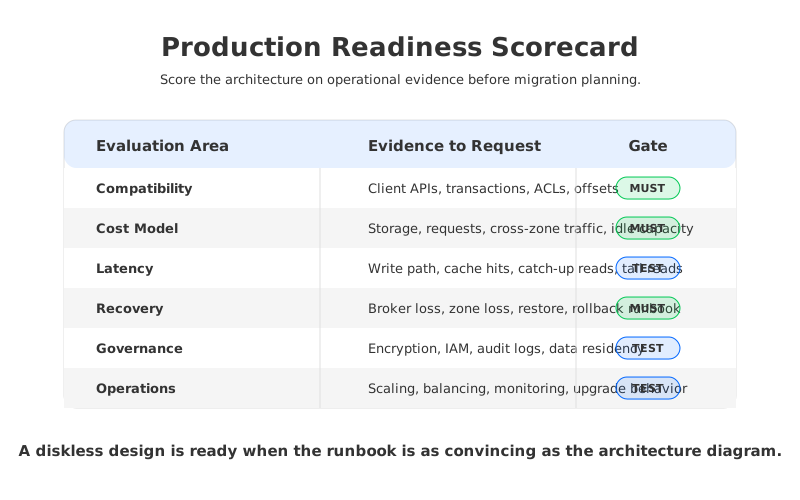
Once the cost case looks plausible, the review should move to a scorecard. Diskless Kafka is a platform decision, so the scorecard must include SRE, security, data governance, application owners, and FinOps. Each group sees a different failure mode. SRE worries about recovery and alerting. Security worries about object storage permissions and encryption. Application owners worry about client behavior. FinOps worries about cost shifting from one line item to another.
The highest-value questions are concrete:
- Compatibility: Which Kafka client versions, admin APIs, security features, and transactional behaviors have been tested? Which features are unsupported or have different limits?
- Latency: What are the tail-latency results for produce, consume, and catch-up reads under the buyer's workload shape? How does the system behave when the cache is cold?
- Recovery: How long does broker replacement take when durable data is not local? What manual steps are required during zone-level failure?
- Governance: Which cloud identities can read object storage data? How are encryption keys, audit logs, deletion policies, and retention controls handled?
- Operations: How do scaling, partition movement, upgrades, alerting, and capacity planning change when brokers are closer to stateless compute?
The scorecard should produce a go/no-go decision by workload class. For example, high-throughput analytics ingestion may pass earlier than a latency-sensitive payment authorization stream. That is not a weakness in the evaluation. It is how infrastructure adoption should work: by risk class, with evidence attached.
6How AutoMQ Fits This Evaluation
If the evaluation points toward a Kafka-compatible shared-storage architecture, AutoMQ is one system worth putting into the proof-of-concept set. AutoMQ keeps the Kafka protocol surface familiar while rebuilding the storage layer around S3-compatible object storage through its S3Stream architecture. Brokers are designed to be stateless with respect to durable user data, while WAL and cache layers absorb the low-latency write and read requirements that raw object storage cannot satisfy on its own.
The important point is not that AutoMQ uses object storage. Many systems can store bytes in object storage. The architectural question is whether the system can preserve Kafka-compatible behavior while reducing the operational weight of local broker disks. AutoMQ's evaluation areas map directly to the buyer scorecard: Kafka API compatibility, independent compute and storage scaling, fast broker replacement, self-balancing behavior, and reduced cross-zone traffic patterns when clients and brokers are configured with zone awareness.
For a serious evaluation, test AutoMQ the same way you would test any diskless Kafka candidate:
- Run existing Kafka clients and admin tooling against representative topics.
- Measure produce and consume latency under both tail-read and catch-up-read conditions.
- Model object storage, compute, and network costs with your own traffic shape.
- Simulate broker loss and zone routing changes during a controlled rehearsal.
- Validate observability, ACLs, encryption, and operational ownership before production cutover.
That sequence avoids product-led shortcuts. It also gives procurement and architecture review boards a cleaner artifact: a workload-specific decision record. The result may be that some topics stay on classic Kafka, some use Tiered Storage, and some move to a diskless Kafka-compatible platform. A mature platform strategy can contain all three.
If your team is evaluating diskless Kafka because local-disk operations and cloud traffic costs are starting to shape roadmap decisions, the next step is not a generic demo. Build a workload scorecard, pick one topic class, and run a migration rehearsal against a Kafka-compatible shared-storage system. AutoMQ can help with that evaluation through its technical docs and engineering review; start with AutoMQ contact when you have a representative workload profile.
7References
- Apache Kafka, KIP-1150: Diskless Topics: https://cwiki.apache.org/confluence/display/KAFKA/KIP-1150%3A%2BDiskless%2BTopics
- Apache Kafka documentation, Tiered Storage: https://kafka.apache.org/documentation/#tiered_storage
- AWS EC2 On-Demand Pricing, data transfer: https://aws.amazon.com/ec2/pricing/on-demand/#Data_Transfer
- AWS S3 Pricing: https://aws.amazon.com/s3/pricing/
- AutoMQ documentation, Compatibility with Apache Kafka: https://docs.automq.com/automq/what-is-automq/compatibility-with-apache-kafka?utm_source=blog&utm_medium=reference&utm_campaign=gs100-0001
- AutoMQ documentation, S3Stream Shared Streaming Storage: https://docs.automq.com/automq/architecture/s3stream-shared-streaming-storage/overview?utm_source=blog&utm_medium=reference&utm_campaign=gs100-0001
- AutoMQ documentation, eliminating inter-zone traffic: https://docs.automq.com/automq/eliminate-inter-zone-traffics/overview?utm_source=blog&utm_medium=reference&utm_campaign=gs100-0001
8FAQ
8.1Does diskless Kafka mean brokers have no disks?
No. In practical architectures, brokers may still use disks for cache, logs, temporary staging, operating system storage, and metadata-related functions. The meaningful change is that broker-local disks are no longer the primary durable storage layer for user topic data.
8.2Is diskless Kafka the same as Tiered Storage?
No. Tiered Storage moves inactive log segments to remote storage while the active write path still depends on local broker durability. Diskless Kafka shifts the durable write path toward shared storage, which changes recovery, scaling, and cost behavior.
8.3Is Apache Kafka KIP-1150 production-ready?
KIP-1150 is marked Accepted, which means the community accepted the direction and requirements. Production readiness depends on implementation work, follow-up KIPs, distribution support, and workload testing. Buyers should treat it as architecture evidence rather than an immediate production switch.
8.4Which workloads are strong candidates for diskless Kafka evaluation?
High-throughput topics with meaningful retention, expensive replication behavior, or frequent scaling pain are strong first candidates. Ultra-low-latency control-plane topics should be tested later unless the candidate system has already proven the required latency envelope under comparable load.
8.5How should a team compare AutoMQ with classic Kafka?
Use the same workload, clients, security model, retention policy, and failure drills. Compare compatibility, latency, recovery, cost, scaling, and operational effort. AutoMQ should win the evaluation through measured behavior in your environment, not through an architecture claim alone.


