
Table of Contents
Table of Contents
Diskless Kafka sounds like a clean architectural promise: keep the Kafka API, stop treating broker-local disks as the center of durability, and let cloud object storage absorb the long-term data footprint. For teams operating large Kafka estates, that promise is attractive because the most expensive operational work often begins when storage and compute are tied together. Scaling brokers triggers partition movement. Replacing failed brokers triggers replica catch-up. Extending retention raises disk planning questions. Multi-AZ durability multiplies data movement.
WarpStream made this architecture category visible by pushing a Kafka-compatible, object-storage-first model with stateless agents and no local disks in the hot path. Confluent's September 2024 acquisition of WarpStream also made the category harder to ignore: diskless streaming is no longer a niche experiment, but a mainstream design direction for cloud Kafka workloads. Still, "diskless" is a label, not a complete architecture review. Two systems can remove broker-local disks while making very different choices about write durability, metadata, recovery, read latency, and object storage API behavior.
The right question is not "Which product says diskless?" It is "Which failure and latency model can this workload trust?"
1What "Diskless Kafka" Really Means
Traditional Apache Kafka stores partition logs on broker disks and uses replication across brokers for durability and availability. Kafka documentation describes a replicated log where partitions have leaders, followers, in-sync replicas, and committed messages. That model is battle-tested, but it also couples compute placement, local storage capacity, broker failure recovery, and partition reassignment. When the local disk is the durable data plane, broker lifecycle operations tend to become data movement operations.
Diskless Kafka architectures try to break that coupling. The durable copy moves to cloud object storage or another shared storage layer, while brokers, agents, or compute nodes become easier to replace. In the strongest version of the idea, losing a compute node should not mean copying large partition replicas from other compute nodes before the workload is healthy again.
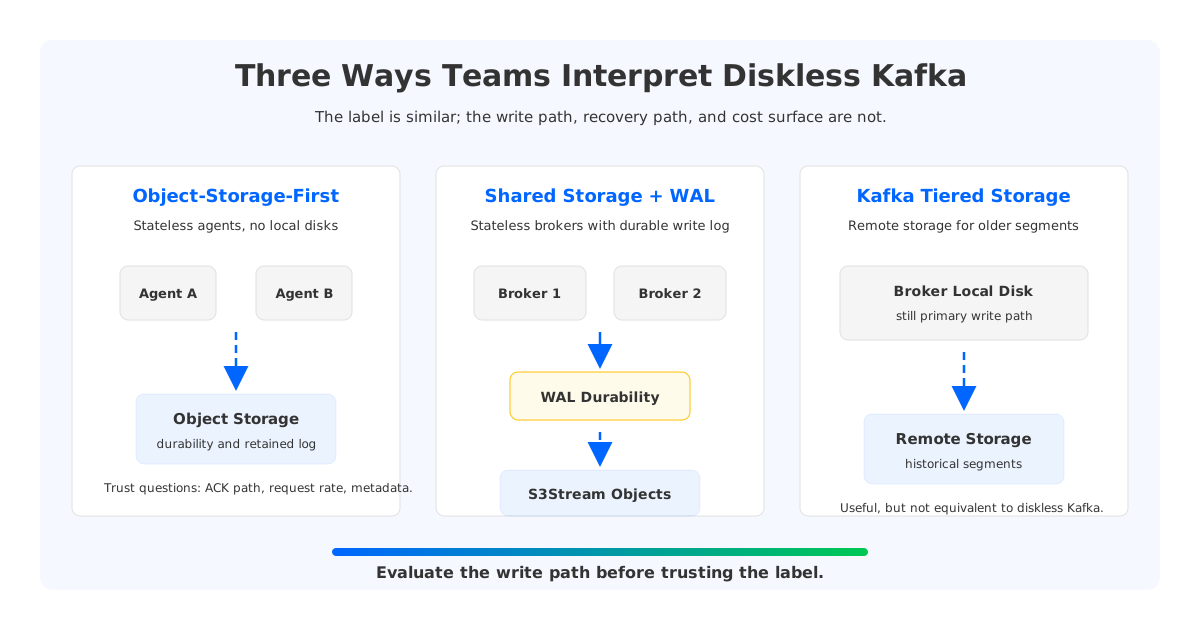
That does not mean every diskless design has the same behavior. A useful evaluation separates three related but different patterns:
| Pattern | What changes | What still needs scrutiny |
|---|---|---|
| Object-storage-first agents | Agents serve the Kafka protocol and persist data directly through object storage-oriented paths | Write acknowledgment path, object request amplification, metadata availability, tail latency |
| Shared storage with WAL | Brokers are stateless for long-term data, while a write-ahead log absorbs low-latency durability before object compaction | WAL failure domain, object flush behavior, read-after-write path, operational ownership |
| Tiered storage | Kafka keeps local broker storage for hot data and moves older segments to remote storage | Local disk remains part of the primary write path, so it is not the same as diskless Kafka |
The third row is a common source of confusion. Apache Kafka tiered storage, introduced through KIP-405 and documented in Apache Kafka, can reduce pressure on broker disks for older log segments. It is valuable, especially for long retention and faster reassignment of historical data. But it does not remove broker-local storage from the primary write path. If the search intent is "Kafka without local disks," tiered storage belongs in the comparison as a migration option, not as an equivalent architecture.
2Architecture Patterns to Compare
WarpStream's official architecture documentation describes a model with stateless agents and object storage as the backing store. In practical evaluation terms, that means the data plane is designed around removing disks from the agents and using cloud infrastructure primitives for durable storage. The appeal is operational: agents can be replaced, scaled, or rescheduled without treating each one as a holder of unique partition data.
The first design question is the write path. When a producer receives an acknowledgment, what durable systems have accepted the write? Is the acknowledgment tied to object storage completion, a quorum, a metadata commit, a local buffer, or a WAL? Object storage durability is strong, but object APIs have different latency and request-cost characteristics from local SSDs. A diskless system must bridge that gap deliberately.
The second design question is the read path. Tail reads, catch-up reads, and replay reads are not the same workload. Tail reads care about fresh data latency. Catch-up reads care about how efficiently a consumer can read a backlog without disturbing current traffic. Replay reads care about large historical scans, often after an incident, deployment rollback, or downstream rebuild. A system can look excellent under steady tail consumption and still surprise operators during catch-up or replay.
The third design question is metadata. In Kafka, metadata is not decorative. Partition leadership, topic configuration, offsets, group coordination, and cluster membership shape client behavior. If brokers or agents become stateless, the metadata layer becomes more important, not less. A design review should ask where metadata lives, how it is replicated, how it recovers, and what happens to producers and consumers when metadata is degraded.
AutoMQ sits in the shared-storage, Kafka-compatible branch of this design space. Its documentation describes a shared storage architecture, stateless brokers, S3Stream, and configurable WAL storage. The relevant point is not that every diskless alternative should look like AutoMQ. It is that WAL plus object storage is a different trust model from an object-storage-only mental model: the evaluator should look at how the WAL absorbs write latency, how data is organized into object storage, and how broker recovery avoids bulk local-disk reconstruction.
3Failure Recovery Is the Real Architecture Test
Most proof-of-concept tests over-index on the happy path: produce records, consume records, watch latency, maybe scale a node group. That is useful, but it does not expose the reason teams search for diskless Kafka in the first place. The hard promise is operational resilience when the cluster changes shape.
Run the failure review as a sequence, not a feature checklist:
- A compute node disappears during sustained writes.
- Producers continue writing with idempotence and acknowledgments configured as they would be in production.
- Consumers include one tailing group and one lagging group.
- Replacement capacity joins in another zone.
- The system must restore balance without a large partition-copy event.
In traditional Kafka, the recovery path is shaped by replica state and broker-local logs. In a diskless or shared-storage system, the recovery path should be shaped more by metadata and compute assignment. But "should" is not enough. Measure the time to restore write capacity, the time for lagging consumers to stabilize, the object storage request pattern during recovery, and the effect on unrelated partitions.
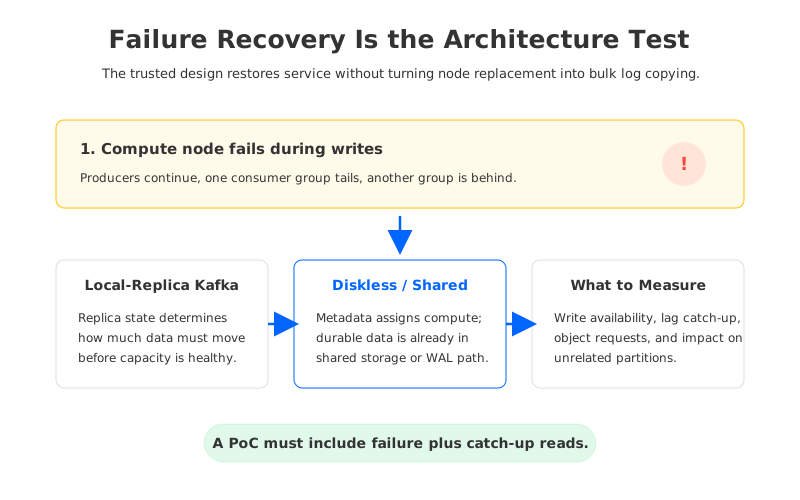
The most revealing test is often catch-up read after failure. A broker-local Kafka cluster can create heavy disk and network pressure when consumers read old data while the cluster is also rebalancing. A diskless architecture may reduce the broker reconstruction burden, but it may move pressure to object storage reads, cache behavior, request rate limits, or network paths. That is not a flaw by itself. It is the tradeoff you need to quantify.
4Latency and Cost Are Coupled
Diskless Kafka evaluation often separates latency and cost into different workstreams. That separation is convenient for org charts, but misleading for architecture. The system choices that reduce local disk ownership may increase object storage operations. The choices that reduce object request amplification may introduce buffering, batching, or WAL dependencies. The choices that improve catch-up read isolation may require cache capacity or specific object layouts.
Treat cost as a workload-derived model rather than a vendor line item. For each candidate, build the same worksheet:
- Average and peak write throughput, with compression ratio assumptions.
- Number of partitions, keys, and hot topics.
- Consumer fan-out, including tailing groups and replay-heavy groups.
- Retention split between hot access and rare historical access.
- Availability zone placement for producers, consumers, compute, metadata, and object storage access.
- Object storage capacity, request volume, data retrieval, and network paths.
- Operational cost for upgrades, scaling, incident response, and observability.
Cloud object storage services publish strong durability claims and detailed pricing dimensions, but those numbers do not automatically translate into low Kafka TCO. The decisive variable is how the streaming engine maps Kafka traffic into objects and requests. Small objects, frequent LIST operations, inefficient compaction, or poorly localized reads can erode the expected advantage. Conversely, an efficient object layout and predictable batching model can make long retention and large replay workloads much easier to operate.
This is why "no local disks" is a starting point. The architecture you can trust is the one whose latency budget and object-storage bill can be explained from first principles.
5Kafka Compatibility Needs More Than a Bootstrap Test
Most diskless Kafka alternatives expose Kafka-compatible endpoints because compatibility is the adoption bridge. Existing Kafka clients, Kafka Connect, Kafka Streams, schema tooling, and observability pipelines are too important to replace lightly. But a bootstrap-server smoke test proves little.
Compatibility should be tested across behavior that production clients actually depend on:
| Compatibility area | What to test |
|---|---|
| Producer semantics | idempotent producers, batching, retries, acks, transactions if required |
| Consumer groups | rebalances, offset commits, lag visibility, reset workflows |
| Admin APIs | topic creation, partition changes, configs, ACLs where applicable |
| Ecosystem tools | Kafka Connect, Flink, Debezium, schema registry integrations, Kafka UI tools |
| Observability | broker metrics, client metrics, logs, quotas, alert semantics |
Be especially careful with "Kafka-compatible" in procurement language. Some systems are protocol-compatible for common produce and consume paths but differ in administration, transactions, quotas, or operational metrics. That may be acceptable for a workload. It may even be preferable if the system removes operational burdens you no longer want. But the gap should be discovered in a PoC, not during migration week.
6A Practical Trust Framework
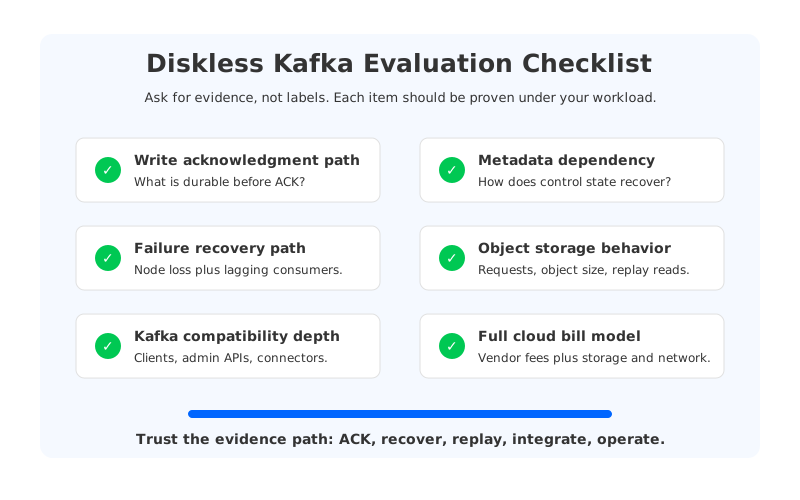
Use the following checklist to compare WarpStream, AutoMQ, tiered Kafka, and any other diskless Kafka alternative. The point is not to force every system into the same implementation. The point is to make the hidden trust assumptions visible.
| Question | Why it matters | Evidence to request |
|---|---|---|
| What accepts a write before acknowledgment? | Defines the real durability and latency contract | Write-path diagram, failure-mode test, producer config guidance |
| What happens when compute disappears? | Separates stateless recovery from replica rebuild | Node-loss test with producers and lagging consumers active |
| Where does metadata live? | Metadata failure can become the real control-plane outage | Metadata replication and recovery documentation |
| How are objects organized? | Object layout drives request cost and replay behavior | Object sizing model, compaction behavior, read amplification data |
| How complete is Kafka compatibility? | Migration risk often hides in edge APIs | Client, admin, connector, and stream-processing test matrix |
| Which costs move to the customer cloud bill? | BYOC and object storage shift the accounting boundary | Full bill-of-materials worksheet, not only vendor usage fees |
One useful rule: do not accept an architecture claim without a failure claim next to it. "Stateless agents" should be paired with a node-loss recovery measurement. "Object storage backed" should be paired with request-rate and replay-read behavior. "Kafka compatible" should be paired with the exact APIs and client configurations tested.
7Where AutoMQ Fits
AutoMQ is worth considering when the requirement is not merely "a WarpStream alternative," but a Kafka-compatible system that separates compute from storage while keeping a clear durability path through WAL and object storage. Its public documentation describes stateless brokers, S3Stream shared storage, WAL storage options, and Kafka protocol compatibility. In buyer terms, it belongs in the architecture category where brokers should scale and recover without treating local disks as durable partition homes.
That category can be a strong fit for teams that want Kafka compatibility, cloud object storage economics, and operational elasticity without moving every workload into a fully vendor-owned SaaS boundary. It still deserves the same scrutiny as any other candidate: test producer acknowledgments, metadata behavior, catch-up reads, connector compatibility, zone-local traffic, and object storage costs under your workload.
The healthiest evaluation posture is skeptical but specific. WarpStream, AutoMQ, and Kafka with tiered storage each solve a real problem, but they do not solve the same problem in the same way. If your pain is broker disk sizing and replica movement, diskless or shared-storage architectures deserve serious attention. If your pain is only long retention, tiered storage may be enough. If your pain is operational ownership, a managed service boundary may matter as much as the storage engine.
8References
- WarpStream Architecture
- Confluent: Confluent Acquires WarpStream
- Apache Kafka Documentation: Replication
- Apache Kafka Documentation: Tiered Storage
- AutoMQ Architecture Overview
- AutoMQ S3Stream Overview
- AutoMQ WAL Storage
- AutoMQ Stateless Broker
- Amazon S3 User Guide
9FAQ
9.1Is diskless Kafka the same as Kafka tiered storage?
No. Kafka tiered storage moves older log segments to remote storage, but broker-local storage remains part of the primary Kafka write path. Diskless Kafka or shared-storage Kafka designs aim to remove broker-local disks as durable partition homes.
9.2Is WarpStream still independent after the Confluent acquisition?
Confluent announced the acquisition of WarpStream on September 9, 2024. Buyers should evaluate the current packaging, support model, pricing, and product roadmap from Confluent's official materials before making a procurement decision.
9.3What is the main risk in diskless Kafka?
The main risk is assuming that removing local disks removes all operational complexity. It changes the complexity. You still need to validate write acknowledgments, metadata recovery, object storage request behavior, tail latency, catch-up reads, and Kafka compatibility.
9.4When should AutoMQ be compared with WarpStream?
Compare AutoMQ with WarpStream when you want a Kafka-compatible, object-storage-backed architecture and need to understand different durability and recovery models. AutoMQ's stateless broker, S3Stream, and WAL architecture place it in the shared-storage alternative category.
9.5What should a PoC include?
A useful PoC should include steady writes, tail reads, lagging consumers, node loss, replacement capacity, catch-up reads, connector tests, admin API tests, and a cloud bill model. A happy-path produce-consume benchmark is not enough for an architecture decision.


