
Table of Contents
Table of Contents
The main Diskless Kafka solutions in active evaluation include AutoMQ, Aiven Inkless, StreamNative Ursa for Kafka, and Redpanda's object-storage-based Cloud Topics architecture. Each belongs in a diskless kafka comparison because each tries to move retained Kafka data away from broker-attached disks and toward Kafka object storage. The similarity ends there. The hard question is no longer whether a platform can use S3 or object storage; it is where the platform puts write ownership, ordering, coordination, cache locality, and Kafka semantics.
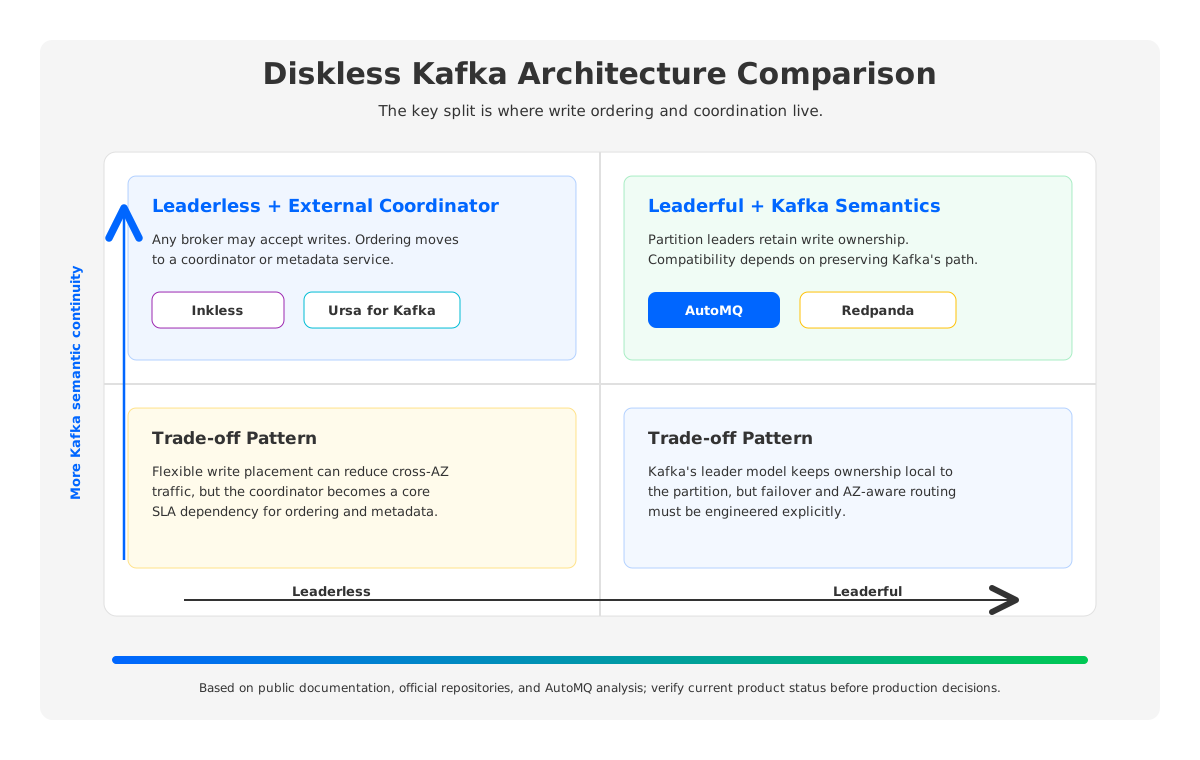
Cloud Kafka has a structural cost problem because Kafka's original storage model assumes local disks and broker-to-broker replication. In a cloud environment, that turns into provisioned disks, capacity headroom, replica traffic across availability zones, and slow operational loops when partitions need to move. Diskless Kafka solutions attack that problem by treating object storage as the durable data layer. That creates a different design space: leaderless platforms move write placement away from a fixed partition leader and rely on a coordination layer; leaderful platforms keep Kafka's leader ownership model and redesign the storage path underneath it.
1Definition Snippet: Diskless Kafka Platform, Leaderless Architecture, Leaderful Architecture
A Diskless Kafka platform is a Kafka-compatible streaming platform that stores retained topic data primarily in object storage or shared cloud storage rather than broker-attached disks. The broker may still use memory, local buffers, metadata logs, or a write-ahead log, but long-lived topic data no longer depends on a broker's local disk capacity.
A leaderless architecture allows any broker to accept writes or reads for partitions, while an external or internal metadata layer coordinates ordering, offsets, and batch locations. This can make write placement more flexible, but the coordinator becomes part of the core write path.
A leaderful architecture preserves Kafka's partition leader model. Each partition still has a broker leader responsible for write ownership and ordering. The storage layer can be diskless, but the Kafka mental model remains closer to the original protocol and operational contract.
2Leaderless vs Leaderful Diskless Kafka Architecture
Leaderless and leaderful are not maturity labels. They are placement choices for complexity. In a leaderless design, the system loosens the coupling between a partition and a broker so a producer can write through a more convenient broker, often in the same availability zone. That flexibility is useful when cross-AZ traffic is one of the largest costs in the bill. The price is that concurrent writes still need a single ordered truth, so the system introduces a coordinator, metadata service, or global ordering mechanism that every successful write must respect.
That trade-off changes the failure model. If the coordinator is slow or unavailable, the data plane may have brokers and object storage capacity available but still struggle to make progress. Transactions, idempotent producers, compaction, and Kafka Streams state stores also need to be rebuilt, mapped, or explicitly limited under the leaderless model. For high-throughput ingestion where the application mostly appends and scans, that may be acceptable. For teams that lean on Kafka's full semantic surface, it becomes a checklist item rather than an assumption.
Leaderful diskless systems make the opposite bet. They keep partition ownership with a broker leader and remove local disk from the retained data path. That tends to preserve Kafka semantics more naturally because the existing leader-based ordering path remains intact. It also avoids third-party metadata arbitration for every message, although the broker still needs a durable WAL or metadata path before acknowledging writes. The risk moves to leader failover: when a broker dies, the system waits for timeout detection, ownership transfer, and recovery. In many Kafka-style deployments that impact is seconds-level and can be around a 10-second order of magnitude depending on timeout configuration and implementation, so it should be treated as an operational parameter rather than a universal constant.
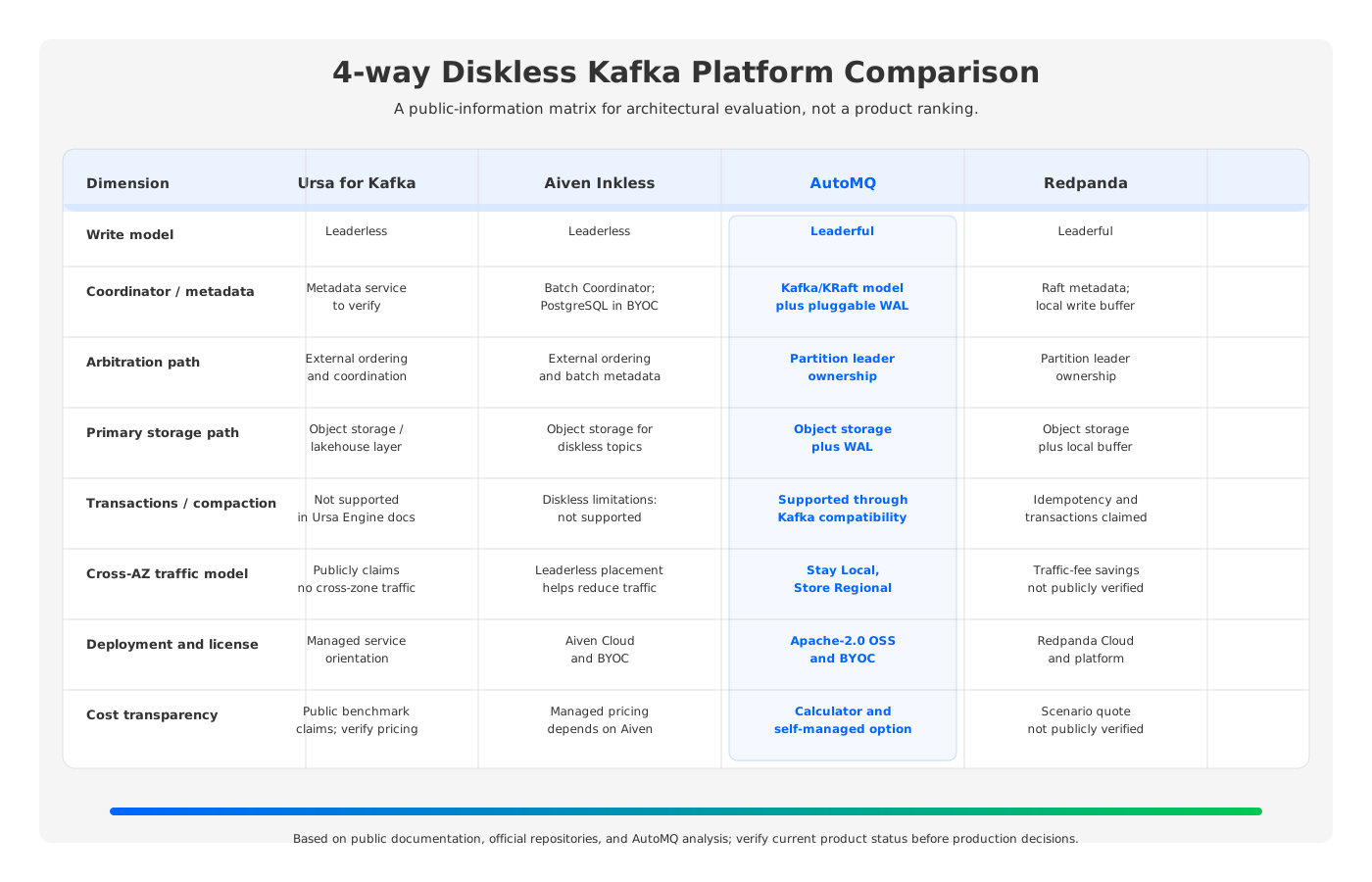
The cross-AZ point is especially important. Leaderless placement can make same-AZ writes easier, but leaderless design is not required to remove producer-side cross-AZ traffic. AutoMQ's approach, for example, keeps a leaderful Kafka model while using AZ-aware routing under the "Stay Local, Store Regional" design: producers connect to a broker in the same AZ, and the broker bridges to the owner while data durability is handled through shared cloud storage and WAL. Redpanda's Cloud Topics documentation focuses on object-storage-backed data and Raft metadata; public material does not establish the same producer-side traffic-fee model, so this article treats that point as not publicly verified for Redpanda.
3AutoMQ: Kafka-Compatible Diskless Storage With Leaderful Ownership
AutoMQ is built on the Apache Kafka codebase and redesigns the storage layer around object storage. Its public materials describe a Diskless Engine where Kafka's compute layer remains compatible while retained data moves into object storage through S3Stream and a pluggable WAL. That distinction matters: AutoMQ is not asking operators to separate "normal topics" from "diskless topics." All topics are diskless, so the architecture is not a side path bolted onto an existing disk-based cluster.
The write path is designed around a durable WAL before object storage compaction. For throughput-oriented workloads, AutoMQ can use an S3 WAL path. For lower-latency deployments, public AutoMQ materials describe alternatives such as Regional EBS WAL or NFS WAL, with data later compacted into object storage. The important point for a Kafka team is not the acronym attached to the WAL; it is that the platform avoids broker-attached retained storage while preserving the Kafka write ownership model.
This gives AutoMQ a clear architectural profile:
- Write ownership: Leaderful. The partition leader remains the owner of ordering and write acceptance.
- Coordination path: Kafka/KRaft-style metadata and a WAL, rather than a separate per-message ordering database.
- Kafka semantics: Transactions, compaction, idempotency, and Kafka protocol compatibility are part of the public compatibility story.
- Cross-AZ traffic: AutoMQ documents AZ-aware routing and "Stay Local, Store Regional" to avoid producer-side cross-AZ transfer in supported cloud deployments.
- Deployment model: Apache-2.0 open source code is available, with BYOC and managed operational models depending on customer needs.
This profile makes AutoMQ especially relevant for teams that want diskless economics without turning their Kafka migration into a semantic migration. The trade-off is also clear: AutoMQ keeps leader ownership, so it must handle leader failover like a Kafka-native system. For many production Kafka teams, that is a familiar operational risk. The attraction is that it is a familiar risk attached to a storage model that is no longer limited by broker disks.
4Aiven Inkless: Leaderless Diskless Topics With a Batch Coordinator
Aiven Inkless brings diskless topics into Kafka by introducing a leaderless data layer for those topics. Aiven's docs describe diskless topics where partitions do not have leaders in the traditional Kafka data path; brokers can read any diskless partition through object storage, and a Batch Coordinator assigns offsets, tracks batch locations, and preserves ordering. In Aiven BYOC deployments, the docs state that an Aiven for PostgreSQL service is created and required for diskless topics, which makes the coordinator dependency concrete rather than abstract.
That design has a strong reason to exist. If any broker can accept a write, a producer can avoid being routed across availability zones to reach a fixed partition leader. The result can be a simpler path to cross-AZ cost reduction, especially for append-heavy workloads. The leaderless model also fits the direction of multi-AZ and multi-region streaming architectures where compute placement should be more flexible than local disk placement ever allowed.
The limitation is Kafka semantics. Aiven's limitations page states that diskless topics do not support transactions, compacted topics, or Kafka Streams state stores, and that classic or tiered topics cannot be converted into diskless topics. That does not make Inkless uninteresting; it makes it specific. If the workload is log ingestion, analytics buffering, or high-throughput append and scan, those limitations may be manageable. If the workload uses transactional writes, compaction-heavy changelog topics, or Kafka Streams state, the evaluation has to include topic-by-topic migration planning.
Inkless therefore belongs in the leaderless side of the map. It shows how far Kafka can be stretched when the data layer is allowed to break away from leader ownership. It also shows why "diskless topics Kafka" is not a single feature checkbox. The term can mean "all topics keep Kafka semantics while storage changes," or it can mean "a subset of topics use a different data layer with explicit limitations."
5StreamNative Ursa for Kafka: Lakehouse-Native, Leaderless Streaming
StreamNative Ursa for Kafka is positioned around a lakehouse-native streaming engine that serves Kafka and Pulsar workloads on top of a shared storage architecture. StreamNative public materials emphasize no local disks, no replica data copies, and a leaderless storage architecture that routes data into object storage or a lakehouse layer. In that sense, Ursa belongs in the same broad diskless kafka platforms category as Inkless, but its framing is more lakehouse-native than Kafka-only.
The architectural upside is clear: if the retained data layer is shared and brokers do not own local replicas, scaling compute and retaining data become less coupled. That is attractive for teams whose streaming platform is converging with an analytics lakehouse. It also reduces the duplication between a hot streaming system and downstream storage. Kafka becomes one API over a broader storage substrate rather than a standalone durable system in the path.
The semantic trade-off needs careful reading. StreamNative's Kafka client docs include warnings that, for Ursa-Engine powered clusters, transactions and topic compaction are not supported. That puts Ursa in a similar evaluation bucket to other leaderless diskless systems: strong architectural potential for flexible placement and object-storage economics, paired with a need to validate Kafka feature coverage before migration. Some public discussions associate Ursa metadata with Oxia, but this article does not rely on that as a documented managed-service fact because official implementation details can change. The safer engineering question is the same regardless of the metadata backend: what component orders writes, how is it replicated, and what SLA does it add to the write path?
For a platform team, Ursa is most interesting when streaming is part of a broader lakehouse consolidation strategy. It may be less natural for a team that wants a minimal-change Kafka replacement with compacted topics and transactional producers already in production. That distinction is not about which design is more ambitious; it is about whether the target workload wants Kafka compatibility first or storage-system convergence first.
6Redpanda Cloud Topics: Object Storage With Raft Metadata
Redpanda's Cloud Topics architecture takes another path. Redpanda describes Cloud Topics as storing topic data primarily in object storage, with local storage used as a write buffer and metadata path. Its architecture posts explain that produce batches are accumulated and uploaded to object storage, while a placeholder batch containing data location metadata is replicated through the corresponding Raft log. Redpanda's topic properties also expose a cloud storage mode where topic data is stored using the Cloud Topics architecture and local storage is used only as a write buffer.
This makes Redpanda leaderful in the sense that it still relies on partition ownership and Raft metadata rather than a separate leaderless ordering coordinator for each write. That has a compatibility advantage. Redpanda's Cloud Topics architecture discussion says Cloud Topics inherit transaction and idempotency logic by reusing the normal produce path around placeholder batches. The result is not the same shape as AutoMQ, but it belongs on the same side of the leaderless-versus-leaderful split.
The open questions are operational rather than conceptual. Redpanda's public materials describe the write buffer, Raft metadata, L0 object files, and L1 reconciled files for historical reads. They also describe Cloud Topics as useful for relaxed-latency workloads and object-storage-backed retention. For this comparison, public sources do not provide a scenario pricing model comparable to the AutoMQ calculator, nor do they prove an AutoMQ-style same-AZ producer routing model for traffic-fee reduction. A buyer should ask Redpanda for Cloud Topics latency targets, feature support by topic type, cross-AZ transfer assumptions, and production pricing under their workload.
Redpanda is therefore not a pure local-disk Kafka design once Cloud Topics enters the picture. It is a leaderful streaming engine with object-storage-backed topics and a metadata path rooted in Raft. That makes it a useful comparison point because it shows that "Kafka without local disk" can still keep a leaderful control model.
7Kafka Transactions and Compaction Are Architecture Tests
Transactions and compaction are not edge features for many Kafka estates. Transactional producers are common in exactly-once processing pipelines, and compacted topics are the backbone of changelog, metadata, and state-store patterns. A diskless design that handles append-only topics well may still fail a migration if it cannot support these features.
The distinction is clearest in a feature matrix:
| Platform | Public status for transactions | Public status for compaction | How to interpret it |
|---|---|---|---|
| AutoMQ | Supported through Kafka compatibility | Supported through Kafka compatibility | Fits workloads that expect Kafka semantics across all topics. |
| Aiven Inkless | Not supported for diskless topics | Not supported for diskless topics | Stronger fit for append-heavy diskless topics than stateful Kafka workloads. |
| StreamNative Ursa for Kafka | Not supported in Ursa Engine docs | Not supported in Ursa Engine docs | Evaluate as a lakehouse-native streaming engine with Kafka API coverage limits. |
| Redpanda Cloud Topics | Public docs describe inherited transaction and idempotency logic | Current support should be verified by topic type | Promising leaderful path, but buyers should validate workload-specific semantics. |
This table is the reason architecture diagrams matter. If ordering is owned by a separate coordinator, features that depend on ordering, offsets, and log mutation need additional engineering. If ordering remains with a partition leader, the system can often reuse more of the Kafka path, but it still needs a durable diskless storage design that meets latency goals.
8Low-Latency Kafka on Object Storage Is Really a WAL Question
Object storage gives Kafka platforms a regional, elastic, low-administration storage layer. It does not magically turn every write into a low-latency write. The practical design question is what happens before data lands in object storage. A platform can acknowledge after object storage persistence, after a replicated WAL, after a metadata commit plus upload, or after a coordinator assigns offsets and records batch locations.
That is why "Kafka S3 low latency" comparisons often talk past each other. A throughput-oriented S3-only path may be excellent for log aggregation, analytics pipelines, and long retention. A financial eventing workload or user-facing event pipeline may need a faster WAL path. AutoMQ exposes this distinction directly through S3 WAL for cost efficiency and NFS or Regional EBS WAL options for lower latency. Redpanda exposes a local write buffer and Raft metadata path. Inkless and Ursa move the question toward coordinator latency, object-storage write behavior, and cache locality under leaderless placement.
Cache locality is easy to miss during a paper comparison. If any broker can handle any partition, the system has more placement freedom, but the hot buffer for a partition may be less stable unless the implementation pins or predicts access patterns well. If a leader owns the partition, cache locality is easier to reason about, but producers may need AZ-aware routing so the owner model does not recreate cross-AZ traffic. There is no free placement model; every design pays somewhere.
9TCO: Use Scenario Costs, Not Generic Claims
Cost is where diskless Kafka becomes concrete. Moving retained data to object storage reduces the need to overprovision broker disks and can reduce cross-AZ replica traffic. Yet a fair comparison must state workload assumptions. The numbers below come from the AutoMQ pricing calculator using AWS us-east-1, Multi-AZ, 2,000 partitions, pay-as-you-go AutoMQ BYOC pricing, and the same workload profile across products supported by the calculator. They compare cost structures for AutoMQ, Kafka, MSK, Confluent Cloud, and WarpStream; they are not a substitute for private quotes from Aiven, StreamNative, or Redpanda.
Large workload: 1,024 MiB/s writes, 3x read fanout, 7-day retention.
| Product | S3 WAL scenario | Low-latency WAL scenario |
|---|---|---|
| AutoMQ BYOC | $76,967.77/mo | $88,820.59/mo |
| WarpStream | $80,936.20/mo | $80,936.20/mo |
| AWS MSK Express | $266,234.88/mo | $266,234.88/mo |
| AWS MSK Standard | $571,105.20/mo | $571,105.20/mo |
| Apache Kafka self-managed | $576,423.12/mo | $576,423.12/mo |
Medium workload: 300 MiB/s writes, 2x read fanout, 72-hour retention.
| Product | S3 WAL scenario | Low-latency WAL scenario |
|---|---|---|
| AutoMQ BYOC | $21,804.35/mo | $25,026.31/mo |
| WarpStream | $24,160.90/mo | $24,160.90/mo |
| AWS MSK Express | $57,705.60/mo | $57,705.60/mo |
| AWS MSK Standard | $86,477.18/mo | $86,477.18/mo |
| Apache Kafka self-managed | $103,194.63/mo | $103,194.63/mo |
| Confluent Cloud | $123,328.05/mo | $123,328.05/mo |
The useful reading is not that one number decides every architecture decision. The useful reading is that diskless storage changes which parts of the bill scale with throughput and retention. Traditional Kafka and MSK Standard carry the weight of broker disks and cross-AZ replication. AutoMQ's S3 WAL scenario shows the lower-cost end of the design. Its low-latency WAL scenario adds cost for the lower-latency path, which is exactly the trade-off buyers should expect to see rather than having it hidden inside a generic claim.
10How to Shortlist Diskless Kafka Solutions
Start with workload semantics, not vendor names. A platform that looks excellent for append-heavy telemetry may be a poor match for compacted changelog topics. A platform that preserves Kafka semantics may still need cost and latency validation at your scale. The shortlist usually becomes clear when the questions are concrete:
- Do you need transactions, compaction, Kafka Streams state stores, or broad client compatibility? If yes, prioritize platforms that publicly support those semantics for diskless topics, then test failure recovery and latency.
- Is cross-AZ traffic one of the largest bill items? If yes, evaluate same-AZ producer routing, write placement, and whether the cost reduction applies to your producer and consumer topology.
- Are you consolidating streaming with a lakehouse? If yes, Ursa-style lakehouse-native architectures may deserve a deeper look even if some Kafka features need validation.
- Do you need all topics to be diskless, or only selected topics? Mixed classic and diskless topic models can be useful, but they also create migration boundaries.
- Do you want open source control over the implementation? AutoMQ's Apache-2.0 repository changes the risk profile for teams that want to inspect, run, or contribute to the storage engine.
For many Kafka teams, AutoMQ's argument is pragmatic: keep Kafka's leaderful semantics and client behavior, move retained data to object storage, and make cross-AZ traffic an architecture problem rather than an unavoidable replication tax. That does not erase the trade-offs. It narrows them to the ones Kafka teams already know how to reason about: leader failover, WAL latency, object storage durability, and operational automation.
11The Decision Is About Where Complexity Belongs
Diskless Kafka has become a multi-architecture market because the old broker-disk model is no longer the default answer for Kafka-compatible streaming. Inkless and Ursa show the leaderless path: flexible placement, object-storage economics, and a coordinator-centered write model. AutoMQ and Redpanda show the leaderful path: preserve partition ownership, redesign storage, and keep more of the Kafka mental model intact.
That split is more useful than a product ranking. If your workload is append-heavy and cross-AZ cost dominates, leaderless systems deserve attention, provided the coordinator and feature limits match your risk tolerance. If your workload depends on Kafka transactions, compaction, idempotency, and familiar migration behavior, leaderful diskless systems are usually the first place to test. The right diskless kafka solution is the one that puts complexity where your team can operate it.
For teams evaluating Kafka object storage architectures, AutoMQ is worth testing when the goal is to reduce cloud cost and disk operations while keeping Kafka semantics close to home. The architecture does not ask you to choose between diskless economics and Kafka compatibility as separate worlds. It treats them as the same engineering problem: durable ordering first, elastic storage underneath, and fewer places where local disks decide the shape of the cluster.
12Source Notes
- AutoMQ Diskless Engine
- AutoMQ pricing
- AutoMQ GitHub repository
- AutoMQ Kafka compatibility
- Aiven Inkless overview
- Aiven diskless topics architecture
- Aiven diskless topics limitations
- Aiven Inkless GitHub repository
- StreamNative Ursa
- StreamNative Ursa architecture deep dive
- StreamNative Kafka transactions documentation
- StreamNative compacted topic documentation
- Redpanda Cloud Topics architecture
- Redpanda Cloud Topics introduction
- Redpanda Cloud Topics GA in Redpanda Streaming 26.1
- Redpanda topic properties


