
Table of Contents
Table of Contents
Teams searching for diskless kafka architecture are rarely asking whether a broker can run with an empty filesystem. They are asking whether Kafka-style streaming can stop making broker-local disks the center of capacity planning, recovery, retention, and cloud cost. That is a more useful question because production Kafka is not a single storage feature. It is a bundle of responsibilities that grew around the broker: accepting writes, assigning offsets, storing partition logs, replicating data, serving reads, enforcing retention, coordinating consumer progress, and recovering after failure.
Diskless Kafka becomes interesting only when that bundle is separated carefully. Move too little and the cluster remains a traditional stateful Kafka deployment with remote archival. Move too much and the platform may preserve the shape of the Kafka API while changing important operational or semantic assumptions. The architecture work is therefore not "remove disks." It is deciding which responsibilities should stay close to the broker and which should move to durable shared infrastructure.
1Why Diskless Kafka Architecture Matters Now
Classic Kafka's shared-nothing design is elegant: each broker owns local partition replicas, leaders accept writes, followers replicate those writes, and consumers fetch from the log. Apache Kafka documentation describes this replicated log model as a core part of Kafka's design, where partitions are replicated across servers for fault tolerance. That model remains dependable, but cloud infrastructure changes the economics around it.
A broker-local log makes the broker both compute and storage. When throughput grows, teams add brokers, disks, and replica bandwidth. When retention grows, they provision more broker-attached storage or enable tiered storage. When a broker fails, the cluster still has to reason about replica catch-up, leadership, and local data placement. When the platform runs across availability zones, broker-to-broker replication and client placement become network design problems as well as reliability design problems.
Diskless architecture aims to reduce that coupling. Durable stream data moves from broker-attached disks into a shared storage layer, often object storage plus a write-ahead log. Brokers still speak the Kafka protocol, own request handling, and participate in metadata and partition ownership. But the long-lived bytes are no longer stranded on the broker instance that first accepted them.
That distinction matters for architects because it changes the unit of scaling. In traditional Kafka, adding compute also changes storage placement. In a diskless design, a broker can become closer to replaceable serving capacity while the durable log remains in shared storage. This can shorten recovery loops, reduce data movement during scaling, and make long retention less dependent on local disk sizing.
2What Stays in the Broker
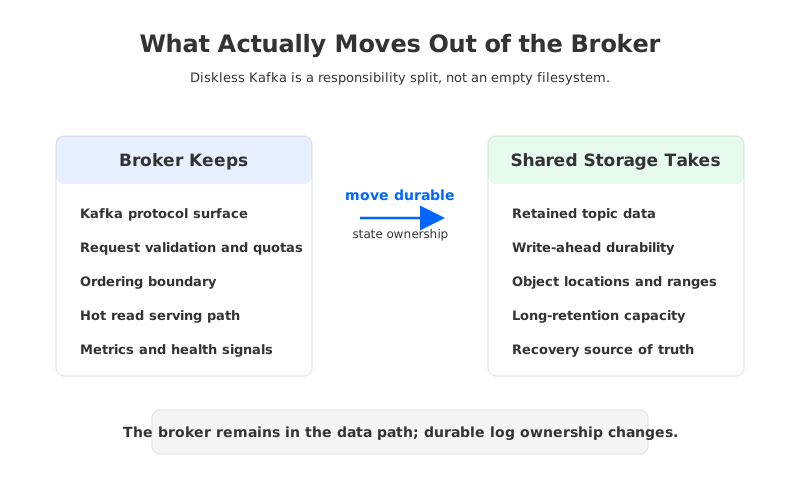
The broker does not disappear. In a Kafka-compatible system, the broker remains the API boundary for producers, consumers, and admin clients. It still needs to validate requests, enforce authorization, manage quotas, handle fetch sessions, serve committed data by offset, expose metrics, and coordinate with the cluster metadata layer. If the platform keeps Kafka's leaderful model, the broker also remains the partition leader for write ordering.
This is where some diskless diagrams become misleading. They draw brokers as blank stateless boxes and storage as a large durable bucket, but a production streaming system needs more than a bucket. The broker is still part of the latency path. It decides when a produce request can be acknowledged. It protects ordering. It maps client protocol behavior to the underlying storage system. It serves hot reads without forcing every consumer fetch to become a remote object request.
In practical terms, these responsibilities usually remain broker-side:
- Protocol surface: Kafka producer, consumer, admin, security, and observability interfaces.
- Request path: batching, validation, throttling, compression handling, fetch behavior, and connection management.
- Ordering boundary: partition leadership or an equivalent ordering mechanism.
- Hot serving path: cache-aware reads for tail consumers and catch-up consumers.
- Operational visibility: broker metrics, logs, health checks, and client-facing failure signals.
The point is not that brokers become unimportant. The point is that their durable storage burden changes. A broker can be important in the data path without being the permanent home of the data.
3What Moves Out of the Broker
The main responsibility that moves is durable ownership of retained topic data. In classic Kafka, a partition replica is a local log stored under broker log directories. In diskless Kafka, the source of truth moves to shared storage, while local broker resources become cache, buffers, or temporary recovery aids rather than the durable retained log.
The write path usually gains an explicit write-ahead log. A producer sends records to a broker. Before the broker acknowledges the write, the system must reach a durability boundary. That boundary may be a shared WAL, a cloud block or file service, object storage, or a storage service built for streaming writes. After that, data can be organized into objects or stream segments for long-term retention and later fetches. AutoMQ's S3Stream documentation, for example, describes data being written to WAL and then uploaded to S3 storage, with cache used to accelerate tailing and catch-up reads.
Metadata becomes more important as well. If retained data no longer lives in broker-local log segments, the platform needs accurate metadata for stream ranges, offsets, object locations, ownership, retention, and recovery. Apache Kafka's KRaft mode already shows how central metadata durability is to Kafka operations; diskless storage raises the importance of metadata because storage placement is no longer implicit in broker-local files.
The moved responsibilities can be grouped this way:
| Responsibility | Traditional broker-local Kafka | Diskless Kafka architecture |
|---|---|---|
| Durable retained data | Local partition replica files | Shared storage objects or streams |
| Write durability boundary | Local log plus replica acknowledgments | WAL or shared write path plus storage metadata |
| Long retention | Broker disk capacity and remote tier if enabled | Shared storage capacity and lifecycle policy |
| Recovery after broker loss | Leadership change plus replica catch-up | Ownership change plus WAL/object recovery |
| Scaling bottleneck | Broker, disk, network, and partition data movement | Broker compute, cache, metadata, and shared storage throughput |
Tiered storage deserves a separate note. Apache Kafka tiered storage moves older log segments to remote storage while retaining a local tier for active data. That is valuable for long retention and delayed reads, but it is not the same as making shared storage the primary durable log. A diskless design changes the active ownership model; tiered storage primarily changes where colder segments can live.
4Stateful Brokers vs Stateless Brokers
The phrase "stateless broker" needs precision. A broker can be stateless with respect to retained data and still maintain in-memory state, local cache, network sessions, leadership assignments, or temporary write buffers. Kubernetes teams understand this distinction well: a service can be operationally replaceable only if the state it depends on has a durable external home.
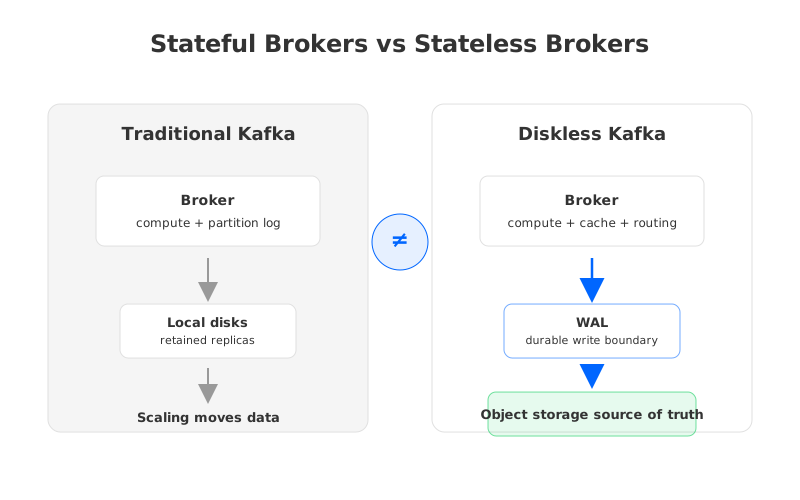
In a stateful broker model, a node failure affects both compute and data placement. The cluster may elect replacement leaders, but storage work remains tied to replicas, log directories, and catch-up. In a stateless or near-stateless broker model, the failed broker's durable data already exists outside the broker. Replacement focuses on ownership, cache warm-up, and request routing rather than copying retained logs from one broker disk to another.
This difference changes several operational habits:
- Capacity planning: teams size broker compute and retained storage separately.
- Elasticity: adding brokers can increase serving capacity without first copying large local logs.
- Failure recovery: the cluster can treat broker replacement as compute recovery when the WAL and shared storage path are healthy.
- Retention: long retention is planned around shared storage policy rather than each broker's disk ceiling.
- Data governance: object storage policy, encryption, lifecycle rules, and access boundaries become part of the streaming architecture.
The trade-off is that shared storage becomes a first-class dependency. Object storage, WAL storage, metadata services, network paths, IAM policy, and cache strategy now sit on the critical architecture review path. Diskless Kafka is not less engineered than classic Kafka. It moves engineering effort from broker disk operations to shared storage correctness and performance.
5Evaluation Checklist for Platform Teams
A production review should start with semantics, not a cost slide. Kafka is often embedded in systems that assume ordered offsets, consumer group behavior, idempotent producers, transactions, compaction, retention policies, ACLs, metrics, and ecosystem tools. A diskless platform must either preserve those behaviors or document where the contract differs.
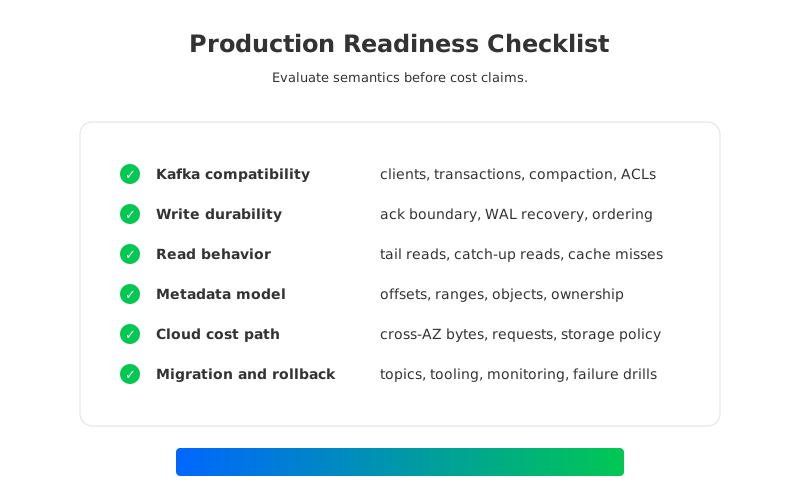
Use these questions before comparing product names:
| Review area | Questions to ask |
|---|---|
| Kafka compatibility | Which Kafka client versions, APIs, transactions, compaction, consumer groups, and admin operations are supported? |
| Write path | What storage operation must complete before producer acknowledgment? What happens after broker failure before object upload finishes? |
| Read path | How are tail reads, catch-up reads, cache misses, and high fan-out consumers served? |
| Metadata | Where are stream ranges, offsets, object locations, and ownership stored? How is metadata recovered? |
| Cloud cost | Which bytes cross availability zones? Which requests hit object storage? Which storage classes or volumes are required? |
| Operations | How are scaling, broker replacement, upgrades, rollback, observability, and disaster recovery handled? |
| Migration | Can existing clients, connectors, ACLs, topics, and monitoring systems move without application rewrites? |
This checklist also prevents a common mistake: evaluating diskless Kafka as if all implementations make the same choices. Some designs preserve Kafka's leader model and replace the storage layer underneath it. Others relax partition leadership and introduce a different ordering or coordination mechanism. Both can be valid, but they put risk in different places.
Leaderful diskless systems keep write ownership closer to Kafka's existing mental model. The storage path changes, but partition leadership remains familiar. Leaderless or more flexible designs can improve placement options, especially in multi-AZ environments, but they need a coordination path that preserves ordering, offset assignment, and failure recovery. The right choice depends on workload semantics, latency budget, governance requirements, and the team's migration tolerance.
6Where AutoMQ Changes the Operating Model
After the neutral evaluation, AutoMQ fits into a specific category: Kafka-compatible streaming with a Shared Storage architecture, where brokers no longer own retained data on local disks. AutoMQ documentation describes S3Stream as a storage component that offloads Kafka's built-in ISR-based log storage layer to object storage, with WAL storage used to absorb the streaming write path. Its compatibility documentation also frames AutoMQ as using the Apache Kafka compute layer while modifying the storage layer.
That design matters because it does not ask teams to abandon the Kafka ecosystem first and think about storage later. The API remains Kafka-compatible, while the storage architecture changes the operating model behind the API. For a platform team, the immediate architectural questions become concrete:
- Can broker compute scale independently from retained storage?
- Can broker replacement avoid large retained-log data movement?
- Can object storage become the durable data foundation without making every fetch path remote and slow?
- Can existing Kafka clients and ecosystem tools keep working during migration?
AutoMQ's answer is a Shared Storage architecture with WAL options, object storage as primary durable storage, caching for read acceleration, and deployment models that can run in customer-controlled cloud environments. In supported multi-AZ patterns, AutoMQ documentation also describes reducing cross-AZ traffic by using S3-based shared storage and AZ-aware routing. That point should still be validated against the chosen cloud region, network layout, WAL mode, and client placement before a production design is approved.
This is the right level of product evaluation. AutoMQ should not be selected because "diskless" sounds efficient. It should be evaluated when the team wants Kafka-compatible semantics, cloud-native elasticity, the economics of Shared Storage architecture, and a migration path that does not turn every application into a different streaming client.
7Decision Table
The practical decision is not binary. Many teams should first tune their existing Kafka deployment, add tiered storage, or improve partition and retention hygiene. Diskless architecture is most compelling when broker-local state is the source of repeated operational friction.
| Situation | Likely direction |
|---|---|
| Local disks are manageable, retention is short, and scaling events are rare | Optimize the existing Kafka deployment before changing architecture. |
| Long retention is the main pain, but active hot data is stable | Evaluate Kafka tiered storage or remote log storage. |
| Broker replacement, partition movement, cross-AZ traffic, or storage over-provisioning dominates operations | Evaluate diskless Kafka or Kafka-compatible shared storage. |
| Existing applications depend heavily on Kafka clients, connectors, transactions, ACLs, and monitoring | Prioritize compatibility tests before cost modeling. |
| Cloud control, data boundary, and infrastructure ownership are required | Prefer BYOC or self-managed deployment patterns with explicit storage and network review. |
The strongest diskless Kafka evaluations start with a workload inventory. Identify topic classes: append-only ingestion, compacted changelogs, transactional pipelines, high fan-out analytics, long-retention audit logs, and AI feature streams. Then test each class against compatibility, write durability, read behavior, recovery, and migration requirements. Architecture diagrams are useful, but workload behavior decides the design.
8References
- Apache Kafka Documentation: Design
- Apache Kafka Documentation: Operations
- Apache Kafka Documentation: KRaft
- AutoMQ Documentation: S3Stream Shared Streaming Storage
- AutoMQ Documentation: Compatibility with Apache Kafka
- AutoMQ Documentation: Eliminate Inter-Zone Traffic
- Amazon S3 User Guide: What is Amazon S3?
- Kubernetes Documentation: StatefulSet
9FAQ
9.1Does diskless Kafka mean brokers use no local storage at all?
No. A diskless Kafka architecture usually means retained topic data is no longer owned by broker-local disks. Brokers may still use memory, local cache, temporary files, or WAL-related resources. The important question is whether acknowledged durable data depends on the broker's local log directories.
9.2Is Kafka tiered storage the same as diskless Kafka?
No. Tiered storage moves older segments to remote storage while the broker-local tier can still serve as the active log. Diskless Kafka moves the primary durable storage responsibility out of the broker, usually through a WAL plus Shared Storage architecture.
9.3What is the hardest part of diskless Kafka architecture?
The hard part is preserving Kafka behavior while moving storage ownership. Produce acknowledgments, offset ordering, consumer fetches, transactions, compaction, cache misses, and broker failure recovery all need explicit design. Object storage capacity alone does not solve those semantics.
9.4When should a team evaluate AutoMQ?
Evaluate AutoMQ when the team wants Kafka compatibility but broker-local storage is limiting elasticity, recovery, retention, or cloud cost structure. It is especially relevant when platform teams want Shared Storage architecture while keeping familiar Kafka clients and ecosystem integrations.


