
Table of Contents
Table of Contents
The phrase diskless kafka usually appears when a platform team has already hit the limits of local-disk Kafka in the cloud. The team is not asking whether Kafka is useful. It is asking whether the broker should still own the storage lifecycle, replica placement, disk expansion, partition movement, and failure recovery path when the underlying platform already provides elastic compute, durable object storage, and managed network primitives.
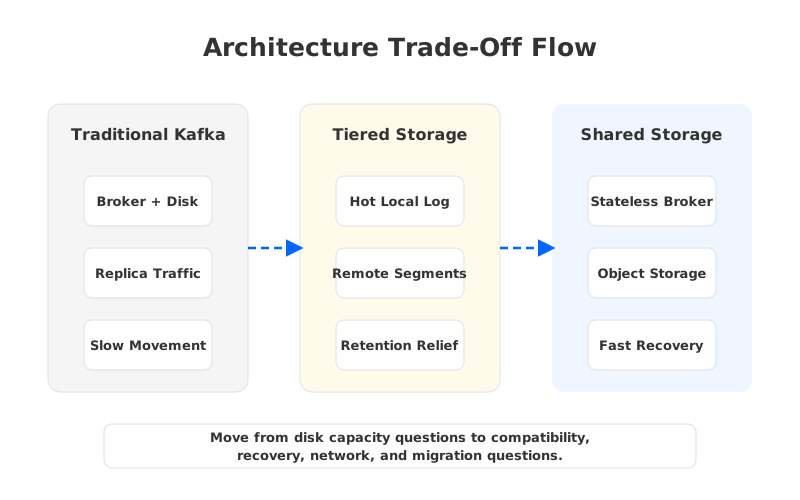
That is a sharper question than "Kafka versus something else." Traditional Kafka made the broker the unit of compute, serving, and durable log storage. That design was a strong fit for clusters built from machines with local disks or attached volumes. In cloud environments, the same design can turn normal operations into storage choreography: add brokers, wait for replica movement, rebalance leaders, watch cross-zone traffic, resize volumes, and plan recovery capacity before the next incident.
Diskless Kafka is interesting because it challenges that unit of ownership. It asks whether the broker can become closer to a stateless serving layer while log durability moves into shared storage. The idea is attractive, but production systems are not purchased on architecture diagrams. They are purchased on compatibility, failure behavior, cost boundaries, migration risk, and operational evidence.
1Why teams search for diskless kafka
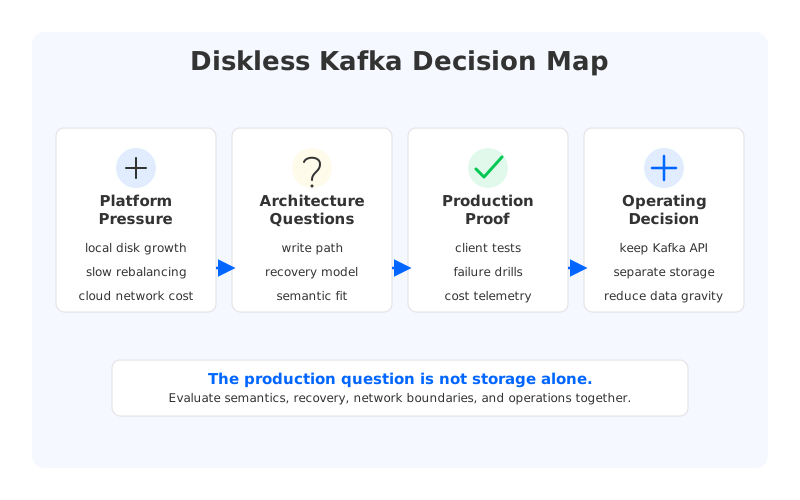
Most searches for diskless kafka come from a familiar sequence. A Kafka estate grows from a few important clusters into a platform dependency. Retention expands because downstream analytics and replay needs grow. Multi-AZ deployment becomes non-negotiable. Then a cost review shows that the expensive part is not only broker compute or storage capacity. It is also data movement, over-provisioned headroom, operational labor, and the time spent waiting for partitions to settle after infrastructure changes.
The term "diskless" compresses several hopes into one word. Teams want to reduce local disk as a scaling constraint. They want broker replacement to be less dramatic. They want object storage economics without turning Kafka into an archival tier that only helps old data. They also want to keep Kafka clients, transactions, consumer groups, ACL patterns, monitoring habits, and operational contracts intact.
Those goals sound aligned, but they create tension:
- Compatibility must be real, not cosmetic. If producers, consumers, Kafka Connect jobs, Flink jobs, ACLs, and admin tooling need broad rewrites, the project becomes a platform migration rather than a storage architecture upgrade.
- Durability must be explicit. Moving bytes away from broker disks does not remove the need for a write path, recovery point, metadata consistency model, and failure-domain analysis.
- Cost must include the network. Cloud pricing makes data movement visible. Cross-AZ traffic, PrivateLink, internet egress, and object-store request patterns can change the answer even when storage capacity looks inexpensive.
- Operations must improve under stress. A diskless design that scales smoothly during a demo but becomes opaque during recovery is not production-ready.
This is why diskless kafka is a buyer-stage query. The team has enough Kafka experience to know where the pain is, but it still needs a way to separate architectural promise from deployable reality.
2The community signal: Kafka is being rethought around storage
The Kafka ecosystem is now openly discussing diskless and shared-storage directions. Apache Kafka's KIP-1150, titled Diskless Topics, is one important signal because it frames diskless storage as an extension path for Kafka itself rather than a vendor-only talking point. The proposal matters even if a team is not waiting for a specific KIP to land. It shows that the community recognizes a structural issue: local broker disks do not have to remain the default place for Kafka log storage in cloud-native deployments.
Kafka already has a related but different storage evolution: tiered storage. Tiered storage moves older log segments to remote storage while the broker still owns the hot path and local log lifecycle. That can reduce local storage pressure for retention-heavy topics, and the official Kafka documentation describes tiered storage as a way to keep older data in a remote tier. Diskless architecture pushes the idea further. It asks whether the broker should stop being the long-term owner of log data in the first place.
The distinction matters because many teams conflate the two. Tiered storage is often a retention optimization. Diskless Kafka is an ownership change. In a tiered model, local disks still shape hot data, broker replacement, and partition movement. In a diskless or shared-storage model, the target is a broker layer that can be scaled, replaced, and rebalanced with less data gravity attached to each node.
That shift changes the evaluation. A platform team should not ask only, "Can this system store Kafka data on S3?" It should ask, "Which part of the log is remote, which part remains local, who owns the write-ahead path, how does recovery happen, and what Kafka semantics survive the change?"
3Production questions the architecture diagram leaves unanswered
Diskless Kafka diagrams tend to look clean: clients on one side, stateless brokers in the middle, object storage underneath. The diagram is useful, but it hides the hard questions. The first one is the write path. Kafka users care about acknowledged writes, ordering within partitions, producer idempotence, transactions, and consumer visibility. If the broker no longer persists the full log locally, the architecture needs a clear mechanism for low-latency durable acknowledgement before data is compacted or organized in object storage.
The second question is failure recovery. A local-disk Kafka cluster pays for replication up front because broker loss should not mean partition loss. A shared-storage design changes the recovery shape, but it does not make recovery automatic by magic. The system still needs metadata correctness, fencing, cache refill behavior, and a plan for object-store or network degradation. The healthier the architecture, the more boring this story should sound.
The third question is data movement. Cloud networking turns architecture into a bill. A traditional replicated Kafka deployment across availability zones can generate traffic from producers, follower replication, consumers, reassignment, and catch-up reads. A diskless design can reduce some of those paths, but only if placement, client routing, storage access, and cache behavior are designed together. Otherwise, the storage bill improves while the network bill quietly takes its place.
The fourth question is governance. Kafka is rarely an isolated queue by the time teams evaluate architecture alternatives. It sits behind organizational contracts: topic naming, quotas, ACLs, audit logs, schema governance, incident response, and workload isolation. A diskless Kafka candidate must show how those controls carry over. A storage architecture that weakens governance will meet resistance even if the cost model is compelling.
4A technical evaluation framework for platform teams
A serious diskless Kafka evaluation starts with semantics, not pricing. Run representative clients before debating savings. Test producers with idempotence enabled, consumer groups under rebalance, Kafka Connect source and sink behavior, Flink checkpoint interaction, ACL enforcement, transactional workloads if you use them, and admin operations such as topic creation, partition expansion, offset reset, and quota changes. Compatibility failures discovered late are the most expensive kind because they invalidate migration planning.
After semantics, inspect the data plane. The evaluation should identify every durable boundary between producer acknowledgement and object storage persistence. It should also identify what happens during broker crash, node replacement, availability-zone impairment, object-store throttling, and control-plane unavailability. A system can be diskless from the broker's perspective while still depending on a write-ahead log, cache, or local buffer. That is not a flaw. It is a design choice that must be visible.
Cost analysis comes third because the first two steps define what must be priced. A useful model includes:
| Cost surface | What to inspect | Why it matters |
|---|---|---|
| Broker compute | CPU, memory, cache, and serving capacity | Stateless brokers still need enough headroom for tail reads, catch-up reads, and protocol work. |
| Durable storage | Object storage capacity, requests, and write path | Storage can be lower cost, but request and write-path design affect the bill. |
| Network traffic | Cross-AZ, cross-region, PrivateLink, and egress paths | Data transfer can dominate cloud Kafka cost when traffic crosses boundaries repeatedly. |
| Rebalancing | Data moved during scale-out, scale-in, and recovery | Moving less data can shorten operations and reduce risk. |
| Labor | Incident work, capacity planning, upgrades, and migration | Operational hours are part of TCO even when they do not show up as a cloud SKU. |
This table is deliberately not a vendor checklist. It is a way to keep the discussion honest. A system that wins on storage capacity but loses on network paths may not reduce total cost. A system that reduces operations but breaks transactional clients is not a drop-in Kafka platform. A system that looks elegant but lacks clear recovery drills is still a research project for production buyers.
The migration plan should be evaluated with the same discipline. Teams need a dual-run period, offset and consumer-group strategy, producer cutover plan, rollback boundary, data retention decision, and monitoring parity. MirrorMaker 2 and Kafka-compatible replication tools can help, but they do not remove the need to define what "done" means. The cleanest migrations are boring because every participant knows which cluster is authoritative at each stage.
5How AutoMQ fits the evaluation
Once the evaluation is framed around semantics, data-plane durability, cost surfaces, and operational recovery, AutoMQ fits as a Kafka-compatible, shared-storage streaming system rather than as a generic "Kafka alternative." AutoMQ keeps the Kafka protocol surface while moving the storage architecture toward S3-backed shared streaming storage. Its brokers are designed to be stateless in the storage sense: they serve Kafka traffic while S3Stream and the write-ahead path handle durable stream storage.
That design is relevant to the diskless Kafka discussion because it addresses the root mismatch between local-disk Kafka and cloud infrastructure. Broker nodes no longer need to be treated as long-lived holders of specific partition data. Compute and storage can scale more independently. Partition movement is less tied to bulk data copying. Recovery can focus on restoring serving capacity and metadata correctness instead of rebuilding a broker's local log footprint.
AutoMQ also makes the network question explicit. Its documentation describes approaches for eliminating inter-zone traffic by using S3-based storage architecture and zone-aware client and broker configuration. That does not mean every deployment has no network cost; cloud topology and client placement still matter. It does mean the architecture is designed around a cost surface that traditional replicated Kafka often exposes painfully in multi-AZ deployments.
For buyers, the important part is not the product name. The important part is that AutoMQ can be evaluated with ordinary Kafka workloads: existing clients, Kafka protocol behavior, topic operations, ACLs, consumer groups, and observability expectations. If those checks pass, the conversation can move to whether shared storage, stateless brokers, and object-storage-backed durability reduce the specific operational and cost problems your platform has.
6A pragmatic buyer checklist
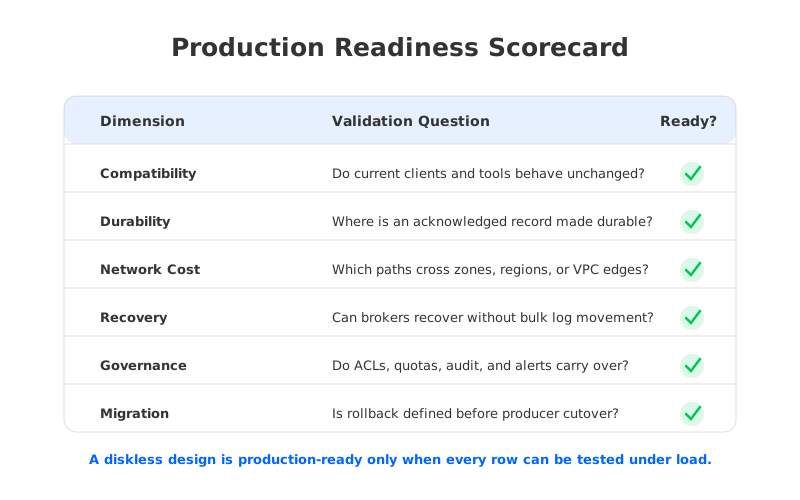
The fastest way to make a diskless Kafka evaluation useful is to force every claim into a testable question. Do not ask whether a product is "cloud-native." Ask what happens when a broker disappears during producer load. Do not ask whether storage is "S3 based." Ask when an acknowledged record becomes durable, how it is recovered, and what reads from cache versus object storage. Do not ask whether the system is "Kafka compatible." Ask which Kafka clients and features your estate uses, then test them.
For a production proof of concept, use a workload that resembles your real platform:
- Protocol path: Produce and consume with the same client libraries, security settings, serializers, and retry policies used in production.
- Operational path: Scale brokers, restart nodes, expand partitions, reset offsets, and trigger consumer-group rebalances while load is running.
- Failure path: Kill brokers, impair a zone if your environment allows it, throttle network paths, and verify recovery time and data visibility.
- Cost path: Capture storage, compute, network, and request metrics during both steady state and catch-up reads.
- Governance path: Validate ACLs, audit expectations, quotas, monitoring, alerts, and on-call runbooks.
This is where community excitement becomes a production decision. Diskless Kafka is not a feature checkbox. It is a change in the fault lines of the platform. The right system should make common operations less dramatic, keep Kafka semantics familiar, and make cloud cost easier to reason about. If it only moves complexity from disks to an opaque storage layer, the architecture has changed but the risk has not.
Consider AutoMQ when your team wants Kafka-compatible APIs with shared storage, stateless brokers, independent compute and storage scaling, and a clearer path to reducing local-disk operations in cloud deployments. A practical next step is to review the AutoMQ architecture overview and map it against your own client, cost, and recovery checklist.
7References
- Apache Kafka KIP-1150: Diskless Topics
- Apache Kafka documentation: Tiered Storage
- Apache Kafka documentation: Message delivery semantics
- AWS EC2 pricing: Data Transfer
- Amazon MSK pricing
- AutoMQ architecture overview
- AutoMQ S3Stream shared streaming storage
- AutoMQ compatibility with Apache Kafka
- AutoMQ and tiered storage differences
8FAQ
8.1Is diskless Kafka the same as tiered storage?
No. Tiered storage usually keeps the broker responsible for the hot log while moving older segments to remote storage. Diskless Kafka changes the storage ownership model more deeply by reducing the broker's dependence on local disk for durable log storage.
8.2Does diskless Kafka mean brokers have no local state at all?
Not necessarily. A broker may still use memory, cache, metadata, or a write-ahead component. The production question is which state is authoritative, how it is recovered, and whether broker replacement requires moving large amounts of partition data.
8.3What should I test first in a diskless Kafka proof of concept?
Start with Kafka client compatibility and failure behavior. Storage cost matters, but it is not useful if your client features, ACL model, consumer groups, or recovery expectations fail under realistic load.
8.4When should AutoMQ be considered?
Consider it when local-disk operations, slow broker replacement, or cloud network cost have become material design constraints rather than background infrastructure details.


