
Table of Contents
Table of Contents
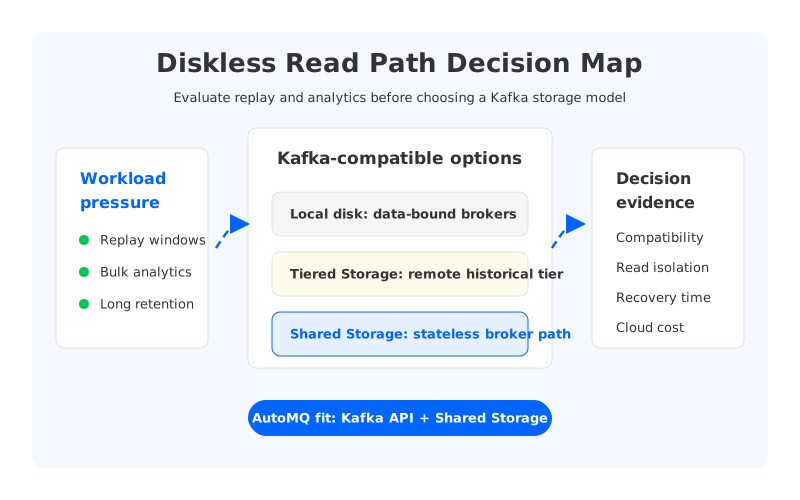
Teams search for diskless kafka read path after a production pattern has outgrown local-disk Kafka. A fraud model needs a multi-day replay. An analytics pipeline wants to scan retained events without disturbing online consumers. A data platform team is asked to keep more history for governance, but the storage budget is under review. The question is not whether Kafka can serve reads. It can. The real question is whether the read path behaves when replay, catch-up, fan-out, and retention become normal operating modes.
That distinction matters because Kafka's original storage model was built around broker-local logs. The broker owns compute, local persistence, cache behavior, replication, and recovery for its partitions. This is a strong design for near-latest reads, but it becomes harder to reason about when old data is read at high volume.
Diskless Kafka is a response to that pressure, but the term is often used loosely. Some people mean Tiered Storage: recent segments stay local, older segments move to object storage. Others mean Shared Storage architecture: brokers stop being the long-term owners of partition data, and object storage becomes the durable system of record. A useful evaluation starts by separating those options before comparing products.
1Why Teams Search for diskless kafka read path
Replay and analytics change Kafka operations because they turn historical reads into foreground traffic. In a classic event streaming cluster, the happy path is a consumer reading near the latest offset, backed by warm page cache and broker locality. In a replay-heavy environment, consumers seek backward and generate bursts that compete with writes, replication, compaction, and recovery.
The operational symptom is usually visible before the architecture problem is named. Consumer lag becomes less useful as a simple alert because some lag is planned. Broker disk I/O becomes noisy because catch-up reads and leader traffic share local devices. Scaling becomes awkward because adding brokers does not immediately add historical data locality; partitions must be reassigned, and reassignment itself generates more I/O. FinOps sees the same issue from a different angle: the cluster is paying for hot local storage and cross-Availability Zone traffic even when much of the retained data behaves like cold history.
Platform teams normally care about four read patterns:
- Tailing reads serve consumers close to the latest offset, where latency expectations are tight.
- Catch-up reads serve consumers that fell behind during deployments, incidents, or maintenance windows.
- Replay reads reprocess a known offset range for backfills, compliance reviews, or bug recovery.
- Analytics reads feed lakehouse ingestion or batch-style scans where large retained ranges are consumed in bulk.
These patterns are the reason Kafka becomes a shared platform instead of a single application dependency. Once they appear, the read path has to be evaluated as a first-class architecture surface, not as a side effect of broker storage.
2The Storage Constraint Behind Cloud Kafka
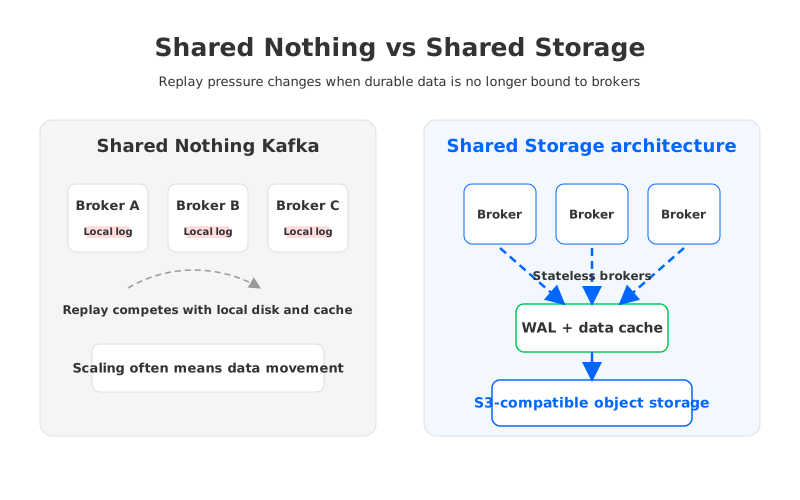
Traditional Kafka uses a Shared Nothing architecture. Each broker stores its assigned partition replicas locally, and Kafka uses ISR replication across brokers for durability and availability. This model made sense when local disks were the natural persistence layer and replication traffic was mostly an internal cluster cost. In the cloud, the same design maps onto provisioned volumes, instance-level throughput limits, and billable cross-zone movement.
The read path inherits those constraints. A historical read is not abstractly "reading Kafka"; it is reading log segments from a broker and storage device that are also serving production writes and replicas. A large replay may evict useful cache pages for tailing consumers. Over-provisioned replay headroom means capacity is paid for before it is used.
Tiered Storage addresses part of this problem by moving older log segments to remote storage while keeping the Kafka broker as the active owner of local hot data. It is a practical step for long retention because it reduces the local disk required for historical segments. It does not automatically make brokers stateless or remove the need to reason about the hot tier.
A true diskless design changes the premise. Instead of asking how much local disk the broker needs before older segments leave the machine, it asks why durable partition data should be bound to broker-local storage at all. The broker can focus on protocol handling, leadership, cache, and scheduling while shared storage handles persistence.
3Architecture Options: Local Disk, Tiered Storage, and Shared Storage
The right architecture depends on the workload. A small cluster with short retention and mostly tailing consumers may not need a diskless read path. A platform cluster with long retention, replay obligations, analytics, and capacity changes should evaluate the storage model directly.
| Architecture option | Read path behavior | Operational trade-off | Where it tends to fit |
|---|---|---|---|
| Local-disk Kafka | Reads come from broker-owned local logs and page cache. Replay competes with local disk, cache, and replication. | Simple mental model, but scaling and recovery are tied to data movement. | Predictable tailing workloads with limited retention. |
| Kafka Tiered Storage | Hot data remains local; older segments can be fetched from remote storage. | Reduces local storage pressure but preserves a hot-tier operating model. | Long retention where historical reads are important but broker-local hot data remains acceptable. |
| Shared Storage architecture | Brokers read durable data through a shared object storage layer, with cache and prefetch handling hot and cold paths. | Requires careful storage, cache, WAL, and observability design, but weakens the tie between brokers and durable data. | Replay-heavy, elastic, cloud-native Kafka-compatible platforms. |
The table is about mechanisms rather than slogans. "Diskless" is not a magic property. If cold reads are slow, cache behavior is opaque, or a broker still needs long local recovery before it can serve traffic, the platform team has only moved the problem. A serious design should specify fetch behavior, cache policy, object layout, and broker-loss recovery.
Apache Kafka's own evolution reflects this tension. KIP-405 introduced Tiered Storage to extend Kafka's storage hierarchy with remote log storage. KIP-1150 discusses diskless topics, where topic data can be placed directly in remote storage without local disk as the primary persistence path. The buyer question is whether object storage is an archive behind Kafka or the main durable substrate for Kafka-compatible streaming.
4Evaluation Checklist for Platform Teams
A diskless Kafka read path should be evaluated by the risk it removes and the risks it introduces. Storage cost matters, but replay and analytics also touch compatibility, governance, security boundaries, consumer semantics, and on-call behavior. The team that owns the cluster will live with those trade-offs after the architecture review ends.
Start with compatibility because it defines migration blast radius. Kafka's value is not only the broker; it is the ecosystem of clients, Connectors, stream processors, monitoring tools, ACL models, offsets, transactions, and operational scripts. A Kafka-compatible platform should preserve Consumer group behavior, offset commits, and idempotent or transactional producer expectations. If compatibility requires application rewrites, the storage architecture has become an application migration project.
Then evaluate the read path itself:
- Offset-range behavior: Test tailing, catch-up, and replay reads separately. Latest-offset benchmarks will not expose the path used by analytics or backfills.
- Cache isolation: Confirm whether historical scans can evict hot data needed by online consumers. If the cache has no consumer-focus logic, replay can become a platform-wide disturbance.
- Object layout: Ask how records are grouped into objects and how small-object amplification is controlled.
- Failure recovery: Simulate broker loss during active replay. The key question is whether the replacement path is metadata-driven or requires large local data restoration.
- Governance boundary: Verify where message data, metadata, logs, metrics, and control-plane operations live.
Cost deserves its own model because "lower storage cost" is too vague for production planning. Local disk, object storage, remote read requests, cross-Availability Zone transfer, private networking, compute headroom, and operator time all appear in different places on the bill. The final result depends on cloud provider pricing, workload shape, replication requirements, and read amplification.
5How AutoMQ Changes the Operating Model
Once the evaluation is framed around durable data ownership, AutoMQ becomes easier to place. AutoMQ is a Kafka-compatible cloud-native streaming platform that replaces Kafka's local log storage with S3Stream, a shared streaming storage library built on object storage and WAL storage. The important move is that AutoMQ keeps Kafka protocol semantics while moving persistent partition data away from broker-local disks into a Shared Storage architecture.
In AutoMQ, Brokers are stateless for persistent data. They still handle Kafka requests, Partition leadership, caching, and scheduling, but durable record history is stored through S3Stream. Writes first go through WAL storage for durability and low-latency acknowledgment, then data is uploaded to S3 storage in near real time. Reads are split into Tailing Read and Catch-up Read, with hot data served from cache where possible and historical data prefetched from S3 storage.
This changes the operational model for replay and analytics. Broker replacement is less about rebuilding local disks and more about restoring ownership, leadership, and cache state. Scaling compute is less coupled to moving durable data because storage is shared. Long retention no longer has to be sized primarily around broker-local persistent volumes. The engineering problem moves toward cache, WAL choice, object layout, and scheduling rather than local disk capacity planning.
AutoMQ also gives platform teams deployment choices that matter for governance. AutoMQ Open Source uses S3 WAL and S3-compatible object storage, keeping the architecture minimal and diskless for workloads that can tolerate object-storage-backed WAL latency. AutoMQ BYOC and AutoMQ Software can use additional WAL storage options for different latency and durability requirements. In BYOC, the control plane and data plane run in the customer's own cloud account VPC, so message data remains within the customer's environment.
Zero cross-AZ traffic is another practical difference for cloud teams. Traditional multi-AZ Kafka replication can generate cross-zone transfer as brokers replicate partition data and clients access leaders across zones. AutoMQ's Shared Storage architecture and routing model are designed to reduce that cross-Availability Zone data movement, so replay planning can separate shared storage from compute.
6A Readiness Scorecard for Migration
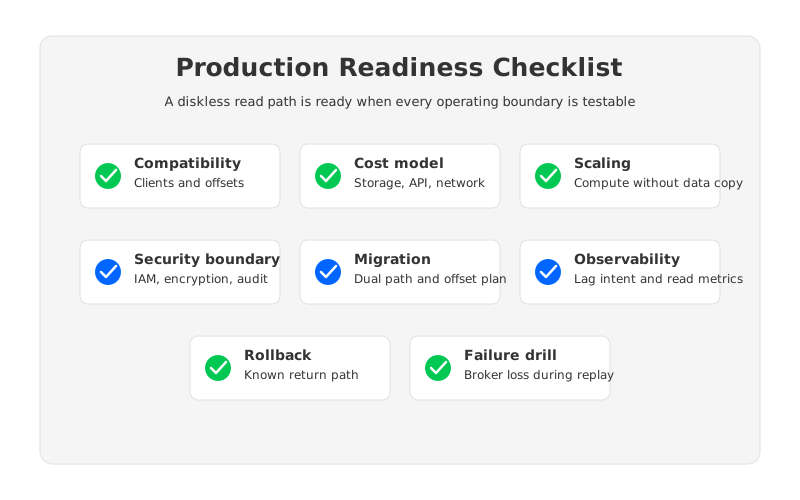
The safest way to evaluate a diskless read path is to make the migration decision measurable. Use a scorecard that covers architecture and operations, and assign owners before the proof of concept starts. Platform teams own broker behavior and observability. Application teams own client semantics. Security owns access boundaries. FinOps owns the cost model.
| Area | Evidence to collect | Pass signal |
|---|---|---|
| Compatibility | Client versions, Connectors, ACLs, transactions, Consumer group behavior, offset reset workflows. | Existing applications run with endpoint and credential changes, not code rewrites. |
| Replay performance | Controlled replay at representative retention windows and fan-out. | Historical reads meet throughput goals without destabilizing tailing consumers. |
| Failure recovery | Broker termination during tailing and catch-up reads. | Recovery is bounded, observable, and does not require large local data rebuilds. |
| Cost model | Storage, compute, API calls, cross-zone transfer, private networking, operator time. | Savings or elasticity claims survive workload-specific pricing assumptions. |
| Governance | Data plane location, object storage policies, encryption, IAM, audit logs, metrics export. | Security can explain where data lives and who can access it. |
| Rollback | Dual-write, linking, MirrorMaker 2, or phased consumer migration plan. | The team can return traffic without offset confusion or data loss. |
This scorecard also prevents a common proof-of-concept mistake: testing only the write path. The production risk appears when reads behave differently under replay. A credible test should include normal consumers, intentional lag, bulk replay, a broker failure, and a rollback drill.
7Decision Guidance
Choose local-disk Kafka when the workload is stable, retention is short, and the team values a familiar operating model over elasticity. Choose Tiered Storage when long retention is the main pressure and the team can continue operating a broker-local hot tier. Evaluate Shared Storage architecture when replay, analytics, cloud cost, and elasticity are all present together.
The strongest signal for diskless architecture is not a single large replay job. It is repeated friction around storage headroom, partition movement, broker replacement, and historical reads. If every analytics use case triggers a storage conversation, the platform is carrying an architectural constraint rather than a one-time capacity problem.
AutoMQ is worth evaluating when the desired end state is Kafka compatibility plus a cloud-native storage model. Test your clients, retention windows, replay jobs, and governance requirements. The benefit of a diskless read path is not that disks disappear from the bill. It is that persistent data stops being trapped inside broker lifecycle decisions.
If you are comparing diskless Kafka read paths for replay and analytics, the next step is a workload-specific architecture review. The AutoMQ team can help map your Kafka traffic, retention, replay patterns, and cloud boundaries into a focused proof of concept.
8References
- Apache Kafka documentation for Consumer groups, offsets, transactions, and broker behavior.
- Apache Kafka KIP-405: Kafka Tiered Storage for the official Tiered Storage design background.
- Apache Kafka KIP-1150: Diskless Topics for Kafka community discussion around diskless topic storage.
- AutoMQ architecture overview for Shared Storage architecture, S3Stream, WAL storage, and stateless broker concepts.
- AutoMQ and Kafka Tiered Storage comparison for the distinction between Tiered Storage and AutoMQ's Shared Storage architecture.
9FAQ
9.1Is diskless Kafka the same as Kafka Tiered Storage?
No. Tiered Storage keeps a hot local tier on brokers and moves older segments to remote storage. A diskless or Shared Storage architecture treats shared object storage as the durable storage layer for Kafka-compatible data, with brokers acting more like stateless compute nodes plus cache and scheduling.
9.2Does a diskless read path make every replay faster?
Not automatically. Replay performance depends on object layout, cache policy, prefetch behavior, network path, storage backend, and consumer parallelism. The architectural advantage is that replay no longer has to be constrained by broker-local durable data ownership, but it still needs workload-specific testing.
9.3What should SREs monitor first?
Monitor Tailing Read latency, Catch-up Read throughput, cache hit ratio, object storage latency, WAL health, consumer lag by intent, and broker recovery time. Label replay jobs so planned lag does not look like an incident.
9.4When is local-disk Kafka still reasonable?
Local-disk Kafka is reasonable for stable workloads with short retention, limited replay, and teams that already operate broker storage confidently. Diskless architecture becomes more attractive when replay, analytics, long retention, and elastic capacity all appear together.
9.5How should a team test AutoMQ for this use case?
Use a proof of concept that includes existing clients, representative retention, tailing consumers, planned catch-up, bulk replay, broker failure, and rollback. The goal is to validate Kafka compatibility and the read path under the workload that motivated the evaluation.


