
Table of Contents
Table of Contents
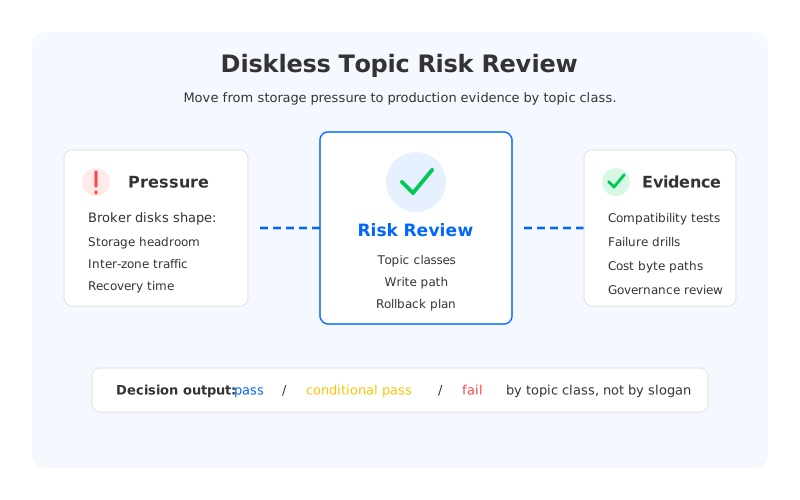
Enterprise Kafka owners search for diskless kafka when the local-disk model stops feeling like an implementation detail. Broker disks begin to drive procurement decisions, recovery time, partition placement, inter-zone network traffic, and capacity reviews. The first question is usually about cost, but the real decision is broader: what happens to Kafka's operational contract when the durable log is no longer tied to a broker's local storage?
That question deserves a risk review, not a slogan. A diskless topic architecture can reduce the weight of broker-local data and make shared storage the durable foundation for user records. It also introduces dependencies in write acknowledgment, cache design, metadata coordination, object storage policy, and rollback. The goal is to decide which topic classes can adopt it without weakening the behaviors application teams already rely on.
1Why Enterprise Teams Are Reopening Kafka Storage Design
Classic Kafka is built around a replicated local log. A broker hosts partition replicas, leaders accept writes, followers replicate data, and consumers fetch by offset. This model remains one of Kafka's strengths because it gives clear ordering, replay, and failure semantics. The pressure comes from running it in cloud environments where compute, storage, and network movement are billed and scaled as separate resources.
The stress shows up in several places at once. Retention growth forces brokers to carry more storage than CPU usage justifies. Multi-Availability Zone (AZ) replication can move bytes across zones before consumers read them. Broker replacement is not a pure compute event because the node may own large replicas. Partition reassignments become operational projects instead of routine balancing. Cloud economics made the storage boundary visible.
Diskless topics change that boundary. Instead of treating broker-local disks as the primary durable home for user topic data, a diskless design moves persistence toward shared storage, usually S3-compatible object storage, with a WAL (Write-Ahead Log), cache, or staging layer to protect writes. The broker becomes closer to request processing, coordination, and cache capacity. That shift can improve elasticity and cost structure, but it also moves risk into places many Kafka runbooks do not cover.
2Separate the Category From the Implementation
The Apache Kafka community has accepted KIP-1150, Diskless Topics, which is important directional evidence. It shows that the Kafka ecosystem is taking the storage-model problem seriously. At the same time, a KIP's status is not the same as an enterprise-ready feature in every Kafka distribution. Buyers should separate the category from any particular implementation.
That separation keeps the review honest. "Diskless" can describe native Apache Kafka work in progress, Kafka-compatible systems built around object storage, managed services that hide the storage layer, or hybrid estates that keep local disks for some topic classes. Each design may preserve different Kafka behaviors, expose different controls, and create different cloud dependencies.
For an enterprise owner, the useful framing is a risk taxonomy:
- Semantic risk: producer acknowledgments, offsets, ordering, transactions, compaction, ACLs, and admin APIs must behave as applications expect.
- Durability risk: the team must know where an acknowledged record is durable and how incomplete writes recover.
- Latency risk: remote storage latency needs a compensating WAL and cache design.
- Operational risk: scaling, upgrades, replacement, observability, and incident response must remain understandable.
- Governance risk: object storage permissions, encryption, retention, audit logs, and deletion policy join the streaming boundary.
This taxonomy turns a vague architecture debate into a review that SRE, security, application teams, and FinOps can all understand before the first production topic moves.
3Tiered Storage Is Not the Same Risk Profile
Tiered Storage and diskless topics both involve remote storage, so teams can confuse them in early architecture reviews. Tiered Storage moves older log segments away from broker-local disks while the active log can still depend on local disk and broker-to-broker replication. It is valuable when long retention is the main problem. It does not necessarily remove the broker's role as the durable owner of active topic data.
Diskless topics start from a different premise. The durable path for topic data is designed around shared storage, and broker-local disk becomes cache, staging, or metadata support rather than the system of record. That change affects the failure model. If a broker disappears, the question becomes: what durable write state exists outside the broker, and how does another broker resume ownership safely?
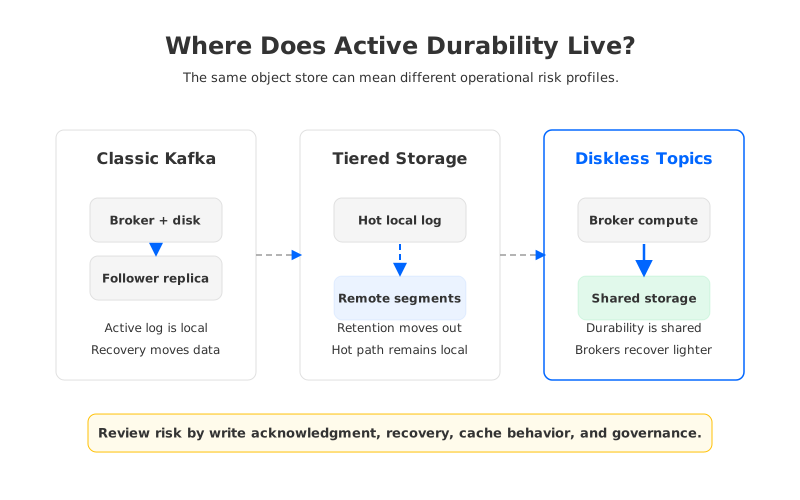
The distinction matters because the buyer's risk changes. Tiered Storage reviews should focus on retention cost, remote fetch behavior, segment lifecycle, and catch-up reads. Diskless topic reviews must also focus on write acknowledgment, storage commit protocol, leader recovery, cache coherency, and shared storage failure. Both can belong in the same estate, but they should not share one acceptance checklist.
4Build the Review Around Topic Classes
Most enterprise Kafka estates are not one workload. They are a portfolio of topic classes with different semantics and failure costs. A diskless topic review should begin by grouping topics according to behavior, not by ordering clusters by size. The largest cluster is not always the strongest first candidate, and the most expensive workload is not always the safest one.
Start with the contracts applications depend on. Append-heavy ingestion topics care about ordered writes, durable replay, and throughput. Compacted topics care about key-level state and cleanup behavior. Transactional pipelines care about fencing, idempotent producers, and exactly-once semantics. High fan-out analytics topics care about cache efficiency and catch-up read cost.
The first review artifact should be a topic-class map:
| Topic class | What to validate | Typical first-move suitability |
|---|---|---|
| Append-heavy ingestion | Producer acks, replay, throughput, retention, and consumer lag recovery | Strong candidate when latency requirements are moderate |
| Long-retention audit logs | Retention policy, object storage lifecycle, deletion, and audit controls | Strong candidate when replay is more important than ultra-low latency |
| High fan-out analytics | Cache misses, remote reads, request costs, and consumer placement | Candidate after read-path modeling |
| Compacted topics | Log compaction semantics, tombstones, restore behavior, and key churn | Needs deeper validation |
| Transactional pipelines | Idempotent producer behavior, transactions, fencing, and rollback | Move only after explicit semantic tests |
This map prevents a common procurement failure: evaluating the platform against an average workload that does not exist. A diskless design may fit high-throughput ingestion and still need more proof for compacted state topics.
5Follow the Write Path Until the Risk Is Visible
The write path is the center of the review because diskless topics move the durability boundary. In classic Kafka, the buyer can reason about leader append, follower replication, in-sync replicas, and acknowledgment settings. In a diskless design, the buyer must reason about the handoff from broker memory to WAL, shared storage, metadata, and cache. The question is always the same: what must complete before the producer sees success?
An enterprise review should ask for a write trace under normal operation and under failure. If the leader fails after accepting a produce request, where is the record? If a WAL write succeeds but an object upload is incomplete, how is that state recovered? If object storage returns throttling or partial errors, does the broker slow producers, fail requests, or accumulate local risk? If metadata commits lag data commits, how are offsets protected from becoming visible before data is readable?
These questions keep a storage architecture review from becoming a diagram review. The answer should be specific enough that an SRE can turn it into tests:
- Produce to a representative topic under load.
- Kill the broker that owns the active partition.
- Verify acknowledged records, offsets, and consumer visibility.
- Inject storage-path delay or error conditions.
- Repeat with cold cache and lagging consumers.
The test needs to reveal whether the system's durability story is operationally understandable.
6Cost Review: Count the Bytes That Still Move
Diskless Kafka cost discussions often overfocus on object storage being more cost-effective than block storage. That can be true for retained data, but it is not enough for an enterprise decision. A streaming platform spends money on compute, storage, requests, data transfer, private connectivity, monitoring, and operations. A diskless design shifts the bill; the review must prove which line items shrink and which new ones appear.
The cost model should start with byte paths. For each topic class, count producer ingress, durability writes, read fan-out, catch-up reads, retention volume, inter-zone routes, and background movement. In classic multi-AZ Kafka, replication can move data between brokers for availability. In a shared-storage design, durable data may land once in regional object storage while brokers serve as compute and cache. Consumers, producers, and storage endpoints still have placement, request, and routing behavior.
| Cost dimension | Classic local-log review | Diskless topic review |
|---|---|---|
| Broker storage | Provisioned for active data, retention headroom, and replica placement | Reduced or repositioned as WAL and cache capacity |
| Replication traffic | Broker-to-broker replication across AZs may dominate write-path network cost | Shared storage can reduce application-layer replica traffic |
| Object storage | Usually a tier for older data when Tiered Storage is enabled | Primary durable store or a central part of the durable path |
| Read fan-out | Served from brokers and local replicas, with possible cross-zone reads | Depends on cache hit rate, remote fetch behavior, and consumer placement |
| Operational churn | Reassignment and recovery move local replica data | Scaling can be lighter if durable data is already outside brokers |
This model also helps procurement avoid a false binary. The decision is not "classic Kafka is expensive, diskless Kafka is lower cost." The decision is "for this topic class and cloud topology, these bytes stop moving, these resources shrink, and these dependencies need governance." A review that cannot name the changed byte paths is not ready.
7The Production Readiness Scorecard
After topic classes, write path, and cost paths are visible, the review can collapse into a scorecard. It should be short enough for an architecture review but concrete enough to drive tests. It should also assign owners. SRE should not carry object storage permissions alone, and FinOps should not carry network topology alone.
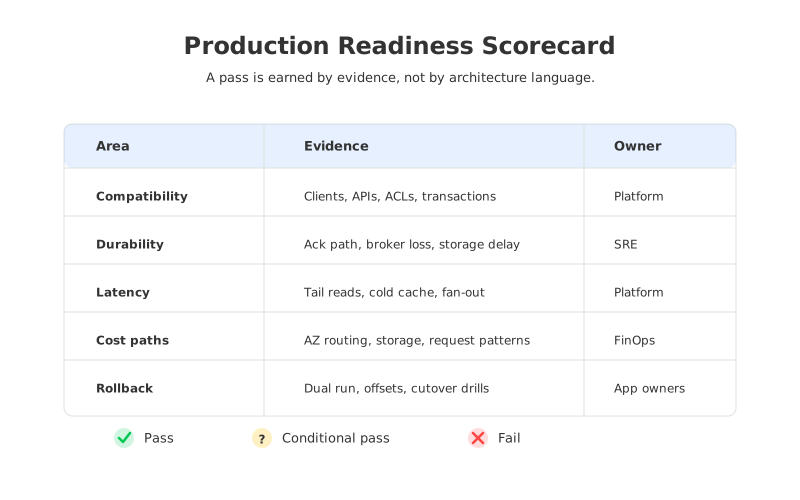
Use a simple pass, conditional pass, or fail rating for each area:
| Area | Evidence required | Owner |
|---|---|---|
| Kafka compatibility | Client versions, admin APIs, security, transactions, compaction, and consumer behavior tested | Platform engineering |
| Durability and recovery | Produce acknowledgment path, broker loss, zone routing, storage delay, and metadata recovery tested | SRE |
| Latency and read path | Tail reads, catch-up reads, cold cache, fan-out, and storage throttling measured | Platform engineering |
| Cost and network | Current and target byte paths mapped across AZs, storage services, and client placement | FinOps and cloud architecture |
| Governance | IAM, encryption, retention, deletion, audit, lifecycle, and data boundary reviewed | Security and data governance |
| Migration and rollback | Dual run, offset handling, cutover, backout, and incident runbooks rehearsed | Application and platform owners |
The scorecard should produce a decision by topic class, not by brand. A "conditional pass" names missing evidence. Append-heavy ingestion may pass with a retention and recovery test, while transactional topics remain conditional until fencing and rollback have been tested. This is how enterprises adopt storage changes without turning the first migration into a company-wide risk event.
8Where AutoMQ Fits the Review
After the neutral framework is in place, AutoMQ fits as a Kafka-compatible, cloud-native streaming platform built around Shared Storage architecture. AutoMQ's S3Stream design moves durable stream data into S3-compatible object storage, while WAL storage and Data caching handle write and read paths that raw object storage alone would not satisfy for Kafka-like workloads. Its Apache Kafka compatibility and inter-zone traffic documentation map directly to the compatibility and network-cost gates in the scorecard.
The reason to evaluate AutoMQ is not that every enterprise should replace every Kafka topic with a diskless design. The narrower reason is stronger: if broker-local disks, cross-AZ traffic, retention growth, or slow recovery are shaping your Kafka roadmap, AutoMQ gives you a concrete implementation to test against the topic-class review. Existing Kafka clients and ecosystem expectations remain central while the storage layer changes under the platform.
Run the same tests against AutoMQ that you would run against any serious diskless Kafka candidate. Use representative clients, real topic configurations, realistic retention, and failure drills. Test the WAL mode and cloud topology that match your latency and durability requirements. Validate object storage policy, encryption, and audit behavior with the same rigor you apply to Kafka ACLs. If the evaluation passes, the decision record is grounded in your workload rather than in a product claim.
Diskless Kafka becomes compelling when it makes the storage boundary easier to operate, not when it hides the boundary from the review. If your team is ready to test that boundary with a Kafka-compatible shared-storage implementation, start with the AutoMQ Cloud deployment path and bring one representative topic class to the proof of concept.
9References
- Apache Kafka KIP-1150: Diskless Topics: https://cwiki.apache.org/confluence/display/KAFKA/KIP-1150%3A%2BDiskless%2BTopics
- Apache Kafka documentation, Tiered Storage: https://kafka.apache.org/documentation/#tiered_storage
- AWS EC2 On-Demand Pricing, data transfer: https://aws.amazon.com/ec2/pricing/on-demand/
- AWS architecture blog, overview of data transfer costs: https://aws.amazon.com/blogs/architecture/overview-of-data-transfer-costs-for-common-architectures/
- AWS S3 Pricing: https://aws.amazon.com/s3/pricing/
- Amazon MSK Developer Guide, Tiered Storage: https://docs.aws.amazon.com/msk/latest/developerguide/msk-tiered-storage.html
- AutoMQ documentation, S3Stream Shared Streaming Storage: https://docs.automq.com/automq/architecture/s3stream-shared-streaming-storage/overview?utm_source=blog&utm_medium=reference&utm_campaign=gs100-0008
- AutoMQ documentation, Compatibility with Apache Kafka: https://docs.automq.com/automq/what-is-automq/compatibility-with-apache-kafka?utm_source=blog&utm_medium=reference&utm_campaign=gs100-0008
- AutoMQ documentation, Eliminate Inter-Zone Traffic: https://docs.automq.com/automq-cloud/eliminate-inter-zone-traffics/overview?utm_source=blog&utm_medium=reference&utm_campaign=gs100-0008
10FAQ
10.1Does diskless Kafka mean brokers use no disks?
No. Brokers may still use disks for the operating system, logs, cache, metadata, or short-term staging. The meaningful change is that broker-local disks are no longer the primary durable store for user topic data.
10.2Is a diskless topic the same as Tiered Storage?
No. Tiered Storage moves older segments to remote storage while the active write path can still depend on local disks and replication. Diskless topics shift primary durability toward shared storage, changing write acknowledgment, recovery, scaling, and cost behavior.
10.3Is KIP-1150 enough reason to migrate?
KIP-1150 is evidence that the Apache Kafka community accepts diskless topics. It is not an enterprise migration plan. Teams still need to evaluate implementation status, semantic compatibility, and operational readiness.
10.4Which topic classes should be evaluated first?
Append-heavy ingestion and long-retention audit topics are often stronger first candidates because their contracts are easier to validate. Compacted topics, Kafka Streams changelogs, and transactional pipelines need semantic and rollback tests.
10.5How should AutoMQ be evaluated in this context?
Evaluate AutoMQ with the same scorecard used for any diskless Kafka candidate: compatibility, write durability, latency, read behavior, cost paths, governance, migration, and rollback. The strongest proof is a representative topic-class test in your cloud topology.


