
Table of Contents
Table of Contents
KIP-1150 is not a minor storage optimization. It asks Kafka operators to revisit the contract between a topic, a broker, and the durable log. That is why serious platform teams search for KIP-1150 architecture, KIP-1150 cost, and KIP-1150 alternative: they are asking which Kafka semantics still hold when broker-local disks stop being the primary home of topic data.
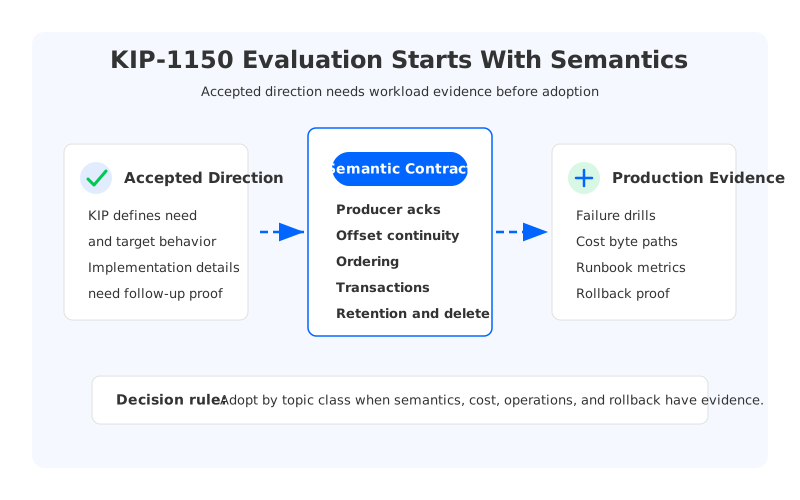
The Apache Kafka KIP is marked Accepted, which matters because it records community agreement around the direction and requirements for Diskless Topics. It also says that concrete implementation work belongs in follow-up KIPs. That split is healthy, but it creates a buyer problem: a platform owner needs a semantic checklist that turns the proposal into validation work.
1Why KIP-1150 Changes the Architecture Conversation
Classic Kafka topics are easy to reason about because the log is local to brokers and replicated across brokers. Leaders append records, followers replicate them, in-sync replicas define the acknowledgment boundary, and consumers fetch by offset. The model has operational cost, especially in cloud environments, but its mental model is clear: durable topic data lives with broker replicas.
Diskless Topics shift that boundary. The KIP describes a topic type where broker disks are no longer the primary durable storage for user data, while disks may still exist for metadata, staging, and cache. The durable path moves toward object storage and associated ingestion, coordination, and retrieval mechanisms. That can make broker replacement, storage elasticity, and cloud cost more attractive, but it raises the bar for semantic validation.
The most useful question is not "does diskless Kafka remove disks?" It does not. The useful question is "what observable behavior changes for producers, consumers, operators, and auditors?" If the answer is unclear, the design is not ready for your most important workloads.
2Accepted Direction Is Not the Same as Deployment Readiness
An accepted KIP is a strong signal, but it is not a release note, a migration guide, or a service-level objective. KIP-1150 establishes the rationale and target behavior for Diskless Topics, including the intent that diskless and non-diskless topics preserve external Kafka semantics. The details of implementation, testing, public interfaces, and migration are deferred to follow-up work.
That distinction should shape an enterprise evaluation. Treat KIP-1150 as the category definition for native Apache Kafka, then evaluate any implementation against the same semantic evidence. This includes upstream Kafka work as it matures, Kafka-compatible engines with object-storage-first designs, and managed Kafka services that hide storage decisions from the operator.
The evaluation should separate four layers:
- Protocol behavior: Kafka clients, producer acknowledgments, fetches, offsets, ACLs, and admin APIs must behave as expected.
- Topic semantics: ordering, retention, compaction, idempotency, transactions, and consumer group behavior need explicit tests.
- Storage protocol: WAL, object storage writes, metadata commits, cache invalidation, and recovery must be explainable under failure.
- Cloud topology: Availability Zone placement, private networking, IAM, encryption, lifecycle policy, and object storage request patterns must be visible enough to govern.
This layered view keeps the review from collapsing into a storage cost debate too early. Cost is part of the decision, but semantic drift is the risk that can turn a cost project into an application incident.
3The Semantics That Need Explicit Evidence
Kafka's value comes from behaviors that application teams rarely want to renegotiate. They depend on ordering within partitions, durable replay, offset continuity, consumer group coordination, idempotent production, transaction guarantees where used, and administrative controls that match their existing automation. Diskless architecture should not be evaluated by whether the diagram looks elegant. It should be evaluated by whether those behaviors survive realistic failure and migration conditions.
The first semantic gate is the producer acknowledgment path. In classic Kafka, acks=all depends on in-sync replicas. In a diskless topic design, the buyer needs to know what storage and metadata operations complete before a producer sees success. If a broker accepts a produce request and then fails, the recovery path must identify whether the record was acknowledged, whether the offset is visible, and whether another broker can serve the record without duplication or loss.
The second gate is fetch and replay behavior. Consumers do not care whether a record comes from local disk, cache, staging storage, or object storage; they care that offset reads are correct and operationally predictable. Cold reads, lagging consumers, high fan-out analytics, and disaster recovery drills should all be part of the test set because they exercise the paths most likely to touch remote storage.
| Semantic area | What to prove before adoption | Why it matters |
|---|---|---|
| Produce acknowledgments | Acknowledged records remain readable after broker loss and storage-path delay | Protects producer correctness and incident diagnosis |
| Offset continuity | Offsets are assigned, committed, and recovered without gaps that break readers | Keeps replay and lag tooling trustworthy |
| Ordering | Partition ordering holds across leader movement and cache misses | Preserves application-level assumptions |
| Idempotency and transactions | Producer fencing, sequence handling, and transaction markers behave consistently | Protects exactly-once pipelines and Kafka Streams workloads |
| Retention and deletion | Object storage lifecycle, Kafka retention, and topic deletion converge cleanly | Prevents governance and cost surprises |
| Compaction | Tombstones, key churn, and restore behavior are tested with diskless storage paths | Protects stateful applications and changelog topics |
This table is workload-facing. It asks whether teams can keep the promises they already made to application owners.
4Cost Modeling Starts After Semantics
The economic case for Diskless Topics is easy to understand: cloud block storage and cross-zone replication can become expensive when every retained byte is tied to broker replicas. Object storage can be more cost-effective for retained data, and shared storage can reduce the amount of broker-owned data that needs to move during recovery or scaling. But a cost model that ignores semantics is a weak model.
Start with the byte paths that change. In classic multi-AZ Kafka, writes may be replicated between brokers across zones, broker disks are sized for replica placement and retention, and recovery can move large amounts of local replica data. In a diskless architecture, the primary durable path may move to object storage, while broker-local disk becomes cache or staging. That can reduce replication and storage pressure, but it introduces object storage requests, WAL capacity, cache sizing, and storage service dependencies.
The cleanest review artifact is a per-topic-class cost map:
| Cost dimension | Classic topic question | Diskless topic question |
|---|---|---|
| Active durability | How many broker replicas and disks carry active data? | What WAL and storage commits define durability? |
| Retention | How much block storage is reserved for hot and retained segments? | How much object storage and lifecycle policy are required? |
| Cross-AZ movement | Which producer, replica, and consumer paths cross zones? | Which paths can stay zone-local, and which still cross service boundaries? |
| Recovery movement | How much data moves when replacing or rebalancing brokers? | How quickly can another broker reconstruct ownership from shared storage and metadata? |
| Read fan-out | Which consumers read locally, remotely, or across zones? | What cache hit rate and remote fetch behavior are expected? |
The key is to identify which expensive byte paths disappear, which additional service costs appear, and which workload classes benefit enough to justify the change. A transactional workload with strict tail-latency constraints may need a different answer from an append-heavy audit topic with long retention.
5Migration Risk Is Mostly Semantic Risk
A diskless topic migration is not only a data movement project. It changes the operational boundary around an application contract. That is why the migration plan should be built around topic classes and rollback behavior rather than cluster averages. The average topic does not exist; the risky topic does.
Start with append-heavy topics that have clear replay requirements and limited compaction or transaction complexity. Validate produce acknowledgments, lagging consumers, retention, cold reads, and broker failure. Then move to topics with higher semantic weight: compacted topics, Kafka Streams changelogs, transactional outbox patterns, and shared platform topics such as offsets or coordination workloads if the implementation touches them.
A practical migration plan has three checkpoints:
- Compatibility checkpoint: existing clients, ACLs, admin tooling, monitoring, quota behavior, and schema workflows run without special-case code.
- Failure checkpoint: broker loss, zone impairment, object storage throttling, cache misses, and metadata recovery are tested with acknowledged writes.
- Rollback checkpoint: the team can stop the migration, restore reads, and explain offset ownership without depending on tribal knowledge.
The rollback checkpoint is where weak plans usually fail. A platform team may be able to dual-write or mirror data, but still lack a clean answer for consumer offsets, transactional state, topic deletion, or compaction state. Diskless adoption is easier when rollback is designed before the first production cutover.
6Operations: What SREs Should Add to Runbooks
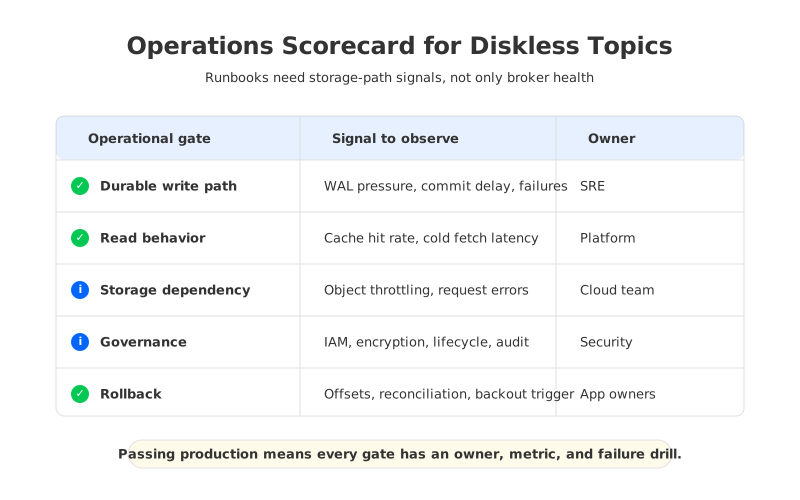
Diskless topics move some operational work away from broker storage and into shared storage, metadata, and cache behavior. That trade can be good. Broker replacement may become lighter because durable data is not trapped on the failed node. Scaling may become faster because compute and storage are less tightly coupled. But the incident model changes, and SREs need expanded observability before production adoption.
The runbook should expose the status of the durable write path, not only broker CPU and disk usage. Operators need to see WAL pressure, object storage write latency, cache hit rate, remote read latency, storage throttling, metadata commit delay, and per-topic recovery status. They also need alarms that distinguish "broker is overloaded" from "shared storage path is degraded." Those two incidents have different mitigations.
Governance enters the operational model as well. Object storage buckets, IAM roles, encryption keys, lifecycle rules, audit logs, and deletion controls become part of the Kafka data boundary. Security teams should review them as part of the streaming platform, not as a generic cloud storage appendix.
7Where AutoMQ Fits the Evaluation
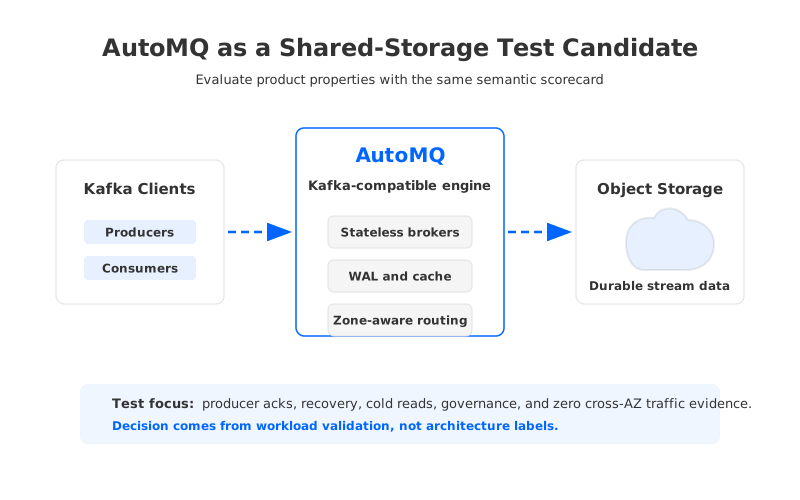
Once the semantic framework is clear, AutoMQ is worth evaluating as a Kafka-compatible, cloud-native streaming platform that already uses Shared Storage architecture. AutoMQ's S3Stream design stores stream data on S3-compatible object storage, while WAL storage and cache layers serve the low-latency write and read paths that raw object storage alone would not satisfy for Kafka-like workloads. Its Kafka compatibility documentation, shared-storage architecture, and inter-zone traffic guidance map directly to the gates above.
That does not mean every KIP-1150 discussion should become a product replacement exercise. The stronger position is narrower: if your team is evaluating Diskless Topics because broker disks, cross-AZ replication, retention growth, or recovery movement are dominating your Kafka roadmap, then AutoMQ gives you a concrete shared-storage implementation to test with the same semantic scorecard. Use representative workloads, existing clients, real retention settings, and failure drills. The evidence should come from your workload, not from a vendor paragraph.
AutoMQ's role in the review is clearest when the organization wants Kafka protocol compatibility and more independent compute and storage scaling. Stateless brokers, object-storage-backed durability, WAL design, and zero cross-AZ traffic patterns are testable architecture properties. Put them under the same scrutiny as producer acknowledgment, remote fetch, compaction, and rollback.
8A Decision Record Template for Platform Teams
The final deliverable should be a decision record, not a slide that says "adopt diskless." The record should identify the topic class, evidence, migration plan, and the owner who accepts each residual risk. That document becomes useful when the team adds another topic class or revisits the decision after upstream Kafka implementation work matures.
Use this format:
| Decision field | Required content |
|---|---|
| Topic class | Workload type, retention, throughput pattern, consumer fan-out, and semantic dependencies |
| Adoption scope | Pilot, limited production, broad production, or rejected for now |
| Semantic evidence | Producer, consumer, transaction, compaction, retention, deletion, and recovery test results |
| Cost evidence | Changed byte paths, storage class, network topology, request costs, and expected operational savings |
| Operational evidence | Metrics, alerts, runbooks, failure drills, backup and recovery procedures |
| Governance evidence | IAM, encryption, lifecycle policy, audit trail, deletion, data residency |
| Rollback path | Cutover trigger, backout trigger, offset handling, data reconciliation, accountable owner |
This is also the right place to record uncertainty. For example, a team may approve append-heavy ingestion topics while keeping compacted topics out of scope. That is a good outcome. Diskless adoption should be incremental because the semantic surface is not identical across workload classes.
KIP-1150 makes the Kafka storage conversation more concrete. It gives the ecosystem a shared direction for reducing broker-disk dependence, but it does not remove the buyer's responsibility to validate behavior. If you are comparing native Kafka roadmap options with Kafka-compatible shared-storage systems, start with semantics, then model cost, then test operations. To evaluate one implementation against that framework, use the AutoMQ Cloud deployment path and bring a representative topic class into a proof of concept.
9References
- Apache Kafka KIP-1150: Diskless Topics: https://cwiki.apache.org/confluence/display/KAFKA/KIP-1150%3A%2BDiskless%2BTopics
- Apache Kafka documentation, design and storage: https://kafka.apache.org/documentation/#design_storage
- Apache Kafka documentation, Tiered Storage: https://kafka.apache.org/documentation/#tiered_storage
- AWS EC2 On-Demand Pricing, data transfer: https://aws.amazon.com/ec2/pricing/on-demand/
- AWS S3 Pricing: https://aws.amazon.com/s3/pricing/
- Amazon MSK Developer Guide, Tiered Storage: https://docs.aws.amazon.com/msk/latest/developerguide/msk-tiered-storage.html
- AutoMQ documentation, What Is AutoMQ: https://docs.automq.com/automq/what-is-automq/overview?utm_source=blog&utm_medium=reference&utm_campaign=gs100-0012
- AutoMQ documentation, S3Stream Shared Streaming Storage: https://docs.automq.com/automq/architecture/s3stream-shared-streaming-storage/overview?utm_source=blog&utm_medium=reference&utm_campaign=gs100-0012
- AutoMQ documentation, Compatibility with Apache Kafka: https://docs.automq.com/automq/what-is-automq/compatibility-with-apache-kafka?utm_source=blog&utm_medium=reference&utm_campaign=gs100-0012
- AutoMQ documentation, Eliminate Inter-Zone Traffic: https://docs.automq.com/automq-cloud/eliminate-inter-zone-traffics/overview?utm_source=blog&utm_medium=reference&utm_campaign=gs100-0012
10FAQ
10.1Is KIP-1150 already a production feature in Apache Kafka?
KIP-1150 is marked Accepted, which records agreement on the need and target requirements for Diskless Topics. It is not the same as a completed implementation or production migration guide. Follow-up KIPs and releases should be reviewed before treating it as an available Apache Kafka feature.
10.2Does diskless mean brokers use no disks at all?
No. Diskless means broker disks are not the primary durable storage for user topic data. Brokers may still use disks for operating system files, logs, metadata, staging, cache, or other implementation details.
10.3Is Diskless Topics the same as Tiered Storage?
No. Tiered Storage moves older log segments to remote storage while the active log can still depend on broker-local disks and replication. Diskless Topics shift the primary durability model for topic data toward shared storage, which affects write acknowledgment, recovery, and operations.
10.4Which topics should teams evaluate first?
Append-heavy ingestion and long-retention audit topics are often better first candidates because their semantics are easier to validate. Compacted topics, transactional pipelines, and stateful stream-processing changelogs need deeper tests before adoption.
10.5How should AutoMQ be tested against this framework?
Test AutoMQ with existing Kafka clients, representative topic configurations, real retention settings, and failure drills. Validate producer acknowledgments, reads, recovery, cache behavior, object storage governance, inter-zone traffic, migration, and rollback before expanding scope.


