
Table of Contents
Table of Contents
Teams searching for document intelligence pipeline kafka usually have a familiar problem with a sharper edge. The business wants contracts, invoices, tickets, claims, research notes, and support transcripts to feed AI systems while the documents are still operationally relevant. A nightly extraction job may be good enough for analytics, but it is awkward when an agent has to answer a customer, route a claim, update a risk score, or enrich a retrieval index before the context goes stale.
Kafka enters the discussion because document intelligence is not one step. A file lands, metadata changes, OCR or parsing emits structure, classification adds labels, embeddings update a vector index, human review may correct the result, and downstream systems need a durable record of what changed. The pipeline needs ordered events, independent consumers, replay, backpressure isolation, and a way to recover from bad extraction logic without re-uploading every document.
The hard part is not moving bytes from a document store to a model. The hard part is keeping the context fresh, governed, and rebuildable while the platform underneath deals with retention, bursty backfills, consumer lag, connector health, and cloud infrastructure cost. That is where the architecture behind the Kafka API starts to matter.
1Why teams search for document intelligence pipeline kafka
A document intelligence pipeline usually starts as a batch workflow because documents look static. A PDF seems like a finished object. A contract appears to have a final version. A support transcript closes when the session ends. That mental model breaks down when AI systems consume document-derived context. The document may be static, but the decisions around it are not: a policy changes, a clause is reclassified, a customer consent flag changes, an embedding model is redeployed, or a human reviewer fixes an extraction error.
Kafka is useful in this environment because it lets teams model document processing as a stream of state changes rather than a chain of opaque jobs. A topic can carry document.created, document.text_extracted, document.classified, document.embedding_updated, review.corrected, and index.published events. Consumer groups allow the search index, compliance audit, analytics store, and AI application to move at their own pace while preserving their own offsets. Transactions and idempotent producers matter when a processor must avoid publishing partial results after a retry.
The search query also hides a governance question. Document intelligence pipelines often touch regulated or sensitive content: contracts, financial statements, health forms, identity documents, internal tickets, or customer conversations. Freshness is valuable only when the pipeline can prove which system saw which document version, which extraction model produced a field, which consumer read it, and whether the derived context is still allowed to be used.
2The production constraint behind the problem
The first production constraint is freshness budget. Platform teams should define the allowed time from document event to usable AI context, not only the broker write latency. The measured path includes file arrival, metadata capture, Kafka produce behavior, parsing, enrichment, embedding, vector index update, serving cache refresh, and consumer progress. A pipeline can show healthy broker latency while the AI application still reads yesterday's extracted clause.
The second constraint is rebuildability. Document intelligence logic changes frequently because extraction rules, model prompts, embedding dimensions, entity taxonomies, and compliance policies change. Kafka's offset model gives each consumer a way to resume or replay, but replay is only practical when retention, read throughput, and cluster headroom are designed for it. A rebuild that requires an emergency storage expansion or a risky partition reassignment is not a normal operating procedure.
The third constraint is boundary control. Document data tends to cross organizational lines: data engineering owns ingestion, AI platform owns models, search owns retrieval, security owns access control, and application teams own the user-facing workflow. The streaming platform must preserve a shared contract across these teams. That contract includes Kafka client compatibility, stable schemas, clear access policies, visible consumer lag, audit trails, and a migration path that does not force every application to change at once.
These constraints turn "real time" into an engineering question. The pipeline is not real time because it has Kafka in the diagram. It is real time when document-derived context reaches the decision point within a defined budget, with enough history to replay, enough governance to trust, and enough operational slack to handle backfills without breaking the online path.
3Architecture options and trade-offs
Traditional Apache Kafka uses a Shared Nothing architecture. Each Broker owns local storage for the partitions it serves, and durability is achieved through replication across Brokers. This architecture is mature and widely understood, but it couples compute, storage, and recovery work. Longer retention consumes broker-local storage. Scaling can trigger partition reassignment. Broker replacement and data balancing can become operational projects, especially when large retained logs and multi-Availability Zone deployments are involved.
Apache Kafka Tiered Storage helps when historical retention is the main pressure. It moves older log segments to remote storage while keeping the hot path on broker-local storage. That distinction matters: Tiered Storage can make long retention more practical, but it does not make Brokers stateless, and it does not remove the operational work around hot data, leader ownership, local storage, and failure recovery.
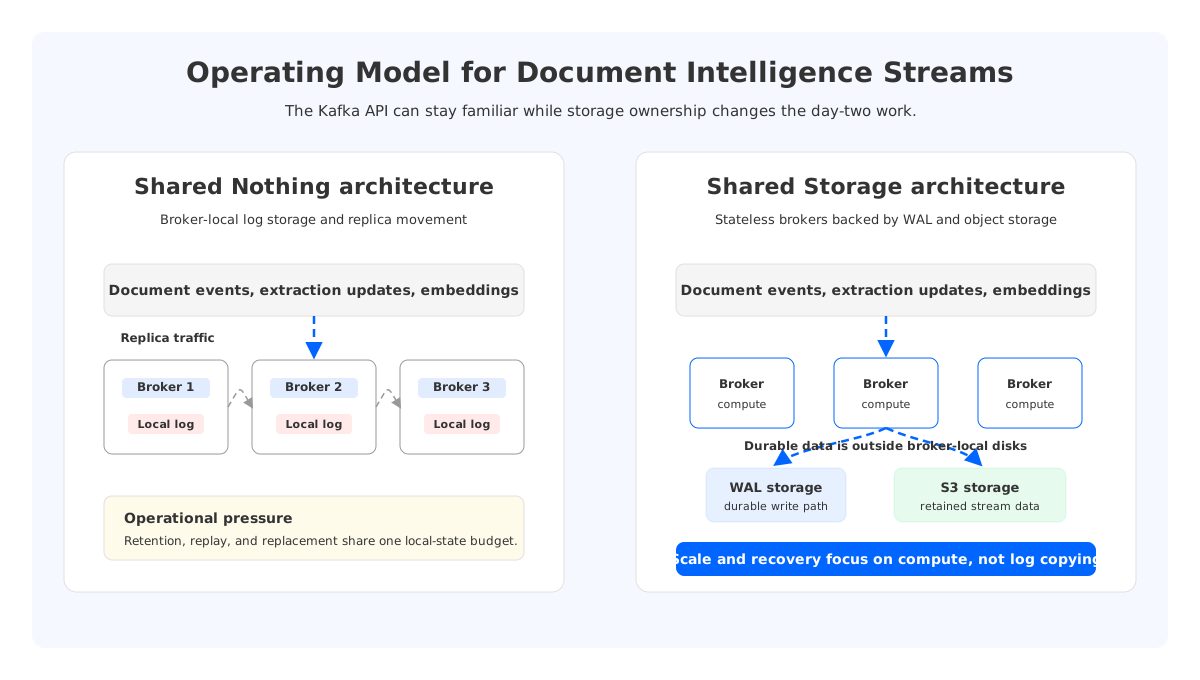
The useful evaluation separates the application contract from the infrastructure contract. The application contract is Kafka compatibility: Producers, Consumers, Consumer groups, Offsets, transactions, Kafka Connect, security controls, and observability integrations. The infrastructure contract is the work required to keep that API healthy as document volume, retention, replay, and consumers change.
| Option | Where it fits | Document intelligence risk to test |
|---|---|---|
| Traditional Kafka on broker-local storage | Predictable document volume, short retention, and an experienced Kafka operations team | Backfills and retention growth may compete with local storage and reassignment windows |
| Kafka with Tiered Storage | Large historical retention with a manageable hot path | Replay from older data improves, but hot updates still depend on Broker-local behavior |
| Kafka-compatible Shared Storage architecture | Teams that need Kafka APIs with more elastic storage and operations | Validate write path, replay throughput, cache behavior, data boundary, and migration |
| Fully managed streaming service | Teams that prioritize service abstraction over infrastructure control | Data residency, network boundary, cost visibility, and portability require review |
There is no universal answer in this table. A well-run Kafka estate can support document intelligence when the workload is bounded. Tiered Storage can be a practical improvement when retention is the bottleneck. A fully managed service can reduce operational ownership for teams comfortable with that boundary. The architectural pressure increases when freshness, replay, retention, and governance all grow at once.
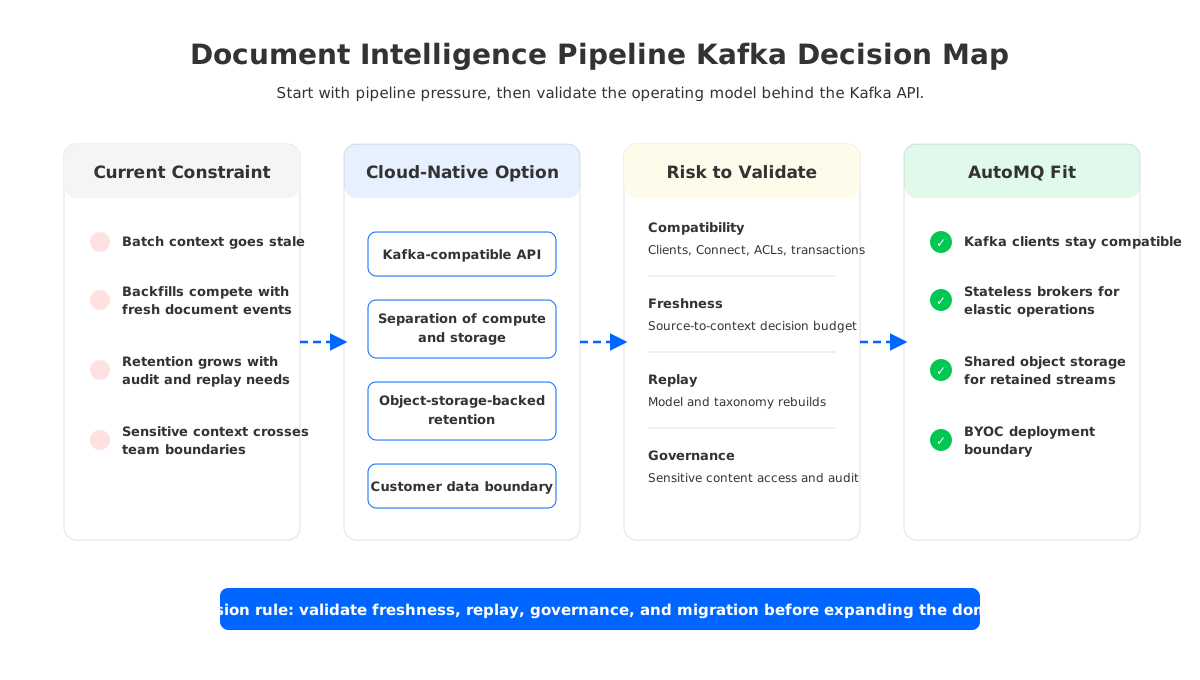
4Evaluation checklist for platform teams
A good checklist starts with the document decision, not the cluster. Identify which decisions depend on document-derived context: retrieval-augmented generation, claim routing, contract review, invoice approval, support automation, policy enforcement, or compliance monitoring. Then trace which events must arrive before that decision and which consumers need to replay those events later.
Use these questions before choosing or replacing the streaming platform:
- Freshness: Where is source-to-context lag measured, and what budget does each decision require?
- Ordering: Which key preserves the sequence that matters: document ID, account ID, case ID, tenant ID, or workflow ID?
- Replay: Which consumers must rebuild after OCR, parsing, prompt, taxonomy, embedding, or policy changes?
- Governance: Which topics carry sensitive content, derived attributes, consent state, regional restrictions, or legal holds?
- Elasticity: Can the platform absorb ingestion bursts, model backfills, and index rebuilds without manual data movement becoming the bottleneck?
- Observability: Can teams see producer errors, Broker health, connector status, processor delay, consumer lag, and index freshness together?
- Migration: Can producers and consumers move gradually while preserving offset continuity, rollback, and historical correctness?
This checklist turns a vague "real-time AI pipeline" into testable platform behavior. "The contract review assistant sees extracted renewal terms within the approved decision budget, and the extraction can be replayed after a model change without disrupting fresh documents" is a stronger requirement than "stream documents through Kafka." It gives engineering, security, and application teams something concrete to validate.
5How AutoMQ changes the operating model
Once the neutral evaluation is clear, AutoMQ becomes relevant as a Kafka-compatible streaming platform built on Shared Storage architecture. It keeps the Kafka protocol and ecosystem contract while moving durable stream data into S3-compatible object storage through S3Stream. AutoMQ Brokers act as stateless brokers for durable data ownership: persistent stream data is not pinned to broker-local disks in the traditional Kafka model.
That changes the platform work behind document intelligence. Brokers still process Kafka requests, serve leaders, cache hot data, and coordinate through Kafka-compatible metadata behavior. WAL (Write-Ahead Log) storage provides the durable write path, while S3 storage acts as the primary storage layer for stream data. Because durable data lives in shared object storage, adding, replacing, or rebalancing Brokers does not have to revolve around copying large local log segments between nodes.
For document pipelines, the benefit is not a generic speed claim. The benefit is that storage growth, replay, and compute elasticity become less tightly coupled. A team evaluating document reprocessing can reason about retained event history in object storage while scaling compute around Kafka serving and consumer work. A team handling a sudden document burst can test whether adding Brokers and tuning consumers returns the pipeline to its freshness budget without long reassignment windows.
Deployment boundaries matter as much as scaling. In AutoMQ BYOC, the control plane and data plane run in the customer's cloud account or VPC, and customer business data remains in customer-owned infrastructure. For document intelligence, that boundary is relevant because raw documents and derived context can include regulated content, customer records, or internal knowledge. A platform that preserves Kafka client behavior while keeping the data path inside the customer's environment is easier to review with security and compliance teams.
AutoMQ should still be evaluated like infrastructure, not accepted as a label. Test producer and consumer compatibility, transactions if your processors depend on them, Kafka Connect behavior, schema evolution, replay throughput, access controls, observability, failure recovery, cost envelope, and rollback. Shared Storage architecture changes the operating model; the proof is whether your document intelligence workload stays fresh, governed, and recoverable under the traffic pattern you actually run.
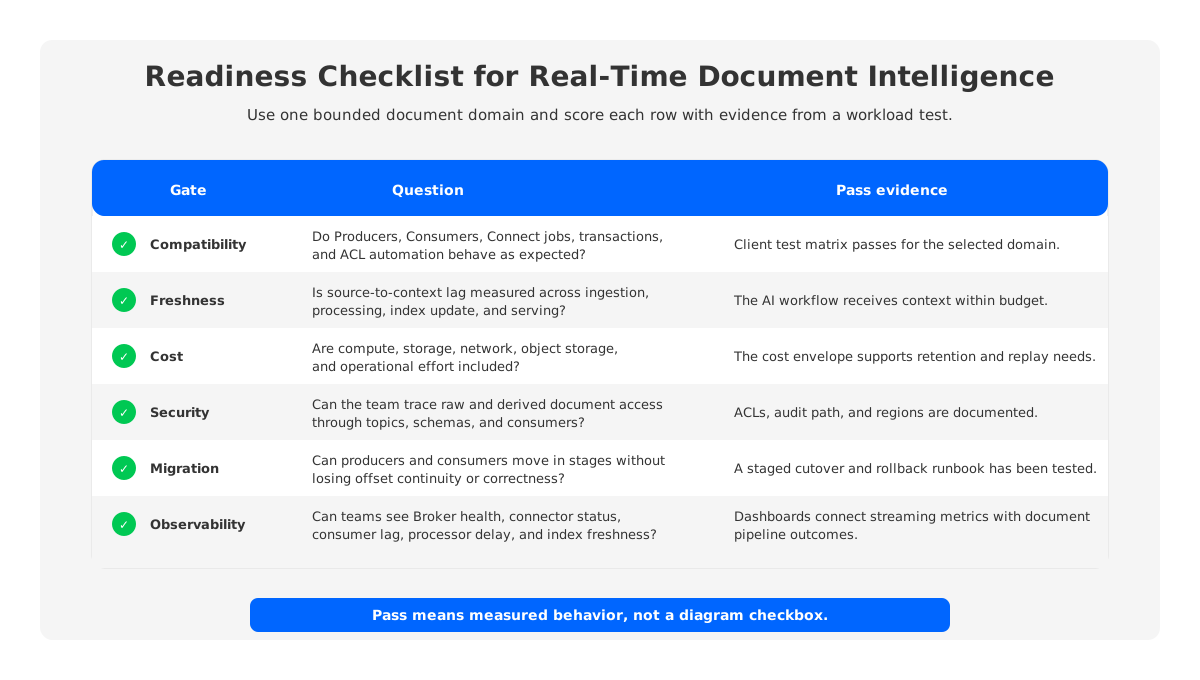
6A readiness scorecard for document intelligence
The safest evaluation starts with one bounded document domain. Good candidates include contract metadata extraction, invoice approval events, support ticket summarization, claim intake, product manual indexing, or compliance evidence collection. Avoid starting with every document in the company. A focused domain exposes the real constraints while keeping rollback possible.
Score the candidate platform with evidence rather than impressions:
| Domain | Evidence to collect | Pass condition |
|---|---|---|
| Freshness | Source-to-context lag across ingestion, stream, processor, index, and serving path | The AI workflow receives the required context version within its decision budget |
| Rebuild | Time and runbook required to replay one document domain from retained events | Rebuild is repeatable without emergency cluster changes |
| Governance | Topic ACLs, schema controls, retention, region boundary, and audit path | Security can trace who can read raw and derived document context |
| Elasticity | Broker scaling, consumer catch-up, and index rebuild behavior under burst traffic | Freshness returns to target without manual data movement becoming the critical path |
| Cost | Compute, storage, network, object storage, and operational effort | The cost envelope supports the promised retention and replay behavior |
| Migration | Dual-write, mirror, or staged consumer cutover plan | Rollback preserves document correctness and consumer progress |
This scorecard prevents a common failure mode: proving extraction throughput while ignoring correctness. A document pipeline can be fast and still publish the wrong clause. It can be correct and too stale for the workflow. It can be fresh and still fail compliance because no one can explain which derived context came from which document version.
If the search that brought you here was document intelligence pipeline kafka, make freshness and rebuildability production contracts before adding more AI consumers. Use the checklist to compare Kafka-compatible options, then run a contained workload on AutoMQ when broker-local storage, scaling, replay, or data-boundary review are becoming blockers.
7FAQ
7.1What does document intelligence pipeline kafka mean?
It means using Kafka or a Kafka-compatible streaming platform to coordinate document ingestion, extraction, enrichment, embedding, indexing, review, and audit events. The goal is to keep document-derived context fresh enough for AI applications and operational workflows.
7.2Is Kafka a good fit for document intelligence pipelines?
Kafka is a strong fit when the pipeline needs ordered events, independent consumers, durable replay, connector integration, and clear consumer progress. It is less useful for a one-off extraction job with no fan-out, no replay requirement, and no operational dependency on freshness.
7.3Does Tiered Storage solve document pipeline retention by itself?
Tiered Storage can reduce pressure from historical log retention by moving older segments to remote storage. It does not make Brokers stateless, and it does not remove hot-path work around local storage, leader ownership, and recovery. Teams should test it against their replay and freshness budgets.
7.4When should a team evaluate Shared Storage architecture?
Evaluate Shared Storage architecture when retention growth, Broker replacement, partition reassignment, cross-zone traffic, or model-driven replay creates recurring operational risk. The goal is not a different storage label; it is a Kafka-compatible operating model that decouples durable data from broker-local disks.
7.5How should teams test AutoMQ for document intelligence workloads?
Start with one bounded document domain and keep the existing path available during validation. Test client compatibility, source-to-context lag, consumer replay, connector behavior, access control, observability, failure recovery, cost envelope, and rollback before expanding to more document domains.
8References
- Apache Kafka documentation
- Apache Kafka Consumer Design
- Apache Kafka Transactions and Semantics
- Apache Kafka Connect
- Apache Kafka KRaft
- Apache Kafka Tiered Storage
- AutoMQ Kafka Compatibility
- AutoMQ Architecture Overview
- AutoMQ S3Stream Shared Streaming Storage
- AutoMQ BYOC Overview
- AutoMQ zero cross-AZ traffic overview
- Amazon S3 data durability
- AWS PrivateLink pricing


