
Table of Contents
Table of Contents
Teams usually search for dual cluster validation kafka after the migration plan has stopped being theoretical. The target platform may already exist, replicated topics may already be flowing, and the remaining question is harder than provisioning: how do you prove that the replacement cluster can carry production traffic without turning cutover into a one-way bet? Kafka migrations rarely fail because engineers forgot to copy data. They fail because production behavior is spread across client compatibility, consumer offsets, connector state, runbooks, network cost, and rollback timing.
Dual-cluster validation is the discipline of running the source and target streaming environments side by side long enough to prove equivalence where equivalence matters. It is not the same as mirroring topics and hoping lag stays low. A serious plan compares write paths, read paths, offset movement, governance, security boundaries, recovery behavior, and operator response under pressure. The point is to know which differences are acceptable before a team moves the production dependency.
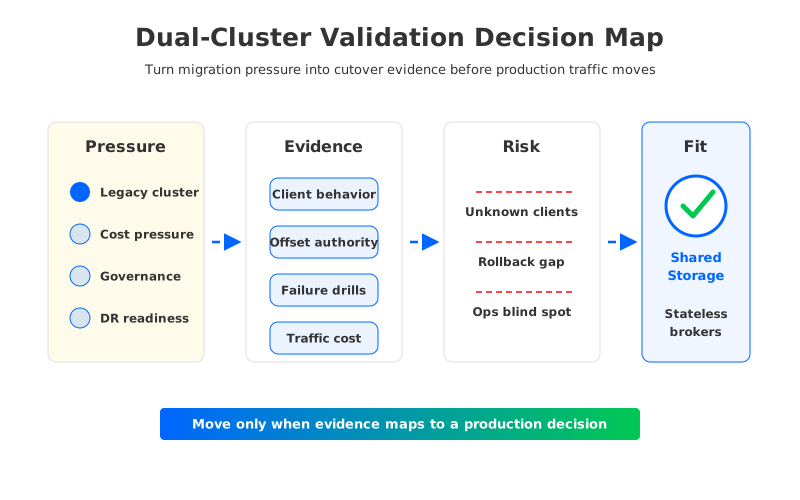
The useful mindset is closer to release engineering than backup testing. A streaming migration changes a live dependency that many services treat as always-on infrastructure. Producers may retry with assumptions about acknowledgments and idempotence; consumers may commit offsets in patterns that look harmless until a rebalance happens. A dual-cluster plan surfaces those assumptions before the final DNS, bootstrap, or routing change.
1Why Teams Search for dual cluster validation kafka
The search query usually comes from a production situation with real consequences. A team may be replacing an aging self-managed Kafka deployment because broker-local storage has become expensive to scale and slow to rebalance. Another team may be moving from a managed service to a customer-controlled environment because governance, regional control, or cost allocation has become more important than outsourcing operations. Another may be preparing disaster recovery and wants to know whether a second cluster can become a real failover target instead of a cold copy of topics.
Those situations look different on a project plan, but they share the same validation problem. The source cluster is not only a set of topics; it is a set of production contracts. Applications depend on Kafka protocol behavior, consumer group coordination, topic configuration, authentication, network paths, and operational expectations. The target cluster must prove that it preserves the contracts the business actually uses.
Three failure modes deserve early attention:
- Protocol compatibility that is too shallow. A smoke test proves that a producer sends records and a consumer reads them. It does not prove idempotence, transactions, group rebalances, offset commits, admin APIs, or client version behavior under production conditions.
- Data equivalence without operational equivalence. Mirrored topics may match record counts while the target cluster still has retention differences, ACL gaps, observability blind spots, or untested recovery procedures.
- Rollback paths that assume time can move backward. Once consumers commit offsets or downstream systems process target-cluster data, rollback is no longer a simple routing reversal. Validation has to define which state moves and which state becomes authoritative.
The result is a practical question: which risks should be proven with parallel traffic, which need controlled cutover tests, and which require explicit acceptance because there is no perfect technical equivalence?
2The Production Constraint Behind the Problem
Traditional Kafka was built around a shared-nothing model: brokers own partitions, partitions live on broker-local storage, and replication copies data between brokers for durability and availability. That design makes partition ownership explicit and keeps storage close to the broker. In cloud environments, it also makes migration and validation harder because capacity, durability, and topology changes are tied to broker-local data movement.
This matters during dual-cluster validation because every operational weakness becomes visible twice. The source cluster continues to carry production while the target cluster needs enough compute, storage, and network capacity to mirror or replay traffic. If validation requires full-fidelity traffic over a long window, the team may pay for duplicate broker fleets, storage, observability, and cross-zone or cross-region movement.
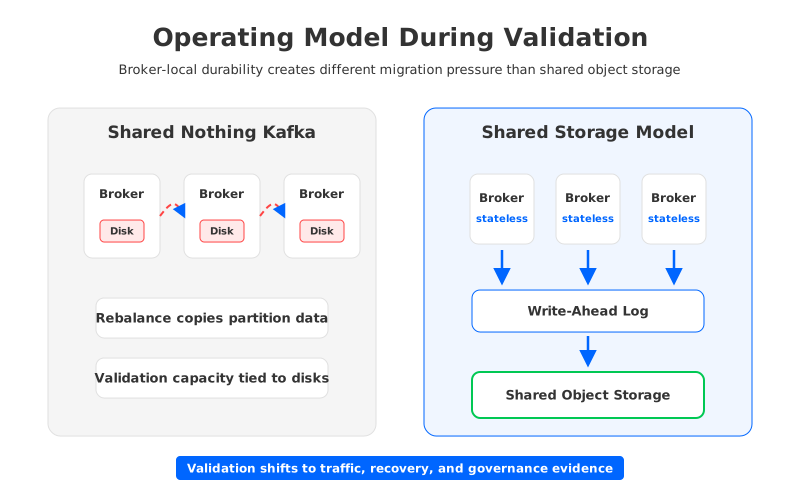
The pressure is not only financial. Broker-local storage can turn validation into a scheduling problem. Adding brokers may require partition reassignment before the target cluster is useful, and testing failure recovery may trigger more data movement than expected. The migration plan must account for the operating model that comes with it.
Dual-cluster validation therefore needs an architecture-aware plan. A checklist that treats all Kafka-compatible platforms as identical will miss the failure modes that matter. A target platform with decoupled compute and storage changes validation economics because brokers can be scaled for traffic without copying all durable data between broker disks. The validation plan should expose these differences instead of hiding them behind a generic pass/fail label.
3Architecture Options and Trade-Offs
The first design choice is the traffic pattern. Some teams mirror source topics into the target cluster and run shadow consumers there. Others dual-write from producers to both clusters. Some use a linking or replication layer and move applications in waves.
Mirroring is usually the lowest-friction starting point because it lets the target cluster receive production-shaped data without changing producer applications. It is strong for validating throughput, topic configuration, retention, consumer behavior, and observability, but it may hide producer-side compatibility issues until later.
Dual-write tests producer compatibility earlier, but it moves complexity into the application layer. The team has to decide whether the second write is synchronous, how failures are handled, and whether downstream systems can tolerate duplicate paths. It is useful for a few high-value services, but risky as a broad pattern.
Cluster linking or managed replication sits between these approaches. It gives platform teams a central control point for topic movement, offset planning, and phased cutover, but still needs validation around lag, security mapping, and operational ownership.
| Pattern | Proves Well | Main Risk | Better Fit |
|---|---|---|---|
| Topic mirroring | Target throughput and shadow reads | Producer compatibility is delayed | Early validation |
| Dual-write | Producer behavior | Application complexity | Critical services |
| Linking service | Centralized movement | Lag and governance assumptions | Platform-led waves |
| Blue/green cutover | End-to-end readiness | Rollback hardens after state moves | Final waves |
The table is not a ranking. A low-risk migration often mirrors early, tests sensitive producers selectively, then moves consumer groups in waves while preserving a rollback window. Each pattern needs a named purpose; otherwise teams collect reassuring metrics that do not answer the cutover question.
4Evaluation Checklist for Platform Teams
A validation plan should turn migration risk into observable evidence. Start with compatibility because it is easy to underestimate. Kafka is not a single API call; it is a protocol ecosystem with producers, consumers, admin clients, transactions, offset commits, consumer groups, Connect workers, schema tooling, and monitoring integrations. Test the target with the client versions and configurations production actually uses.
The second category is state. Topic data is visible, but migration state is often less visible: committed offsets, consumer lag, connector offsets, ACLs, quotas, and topic-level overrides. A team should decide which state must move, which state can be recreated, and which state should be abandoned because it belongs to a shadow-only path.
The third category is cost and capacity. Dual-cluster validation can double infrastructure during the test window, but the drivers differ by architecture. Broker-local systems bind storage, replication, and compute together. Shared-storage systems can separate durable data from broker capacity, while adding questions around object storage access, WAL design, and network boundaries.
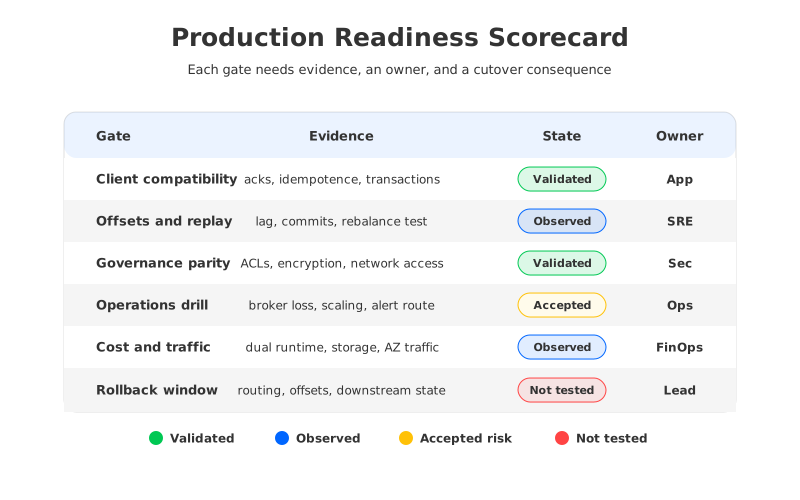
A practical checklist should cover these gates:
- Client and protocol gate. Test deployed producer, consumer, admin, Connect, and stream-processing clients, including idempotence, transactions, batching, offset commits, rebalances, and topic management when production uses them.
- Data and offset gate. Compare record counts, timestamps, key distribution, lag, committed offsets, and replay behavior. Define when the target becomes authoritative for each consumer group.
- Security and governance gate. Map authentication, authorization, encryption, network access, audit expectations, and ownership workflows.
- Operations gate. Exercise broker failure, zone impairment, scaling, alert routing, dashboards, escalation, and rollback.
- Cost gate. Separate validation cost from steady-state cost, including duplicate clusters, replication traffic, object storage, monitoring, private connectivity, and cross-zone or cross-region movement.
- Decision gate. Record which metrics must pass, who signs off, what rollback means, and when rollback expires.
This checklist is stricter than a basic migration guide because Kafka is often a shared platform. The evidence must be legible to application owners, security reviewers, finance stakeholders, and on-call engineers.
5How AutoMQ Changes the Operating Model
Once the evaluation framework is clear, the architecture question becomes sharper: can the target platform reduce validation risk without requiring every application team to relearn Kafka? AutoMQ is a Kafka-compatible cloud-native streaming system that keeps Kafka protocol semantics while moving the storage foundation toward shared object storage and stateless brokers. That does not remove the need for validation, but it changes what validation proves.
In a shared-nothing cluster, broker capacity and durable data placement are tightly coupled. When the target cluster needs more headroom, the team thinks about broker disks, partition placement, and replication movement together. In AutoMQ's shared-storage architecture, brokers are designed to be stateless from the perspective of durable stream data, with object storage carrying the durable layer and a write-ahead log absorbing the write path.
This separation affects migration planning in concrete ways. The platform team can size broker compute for validation traffic without assuming every broker is a long-lived owner of local data. Scaling tests focus more on traffic handling, and recovery drills can evaluate whether a replacement broker resumes service without local disk rebuilds.
AutoMQ also fits the governance side of migration because it is designed for customer-controlled deployments, including BYOC and software deployment models. For teams moving because of compliance or regional boundaries, this matters as much as performance. A target platform can be technically strong and still fail procurement if its data plane, network path, or control model does not match governance requirements.
Zero cross-AZ traffic is another operating-model difference worth validating. Traditional Kafka replication across availability zones can generate predictable inter-zone movement because replicas must stay in sync. AutoMQ's architecture is designed to avoid cross-AZ traffic for normal reads and writes in supported deployment patterns. A validation plan should measure traffic paths during writes, reads, broker failure, and scaling.
The product-specific migration question then becomes practical rather than promotional. If you are evaluating AutoMQ as a Kafka-compatible target, validate it against the same gates used for any platform: client behavior, topic configuration, offsets, security, observability, recovery, and rollback. Then add shared-storage gates: independent compute scaling, broker replacement, WAL choice, object storage access, and cross-AZ traffic measurement.
6A Readiness Scorecard That Avoids False Confidence
The final cutover decision should be boring. That does not mean the migration was easy; it means the important uncertainty was removed earlier. A useful readiness scorecard has fewer fields than a project tracker and more accountability than a dashboard.
Use a four-state scale instead of a binary pass/fail. Not tested means no production decision can use that area as evidence. Observed means the target behaved correctly in a narrow test. Validated means the behavior was proven under production-shaped traffic or a realistic failure drill. Accepted risk means the team understands the gap and mitigation.
For a Kafka-compatible migration, the scorecard should include at least these rows:
| Area | Evidence | Cutover Consequence |
|---|---|---|
| Producer compatibility | Retries, acks, idempotence, transactions | Move producers after write-path validation |
| Consumer continuity | Lag, commits, replay, rebalances | Move groups with defined offset authority |
| Governance parity | Topic configs, ACLs, quotas, encryption | Require security and ownership parity |
| Operational recovery | Broker failure, zone impairment, scaling, alerts | Require a tested runbook |
| Cost and traffic | Duplicate runtime, storage, cross-zone traffic | Separate validation from steady-state cost |
| Rollback | Routing, offsets, downstream state | Define rollback before cutover starts |
The scorecard also protects the team from a common migration trap: counting green dashboards instead of answered questions. A cluster can show low replication lag while security mappings are incomplete. A consumer can read from the target while its offset rollback plan is undefined. The scorecard forces each green signal to map back to a production decision.
The same discipline applies after cutover. Keep the source cluster available only for the defined rollback window, then retire it decisively. Long-lived dual operation sounds safe, but it can create a second source of truth and unclear ownership.
If your team is evaluating a Kafka-compatible migration path and wants to test a shared-storage operating model, the AutoMQ migration documentation is a useful next step: review the AutoMQ migration overview. The right outcome is a cutover where remaining risks are named, measured, and owned before production traffic moves.
7References
- Apache Kafka documentation for producers, consumers, transactions, consumer groups, Kafka Connect, KRaft, and tiered storage concepts.
- AutoMQ migration overview for Kafka-compatible migration planning.
- AutoMQ architecture overview for shared-storage architecture and stateless broker concepts.
- AutoMQ WAL storage documentation for write-ahead log design considerations.
- AutoMQ overview for deployment model and Kafka compatibility context.
- Amazon S3 user guide for object storage service behavior and integration context.
8FAQ
8.1What is dual-cluster validation for Kafka?
Dual-cluster validation is a migration approach where the source Kafka cluster and the target Kafka-compatible cluster run side by side while the team proves production readiness. It usually includes mirrored data, shadow consumers, compatibility tests, failure drills, and a documented cutover and rollback plan.
8.2Is topic mirroring enough for a Kafka migration?
Topic mirroring is a strong starting point, but it is not enough by itself. It validates the target cluster's ability to receive production-shaped data, yet it may not prove producer compatibility, offset authority, connector state, security parity, or rollback safety.
8.3How long should dual-cluster validation run?
The validation window should cover peak traffic, batch bursts, consumer rebalances, maintenance events, and at least one meaningful failure drill. A fixed duration is less useful than evidence that the target handled risky production conditions.
8.4How does shared storage affect Kafka migration validation?
Shared storage changes the operating model by separating durable data from broker-local disks. During validation, that can make compute scaling, broker replacement, and storage cost easier to reason about independently. The team still needs to test compatibility, WAL behavior, object storage access, network paths, and recovery.
8.5When should AutoMQ enter the evaluation?
AutoMQ should enter after the team has defined the validation gates it would use for any Kafka-compatible target. Evaluate it against client compatibility, state movement, governance, operations, cost, and rollback, then add shared-storage checks such as compute scaling, stateless broker recovery, WAL selection, and cross-AZ traffic measurement.


