
Table of Contents
Table of Contents
Teams search for dual write exit strategy kafka after migration becomes real. The target cluster exists, a few services write to both sides, dashboards show records arriving, and the question is no longer whether dual writes work. The question is when the team can stop them without creating a hidden split-brain event log.
That is the uncomfortable part of a Kafka-compatible cutover. Dual write is introduced as a risk reducer, but it becomes a risk amplifier if the exit criteria are vague. Every additional day of parallel writes increases the surface area for ordering differences, retry behavior, schema drift, idempotency gaps, monitoring confusion, and unclear rollback authority. A good exit strategy treats dual write as temporary migration scaffolding, not as steady-state architecture.
The hard work is not picking a magic timestamp. It is proving that the target platform can become authoritative for producers, consumers, governance, observability, and recovery. That proof has to include producer acknowledgments, transactions where used, consumer group offsets, ACLs, and stream processing checkpoints. If those details are not written down before traffic moves, the exit decision will be made under pressure.
1Why Teams Reach for Dual Writes
Dual write appears because a clean stop-and-switch cutover is too disruptive. Some workloads cannot pause writes long enough for replication lag to drain. Some application teams need gradual rollout by service, region, or business domain. Others want to compare latency, consumer lag, error rates, and data quality under real traffic before they promote the target.
Those are legitimate reasons. Dual write gives migration teams a way to run the target path under production load while the source path remains available. It can also expose client compatibility issues that synthetic benchmarks miss: serializer versions, retry settings, transactions, consumer rebalance behavior, and tooling assumptions. The problem begins when dual write is treated as the migration plan itself.
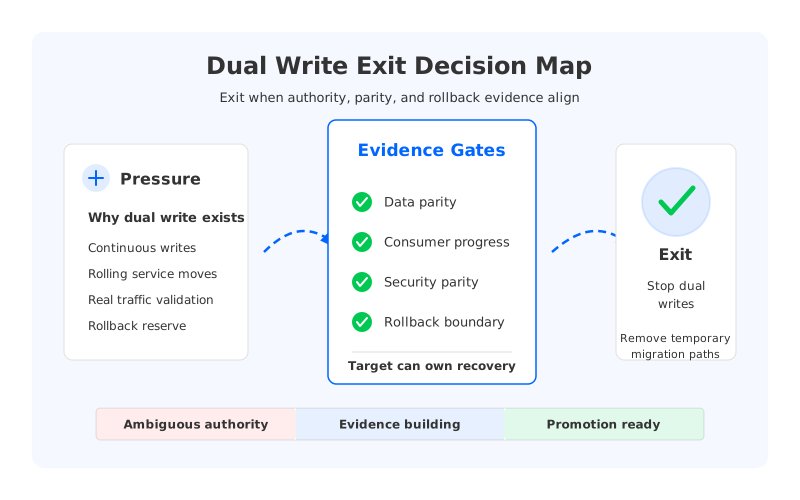
The exit decision should be tied to authority, not comfort. During discovery, the source cluster is authoritative and the target is a candidate. During dual write, both clusters may receive the same event, but that does not make them equally trusted systems. During promotion, one side must become the recovery baseline.
Three questions keep the plan grounded:
- What is the source of truth for each event family? A payment authorization event, an observability metric, and a recommendation feature update may tolerate different replay and duplicate behaviors.
- What exactly proves target readiness? "Data is flowing" is too weak. The team needs evidence across offsets, lag, producer errors, consumer progress, schema compatibility, security controls, and downstream outcomes.
- Where does rollback stop being clean? After consumers commit progress on the target and source retention moves past the old boundary, rollback may require replay or repair rather than a simple client switch.
These questions are intentionally operational. A dual-write exit is not a philosophical debate about source and target platforms. It is a release gate for a system that carries business state.
2The Migration Risk Behind the Workload
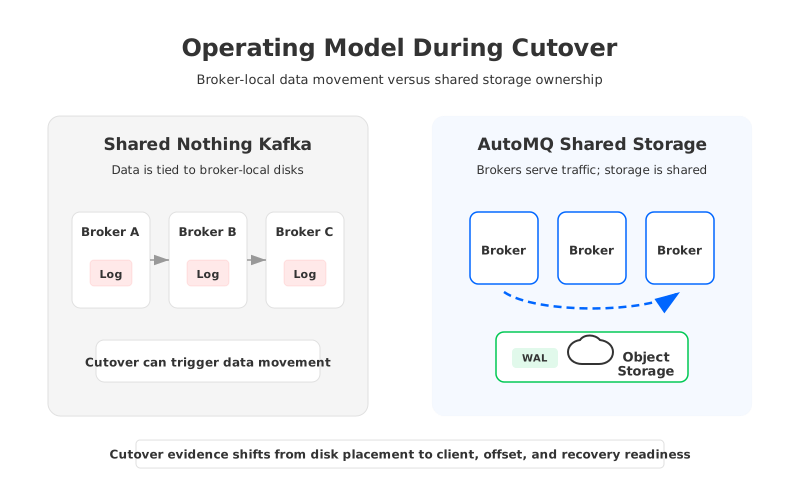
Traditional Apache Kafka clusters make this gate harder because the operational model is coupled to broker-local storage. Brokers own local log segments. Replication, leader placement, disk balance, broker replacement, and partition reassignment are connected through local data movement. When migration overlaps with a capacity event, the source may need to replicate data, serve clients, rebalance partitions, and retain rollback history at the same time.
That coupling affects the target side too. If the destination also relies on broker-local storage, the migration must provision enough broker, disk, and network headroom for steady-state traffic plus temporary migration load. Backfill and dual write can make the destination look healthy during average traffic but fragile during replay or broker maintenance.
The risk is sharper for stateful consumers. Kafka offsets are scoped to topic partitions, and many systems treat them as application state. Stream processors may store Kafka positions in checkpoints; connectors may have their own source or sink state. If dual write changes record ordering, topic names, partition counts, or commit timing, the target may contain the data while applications still cannot resume safely.
There is also a governance dimension that gets less attention than throughput. Dual write doubles the paths that need ACLs, certificates, schemas, quotas, audit logs, and ownership. A small configuration mismatch can look like a platform failure during cutover. In regulated environments, the team also has to explain whether both clusters are inside the same data boundary and whether rollback keeps sensitive data under the same controls.
3Compatibility, Replication, Rollback, and Observability Trade-Offs
An exit strategy should start with the migration pattern rather than the tool name. Different patterns create different failure modes, and putting all of them under "dual write" hides the decisions operators need.
| Pattern | What it optimizes for | Exit risk to manage |
|---|---|---|
| Application-level dual write | Gradual producer rollout with real business traffic | Duplicate semantics, retry divergence, and unclear authority if one side accepts a write and the other side fails |
| Replication bridge | Keeping a target cluster populated before traffic moves | Lag, offset translation, topic mapping, and cutover timing between replicated data and live writes |
| Temporary write proxy | Rolling producer migration while preserving a single authoritative stream | Proxy availability, source/target ownership timing, and clear promotion criteria |
| Stop-and-switch | Simpler authority model for smaller workloads | Maintenance window length, lag drain, consumer restart coordination, and rollback if the target rejects traffic |
The right pattern depends on the workload. Application-level dual write can be reasonable when producers own idempotency keys and downstream systems tolerate duplicates. It is risky when producers rely on Kafka ordering alone or when teams cannot prove that retries behave identically across both destinations. A replication bridge can reduce application changes, but it does not automatically solve consumer progress or rollback. For a small, low-dependency workload, stop-and-switch may be more reliable.
Rollback deserves a separate design because it changes over time. Early in dual write, rollback may mean disabling the target write path and continuing from the source. After a producer batch is promoted, rollback may require confirming that every event written to the target also exists in the source or can be replayed. After consumers move and commit offsets on the target, rollback must answer where those consumers resume on the source.
Observability turns these trade-offs into evidence. A dual-write dashboard should not only compare source and target throughput. It should compare producer success rate, produce latency, append errors, replication or proxy lag, consumer progress, rejected ACL requests, schema errors, duplicate detection, and downstream business counters. If broker metrics look healthy but downstream totals diverge, the exit gate should stay closed.
4Evaluation Checklist for Migration Teams
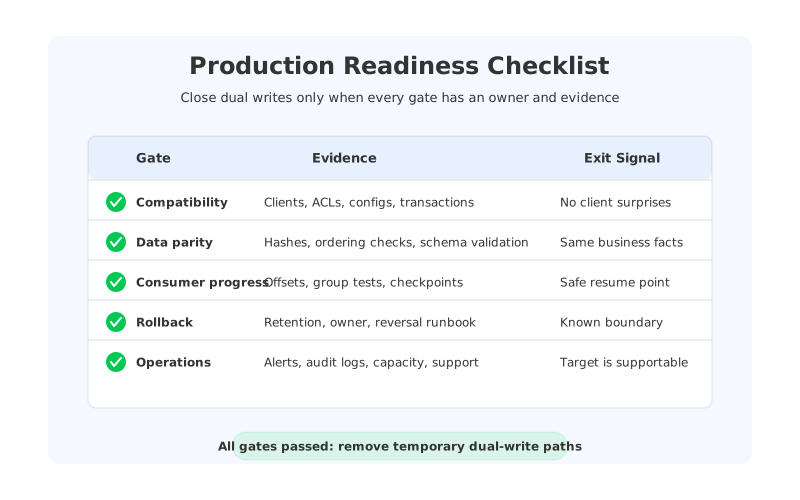
The practical exit checklist is a contract between platform owners and application owners. It should be short enough for a change window and strict enough to prevent optimistic promotion.
| Gate | Evidence to collect | Exit implication |
|---|---|---|
| Compatibility | Client versions, protocol features, authentication, ACLs, topic configs, transactions where used | Producers and consumers can use the target without application surprises |
| Data parity | Sampled event hashes, key counts, ordering checks for critical partitions, schema validation, duplicate handling | The target stream represents the same business facts, not merely similar throughput |
| Consumer progress | Offset mapping or byte-level continuity, group restart tests, stateful job checkpoint behavior | Consumers can resume on the target without silent skips or uncontrolled reprocessing |
| Rollback boundary | Source retention window, reverse path, disabled-write procedure, DNS or bootstrap reversal, decision owner | The team knows when rollback is still clean and when recovery requires a different runbook |
| Cost and capacity | Temporary dual-write cost, broker headroom, storage growth, network paths, connector or proxy fleet capacity | The migration does not hide a steady-state cost problem behind temporary overprovisioning |
| Operations | Dashboards, alerts, audit logs, runbook owners, change freeze rules, escalation path | The target is supportable after the migration team leaves the room |
The checklist should be applied per workload family, not only per cluster. A low-value telemetry topic and a financial transaction stream should not share the same exit threshold. Some topics need only a small replay window and duplicate-tolerant consumers; others need partition-level parity checks, strict consumer group coordination, and a longer observation period.
Define the final dual-write day in reverse. Start from the moment when the target is the recovery baseline, then ask what must be true one hour, one day, and one week before promotion. This forces the team to prepare retention, consumer movement, alert ownership, and rollback decisions before "we are almost done" pressure takes over.
5How AutoMQ Changes the Operating Model
Once the evaluation framework is clear, the platform architecture becomes easier to judge. If broker-local storage makes migration, capacity, and recovery tightly coupled, the target platform should reduce that coupling rather than recreate it.
AutoMQ is a Kafka-compatible cloud-native streaming platform built around a Shared Storage architecture. It keeps Kafka protocol and client compatibility while moving persistent storage away from broker-local disks and into object storage, with WAL storage used for durable write acceleration and recovery. Brokers become more stateless because they are no longer the long-term home of partition data.
That shift matters for dual-write exit planning. Capacity planning becomes less tied to local disk placement and partition data movement. Broker replacement and scaling decisions can focus more on compute and traffic because persistent data remains in shared storage. Cross-AZ broker-to-broker replication pressure can be reduced by avoiding the classic model where each broker replica stores its own full local copy. Migration planning can focus on client behavior, offsets, governance, and rollback rather than local-disk reshuffles.
AutoMQ also provides Kafka Linking for migration scenarios where teams need coordinated producer movement, consumer group progress handling, and clearer rollback boundaries. That does not remove the need for workload-specific proof. It changes the kind of proof a platform team can demand: byte-level message synchronization, rolling producer migration, consumer progress coordination, and target-side readiness can be evaluated as one workflow.
The most important discipline is still the same: do not promote the target because dual write has been running for a certain number of days. Promote it because the evidence says the target can own the workload. For teams evaluating a move from Apache Kafka, MSK, or another Kafka-compatible environment, an AutoMQ proof should include the exact client versions, authentication mode, topic subset, consumer groups, stateful jobs, dashboards, and rollback steps that will appear in production.
When the target architecture separates storage durability from broker identity, the exit discussion becomes more precise. The team can stop asking whether the target cluster has enough local disk history to survive every migration edge case and start asking the questions that matter to the application contract: are the events present, are the offsets meaningful, are the consumers controlled, and is rollback still understandable?
6A Practical Exit Sequence
A clean exit sequence is staged. First comes proof without authority: the target receives replicated, proxied, or dual-written events, but the source remains the recovery baseline. Next comes limited authority: one non-critical workload family promotes producers and consumers while source retention remains long enough to recover. Then more workloads move after the first group proves that monitoring, support, and rollback procedures work outside a lab. The final stage is scaffold removal: dual write, replication connectors, proxy paths, temporary dashboards, and emergency permissions are retired.
Each stage needs a named owner and a stop condition. A stop condition can be technical, such as sustained produce errors, unexplained consumer lag divergence, schema validation failures, or duplicate rates above tolerance. It can also be operational, such as missing on-call coverage or unresolved access-control drift. The point is to make stopping normal.
The exit is complete only when the temporary architecture is gone. That includes dual-write flags, special retry paths, one-off ACLs, extra connector capacity, custom dashboards, and source-cluster retention extensions. Leaving those pieces in place makes incidents harder because no one can tell which path is active. The final runbook should say what was removed, what remains for audit, and which cluster is now the source for restore, replay, and reconciliation.
Back at the original search query, dual write exit strategy kafka is really a question about confidence. The safest answer is not "run both clusters longer." It is a controlled path to stop running both clusters. If your team is evaluating a Kafka-compatible migration to AutoMQ, start with a small workload and validate the exit mechanics before expanding: open the AutoMQ console and test compatibility, producer movement, consumer progress, and rollback with real traffic patterns.
7References
- Apache Kafka documentation
- Apache Kafka consumer configuration:
group.id - Apache Kafka message delivery semantics
- Apache Kafka MirrorMaker 2 configuration
- Apache Kafka KIP-405: Kafka Tiered Storage
- AutoMQ architecture overview
- AutoMQ compatibility with Apache Kafka
- AutoMQ migration overview
- AutoMQ Kafka Linking
8FAQ
8.1What is a dual-write exit strategy in Kafka migration?
A dual-write exit strategy defines when and how a workload stops writing to both the source and target Kafka-compatible systems. It should specify authority, data parity checks, consumer progress handling, rollback boundaries, observability, and the cleanup of temporary migration paths.
8.2Is dual write safer than MirrorMaker 2 for Kafka cutover?
Not automatically. Dual write can reduce cutover pressure, but it introduces duplicate, ordering, retry, and authority risks. MirrorMaker 2 is useful for cross-cluster replication, while dual write is an application or migration-pattern decision. Production teams should evaluate idempotency, consumer behavior, offset handling, and rollback needs before choosing either pattern.
8.3When can a team stop dual writes?
A team can stop dual writes when the target is proven authoritative for the workload. That proof usually includes producer success, data parity, consumer progress, security parity, monitoring coverage, rollback criteria, and a defined source retention window. Calendar time alone is not a reliable exit signal.
8.4How does a shared storage architecture help Kafka-compatible cutovers?
Shared Storage architecture separates persistent data from broker identity. That can reduce the amount of local broker data movement involved in scaling, replacement, and recovery. During migration, this helps teams focus the exit gate on client compatibility, offsets, governance, and rollback rather than on broker-local disk reshuffling.
8.5Does AutoMQ eliminate the need for migration testing?
No. AutoMQ's Kafka compatibility, Shared Storage architecture, and Kafka Linking can reduce migration complexity, but production teams still need workload-specific tests. The proof should use real client versions, authentication settings, topic configurations, consumer groups, stateful jobs, and rollback procedures.


