
Table of Contents
Table of Contents
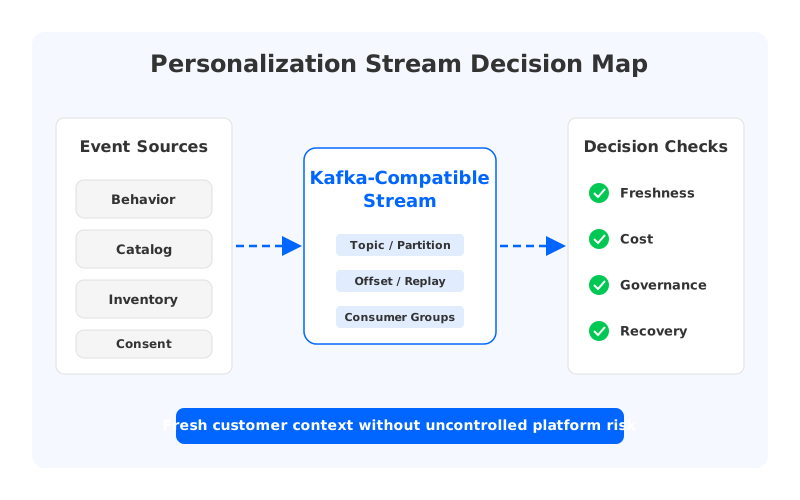
Teams searching for ecommerce personalization streams kafka are usually past the point of asking whether personalization matters. They already have product views, cart events, search queries, promotion clicks, inventory updates, profile changes, and customer service signals moving through the business. The unresolved question is how fresh that context needs to be, and what kind of streaming foundation can keep it fresh without turning every campaign, replay, and holiday traffic spike into a platform incident.
Personalization looks simple from the storefront. A customer lands on a page, and the site should rank products, offers, recommendations, and delivery promises using current context. Behind that decision is a moving graph of events: anonymous browsing behavior, authenticated identity, consent state, catalog availability, pricing rules, fraud signals, loyalty tier, carts, and model outputs. The data changes quickly, while retail teams still expect predictable cost, governance, and recovery.
Kafka is a natural substrate for this problem because it gives teams durable ordered records, Topic and Partition structure, Consumer group parallelism, Offset tracking, replay, Kafka Connect integration, and a broad ecosystem of stream processing tools. Those strengths do not settle the architecture decision. An ecommerce personalization platform does not only need a place to send events. It needs a way to preserve context freshness while controlling storage growth, cross-zone traffic, schema evolution, model feedback loops, and production recovery.
1Why teams search for ecommerce personalization streams kafka
The search query usually appears when batch personalization starts missing the business moment. A nightly segment can still support email campaigns and reporting. It cannot reliably support "customer compared two products," "inventory dropped below a threshold," "this shopper used a coupon," or "the model should stop showing an unavailable product." Ecommerce context has a half-life. Some facts are useful for months, while others lose value before a user leaves the session.
That half-life creates different expectations across teams. Product managers want faster experiments and more relevant journeys. Data scientists want feature freshness and a clean training trail. Marketing teams want targeting changes to propagate quickly. SREs want the pipeline to absorb campaign spikes. Security and privacy teams want consent, deletion, and access boundaries to travel with the data.
A useful Kafka design starts by separating event classes:
- Behavior events capture page views, searches, clicks, carts, checkouts, and returns. They usually dominate volume and drive low-latency decisions.
- Context events describe catalog, inventory, price, promotion, location, loyalty, and profile changes. They may be lower volume but can invalidate many recommendations.
- Decision events record what was shown, why it was ranked, which model or rule version ran, and whether the customer responded.
- Governance events carry consent, deletion, policy, access, and audit state. They should not be an afterthought because they determine which downstream uses are allowed.
Once those event classes are explicit, the platform team can ask which streams require tight freshness, which need replayable history, which must be compacted by key, which should be retained for model analysis, and which must be restricted by tenant, region, or privacy policy. Kafka can support all of these patterns, but the cost and operating model depend on how the cluster stores, replicates, scales, and recovers.
2The production constraint behind the problem
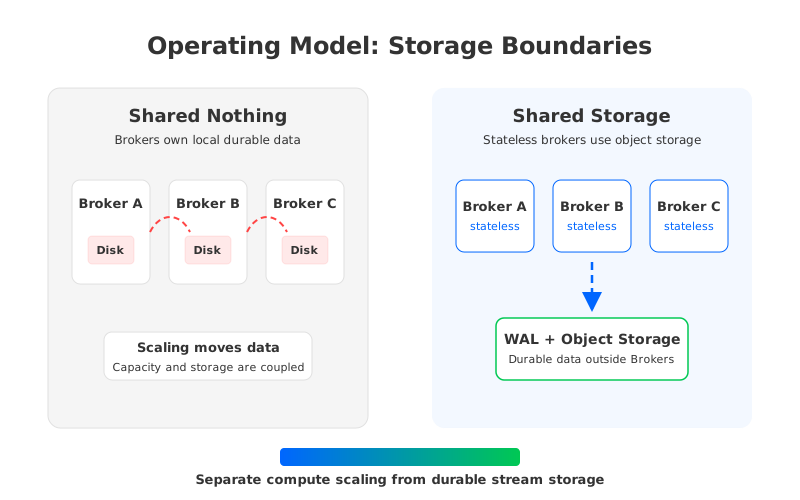
Traditional Kafka uses a Shared Nothing architecture. Each Broker owns local persistent storage, and availability comes from replication across Brokers. This model is clear and battle-tested. Operators can reason about Partition leaders, followers, replication factor, ISR behavior, retention, and disk usage. The trade-off is that compute capacity, storage capacity, recovery behavior, and data placement meet at the Broker.
Ecommerce personalization puts pressure on that coupling because traffic is seasonal, bursty, and business-driven. A flash sale can multiply behavior events. A campaign launch can create a short-lived fan-out of enrichment jobs. A recommendation incident can require replaying a recent window through a corrected feature pipeline. A privacy request can force deletion propagation and evidence checks across derived datasets. With broker-local storage, the platform team often plans around peak write rate, retained history, and recovery headroom at the same time, even though those dimensions rarely grow together.
Cross-zone replication is another constraint that appears late if the team focuses only on Kafka throughput. Highly available Kafka deployments commonly span multiple Availability Zones. Broker-to-broker replication, client placement, private connectivity, and sink traffic can all create inter-zone data transfer. The exact price depends on cloud provider, region, and service, so every production plan should verify current cloud pricing. The stable architectural point is simpler: if every event must be copied through the application layer between zones, traffic growth becomes a direct infrastructure cost driver.
The third constraint is replay. Personalization systems replay for legitimate reasons: rebuilding features, backfilling models, correcting late catalog updates, investigating ranking defects, and reconciling consent state. Replay is where a fragile design exposes itself. If replay saturates Brokers, starves live consumers, breaks idempotency in sinks, or writes stale decisions into analytics, the team does not have a personalization platform. It has a fast ingestion path with a risky recovery story.
3Architecture options and trade-offs
The useful comparison is not "Kafka or not Kafka." It is how each architecture handles freshness, replay, feature lineage, and operating ownership when ecommerce traffic is unpredictable.
| Option | Where it fits | Main trade-off |
|---|---|---|
| Batch personalization exports | Email campaigns, offline reports, slow-changing segments | Simple to operate, but stale for session-time decisions and incident response. |
| Application logs plus warehouse jobs | Early experimentation with limited real-time needs | Fast to start, but weak ordering, replay, and cross-team ownership. |
| Kafka-backed personalization streams | Real-time ranking, feature updates, fan-out, and model feedback | Strong event substrate, but Kafka operations become part of the storefront SLO. |
| Hot stream plus governed archive | High-volume behavior events with long-term analysis and compliance needs | Clear separation of serving and evidence paths, but requires explicit lineage between them. |
A Kafka-backed design works because ecommerce personalization is event-shaped. The storefront emits behavior events. Catalog and inventory systems emit context changes. Feature jobs consume both and write derived feature updates. Ranking services emit decision events. Analytics, lakehouse ingestion, fraud checks, experimentation, and customer support tools consume the same durable stream at their own pace. Offsets give the platform a shared coordinate system for downstream progress.
The design still needs discipline. Partitioning by customer, session, cart, or item changes ordering and parallelism. Compacted topics are useful for latest-state context, but they do not replace an immutable event trail. Idempotent producers and transactions can help protect multi-step writes, yet downstream sinks still need stable keys and duplicate handling. Kafka Connect can standardize movement into search indexes, lakehouse tables, and operational stores, but connector ownership, dead-letter topics, and schema evolution remain production work.
Tiered Storage also deserves a role. Apache Kafka Tiered Storage can move older log segments to remote storage and help with long retention. That is valuable when the main pain is retaining more history. It does not fully decouple Broker compute from the active storage path, and it does not by itself remove the operational coupling between scaling and broker-local state. A Shared Storage architecture becomes more relevant when scaling, replay, and data movement are the repeated source of operational risk.
4Evaluation checklist for platform teams
Start with compatibility, because ecommerce platforms rarely get a clean-room rewrite. The evaluation should use the real producers, serializers, authentication methods, ACLs, quotas, Schema Registry pattern, stream processing jobs, connectors, observability stack, and admin workflows. A platform that changes behavior around Consumer group rebalancing, transactions, compaction, or connector workloads can create migration risk in the least visible parts of the system.
Move next to freshness budgets. Product-page ranking, cart recovery, fraud scoring, and inventory suppression may have tight freshness budgets. Training data, long-term attribution, and campaign reporting may tolerate slower paths. The architecture should make these budgets explicit rather than forcing every event through the same operational posture.
Cost modeling should be line-item based. A single number helps finance, but it hides the architecture. Platform engineers need to know which costs grow with write throughput, retained bytes, replication factor, read fan-out, inter-zone traffic, private connectivity, object requests, lakehouse writes, and observability. Once those lines are separate, the team can tell whether a cost spike is business success, a bad partitioning choice, replay, or a storage architecture issue.
Governance should be evaluated by event class, not by cluster. Behavior events, profile updates, consent state, delivery promises, model features, and ranking decisions do not always share the same retention, region, encryption, or access policy. A mature design separates these concerns by Topic, schema, role, sink, and replay procedure. It also records lineage fields such as Topic, Partition, Offset, schema version, model version, and source system timestamp so a ranking decision can be explained after the fact.
Migration planning is where optimism gets expensive. A credible plan defines source topics, target topics, schema compatibility, offset mapping, dual-write or mirroring strategy, validation metrics, cutover criteria, and rollback criteria. The rollback question should be concrete: if the new personalization stream mishandles ordering, feature freshness, or consent propagation, how does the team return to a known-good offset without replaying bad decisions into customer-facing systems?
If a platform cannot answer these items in a test environment, production traffic will not make the gaps smaller.
5How AutoMQ changes the operating model
After the neutral evaluation is complete, the architecture requirement becomes clearer: keep Kafka-compatible behavior while reducing the amount of durable state tied to Brokers. AutoMQ is a Kafka-compatible cloud-native streaming platform that keeps the Kafka protocol and ecosystem surface while replacing broker-local persistent storage with a Shared Storage architecture backed by S3-compatible object storage.
That shift matters for ecommerce personalization because Brokers are no longer the long-term home of the stream. AutoMQ Brokers handle Kafka protocol processing, leadership, caching, and request routing. Durable stream data is stored through S3Stream with WAL storage and S3 storage. In practice, the operating model changes from "scale Brokers and move their local data" to "scale stateless Brokers while durable data remains in shared storage."
For personalization streams, the difference shows up during the messy moments. A sale spike should require useful compute capacity, not a long storage rebalance before that capacity helps. A feature backfill should not turn retained history into a Broker-local recovery project. A node replacement should not be treated as a data migration event. A capacity review should distinguish request processing, cache behavior, retained history, and downstream fan-out.
AutoMQ also changes the deployment-boundary conversation. AutoMQ BYOC runs the control plane and data plane in the customer's cloud account and VPC, and AutoMQ Software targets private deployments. For ecommerce teams that process customer behavior, profile context, and regional consent signals, this boundary can be as important as storage mechanics. The point is to evaluate whether Kafka-compatible streaming can operate inside the environment the organization already audits.
AutoMQ does not remove the need for personalization design. Teams still need schema discipline, consent propagation, idempotent sinks, feature-store ownership, retention policy, observability, and rollback procedures. It changes the platform layer underneath those controls. When the repeated pain is Kafka-compatible streaming plus cloud cost, scaling friction, and broker-local data movement, AutoMQ deserves evaluation alongside the existing Kafka operating model.
6A practical readiness scorecard
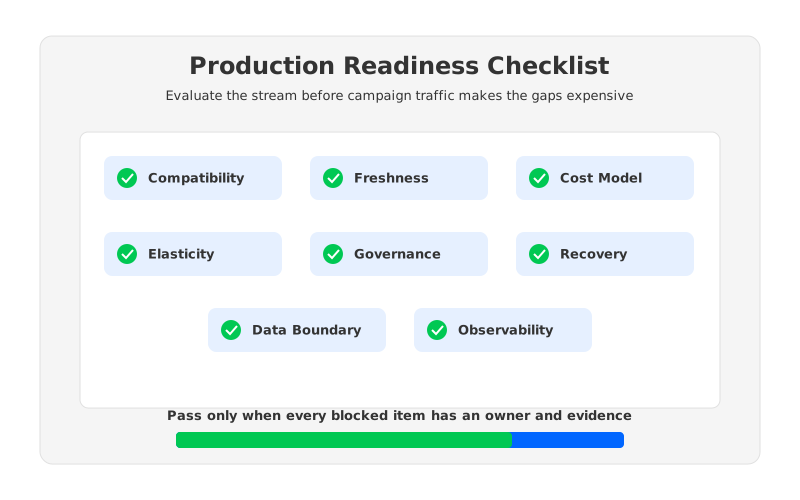
Use the scorecard before a platform migration or a new personalization rollout. Rate each item as pass, risk, or blocked. A blocked item should stop the rollout until the team has an owner and evidence.
| Area | Pass condition |
|---|---|
| Compatibility | Existing Kafka clients, Consumer groups, connectors, schemas, ACLs, quotas, and monitoring work with minimal application change. |
| Freshness | The team measures event-to-feature, event-to-ranking, and event-to-lake lag, not only raw Consumer lag. |
| Cost | Compute, storage, replication, read fan-out, cross-zone traffic, object requests, enrichment, and observability are modeled separately. |
| Elasticity | Campaign spikes and replay jobs do not require long storage movement before useful capacity appears. |
| Governance | Consent, deletion, profile, feature, model, and decision events carry clear lineage and access policy. |
| Recovery | Replay, rollback, duplicate handling, late events, and sink idempotency are tested before cutover. |
| Data boundary | Customer context stays within the intended account, VPC, region, or private environment. |
The scorecard is plain because personalization failures are usually plain. A customer sees the wrong recommendation. A model uses stale inventory. A replay writes duplicate features. A privacy update arrives after a decision has already been made. Kafka can provide the durable event backbone, but the production design has to make freshness, lineage, and recovery visible enough to operate.
Return to the original search query: ecommerce personalization streams kafka. The useful answer is not "put every customer event into Kafka" or "stream everything in real time." The useful answer is to map which customer context decays quickly, which evidence must be replayable, which costs grow with the architecture, and which operating model gives the platform team room to recover. If your evaluation points toward Kafka-compatible Shared Storage architecture inside your own cloud boundary, start with a hands-on AutoMQ review here: try AutoMQ BYOC.
7References
- Apache Kafka documentation
- Apache Kafka consumer configuration
- Apache Kafka producer configuration
- Apache Kafka Tiered Storage documentation
- AutoMQ Shared Storage architecture overview
- AutoMQ WAL storage documentation
- AutoMQ compatibility with Apache Kafka
- AutoMQ migration overview
- AWS EC2 data transfer pricing
- AWS PrivateLink pricing
8FAQ
8.1Is Kafka required for ecommerce personalization streams?
No. Some personalization use cases work with batch exports, warehouse jobs, or application-level logs. Kafka becomes valuable when the team needs ordered events, independent consumers, replay, feature freshness, and integration across serving, analytics, experimentation, fraud, and customer support systems.
8.2How should ecommerce teams choose Kafka partition keys?
Choose the key based on the order that matters. Customer ID, session ID, cart ID, item ID, and tenant ID all create different ordering and parallelism trade-offs. For recommendation and feature pipelines, test the key against hot customers, popular items, replay jobs, and downstream join behavior before locking the design.
8.3Does Tiered Storage solve personalization stream retention?
Tiered Storage can help retain older Kafka data in remote storage, which is useful for longer history. It does not by itself remove the active-path coupling between Brokers and local state, and it does not define governance, feature lineage, or replay safety. Compare it with Shared Storage architecture when scaling and data movement are central concerns.
8.4Where should AutoMQ enter the evaluation?
After the team has defined compatibility, freshness, cost, governance, migration, and deployment-boundary requirements. AutoMQ is most relevant when the team wants Kafka compatibility but does not want broker-local storage and data movement to dominate scaling, replay, and recovery.


