
Table of Contents
Table of Contents
Edge telemetry sounds small until it arrives all at once. A gateway reports device health, firmware state, sensor readings, network quality, local inference results, and security events. Multiply that by factories, vehicles, retail locations, payment terminals, cameras, robots, or base stations, and the platform problem stops being "how do we ingest messages?" The harder question is how to keep the event stream compatible with downstream systems while traffic is bursty, scattered, and expensive to operate in the cloud.
That is why many teams search for edge telemetry processing kafka. They are not looking for a message queue definition. They already know Kafka is a common interface for event-driven systems, stream processing jobs, lakehouse ingestion, and operational analytics. What they need is a production model that can absorb edge variability without turning every expansion, retention increase, or regional rollout into a storage and networking exercise.
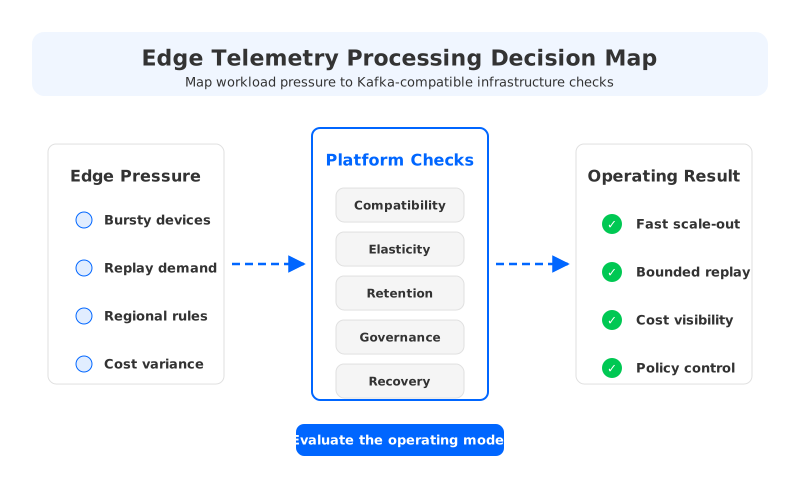
The edge also changes the shape of failure. In a data center, producers and consumers often sit near the brokers, and network topology is predictable. In an edge telemetry system, producers may disappear for hours, reconnect in bursts, replay buffered data, and send events from locations with different privacy or residency requirements. Kafka compatibility handles the application contract, but the infrastructure underneath determines whether the operating model stays manageable.
1Why Edge Telemetry Stresses Kafka-Compatible Platforms
Telemetry workloads combine three patterns that are individually common and collectively unpleasant: many producers, uneven traffic, and a strong need for replay. A platform team can usually tune for one dimension. The problem arrives when all three show up in the same cluster and the business asks for lower latency, longer retention, and a smaller cloud bill at the same time.
The producer side is fragmented by design. Edge applications may run in constrained devices, local gateways, Kubernetes clusters, and regional aggregation services. Some publish continuously, while others buffer events and reconnect after a local outage. That behavior creates write spikes that do not align with office hours or batch windows. If the platform scales slowly, the team reserves capacity for rare reconnect storms or firmware rollouts.
The consumer side is less visible but equally important. Telemetry streams rarely have one reader. A real deployment feeds stream processing jobs, alerting systems, device operations dashboards, anomaly detection pipelines, lakehouse tables, and support tools. Consumer groups make this fan-out workable at the protocol level, but fan-out still consumes network, broker CPU, storage read bandwidth, and operational attention. When one analytics job falls behind, a catch-up read can compete with the hot path.
The last pressure is retention. Edge telemetry is useful because teams can replay it after an incident, reprocess it with a revised model, or reconstruct what happened before a device failed. Short retention reduces operational load but weakens the stream. Long retention preserves optionality, but on broker-local storage it ties capacity planning to disk, replica placement, and data movement.
2The Production Constraint Behind the Problem
Traditional Kafka was built around brokers that own local log segments. This shared-nothing model is one reason Kafka became so useful: a partition has leaders, followers, offsets, and a clear replication path. It is also why capacity planning can become awkward in cloud edge telemetry systems. The same broker fleet serves clients, stores logs, replicates data, handles catch-up reads, and recovers when a node fails.
That coupling is not automatically wrong. For stable workloads with predictable growth, local disks and broker-level replication can be tuned well. Edge telemetry is different because the workload keeps asking for independent changes: more compute during a reconnect spike, more retention for investigation, more read capacity for a backfill, or more zones for resilience. In a broker-local model, those requests often touch the same machines.
The operational symptoms are familiar:
- Scaling brokers can trigger partition reassignment and data movement, so capacity changes become maintenance work instead of routine elasticity.
- Longer retention increases local storage pressure, which can force larger instances when CPU is not the bottleneck.
- Multi-AZ deployment improves availability, but replication and client traffic can create cross-zone transfer costs that are missed during design reviews.
- Catch-up reads after delayed consumers can disturb hot ingestion when storage and compute are not isolated.
- Governance becomes harder when teams need separate regional policies, encryption controls, and audit paths for each deployment boundary.
These are not Kafka protocol problems. They are consequences of where the durable log lives and how tightly that storage is coupled to broker compute. Edge telemetry makes the coupling visible because the workload keeps changing along axes that infrastructure teams would prefer to scale separately.
3Architecture Options and Trade-Offs
There are several ways to build an edge telemetry processing architecture with Kafka-compatible event streams. The right choice depends less on a vendor checklist and more on which constraint will dominate in production. A small industrial monitoring deployment may care most about operational simplicity. A global connected-device platform may care more about isolation, replay capacity, and cloud network cost.
The first option is to run conventional Kafka clusters close to the ingestion boundary. This keeps the architecture familiar and preserves a broad ecosystem of clients, connectors, and operational tools. It works well when traffic is predictable, retention is modest, and the team has Kafka operations expertise. The trade-off is that each regional cluster becomes its own capacity and reliability domain. When edge traffic grows unevenly, the team rebalances partitions, resizes brokers, and manages storage headroom cluster by cluster.
The second option is to put a managed Kafka-compatible service behind edge gateways and regional collectors. This reduces direct operational burden, but it does not remove placement, data transfer, quotas, retention, or consumer behavior. Managed services are valuable when the provider's operational envelope matches the workload. They become harder to fit when the application needs private deployment boundaries, custom networking, or cost controls that depend on traffic locality.
The third option is a cloud-native Kafka-compatible architecture that separates broker compute from durable storage. Brokers focus on serving protocol traffic while the log is backed by shared storage such as object storage, with a write-ahead log layer absorbing the latency-sensitive write path. The important distinction is the ability to scale compute, retention, and recovery behavior without treating every change as broker-local disk choreography.
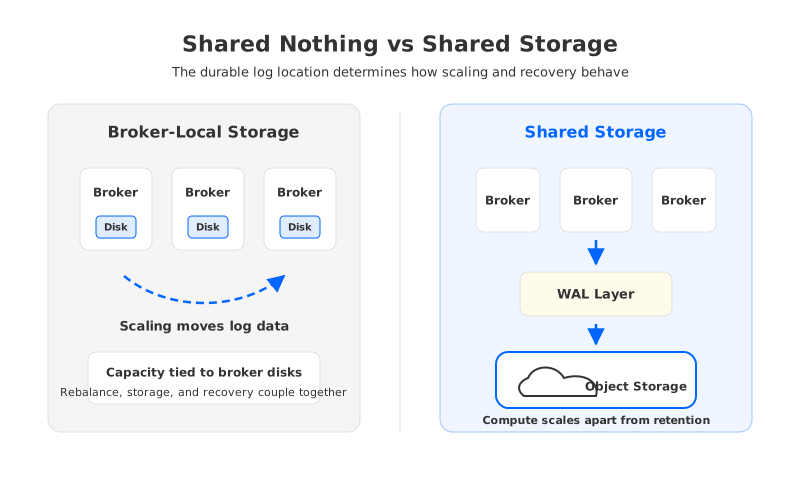
This architectural split changes the decision framework. A platform team no longer asks only whether the event stream speaks Kafka. It asks whether the system keeps Kafka compatibility while reducing the operational coupling that makes edge telemetry expensive to run at scale.
| Evaluation area | What to test | Why it matters for edge telemetry |
|---|---|---|
| Kafka compatibility | Client APIs, consumer groups, offsets, transactions where required, Connect compatibility | Edge pipelines often reuse existing Kafka clients, stream processors, and connectors. |
| Elasticity | Broker scale-out, scale-in, partition movement, and recovery time | Reconnect storms and regional growth should not require long maintenance windows. |
| Retention economics | Storage cost, read amplification, and replay behavior | Telemetry value increases when teams can retain and reprocess events affordably. |
| Network locality | Cross-zone traffic, client routing, and private connectivity | Multi-AZ resilience can quietly become a recurring cost center. |
| Governance | Encryption, access control, audit trails, and regional deployment boundaries | Edge data may include operational, customer, or regulated information. |
| Migration safety | Dual writes, mirroring, cutover, rollback, and consumer progress | Telemetry systems are hard to pause, so migration must preserve continuity. |
The table is intentionally practical. A benchmark number without these surrounding checks can be misleading. Low latency during a clean test does not tell you what happens when devices reconnect, a consumer group starts a backfill, and a regional team asks for longer retention in the same week.
4Processing Patterns That Keep the Edge Manageable
The event stream is only the middle of the system. The edge side needs buffering and normalization, and the cloud side needs processing paths that do not fight each other. A common mistake is to treat every telemetry event as equally urgent. That creates one overloaded stream where health pings, critical alarms, model outputs, and bulk diagnostics compete for the same latency budget.
A better design separates streams by operational intent. Critical alerts need low latency, tight retention, and strong observability. Device state updates need ordering and compaction semantics where appropriate. Bulk diagnostics may tolerate higher latency but need longer retention and efficient backfill. Analytical features may flow into a lakehouse table after stream processing. The Kafka topic model can express these differences, but topic design must be paired with infrastructure capacity that can honor them.
Stream processors such as Apache Flink, Spark Structured Streaming, or Kafka Streams are part of the platform decision. They consume the telemetry stream, maintain state, write derived events, and feed operational systems. Their reliability depends on checkpointing, offset management, and predictable catch-up behavior. When the underlying event stream struggles during replays, the processing layer inherits the instability.
Three design rules help keep the architecture from collapsing into a single oversized pipe:
- Separate hot operational streams from bulk analytical streams. This protects alerting and device operations from backfill-heavy consumers.
- Design topic keys around the entity that needs ordered processing, such as device ID, gateway ID, or site ID. Ordering is useful only when the key matches the decision being made downstream.
- Treat replay as a first-class workload. If a stream processor cannot catch up after downtime without disturbing ingestion, the system is not production-ready.
These rules force a useful conversation. The team has to decide which events are latency-sensitive, which events are retention-sensitive, and which consumers may spend shared capacity during recovery.
5How AutoMQ Changes the Operating Model
Once the evaluation reaches storage coupling, a cloud-native Kafka-compatible platform becomes relevant. AutoMQ is in this category: it keeps Kafka protocol compatibility while using shared storage, stateless brokers, and object-storage-backed durability. That combination fits edge telemetry because the workload asks for Kafka semantics at the application layer and cloud elasticity at the infrastructure layer.
In AutoMQ's shared storage model, broker nodes do not carry durable log ownership in the same way as traditional broker-local storage. The storage layer is backed by object storage, while the write-ahead log handles the low-latency persistence path before data is organized in shared storage. The practical effect is that scaling broker compute is less entangled with moving local log data. For edge telemetry, that matters during reconnect spikes, regional expansion, and recovery events.
This does not remove the need for engineering judgment. Teams still design topics, size throughput, monitor consumer lag, and set retention policies. Shared storage changes the failure and scaling mechanics; it does not make workload design irrelevant. The benefit is that platform teams can evaluate those workload decisions without every answer turning into a broker disk placement problem.
AutoMQ also fits a common edge governance requirement: keeping deployment boundaries under the customer's control. Many edge telemetry systems run in sensitive environments, where teams care about VPC design, object storage ownership, private connectivity, encryption, and access management. A Kafka-compatible architecture that can run in customer-controlled cloud environments preserves Kafka ecosystem compatibility while aligning with internal governance rules.
The cost conversation becomes concrete as well. In a traditional multi-AZ Kafka deployment, replication and client placement can produce inter-zone traffic that teams underestimate. AutoMQ documents patterns for reducing inter-zone traffic through its storage architecture and client/broker configuration. For telemetry systems with continuous writes and multiple consumers, that traffic model should be reviewed before production, not after the cloud bill starts explaining the architecture back to you.
6A Production Readiness Checklist
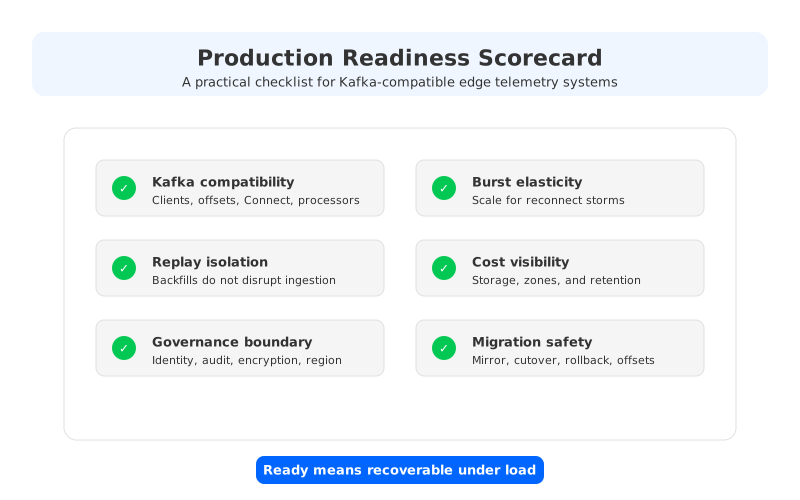
An edge telemetry platform is ready when it can fail in boring ways. Device outages, regional reconnects, delayed consumers, schema changes, and replay jobs should be observable, bounded, and recoverable. If every one of those events requires a war room, the architecture is too fragile.
Use this checklist before committing:
- Compatibility: existing producers, consumers, stream processors, and connectors can run with minimal code change, and required Kafka semantics are tested.
- Burst handling: the platform can absorb reconnect spikes without over-provisioning every region for rare peaks.
- Replay isolation: catch-up reads and backfills do not destabilize hot ingestion paths.
- Cost visibility: storage, cross-zone traffic, connector operations, and retention growth are modeled before rollout.
- Governance: encryption, identity, audit trails, and regional data boundaries match the organization's control requirements.
- Migration plan: mirroring, cutover, rollback, and consumer offset handling are documented and tested against production-like traffic.
- Observability: lag, throughput, broker health, storage behavior, and network traffic are visible where operators make decisions.
The checklist is not a procurement form. It prevents a familiar failure mode: choosing a Kafka-compatible platform because it passes the client API test, then discovering that the hard part was elasticity, retention, network locality, and recovery.
For teams evaluating this architecture, the next step is to test the operating model rather than only the message path. Run a workload with uneven producer bursts, multiple consumer groups, a delayed processing job, and longer retention. Then compare what moves, what gets resized, and what an operator touches. If shared storage and stateless brokers fit the result you want, the AutoMQ documentation is a practical place to inspect the architecture, compatibility model, deployment options, and inter-zone traffic guidance.
7References
- Apache Kafka Documentation
- Apache Kafka Connect Documentation
- Apache Flink Documentation
- AWS Amazon S3 Documentation
- AutoMQ Shared Storage Architecture
- AutoMQ Kafka Compatibility
- AutoMQ Inter-Zone Traffic Guidance
8FAQ
8.1Is Kafka a good fit for edge telemetry processing?
Kafka fits when the system needs durable event streams, consumer groups, replay, and broad ecosystem compatibility. The main design risk is assuming that protocol compatibility alone solves edge variability. Platform teams need to validate burst handling, retention economics, catch-up reads, regional governance, and cloud network cost.
8.2What is the biggest architecture mistake in edge telemetry pipelines?
The common mistake is treating all telemetry events as one stream with one latency and retention policy. Critical alerts, device state, diagnostics, and analytical events usually need different topic design, processing paths, and recovery expectations. Separating those paths early makes the platform easier to operate.
8.3How does shared storage help Kafka-compatible edge telemetry systems?
Shared storage reduces the coupling between broker compute and durable log storage. That can make scaling, recovery, and retention planning less dependent on broker-local disks and data movement. The benefit depends on workload shape, cloud deployment, and operational requirements, so test it with realistic producer bursts and consumer backfills.
8.4When should AutoMQ be evaluated for this use case?
Evaluate AutoMQ when the team wants Kafka-compatible APIs but also needs cloud-native elasticity, object-storage-backed durability, stateless broker operations, and customer-controlled deployment boundaries. It is relevant when edge telemetry growth makes traditional broker-local capacity planning too slow or too expensive to manage.


