
Table of Contents
Table of Contents
Kafka platform teams usually start searching for storage separation tradeoffs kafka after a practical incident, not after a whiteboard debate. A broker fleet needs to scale for a traffic spike, but the disks attached to those brokers are still full of partitions. A retention change becomes a storage migration. A multi-AZ architecture is required for availability, yet the bill keeps reminding the team that replication is also a network workload.
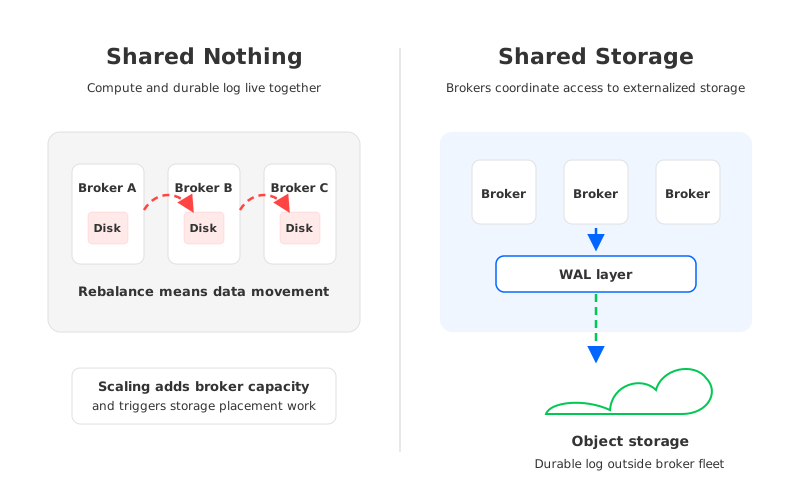
That tension comes from Kafka's original shared-nothing model. Each broker is both a compute process and a durable storage owner. This design is clear, fast, and battle-tested when workloads are stable and operators can plan capacity ahead of demand. It also means that scaling compute, changing storage capacity, moving partitions, and recovering from broker events are tied together. In a cloud environment where compute should be elastic and storage should be paid for as consumed, that coupling becomes the tradeoff.
1Why Teams Revisit Kafka Storage Architecture
The first sign is usually not storage cost by itself. It is a mismatch between the pace of the workload and the pace of the broker fleet. A payments pipeline may be quiet overnight and busy during a campaign. An AI feature may produce bursts of embedding updates. A fraud detection system may retain more event history because investigators need a longer lookback window. The Kafka API can remain the right interface while the storage model becomes the bottleneck.
Traditional Kafka handles durability through replicated logs across brokers. Operators get familiar semantics: producers write to partition leaders, followers replicate, consumers read by offset, and tooling understands topics, partitions, and consumer groups. The cost is that the durable log lives on broker-local storage. When the cluster grows, it grows by adding both compute and disk. When partitions move, bytes move with them.
The cloud changes the economic assumptions behind that model. Compute instances, block volumes, object storage, and inter-AZ traffic are priced separately. A design that made sense when storage and network were internal data center concerns may produce awkward cost lines when replicated bytes cross priced boundaries. The goal is not to declare local disk obsolete. The goal is to decide where broker-local storage is intentional and where it is inherited.
2The Storage Constraint Behind Cloud Kafka
Kafka's local log is not an implementation detail operators can ignore. It shapes every production workflow around the cluster. Rebalancing, broker replacement, retention changes, and compute expansion all become storage operations because partitions need a safe place to live while data moves.
That is why the storage separation discussion should start with operating questions rather than product labels:
- How often does the fleet need to scale because of CPU, network, or connection pressure rather than retained data volume?
- How much time does the team spend waiting for partition movement, replica catch-up, or disk expansion during routine operations?
- Which cost line is growing faster: broker compute, attached storage, object storage, or cross-AZ data transfer?
- Can the team test recovery and rollback without copying large volumes of data between brokers?
- Do existing clients, connectors, ACL policies, and monitoring systems need to keep working through the migration?
These questions separate two concerns that are often mixed together. One is retention economics: old segments should not force expensive hot storage forever. The other is fleet elasticity: brokers should be able to appear, disappear, and rebalance traffic without dragging durable data around the cluster. Tiered storage addresses the first concern well. Shared storage architectures aim at the second concern too.
3Architecture Options: Local Disk, Tiered Storage, and Shared Storage
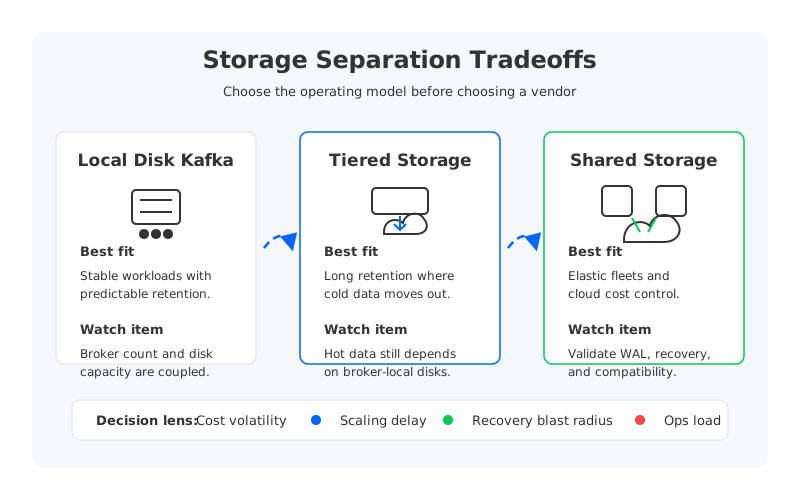
Local disk Kafka is still a strong fit when workloads are steady and retention windows are bounded. The broker owns the log segments it serves, and the recovery model is familiar. The tradeoff is predictability over elasticity: capacity planning has to account for peak storage, replication factor, disk headroom, and data movement.
Tiered storage changes the retention story by introducing a remote tier for completed log segments. Apache Kafka documentation describes the model as a two-tier approach: the local tier remains broker storage, while the remote tier stores completed segments in external systems such as object storage. That is a meaningful improvement for long retention because older data can move away from local disks. It does not fully remove the broker-local hot path. Operators still need to size local storage, monitor remote fetch behavior, and reason about how hot data, cold reads, and recovery interact.
Shared storage goes further by making externalized storage part of the primary operating model. In this architecture, brokers become closer to stateless compute nodes while a shared storage layer holds the durable log. The hard part is not drawing a box labeled "object storage." Object stores differ from local disks. A production design needs a write-ahead log layer, recovery protocol, metadata discipline, and observability around the storage path.
The practical comparison looks like this:
| Decision area | Local disk Kafka | Tiered storage | Shared storage |
|---|---|---|---|
| Compute scaling | Coupled to data placement | Still coupled for hot data | Designed to be independent from durable data |
| Retention economics | Local disk heavy | Better for older segments | Object-storage-backed by design |
| Rebalance behavior | Data movement is central | Data movement still exists | Broker changes should avoid large data copies |
| Operational maturity | Familiar and widely understood | Depends on remote tier implementation | Depends on WAL, recovery, and compatibility quality |
| Best use case | Stable, predictable clusters | Long retention with Kafka-native operations | Elastic cloud fleets and cost-sensitive multi-AZ operations |
The table is not a winner-takes-all ranking. Tiered storage can be the right incremental step for retention relief. Shared storage is more attractive when the real problem is the operating model of the broker fleet. If a team scales brokers frequently, pays meaningful inter-zone traffic charges, or waits on data movement during routine changes, the architectural question becomes "why is durable data tied to this broker in the first place?"
4Evaluation Checklist for Platform Teams
Storage separation has to be evaluated as a production change, not a diagram upgrade. The risky version starts with a new storage backend and assumes Kafka compatibility will fall out naturally. The safer version starts with the contracts applications already depend on: client behavior, ordering, offsets, consumer groups, ACLs, observability, and operational rollback.
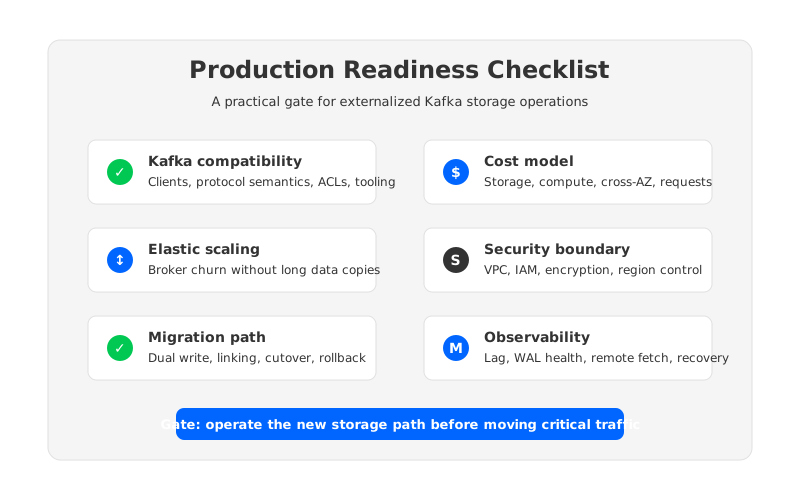
Compatibility is the first gate because the Kafka API is often the reason the platform exists. A storage-separated system should preserve standard client behavior and operational semantics closely enough that application teams do not need to rewrite producers, consumers, or connectors. If the deployment runs inside a customer-controlled cloud boundary, the team must validate VPC networking, IAM, encryption, audit logs, regional control, and object storage access.
Cost is the second gate, and it deserves more than a storage-dollar comparison. Externalized storage may reduce local disk pressure, but the full model includes compute instances, WAL storage, object storage capacity, object requests, read amplification, cross-AZ transfer, and operational headcount. On AWS, official architecture guidance notes that same-AZ data transfer is free, while multi-AZ designs can create priced transfer paths. Kafka teams should model where producers, brokers, consumers, replicas, and storage services communicate before accepting any cost claim.
Recovery is the third gate. Local disk Kafka recovery is operationally familiar: replace a broker, let replicas catch up, and watch under-replicated partitions and consumer impact. Externalized storage changes that workflow. The team needs to know what happens when a broker disappears, when a WAL component is impaired, and when object storage requests slow down. Recovery objectives should be tested under load, not inferred from the architecture diagram.
A readiness review should produce these artifacts:
- A compatibility matrix for client versions, Kafka features, connectors, ACLs, and observability.
- A cost model that separates compute, storage capacity, requests, and network transfer.
- Failure runbooks for broker loss, storage impairment, metadata issues, retry storms, and AZ events.
- A migration plan with replication or linking approach, cutover criteria, rollback criteria, and lag thresholds.
- A security review covering identity, encryption, network paths, private connectivity, and auditability.
The checklist keeps the evaluation anchored in the things that break at 2 a.m. A storage architecture that looks efficient in a steady-state benchmark can still be expensive to operate if the team cannot explain cutover, rollback, and recovery in production terms.
5How AutoMQ Changes the Operating Model
Once the evaluation reaches the point where broker elasticity and storage ownership are the real constraints, AutoMQ becomes relevant as a Kafka-compatible cloud-native streaming system built around shared storage. Its architecture replaces Kafka's broker-local storage layer with a shared storage design that uses WAL storage and object storage, making brokers stateless in the storage sense while preserving Kafka protocol compatibility for applications.
That combination targets both halves of the problem. Object storage provides the elastic durable base, while the WAL layer handles write-path realities that object storage alone does not solve well. Brokers can then focus on serving Kafka traffic rather than owning irreplaceable local data. In operational terms, the fleet can be managed more like elastic compute: add capacity for traffic, remove capacity when demand falls, and reduce partition reassignment work caused by data pinned to specific brokers.
AutoMQ also addresses one of the most visible cloud Kafka cost issues: inter-zone traffic. Its documentation describes zone-aware routing and an S3-based proxy path that allow clients to communicate with brokers in the same Availability Zone for produce traffic, with the platform handling forwarding to the true partition leader. For multi-AZ Kafka, this is a storage-architecture answer to a network-cost problem.
The tradeoffs still need evaluation. A shared storage system must prove WAL durability, object storage behavior, metadata recovery, observability, and compatibility in the environment where it will run. Teams should also distinguish between AutoMQ Cloud, BYOC-style deployment boundaries, and self-managed software deployment when they review governance requirements.
6Migration and Rollback Without Wishful Thinking
The migration path is where storage separation becomes real. A team can like the architecture and still reject the project if cutover risk is unclear. Kafka workloads are often embedded in payment flows, telemetry pipelines, analytics, fraud systems, and machine learning features. The target cluster has to accept traffic, preserve application expectations, expose familiar metrics, and give the team a way back.
For many organizations, the safest migration shape is incremental. Start with non-critical topics or a workload family with clear owners. Replicate or link data from the existing Kafka environment into the target, then compare producer latency, consumer lag, throughput, error rates, storage growth, and network cost. Widen the migration only after the team has run a rollback exercise, not merely written one.
The readiness score should be boring:
| Gate | Pass condition |
|---|---|
| Client compatibility | Existing producer and consumer libraries work without application rewrite |
| Observability | Platform dashboards show lag, throughput, storage path health, and broker health |
| Cost model | Finance and platform teams agree on compute, storage, request, and traffic assumptions |
| Failure testing | Broker loss and storage-path impairment have been tested under representative load |
| Rollback | Source-of-truth ownership and cutback criteria are written before cutover |
If any gate is fuzzy, the migration is not ready. The architecture should not be asked to carry organizational uncertainty that belongs in the migration plan.
7The Decision
The cleanest way to decide is to name the pain precisely. If the team mainly needs lower-cost long retention while keeping the current broker model, tiered storage deserves a close look. If the team needs brokers to scale independently from durable data, if data movement dominates routine operations, or if multi-AZ traffic charges are distorting the Kafka bill, shared storage should be part of the evaluation. If the workload is stable, the team is small, and local-disk operations are well understood, the simplest architecture may still be the right one.
Storage separation is not a feature checkbox. It changes what a broker fleet is responsible for. Local disk makes each broker a storage owner. Tiered storage gives that owner a remote archive. Shared storage moves the durable log outside the broker fleet and turns broker elasticity into a first-class operational goal. That is the decision behind the search query.
For teams evaluating this path, start with a workload that exposes the real constraint: retention growth, bursty compute demand, multi-AZ transfer cost, or slow rebalance operations. Then compare architectures against the same compatibility, cost, recovery, governance, and migration gates. If shared storage is the right fit, AutoMQ's Kafka-compatible shared storage architecture is a practical reference point. You can review the architecture in the AutoMQ documentation and use it as the baseline for a readiness discussion.
8References
- Apache Kafka documentation: Tiered Storage
- Apache Kafka documentation: Tiered Storage Configs
- Apache Kafka 3.9.0 release announcement: Tiered Storage production-ready
- Apache Kafka documentation: Monitoring and tiered storage metrics
- AWS Architecture Blog: Overview of data transfer costs for common architectures
- Amazon S3 pricing
- AutoMQ documentation: Architecture overview
- AutoMQ documentation: Compatibility with Apache Kafka
- AutoMQ documentation: Save Cross-AZ Traffic Costs with AutoMQ
- AutoMQ documentation: S3Stream shared streaming storage
9FAQ
9.1Is tiered storage the same as shared storage?
No. Tiered storage usually keeps a local broker tier for hot data and moves completed segments to remote storage. Shared storage changes the primary operating model by placing durable data outside the broker fleet, so compute scaling and durable data ownership can be separated more aggressively.
9.2When is local disk Kafka still a good choice?
Local disk Kafka remains a good choice for stable workloads, bounded retention, and teams that already operate partition movement, disk sizing, and broker recovery well. Storage separation is most compelling when elasticity, retention growth, or multi-AZ cost pressure is creating operational drag.
9.3What should be tested before moving production traffic?
Test client compatibility, producer and consumer behavior, lag, recovery from broker loss, storage-path impairment, rollback, observability, and the full cost model. A diagram is not enough evidence for a storage architecture change.
9.4How does AutoMQ fit into this evaluation?
AutoMQ is a Kafka-compatible streaming system built around shared storage and stateless brokers. It should be evaluated after the team defines its requirements for compatibility, cost, recovery, governance, and migration risk, not as a shortcut around that work.


