
Table of Contents
Table of Contents
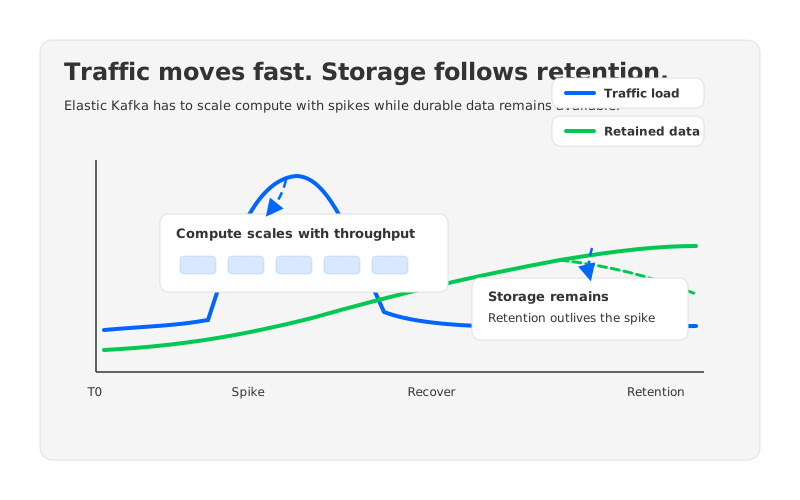
Elastic Kafka is hard because Kafka has two lifecycles that rarely move together. Traffic can jump within minutes during a product launch, mobile reconnect, batch backfill, or observability incident. Storage grows according to retention, replication, segment roll, and delayed consumers. A cluster can need more compute now while still carrying data written yesterday, last week, or last month.
That mismatch is why Kafka elastic scaling is not the same as adding brokers to a stateless web tier. In traditional Apache Kafka, a broker is also a storage owner for partition replicas. When capacity expands, partitions may need to move. When capacity contracts, the data tied to the broker does not evaporate. Durability, ordering, availability, consumer progress, and operational predictability still have to hold.
For platform leaders, SREs, cost teams, and architects, the useful question is not "Can Kafka autoscale?" It is "Which parts of Kafka can scale with traffic, and which parts are still tied to storage movement?"
1What Elasticity Means for Kafka
Elasticity means the platform can align capacity with demand without forcing the operations team to pre-provision for every peak. For Kafka, that capacity is multidimensional: write throughput consumes CPU, network, request handling, and replication bandwidth; consumer fanout consumes read bandwidth and cache; retention consumes durable storage. Partition count and leader placement determine how evenly those resources can be used.
Elastic Kafka design starts with workload shape, not broker count. Steady ingestion with long retention has a different scaling profile from brief write spikes with short retention. Many independent consumer groups behave differently from one read-once downstream application.
Judge elastic Kafka across four questions:
- Can the cluster add serving capacity when write or read throughput rises?
- Can the cluster reduce serving capacity after the spike without long data movement?
- Can durable storage grow independently from compute capacity?
- Can autoscaling decisions respect Kafka-specific guardrails such as lag, partition balance, replication health, and controller load?
Kubernetes Horizontal Pod Autoscaling is useful context, but not a complete Kafka design. HPA adjusts replicas based on observed metrics and target values, which fits replaceable compute. Kafka brokers are harder because replacing or removing one may also change partition placement and storage ownership.
2Why Bursty Workloads Stress Kafka
Bursty workloads compress capacity decisions into a short window. A platform can run smoothly most of the day and then receive several times normal traffic during a campaign, incident, market open, gaming event, or replay job. The spike is temporary, but records are appended, replicas are written, consumers fall behind, and retention timers start.
Assume a workload normally writes 200 MiB/s, then spikes to 800 MiB/s for 45 minutes during a product event. Those numbers are illustrative assumptions, not benchmark claims. The platform must absorb extra writes, protect producer latency, replicate safely, and let consumers catch up. Even when traffic returns to 200 MiB/s, the cluster still holds the spike data until retention removes it.
That is the core tension. Compute pressure follows the spike. Storage pressure follows retention.
2.1Write Throughput
Kafka's write path is partitioned. Producers send records to leaders, leaders append to logs, followers replicate, and acknowledgements depend on durability settings. More brokers can help when there are enough partitions to distribute leadership and clients can route traffic to the expanded broker set. They do not automatically fix hot partitions or replication pressure.
The first guardrail is partition shape. If a few partitions receive most traffic, Kafka horizontal scaling is limited by those leaders. If the topic has enough partitions but leadership is uneven, broker count is not the immediate bottleneck. If replication saturates the inter-broker network, scaling compute helps only after leadership and replicas settle into better placement.
Teams often treat Kafka autoscaling as a controlled operation rather than a reflex. Metrics must distinguish broker saturation from partition skew, batching changes, retries, and downstream lag. Otherwise an autoscaler may add brokers that cannot carry meaningful traffic quickly enough.
2.2Consumer Fanout
Read load can be as elastic as write load. One new consumer group can multiply egress. A replay from old offsets can turn a quiet topic into a cold-read workload. A downstream outage can create lag during the spike, then a second spike during recovery.
Consumer fanout changes the relationship between data written and data served. A topic receiving 200 MiB/s may require much more broker read bandwidth if several consumer groups read independently. During catch-up, the working set may exceed memory cache, shifting brokers from hot tail reads to older segment reads. That often appears as higher fetch latency, lower cache hit rates, and rising network utilization.
Elastic Kafka therefore needs to track both ingress and egress. Producer throughput alone misses fanout-heavy workloads. CPU alone can miss network saturation. Lag alone can react too late because lag is often a symptom of capacity pressure that already happened.
2.3Retention and Disk Pressure
Retention is where bursts leave their footprint. A short spike may be over, but the data remains until the retention policy deletes it. In traditional Kafka, that retained data sits in broker-local log directories, so the cluster must keep disk capacity for the retained peak, not only the current ingest rate.
Disk pressure is also uneven. A broker can become disk-heavy because it hosts partitions that received more data during the spike. Adding another broker helps only after data and leadership are redistributed. Removing one later requires the opposite operation: its replicas have to move elsewhere or become unnecessary.
This is the operational reason elastic Kafka is harder than elastic compute. The traffic spike may be temporary; the storage consequence is not.
3Why Scaling Down Is the Hard Part
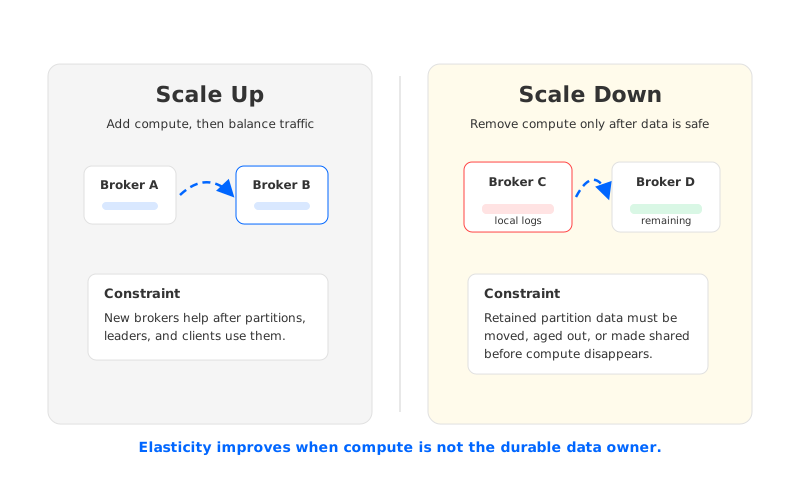
Most Kafka scaling discussions focus on scale-up because scale-up is urgent. Producers time out, consumers fall behind, and the team needs capacity. Scale-down is quieter but often more expensive. After the spike, extra brokers may stay online because removing them is tied to reassignment, data movement, and risk.
Apache Kafka's operational documentation describes cluster expansion as assigning partitions to added brokers and using partition reassignment to move existing data. The same fact applies in reverse: when brokers are removed from a local-disk Kafka cluster, the replicas they hold must be accounted for. In large or storage-heavy clusters, scale-down can outlast the spike that caused scale-up.
That creates a familiar pattern:
| Phase | What the team wants | What broker-local storage requires |
|---|---|---|
| Before the spike | Keep spare headroom small | Maintain enough broker and disk capacity for expected risk |
| During the spike | Add compute quickly | Add brokers, then rebalance leadership and replicas safely |
| After the spike | Remove excess compute | Drain broker-local replicas or accept ongoing overcapacity |
| During retention | Keep durable data available | Keep disk capacity until data ages out or is moved |
Kafka can move data. The difficult part is that movement competes with live traffic. Reassignment consumes network and disk I/O, can disturb cache locality, and requires limits to avoid harming producers and consumers. In a bursty environment, the team may keep extra brokers running because scale-down risk outweighs the savings.
This is where broker-local storage slows Kafka elastic scaling. It couples compute to the data lifecycle. If a broker is removed, its storage role must be resolved. If storage is still needed, compute cannot be reduced as a pure compute decision.
4How Shared Storage Enables More Elastic Kafka
The architectural alternative is to separate compute from durable stream storage. In a shared-storage Kafka-compatible design, brokers act more like a serving and coordination layer, while durable data is placed in shared storage such as object storage, usually with a write-ahead log or equivalent durable write path in front of it. Local resources may still serve cache, but broker-local disk is no longer the primary owner of retained partition data.
This changes the scaling problem. Adding brokers becomes closer to adding compute because the new broker does not need a large copy of historical data before it can become useful. Removing brokers becomes less tied to draining data because durable data is not stranded on that broker's local volume. Metadata and ownership still matter, but the operation is no longer dominated by moving retained logs between broker disks.
AutoMQ fits this category as a Kafka-compatible, storage-compute-separated streaming system. Its documentation describes stateless brokers, S3Stream shared storage, and continuous self-balancing as core architecture choices. For elastic Kafka, the operational consequence is that compute scaling can align more closely with throughput changes while object storage carries durable stream data.
Shared storage still needs engineering discipline:
- What durable path acknowledges producer writes before data is organized into object storage?
- How are hot reads cached so that tail consumers are not forced through cold object reads?
- How does metadata map topics, partitions, offsets, and object locations?
- What happens when object storage throttles, a broker fails, or a consumer replays older data?
- How does the system prevent automatic balancing from fighting application traffic?
These questions move the evaluation from "Can I add a broker?" to "Can I change compute capacity without dragging the storage lifecycle with it?" For bursty workloads, that boundary matters.
5Metrics and Guardrails
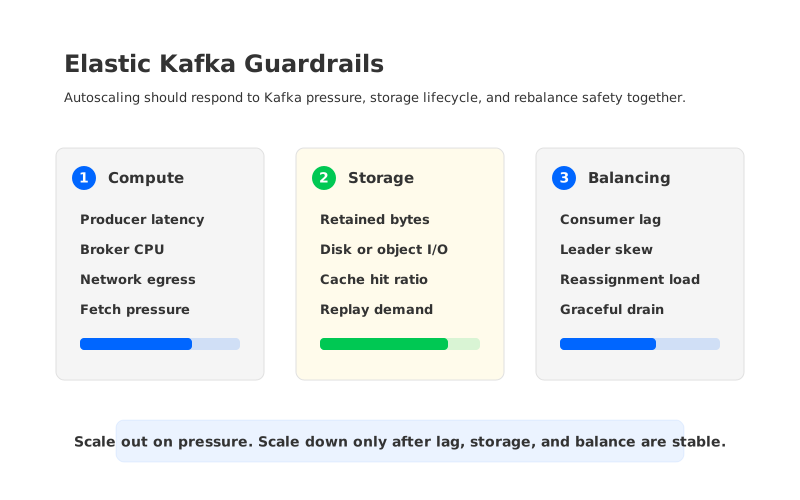
A useful elastic Kafka design treats compute, storage, and balancing as separate control loops. Compute reacts to throughput, CPU, network, request latency, and read pressure. Storage tracks retention, disk or object-storage growth, write amplification, and replay demand. Balancing watches leadership, lag, broker load, and reassignment safety. In traditional Kafka, these loops are tightly connected because brokers own local data; in shared-storage designs, they can be loosened.
Elastic Kafka needs metrics that describe where pressure is building. CPU is useful, but not enough. Network saturation can arrive first. Consumer lag can rise because consumers are under-provisioned, brokers cannot serve reads, or a downstream system is throttling. Disk usage can be a storage lifecycle issue, not a compute issue.
For production design reviews, group metrics by decision:
- Scale out compute when producer request latency, network utilization, request handler pressure, or read egress approaches limits.
- Delay scale-down when consumer lag is rising, reassignment is active, partition leadership is skewed, or cache is still warming after a spike.
- Revisit partitioning when a small number of partitions dominate traffic, even if total cluster capacity looks healthy.
- Revisit retention and storage architecture when retained bytes, delayed replay, or broker disk balance determines the size of the cluster.
- Revisit client behavior when retries, small batches, or many independent consumer groups amplify broker load.
In broker-local Kafka, scale-down guardrails are strict because the operation may move retained data. In shared-storage designs, scale-down can be more compute-oriented, but guardrails still matter. A stateless broker may still hold cache, connections, inflight requests, leadership assignments, or temporary serving responsibilities that need graceful transition.
The goal is controlled elasticity: add capacity before user-visible pain, remove capacity after durable and operational consequences are understood, and avoid turning every traffic spike into a long-lived infrastructure footprint.
6Where AutoMQ Fits
AutoMQ is relevant when a team wants Kafka compatibility but broker-local storage is limiting elasticity. Its architecture keeps the Kafka protocol surface while moving durable stream data into object-storage-backed shared storage and making brokers stateless relative to retained data. AutoMQ's self-balancing capabilities are designed to reduce the manual partition movement work that often makes Kafka scaling feel like a maintenance project.
That makes AutoMQ a natural candidate where burstiness, long retention, and cloud cost pressure appear together. If the pain is one hot partition, fix partitioning first. If the pain is an inefficient consumer, fix downstream capacity first. But if the pattern is "we scaled up for traffic and stayed over-provisioned because scale-down would move too much data," storage architecture deserves direct attention.
For a fair evaluation, test AutoMQ or any shared-storage Kafka-compatible platform with the workload shape that created the problem. Include producer spikes, consumer fanout, retention windows, broker replacement, object storage behavior, and scale-down timing. Elasticity is proven when capacity can follow demand without making durable data movement the pacing item.
If your Kafka roadmap includes bursty traffic, Kubernetes scheduling, long retention, or aggressive cloud cost targets, start by mapping which constraints are compute-driven and which are storage-driven. For architecture details, see the AutoMQ documentation, then test the design against your own spike profile and failure model.
7References
- Apache Kafka documentation, basic operations for cluster expansion and partition reassignment: https://kafka.apache.org/documentation/#basic_ops_cluster_expansion
- Apache Kafka documentation, rebalancing partitions: https://kafka.apache.org/documentation/#basic_ops_rebalancing
- Apache Kafka documentation, tiered storage: https://kafka.apache.org/documentation/#tiered_storage
- Kubernetes documentation, Horizontal Pod Autoscaling: https://kubernetes.io/docs/concepts/workloads/autoscaling/horizontal-pod-autoscale/
- AutoMQ documentation, architecture overview: https://docs.automq.com/automq/architecture/overview?utm_source=blog&utm_medium=content&utm_campaign=elastic-kafka-designing-kafka-for-bursty-workloads-and-fast-scaling
- AutoMQ documentation, stateless broker: https://docs.automq.com/automq/architecture/technical-advantage/stateless-broker?utm_source=blog&utm_medium=content&utm_campaign=elastic-kafka-designing-kafka-for-bursty-workloads-and-fast-scaling
- AutoMQ documentation, continuous self-balancing: https://docs.automq.com/automq/architecture/technical-advantage/continuous-self-balancing?utm_source=blog&utm_medium=content&utm_campaign=elastic-kafka-designing-kafka-for-bursty-workloads-and-fast-scaling
8FAQ
8.1What does elastic Kafka mean?
Elastic Kafka means a Kafka or Kafka-compatible platform can adjust serving capacity as workload demand changes while preserving durability, ordering, consumer progress, and operational safety. In practice, elasticity depends on partition distribution, broker resources, storage architecture, balancing behavior, and client workload shape.
8.2Why is Kafka autoscaling harder than scaling stateless services?
Traditional Kafka brokers own partition replicas on local disks. Adding brokers can require partition reassignment before the new capacity is useful, and removing brokers can require moving retained data away from those brokers. Stateless services usually scale compute replicas without carrying durable local data with each replica.
8.3Why is scale-down harder than scale-up for Kafka?
Scale-up is often urgent and can add broker capacity quickly, though placement still matters. Scale-down has to account for the partition replicas and retained data on the brokers being removed. With broker-local storage, that can mean data movement, rebalance traffic, cache disruption, and operational risk after the traffic spike has already ended.
8.4How do stateless Kafka brokers help elasticity?
Stateless brokers help when durable stream data is stored outside broker-local disks in shared storage. A broker can then be added or removed more like compute capacity because retained data is not stranded on the broker's volume. The system still needs metadata, caching, durable write handling, and balancing guardrails.
8.5Is shared-storage Kafka always the right answer for bursty workloads?
No. If the bottleneck is poor partitioning, inefficient producers, or under-provisioned consumers, those issues should be fixed directly. Shared-storage Kafka is most relevant when broker-local durable data makes scaling, retention, recovery, or cloud cost management the recurring constraint.


