
Table of Contents
Table of Contents
Teams search for elasticsearch indexing streams kafka when search has become part of the product workflow, not a side index refreshed after the fact. Orders must appear in customer support search quickly. Security events must be queryable before an investigation goes cold. Catalog changes must reach discovery and recommendation systems without making every source database responsible for search-specific integration code.
The hard part is not sending records into Elasticsearch. Kafka Connect, custom consumers, stream processors, and managed integration services can all move data. The hard part is keeping the search index aligned with the source of truth while teams change schemas, replay data, scale partitions, handle partial failures, and operate the pipeline across cloud boundaries. Search pipeline drift starts small: one missed delete, one transform that handles nulls differently, one connector task that falls behind after a broker rebalance. Over time, the index still answers queries, but nobody fully trusts the answer.
Kafka-compatible streaming is a natural backbone for search indexing because it gives the pipeline a durable, ordered, replayable change log. That does not make the architecture automatic. The streaming layer must carry CDC events, enrichment results, retries, offset progress, dead-letter records, and replay jobs without becoming the next operational bottleneck. The right design question is not "Can Kafka feed Elasticsearch?" It is "Can the platform keep search, source data, and operational evidence in sync under production pressure?"
1Why teams search for elasticsearch indexing streams kafka
Search indexing through Kafka usually begins with a clean goal: decouple transactional systems from Elasticsearch. A database publishes changes into topics, consumers transform those records, and a sink writes documents into the search index. Product teams get fresher search results without adding search-specific write paths to every service. Data teams get a central place to observe flow, retention, and replay.
The same decoupling also creates a consistency boundary. The database may commit an update, the CDC connector may publish a change event, the streaming platform may retain it, the indexing consumer may transform it, and Elasticsearch may accept a bulk request. Each step can succeed independently, fail independently, or be retried with different semantics. If the pipeline has no durable evidence for what happened at each boundary, teams find out about drift from support tickets, missing search results, or reconciliation jobs.
There are several common sources of drift:
- Deletes and tombstones are handled inconsistently. A delete in the source system may need to remove a document, mark it inactive, or update multiple denormalized documents in Elasticsearch.
- Schema changes arrive before transforms are ready. CDC fields, null handling, and nested structures can change faster than indexing code if ownership is split across teams.
- Retries are not idempotent. Bulk indexing failures can produce duplicate side effects or stale overwrites if document IDs and versioning are not designed deliberately.
- Replays mix old assumptions with current code. A replay can be valuable for repair, but it can also regenerate documents with a transform that no longer matches historical payloads.
- Lag hides behind a healthy search endpoint. Elasticsearch can answer queries while the indexing pipeline is minutes or hours behind the source.
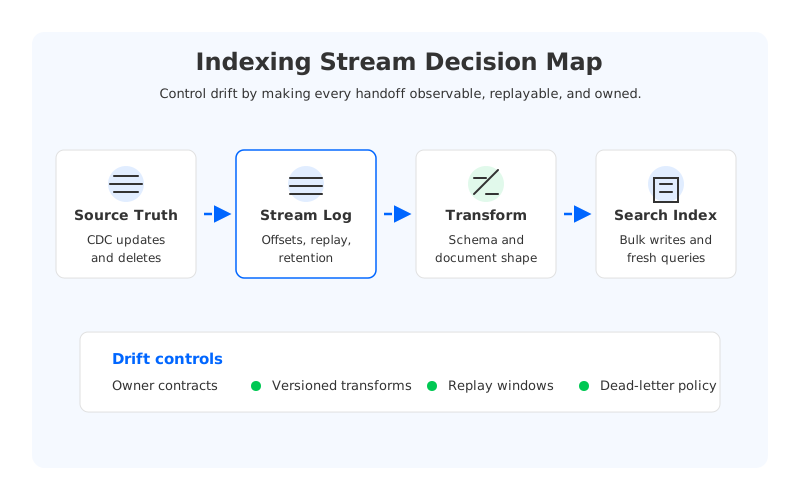
The first architectural move is to define which system owns each truth. The source database owns transactional state. Kafka-compatible streams own the change timeline and replay boundary. Stream processors own derived events and document-shaping logic. Elasticsearch owns query-serving indexes. Drift becomes manageable when every handoff has an observable contract instead of being treated as a direct pipe.
2The operational constraint behind connector-heavy platforms
Connector-heavy platforms are attractive because they reduce custom integration work. Kafka Connect provides a standard runtime model for source and sink connectors, offsets, tasks, converters, and worker operations. Elasticsearch also exposes indexing APIs and bulk operations designed for high-throughput document writes. Those primitives are enough to build a pipeline, but they do not remove the need for platform ownership.
The constraint appears when a search pipeline becomes shared infrastructure. Multiple product teams publish source events. Several indexes may consume the same topic with different mappings. Reindexing jobs may read retained history while live consumers continue writing. Incident responders may need to replay a narrow offset range. Compliance teams may ask where sensitive fields are transformed, masked, or dropped. At that point, a connector is no longer a one-off integration. It is part of a governed streaming platform.
Traditional Kafka's shared-nothing architecture puts durable log storage on broker-local disks. This model is proven and widely understood, but it couples the compute node that serves clients with the storage that holds retained history. Search indexing workloads can stress that coupling in a specific way: teams retain more change history for repair and reindexing, then run bursty read jobs when an index must be rebuilt. The storage footprint and the replay footprint both land on the broker fleet.
That coupling changes the operating conversation. Capacity planning must account for live ingestion, consumer fanout, retained CDC history, replay bursts, and broker disk headroom. Partition movement or broker replacement can move large amounts of data inside the cluster. Cross-zone traffic can become material when replicas, clients, and consumers sit across availability zones. Search teams may see the indexing pipeline as a connector problem, while SREs see a broker storage and network problem.
3Failure handling, schema, and replay trade-offs
A reliable search pipeline is designed around failure paths, not only the happy path. Elasticsearch bulk requests can partially fail. Connector tasks can restart. A downstream mapping can reject a document that passed upstream validation. A CDC source can emit snapshots and incremental changes with different shapes. Consumer lag can grow while the search endpoint still appears healthy.
The platform needs a recovery model for each failure class. Some failures should be retried in place because the downstream cluster was temporarily unavailable. Some should be written to a dead-letter topic because the payload violates an expected schema. Some require a compensating event because the index already contains a stale document. Some require a replay from an earlier offset with a fixed transform. These choices must be explicit because they affect both correctness and operating cost.
Schema deserves particular attention because search documents are often denormalized. A single customer-visible document may combine product attributes, availability, seller data, pricing state, and policy flags. The event stream should not pretend that this document is the source of truth. It should preserve the upstream change events and publish derived indexing commands or shaped documents with clear versioning.
| Pipeline area | Design question | Drift risk if ignored |
|---|---|---|
| Source capture | Are updates, deletes, snapshots, and out-of-order changes represented consistently? | Missing deletes, duplicate documents, and stale fields survive in the index |
| Transform layer | Is document shaping versioned and tied to source schema expectations? | Replays generate documents that differ from the original indexing logic |
| Offset handling | Can the team identify which events were indexed, skipped, retried, or parked? | Incident repair starts from guesswork instead of a known offset range |
| Elasticsearch writes | Are document IDs, external versions, and bulk failure handling deterministic? | Retries overwrite fresher documents or leave partial batches unaccounted for |
| Observability | Can lag, rejection rate, replay load, and index freshness be viewed together? | Search looks available while the pipeline is falling behind |
The table is intentionally operational. Search correctness is not only an Elasticsearch mapping concern, and streaming reliability is not only a Kafka broker concern. Drift lives between systems, so the controls must sit at the handoff points.
4Evaluation checklist for platform teams
Before choosing or redesigning the streaming backbone, platform teams should score the workload rather than starting from a vendor feature list. A small catalog index with low retention and one consumer has different requirements from a security-search pipeline with strict audit needs, high retention, and repeated reindexing. The same Kafka-compatible API can serve both, but the operating model should not be treated as identical.
Use this checklist during architecture review:
- Compatibility. Existing producers, consumers, Kafka Connect workers, security settings, offset behavior, and client libraries should run with minimal application change.
- Retention and replay. The platform should retain enough history to rebuild an index, but replay jobs should not starve live indexing traffic or require emergency broker storage expansion.
- Cost visibility. Include broker compute, durable storage, replicated traffic, cross-zone data movement, connector workers, Elasticsearch bulk load, and replay windows in the cost model.
- Governance. Topic ownership, schema compatibility, access control, masking, dead-letter policy, and retention policy should be reviewed before search becomes a shared dependency.
- Failure recovery. The team should be able to identify a bad offset range, stop indexing, repair transform code, replay, and verify the target index without a full platform freeze.
- Migration path. Dual-run, backfill, cutover, and rollback steps should be defined for both the streaming layer and the search index.
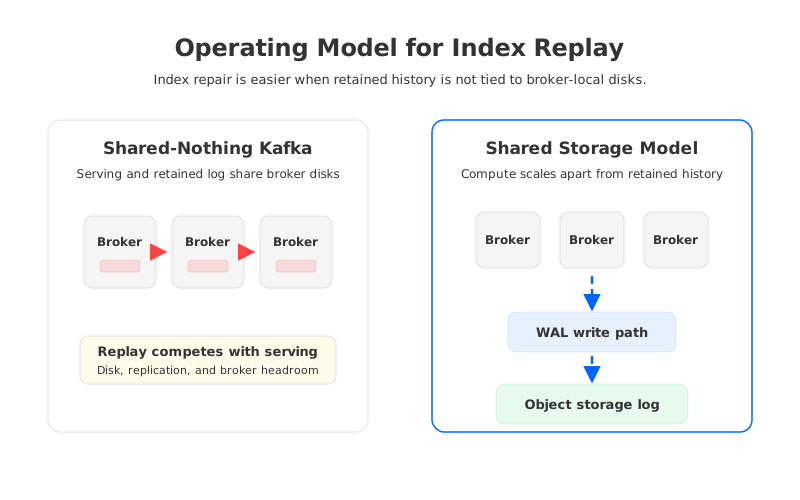
The architecture review often reveals that the biggest risk is not a single component failing. It is the platform becoming hard to change. When retained history is tied to broker-local capacity, index rebuilds and data repair compete with normal serving. When connectors are deployed without shared governance, every team invents its own retry and dead-letter policy. When replay is not tested, the pipeline has a repair mechanism that exists in theory.
5How AutoMQ changes the operating model
Once the evaluation points to Kafka compatibility, long retained history, elastic replay, and cloud cost control, AutoMQ becomes relevant as a Kafka-compatible streaming system built on shared storage. It keeps the Kafka protocol surface familiar while separating broker compute from durable stream storage. In this model, brokers can operate more like stateless compute nodes, object storage holds the long-lived log, and a write-ahead log layer serves the write path.
For Elasticsearch indexing streams, that separation changes the planning boundary. Retaining CDC history for reindexing no longer has to mean sizing every broker around local disk growth. Replaying a large offset range becomes an operation against a storage-backed log rather than a direct bet on broker-local headroom. Scaling the serving layer can focus on live ingestion, connector fanout, and consumer load instead of carrying the full weight of retained history.
This is not a reason to ignore pipeline design. Document IDs still need to be deterministic. Bulk failures still need policy. Schemas still need ownership. Elasticsearch mappings still need review. AutoMQ changes the infrastructure constraints beneath those decisions: storage can scale independently, broker replacement has a different data-movement profile, and deployment boundaries can fit customer-controlled cloud environments.
AutoMQ's public documentation also highlights architecture areas that matter to search indexing platforms, including shared storage, WAL design, Kafka compatibility, and cloud deployment patterns. Teams evaluating it should test with their own CDC payloads, connector workers, mapping failures, replay jobs, and region topology. A useful proof of concept does not ask whether a demo topic can reach Elasticsearch. It asks whether a broken index can be rebuilt predictably while live traffic continues.
6Production readiness scorecard
The final check should be boring on purpose. A search platform that depends on heroic debugging is already drifting. The readiness scorecard should prove that the team can observe, repair, replay, and roll back the pipeline without inventing process during an incident.
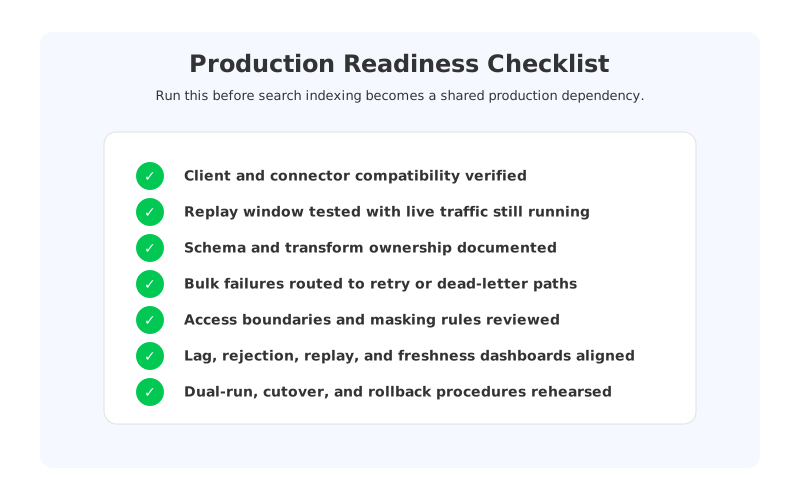
Start with a non-critical index that still behaves like a real workload. Publish CDC events, transform them into index commands, write through a connector or consumer, and inject the failures you expect to see in production: invalid mappings, downstream throttling, task restarts, schema changes, and replay bursts. Measure whether the team can answer four questions quickly: what changed, what reached Elasticsearch, what failed, and which offset range must be repaired.
If your team is evaluating shared-storage Kafka for search indexing streams, read the AutoMQ architecture overview and compare it against your own indexing, replay, governance, and migration scorecard. The useful outcome is a clear boundary: which pipelines can stay where they are, which need stronger stream governance, and which should move to an architecture built for retained history and elastic operations.
7References
- Apache Kafka documentation
- Apache Kafka documentation: Kafka Connect
- Apache Kafka documentation: consumers and consumer groups
- Apache Kafka documentation: delivery semantics
- Elasticsearch API documentation: Index API
- Elasticsearch API documentation: Bulk API
- AutoMQ documentation: Architecture overview
- AutoMQ documentation: S3Stream shared streaming storage
- AutoMQ documentation: WAL storage
- AutoMQ Cloud documentation: eliminate inter-zone traffic
8FAQ
8.1Is Kafka required for Elasticsearch indexing streams?
No. A small application can write directly to Elasticsearch, and some teams can use database-specific sync tools. Kafka-compatible streaming becomes valuable when many producers and consumers share change events, replay matters, and indexing needs an observable operational boundary rather than a direct side effect of application writes.
8.2How do teams prevent search pipeline drift?
Treat the pipeline as a stateful system. Preserve source changes in streams, version transforms, use deterministic document IDs, define dead-letter and retry policies, observe lag and rejection rates together, and test replay before production incidents. Drift is easier to control when every handoff has a contract and an offset trail.
8.3Should Elasticsearch contain the source of truth?
Usually no. Elasticsearch is optimized for search and analytics access patterns, while transactional systems own authoritative state. A durable stream can preserve the change timeline between them, and derived indexing commands can make document updates explicit without turning the search index into the primary record system.
8.4Where does AutoMQ fit in this architecture?
AutoMQ fits when the team wants Kafka-compatible APIs with a shared-storage operating model. That can help indexing platforms retain more history, run replay-heavy repair jobs, and scale broker compute separately from durable storage. The decision should still be validated with real CDC data, connector behavior, Elasticsearch mappings, and failure drills.


