
Table of Contents
Table of Contents
The search for energy efficient streaming architecture usually starts with a sustainability question, but it rarely stays there. A platform team sees the cloud bill rising with retention, cross-zone replication, and recovery traffic. A FinOps team asks why a Kafka estate keeps reserved capacity online during quiet hours. An AI team wants fresher context, longer replay windows, and more backfills. Carbon impact is not a separate concern pasted onto the side of streaming architecture; it is a consequence of how much compute, storage, network transfer, and operational churn the architecture requires to keep events durable and replayable.
That framing matters because streaming systems do not consume resources in one obvious place. A producer write can become broker writes, replica transfers, index updates, object-store operations, metrics, logs, and later consumer reads. Broker replacement can trigger replica catch-up; retention changes can become storage expansion; backfills can compete with tail reads. The useful question is therefore how much avoidable work a platform creates per retained, replayable event across the write path, failure path, scale path, and replay path.
1Why energy efficient streaming architecture matters now
Streaming has moved from an integration layer to a real-time data substrate for operational systems and AI applications. The same topics that feed services, analytics, fraud detection, and observability can now feed retrieval pipelines, feature pipelines, and event-driven AI workflows. These workloads raise the value of retention and replay, which raises the chance that teams keep more brokers, disks, and network capacity available than the steady state requires.
The sustainability angle becomes concrete when you trace the resource chain. More retained data means more storage, more replicas mean more writes and network movement, bursty consumers mean more headroom, and manual rebalancing makes operators avoid scale-in. Cloud sustainability guidance tends to emphasize matching provisioned resources to demand, reducing unnecessary data movement, and selecting efficient storage patterns for the access profile. Those principles apply directly to streaming.
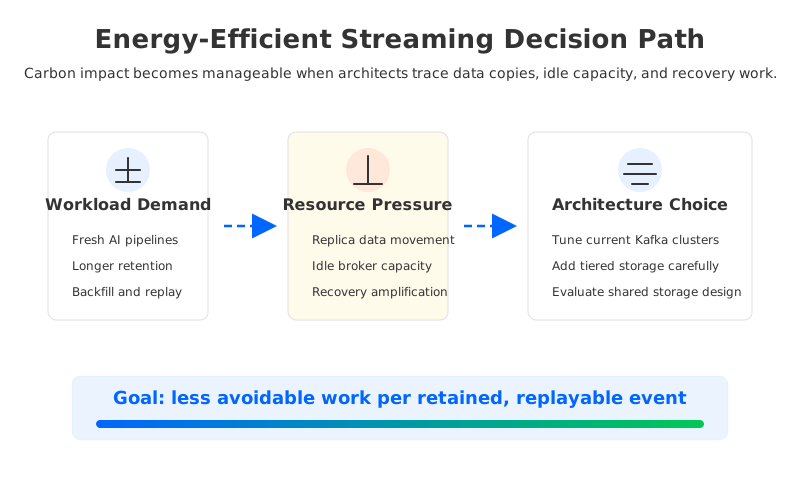
The diagram above starts with workload demand, moves through resource pressure, then asks which architectural pattern reduces unnecessary work without weakening the event contract. Carbon accounting can tell you where the footprint is. Architecture review tells you why it exists.
2The production constraints behind the search
Most platform teams already know the useful tuning advice: right-size instances, clean up unused topics, compress records, tune retention, and set quotas. Those actions help. The harder part is that production streaming systems are constrained by reliability, compatibility, data ownership, and migration risk. You cannot optimize energy use by breaking consumer group behavior, weakening durability, or forcing every application team to rewrite clients.
A serious review has to keep several constraints in view:
- Kafka semantics remain the contract. Producers, consumers, offsets, transactions, compaction, quotas, access control, and ecosystem tools are not optional details.
- Freshness and replay must coexist. AI and operational analytics often need low-latency tail reads and historical backfill at the same time.
- Scaling cannot create more waste than it removes. If adding or removing capacity requires large partition movement, teams will overprovision to avoid the operational risk.
- Governance boundaries matter. Sustainability work does not override data residency, encryption, auditability, network isolation, or support-access controls.
Metrics can reveal CPU utilization, disk fill rate, consumer lag, and network throughput. They cannot decide whether broker-local storage, remote tiering, or shared storage is the right operating model.
3Where traditional Kafka architecture amplifies work
Apache Kafka's shared-nothing design is one reason Kafka became so widely adopted. Brokers store log segments on local disks, partitions are assigned to brokers, and durability is provided through replication across brokers. This design gives operators a clear model: leaders accept writes, followers replicate, consumers read from the log, and offsets define progress. The model is familiar, proven, and well documented.
The same model also couples compute and durable storage. When a broker owns local log segments, scaling the broker fleet is not a pure compute operation. Replacing a node, expanding capacity, changing partition placement, or recovering replicas can move data across the network. In multi-zone deployments, replication is both availability design and resource consumption.
Tiered storage changes part of this equation by moving older log segments to remote storage. For long retention, that can be meaningful because not every byte needs to remain on broker-attached storage. Yet tiered storage does not erase the coupling between hot partitions, broker leadership, local storage, and the replication path. The hot path still has to be sized, operated, and recovered as a broker-local system.
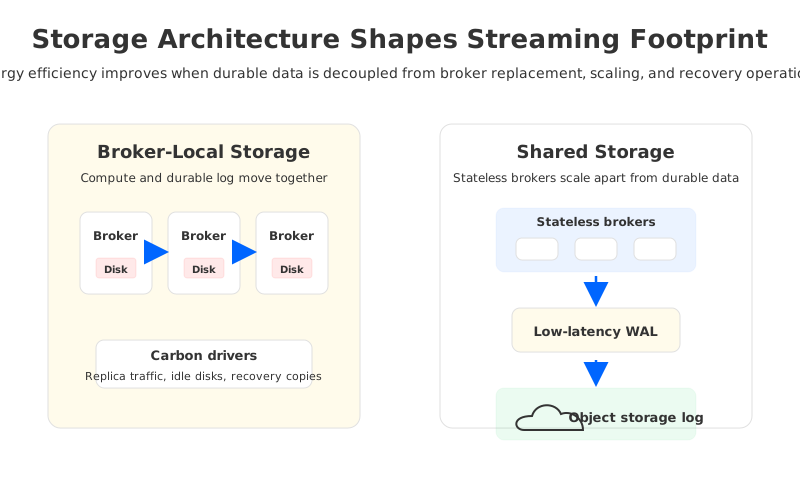
The carbon implication is not that traditional Kafka is wasteful in every workload. For stable traffic, carefully sized clusters, and short retention windows, the model can be reasonable. The issue appears when workloads become bursty, replay-heavy, multi-zone, and retention-sensitive. At that point, elasticity can turn into data movement, which is one of the first places sustainability work should look.
4Architecture patterns teams usually compare
The practical choice is rarely "keep Kafka" or "replace Kafka." Most teams compare Kafka-compatible patterns that preserve the application contract while changing who operates the infrastructure and where durable data lives. The pattern that wins depends on workload evidence, failure expectations, and control requirements.
| Pattern | What it improves | Efficiency risk to examine | Good fit |
|---|---|---|---|
| Self-managed Kafka | Maximum infrastructure control and mature Kafka behavior | Idle headroom, broker-local storage, cross-zone replicas, manual rebalance work | Teams with strong Kafka operations and predictable workload shape |
| Managed Kafka service | Reduced operational burden for common cluster tasks | Pricing dimensions, data-plane boundary, storage and network cost visibility | Teams that value service ownership transfer over low-level control |
| Kafka with tiered storage | Lower pressure from long-lived historical segments | Hot data still follows broker-local placement and replica behavior | Workloads with long retention and moderate elasticity needs |
| Kafka-compatible shared storage | Durable data decoupled from broker lifecycle | WAL design, object-store request behavior, compatibility, metadata recovery | Workloads with bursty compute, long retention, replay, and cloud placement needs |
This table is not a product ranking. A managed service may reduce operational burden while still leaving a resource model that needs cost and sustainability review. Tiered storage may reduce local disk growth while leaving scale-out tied to partition leadership. Shared storage may reduce broker statefulness while introducing a write-ahead log and object-store design that must be validated under your latency and failure requirements.
The most useful test is to model the full lifecycle of a record. How many durable writes happen before acknowledgement? How many copies move between zones? What happens when a broker disappears? How much data moves when capacity is added for a burst and removed later? These questions connect carbon impact to mechanisms rather than slogans.
5Evaluation checklist for platform teams
Energy efficiency needs a production checklist because one-dimensional optimization creates bad trade-offs. Compression cannot compensate for a scaling model that discourages scale-in. Shortening retention can undermine audit, replay, and AI context requirements. Remote storage can help with older data without making the hot path elastic.
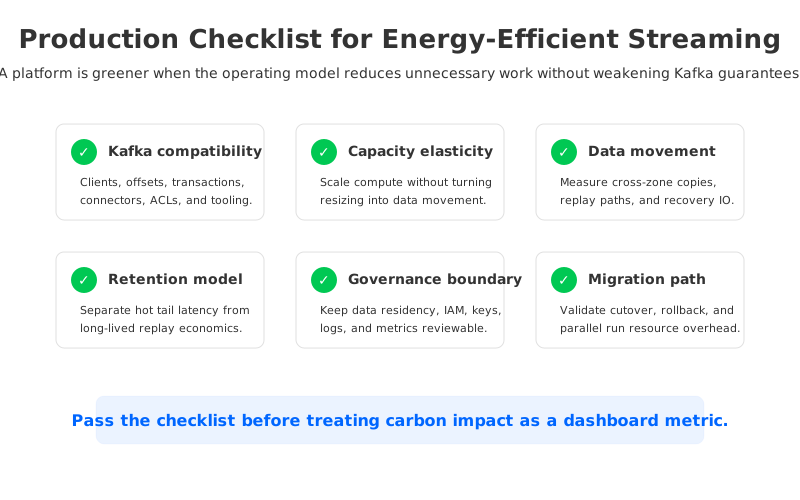
Use the checklist below during architecture review:
- Compatibility. Run the clients and components you actually use: idempotent producers, transactional workloads where relevant, consumer groups, offset commits, compaction, Kafka Connect, stream processors, ACLs, quotas, and observability agents.
- Capacity elasticity. Test scale-out and scale-in as operational events. Measure whether compute changes require partition data movement and whether operators can safely scale down after peaks.
- Data movement. Map producer writes, replication traffic, consumer reads, backfill, recovery, and cross-zone routing before it appears as cost, lag, or sustainability reporting.
- Retention model. Separate the hot tail from retained history. Long retention is valuable for replay and AI context, but it should not force the hot broker fleet to carry cold data.
- Governance boundary. Identify where payloads, metadata, keys, logs, metrics, IAM policies, network endpoints, and administrative access live.
- Migration path. Include the temporary footprint of migration. Dual writes, replication, validation jobs, and rollback windows consume resources.
The checklist also prevents a common measurement mistake. Average CPU utilization alone does not prove energy efficiency. A cluster can look efficient at rest and still create excessive network transfer during failure recovery. The review has to cover steady state and change events.
6Where AutoMQ changes the operating model
After the neutral evaluation, AutoMQ becomes relevant as a Kafka-compatible streaming platform built around shared storage rather than broker-local durable storage. The idea is straightforward: preserve the Kafka-facing compute and protocol layer while replacing the local log storage model with an object-storage-backed stream storage layer. Brokers become stateless in the sense that durable data is not bound to local disks, and a write-ahead log absorbs low-latency writes before data is persisted into shared object storage.
That shift changes the energy-efficiency conversation in three ways. Scaling compute no longer has to imply moving durable partition data between brokers. Shared object storage can reduce application-level replica movement in multi-zone deployments. Separating storage from compute also lets teams reason about hot write latency, retained history, and replay economics as different parts of the system.
AutoMQ's public documentation describes this as a Shared Storage architecture with S3Stream replacing Kafka's local log storage, WAL storage for low-latency persistence, and object storage as the main data repository. It also documents Kafka compatibility, stateless brokers, and approaches for reducing inter-zone traffic. Those details matter because "object storage behind Kafka" is not enough by itself; the write path, recovery path, metadata path, and client compatibility surface all need engineering depth.
For sustainability review, the natural AutoMQ angle is not a generic claim that one platform is greener than another. The practical claim is narrower: when durable stream data is decoupled from broker lifecycle, the platform has fewer reasons to keep compute overprovisioned or to move data during routine scaling and recovery. Teams still need to measure their workloads, regions, storage classes, and policies, but the architecture gives them more levers than broker-local storage alone.
Evaluate this with one representative workload: high-throughput topics, a replay-heavy consumer group, a retention window that matches business requirements, and a failure scenario that reflects on-call reality. Compare idle broker capacity, data moved during scale changes, and recovery behavior after node loss. If the shared storage design reduces avoidable work while preserving Kafka behavior, the sustainability argument becomes measurable.
7Decision table
The decision is clearest when sustainability is treated as an operating-model requirement rather than a branding statement.
| If your main issue is... | Optimize first | Consider an architecture change when... |
|---|---|---|
| Underused broker fleets | Scheduling, quotas, compression, right-sizing, topic cleanup | Scale-in is avoided because partition movement or recovery risk is too high |
| Storage growth | Retention policy, compaction, tiered storage, data lifecycle review | Long retention is required and broker-attached storage dominates platform planning |
| Cross-zone traffic | Placement-aware clients, rack awareness, topic design, traffic analysis | Replica and consumer traffic remain structurally expensive in multi-zone deployments |
| AI freshness and replay | Consumer scaling, lag monitoring, backfill isolation | Replay and tail reads compete so much that teams keep permanent excess capacity |
| Governance pressure | IAM, encryption, network isolation, audit logging, data classification | The control boundary is unclear or cannot satisfy residency and access requirements |
Back where the search started, "energy efficient streaming architecture" is not a request for a prettier carbon dashboard. It is a request for an event backbone that does less unnecessary work while keeping the guarantees that made Kafka valuable. If broker-local storage, replica movement, and idle headroom keep appearing in your review, evaluate shared storage architectures in the next design cycle. AutoMQ is one option to examine when you want Kafka-compatible behavior with a cloud-native storage model and a customer-controlled deployment boundary.
8References
- Apache Kafka Documentation
- Apache Kafka Tiered Storage
- AWS Well-Architected Framework: Sustainability Pillar
- AWS Well-Architected Framework: Use data access and storage patterns that best support how your data is accessed and stored
- Amazon S3 Data Durability
- AutoMQ Documentation: Overview
- AutoMQ Documentation: Architecture Overview
- AutoMQ Documentation: Compatibility with Apache Kafka
- AutoMQ Documentation: Eliminate Inter-Zone Traffics
9FAQ
9.1Is energy-efficient streaming mainly about lower cloud cost?
Cost and energy are not identical, but they often point to the same architectural waste. Idle brokers, unnecessary data copies, inefficient recovery, and over-retained local storage show up in the bill and in the resource footprint. Treat cost as a useful signal, then validate the resource behavior behind it.
9.2Does Kafka tiered storage solve the carbon-impact problem?
Tiered storage can reduce pressure from long-lived historical data, which is valuable for retention-heavy workloads. It does not automatically make the hot path stateless, remove all replica movement, or make scale-in operationally safe. Teams should test tiered storage as one pattern in a wider architecture review.
9.3How should teams measure carbon impact for Kafka-compatible platforms?
Start with workload mechanics: broker count, CPU and memory utilization, storage footprint, cross-zone transfer, replica movement, replay jobs, recovery traffic, and migration overlap. Then map those metrics to the cloud provider's sustainability and carbon-reporting tools. The architecture review should explain the resource drivers before the reporting layer summarizes them.
9.4Where does AutoMQ fit in an energy-efficient streaming strategy?
AutoMQ fits when the main inefficiency comes from broker-local state, replica movement, overprovisioned compute, or scaling constraints. Its Kafka-compatible shared storage architecture separates compute from durable stream storage, which can reduce avoidable data movement and make elasticity easier to operate. Teams should still validate compatibility, latency, replay, governance, and migration against their own production workloads.


