
Table of Contents
Table of Contents
Searches for enterprise copilot data plane kafka usually come from teams that have already moved past the prototype. The copilot is no longer a chat box connected to a handful of documents; it is an operational surface that reads support cases, policy changes, entitlement updates, product telemetry, and user feedback while writing actions that other systems may need to audit. The hard part is not the model call. It is the stream of context around that call, because the context has to be fresh for decisions, durable for replay, and controlled for legal, security, and SRE teams.
Kafka enters the conversation because it already provides properties that AI systems quietly depend on: ordered event logs, consumer groups, offsets, retention, replay, and a mature connector ecosystem. Those properties matter when a retrieval pipeline needs account updates, a risk engine replays policy decisions, and an audit workflow inspects the exact tool-call sequence behind a customer-facing action.
The architecture decision is harder than choosing a message bus. An enterprise copilot data plane sits between fast-changing business systems and AI workflows that are hard to reason about after the fact. If the platform team treats the stream as a thin transport layer, it will miss the problems that show up in production: stale context, duplicated tool actions, unbounded retention cost, connector drift, cross-zone network surprises, and unclear ownership.
1Why teams search for enterprise copilot data plane kafka
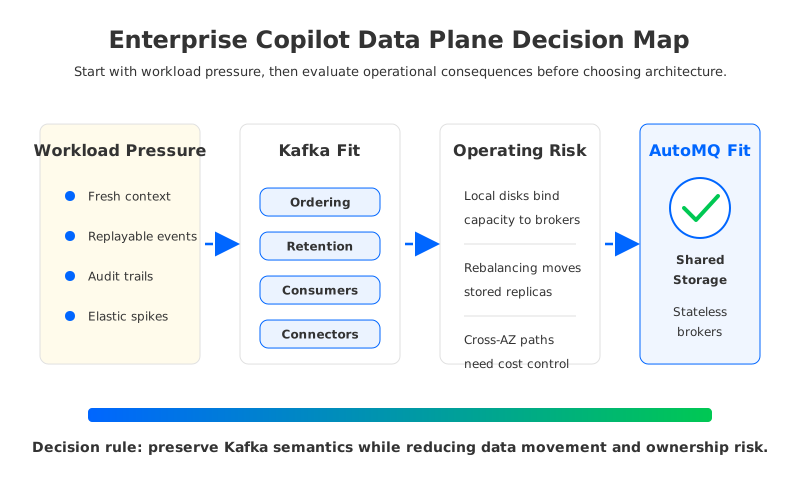
The search phrase is awkward, but the intent is precise. Buyers are trying to understand whether Kafka-compatible streaming can become the durable event backbone for copilots, agent workflows, and retrieval-augmented systems without forcing every application team to learn a separate AI-specific infrastructure stack. That matters because enterprise copilots usually touch systems that already publish or consume events: CRM updates, user profile changes, ticket transitions, billing signals, entitlements, fraud scores, observability events, and knowledge-base changes.
The first production pressure is freshness. A copilot that answers from yesterday's customer status may be worse than no copilot, because it creates confidence around stale context. The second pressure is replay. When a workflow makes a poor recommendation or triggers the wrong tool, the team needs to reconstruct the input sequence, prompt context, tool outputs, policy checks, and downstream effects. The third pressure is governance: which events crossed which boundary, which consumer read them, and whether sensitive fields were masked before reaching an AI workflow.
These pressures push the data plane away from an application-local queue and toward a shared streaming substrate. The stream has to carry operational events, support multiple consumers with different recovery points, and survive downstream outages without losing the audit path. Kafka-compatible infrastructure is attractive because it gives teams a familiar contract for these behaviors, but the infrastructure underneath that contract still decides whether the platform is practical at scale.
2The freshness and governance problem behind AI event streams
Copilot context looks simple when drawn as a retrieval pipeline: ingest documents, index embeddings, retrieve passages, call a model. Enterprise reality adds a messier layer. The same answer may depend on account state, product limits, regional policy, incident status, feature flags, previous tool calls, and the latest human override. Some signals are document-like, but many are event-like. They arrive continuously, age quickly, and need to be interpreted in order.
This is where freshness and governance collide. A low-latency stream can keep the copilot close to the business state, but low latency without control lets sensitive data flow into consumers built for experimentation, not production audit. A heavily governed batch pipeline can reduce exposure, but it may lag behind live operations. The data plane has to keep events moving while controlling schemas, access, retention, and replay boundaries.
For platform teams, the most useful question is not "Can Kafka feed an AI application?" It can. The better question is: what does the stream need to guarantee when the AI workflow becomes part of a regulated business process? The answer usually falls into a short list:
- Event identity and ordering. The team needs stable keys, timestamps, headers, and partitioning rules so consumers can reason about causality.
- Replay and retention policy. Copilot events need history for debugging, backfills, and compliance review, but retention cannot become an unbounded storage bill.
- Consumer isolation. Experimentation, production inference, analytics, and audit consumers should not block each other or share credentials casually.
- Connector discipline. Source and sink connectors need versioning, failure handling, and ownership, because many copilot failures begin as quiet integration drift.
- Observability across the stream. Lag, throughput, error rates, schema failures, and security events should be visible from the same operational surface that SREs already trust.
Kafka gives teams a strong vocabulary for these requirements, including consumer groups, committed offsets, producer configuration, and Kafka Connect. The vocabulary does not remove the operating model question. It makes that question explicit: if the event log is becoming the control surface for enterprise AI, should the storage and scaling model still assume long-lived stateful brokers?
3Architecture options for durable, replayable AI context
Traditional Kafka uses a shared-nothing model where brokers own local log data and replicate it across brokers for durability. This design is proven and widely understood. It also makes operational sense in steady workloads where capacity, traffic, and retention are predictable. Enterprise copilot traffic rarely stays that neat. Tool-use bursts, indexing jobs, incident response workflows, and backfills can change the shape of the cluster faster than a broker-local storage model likes.
Broker-local storage turns several AI data-plane pressures into infrastructure work. If retained data grows, storage is tied to broker capacity. If traffic shifts across partitions, rebalancing may move data between brokers. If the deployment spans availability zones, replication and consumer placement become availability and cost concerns. If a platform team isolates experimental consumers from production consumers by creating more clusters, governance and observability spread across more surfaces.
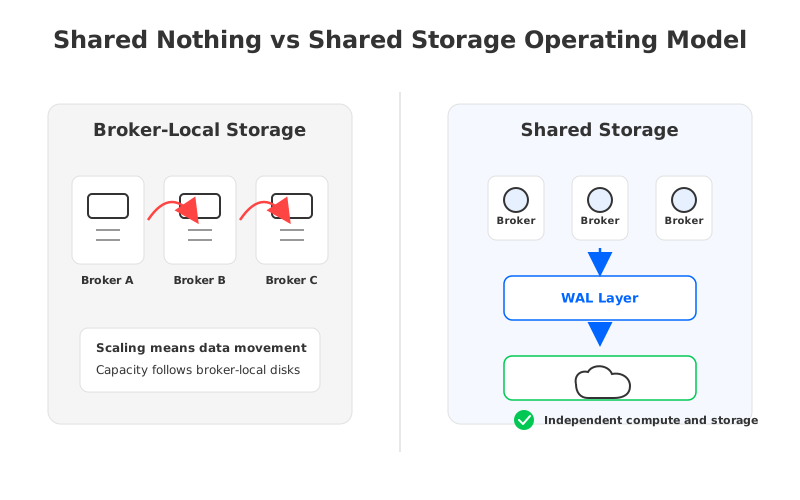
The alternative is a shared storage model for Kafka-compatible streaming. In this model, brokers focus on serving the Kafka protocol and handling compute-side work, while durable stream data is kept in shared storage such as object storage, with a write-ahead log layer protecting the low-latency write path. The design goal is not to make Kafka semantics disappear. It is to keep the client and ecosystem contract while changing where retained state lives and how much data has to move when compute changes.
That distinction matters because retention and replay are core requirements, not afterthoughts. Tiered storage can help traditional Kafka offload older segments, but the hot path still depends on broker-owned storage and replication. A shared storage architecture changes the unit of elasticity. Adding or removing broker compute should not require the same retained log movement, and storage growth should not force the team to provision unused compute.
4Evaluation checklist for platform teams
The right architecture depends on the workload, the team boundary, and the failure modes the business can tolerate. A generic benchmark will not answer that. A useful evaluation starts with the operational questions that decide whether the platform remains predictable after the first copilot goes live.
| Evaluation area | What to test | Why it matters for copilots |
|---|---|---|
| Compatibility | Kafka clients, consumer groups, offsets, transactions, Connect, schema tooling | AI teams should not rewrite reliable event plumbing to adopt a data plane |
| Cost model | Retention growth, replica traffic, object-storage requests, cross-zone paths, idle capacity | Copilot context can grow faster than initial token budgets predict |
| Elasticity | Broker add/remove behavior, partition movement, backfill isolation, burst handling | AI indexing and tool workflows create uneven traffic |
| Governance | ACLs, network boundaries, encryption, audit logs, data residency | Copilots often touch regulated or customer-facing data |
| Recovery | Broker failure, consumer replay, connector restart, region or zone impairment | The team needs to reconstruct and resume workflows under stress |
| Migration risk | Dual running, offset continuity, rollback, topic-by-topic cutover | The data plane should not require a high-risk platform rewrite |
This table puts compatibility before cost. Lower infrastructure cost is valuable, but a copilot data plane that breaks client semantics or offsets will create application risk that no storage saving can defend. Compatibility alone is not sufficient either. If a compatible platform keeps the same broker-local storage coupling, the team may still inherit the scaling and cost behaviors that made the original cluster hard to operate.
One practical readiness test is to trace a single customer-facing decision. Which event changed the account state? Which consumer picked it up? Which policy check approved the tool call? Which output was written back to the business system? If the team cannot answer that across normal operation, backlog recovery, and rollback, the data plane is not ready for enterprise copilot control.
5How AutoMQ changes the operating model
Once the evaluation framework is clear, AutoMQ fits into a specific architectural category: a Kafka-compatible, cloud-native streaming system that keeps the Kafka protocol surface while replacing broker-local retained storage with shared storage. AutoMQ's public architecture documentation describes S3Stream shared streaming storage, a WAL storage layer, and stateless broker principles. For a copilot data plane, the important point is the shift from "state lives with each broker" to "brokers serve the Kafka interface while durable data is backed by shared storage."
That shift changes several operational loops. Capacity planning becomes less tied to retained log size because storage and compute can scale more independently. Broker replacement and scaling become less data-heavy because the broker is not the long-term owner of retained segments. Cross-zone traffic can be controlled with an architecture that avoids application-layer replica movement across zones for every write path.
There is still engineering work to do. Teams have to validate client behavior, topic configuration, ACLs, connector semantics, observability, retention policy, and rollback. A shared storage architecture does not remove SRE discipline; it moves the hard part away from repeated broker data movement and toward deliberate platform design. For enterprise copilots, that is a useful trade because the event stream is expected to grow, replay, and serve multiple AI and non-AI consumers over time.
AutoMQ is most relevant when the data plane has these characteristics:
- Long-lived context streams. The team needs retention and replay for audit, debugging, and backfills, not only transient request buffering.
- Cloud cost sensitivity. Storage growth, cross-zone paths, and over-provisioned brokers are visible enough to affect platform economics.
- Kafka ecosystem dependency. Producers, consumers, Connect pipelines, stream processors, and operational tooling already depend on Kafka semantics.
- Customer-controlled boundaries. The organization wants the streaming layer to live inside its cloud, network, and compliance scope.
Not every copilot workload needs AutoMQ. Small internal assistants with low event volume may be fine with a simpler queue or an existing Kafka cluster. The case becomes stronger when the copilot is connected to production systems, retention matters, multiple consumers need independent replay, and the platform team is already fighting the side effects of stateful broker storage.
6Migration and readiness scorecard
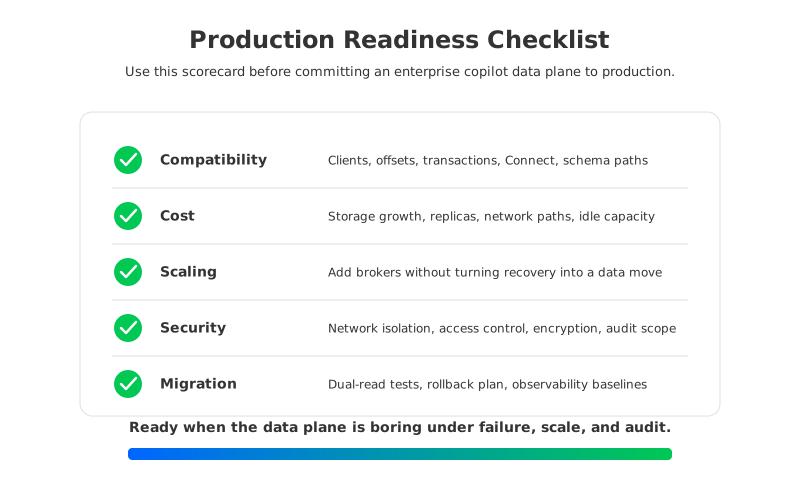
Migration should start with workload classification rather than a cluster-wide move. Group topics by business domain, consumer criticality, retention needs, and rollback complexity. A support copilot event stream with strict audit requirements deserves a different migration plan from an internal experimentation topic.
| Readiness signal | Green | Yellow | Red |
|---|---|---|---|
| Client compatibility | Standard Kafka clients and documented configs | Custom interceptors or uncommon client versions | Unknown client behavior |
| Offset control | Consumer offsets are understood and testable | Some consumers lack clear ownership | Stateful consumers cannot be replayed safely |
| Connector state | Source and sink failures are observable | Connector ownership is split across teams | Silent connector drift is common |
| Governance | ACLs, network paths, and data classes are mapped | Some sensitive fields need cleanup | No data classification for event payloads |
| Rollback | Topic-level rollback path is rehearsed | Rollback exists but has not been tested | Cutover is one-way |
The strongest signal is boring recovery. A production-ready data plane should tolerate a broker replacement, connector restart, consumer backlog, schema rejection, and partial cutover without forcing the AI team into improvised debugging. Enterprise copilots operate close to user trust and business process control, so the streaming layer needs to be more predictable than the model behavior above it.
For teams evaluating this architecture, the next useful step is to compare your current Kafka operating loops against a shared-storage Kafka-compatible model. AutoMQ's verified architecture overview is a good starting point: review the AutoMQ architecture documentation and map it to one real copilot event stream before discussing a broader migration.
7References
- Apache Kafka Documentation
- Apache Kafka Consumer Configuration
- Apache Kafka Connect Documentation
- Apache Kafka Replicated Log Design
- AWS Amazon S3 User Guide
- AWS PrivateLink Documentation
- AutoMQ Architecture Overview
- AutoMQ S3Stream Shared Streaming Storage
- AutoMQ WAL Storage
- AutoMQ Native Compatibility with Apache Kafka
- AutoMQ Stateless Broker
- AutoMQ Eliminate Inter-Zone Traffic Overview
8FAQ
8.1Is Kafka a good fit for an enterprise copilot data plane?
Kafka is a strong fit when the copilot needs durable events, replay, consumer isolation, connector integration, and ordered operational context. It is less compelling for small experiments where a short-lived queue or direct API call is sufficient. The decision should be based on whether the copilot needs an auditable event backbone, not on whether AI is involved.
8.2What makes copilot event streams different from ordinary application events?
Copilot streams often combine business state, retrieval signals, tool calls, policy checks, and audit events. That mixture increases the need for schema discipline, access control, retention policy, and replay. The stream is not only feeding a model; it is becoming evidence for why an automated workflow made a decision.
8.3Why does shared storage matter for Kafka-compatible AI infrastructure?
Shared storage reduces the amount of retained data tied to each broker. That matters when context retention grows, consumers replay, or traffic spikes around indexing and tool workflows. It lets the platform team think about compute elasticity and durable storage as separate planning dimensions while preserving the Kafka-facing contract.
8.4Should every enterprise copilot use AutoMQ?
No. A small assistant with limited event volume may run well on existing infrastructure. AutoMQ becomes more relevant when the team needs Kafka compatibility, long retention, customer-controlled deployment boundaries, lower data movement, and elastic cloud operations for production copilot workloads.
8.5What should teams test before migrating a copilot data plane?
Test client compatibility, consumer offset handling, connector restart behavior, schema failures, ACL parity, lag recovery, observability dashboards, and rollback. The goal is not a flawless demo; it is confidence that the platform behaves predictably when consumers fall behind, brokers change, and audit questions arrive after the incident.


