
Table of Contents
Table of Contents
An enterprise IoT event platform rarely fails because one sensor cannot publish one message. It fails when the same platform has to absorb fleet bursts, keep telemetry replayable, isolate tenants, preserve audit trails, and let downstream teams consume events through familiar APIs. That is why many architecture searches eventually become a Kafka question: can a Kafka-compatible event platform handle edge ingest, retention, replay, governance, and cloud cost without turning growth into storage migration?
The keyword enterprise iot event platform kafka usually comes from teams that already know Kafka's value. They want durable ordering, consumer groups, offset-based replay, a mature connector ecosystem, and compatibility with stream processors. The harder question is whether the operating model behind the Kafka cluster matches IoT workloads. Device traffic is uneven, long retention is common, and replay is not optional.
1Why IoT Turns Kafka Into an Operating Model Decision
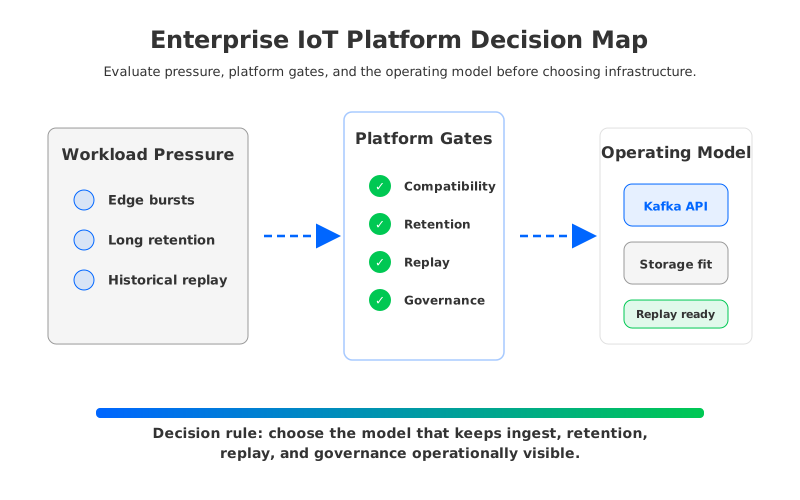
IoT traffic has a different shape from many backend event streams. A payments or web activity stream may be high volume, but the producers are usually a controlled set of services. An IoT platform has gateways, devices, firmware versions, regions, customer tenants, and intermittent networks. The event platform must tolerate late arrivals and bursty reconnects while still giving downstream systems a consistent way to consume data.
That combination creates four pressure zones:
- Edge ingest: gateways and devices need stable write endpoints, buffering, authentication, and backpressure behavior that does not collapse when many devices reconnect after an outage.
- Hot processing: alerting, rules engines, anomaly detection, and operational dashboards usually need low-latency reads from the latest events.
- Retention and replay: analytics, model training, billing, compliance, and incident investigation often need historical events to remain available after the hot window has passed.
- Governance: tenant isolation, encryption, auditability, schema discipline, and access control must be designed into the platform rather than patched onto it later.
Kafka fits much of this model because it gives applications durable ordered logs, Consumer groups, offsets, and a large ecosystem around connectors and stream processing. The problem is that Kafka's API and Kafka's storage architecture are not the same decision. Teams can want Kafka semantics while questioning whether broker-local disks, replica movement, and capacity preallocation are the right foundation for long retention.
2The Production Constraint Behind the Problem
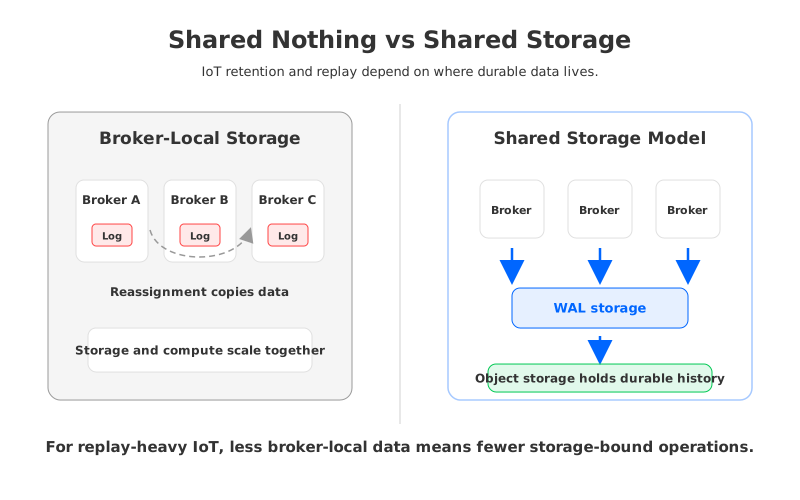
Traditional Kafka is a Shared Nothing system. Each broker owns local log segments, each partition has replicas on specific brokers, and durability is achieved by replicating data between brokers. That design is robust and well understood, but it makes storage placement part of day-to-day operations. When a broker is replaced, a partition is reassigned, or capacity changes, data often has to move between machines.
For IoT workloads, that data movement is not a corner case. Device fleets grow by geography and customer rollout, not by a neat linear plan. A product team may add a device class, a regional team may require longer retention, or a data science team may ask for replay after a model change. Together, these requests force the platform team to keep enough headroom for steady traffic and future rebalancing work.
The operational impact usually appears in three places. Storage and compute scale together even when the workload only needs one of them. Cross-zone replication can become a material cost and capacity concern in multi-AZ deployments. Replay and catch-up reads compete with live ingest if the cluster was sized around hot-path traffic. These are not Kafka API problems; they come from binding durable data to broker-local storage.
3Architecture Options and Trade-Offs
The right enterprise IoT event platform is usually not a single product checkbox. It is a set of boundaries: what happens at the edge, what remains in Kafka-compatible streaming, what belongs in object storage, and who owns the control plane. A clean evaluation starts by separating API requirements from infrastructure requirements.
| Decision area | What to validate | Why it matters for IoT |
|---|---|---|
| Kafka compatibility | Producer and Consumer behavior, offsets, transactions, client versions, connector support | Device and application teams should not rewrite every integration during platform evolution. |
| Retention model | Local disk, tiered storage, or shared object storage | Long retention and replay should not force every broker to carry the same storage burden. |
| Scaling model | Whether compute and storage can scale independently | IoT fleets often grow in traffic, retention, and replay demand at different times. |
| Failure recovery | Broker replacement, partition reassignment, metadata recovery, and rollback path | Device reconnect storms and regional incidents make recovery behavior visible to users. |
| Network boundary | Private networking, cross-zone traffic, egress, and account ownership | IoT platforms often have strict data residency, security, and cost requirements. |
| Governance | Identity, ACLs, schema controls, audit logs, and tenant isolation | A platform used by many device lines and business units needs policy enforcement from the start. |
This table also helps avoid a common mistake: treating tiered storage as the same thing as a shared-storage streaming architecture. Kafka Tiered Storage, described in KIP-405, moves older log segments to remote storage so brokers can keep less local data. That is valuable for long retention, but the hot path can still depend on broker-local logs and replica placement. A shared-storage design goes further by making object storage part of the primary durability model.
The distinction matters during replay. A tiered-storage cluster can make historical data lower-cost to retain, but live brokers still coordinate reads, local cache, leader placement, and fresh writes. A shared-storage architecture changes the recovery and scaling question: if durable data is already in shared storage, replacing compute capacity should be closer to reattaching ownership and cache than copying large volumes of partition data.
4Edge, Retention, and Replay Design
The edge layer should be boring in the useful sense of the word. Gateways authenticate devices, normalize protocols, buffer short outages, and publish into a stable event backbone. They should not contain long-lived business state or complex replay logic. Once replay moves to the edge, every gateway becomes a miniature data platform.
Kafka-compatible streaming is the right middle layer when multiple downstream teams need ordered event consumption. Offset-based consumption lets a rules engine process the latest telemetry while a data lake connector persists raw events and a model pipeline replays historical windows. Consumer groups let those teams move at different speeds. Kafka Connect provides a standard way to integrate source and sink systems, which keeps the IoT platform from becoming a pile of one-off ingestion scripts.
Retention belongs in the architecture discussion early because it changes the economics of everything else. A 24-hour operational stream and a 180-day replayable telemetry stream are not the same platform. The longer the retention window, the more important it becomes to ask where the durable bytes live, how historical reads are served, and whether expanding retention forces broker replacement or disk expansion.
Replay should be treated as a production workflow, not a rare maintenance task. Firmware bugs, schema mistakes, late-arriving data, model retraining, and audit investigations all create legitimate replay demand. A platform design is weak if replay requires heroic coordination between the Kafka team, analytics team, and application owners. A better design lets teams request replay with clear isolation, throughput limits, and observability around lag, read amplification, and downstream side effects.
5Evaluation Checklist for Platform Teams
The evaluation should be strict because IoT platforms tend to become shared infrastructure. A small team may start with one product line, but the platform soon absorbs more devices, more consumers, more regions, and more compliance requirements. The checklist below is intentionally operational, because production failures rarely respect clean architecture diagrams.
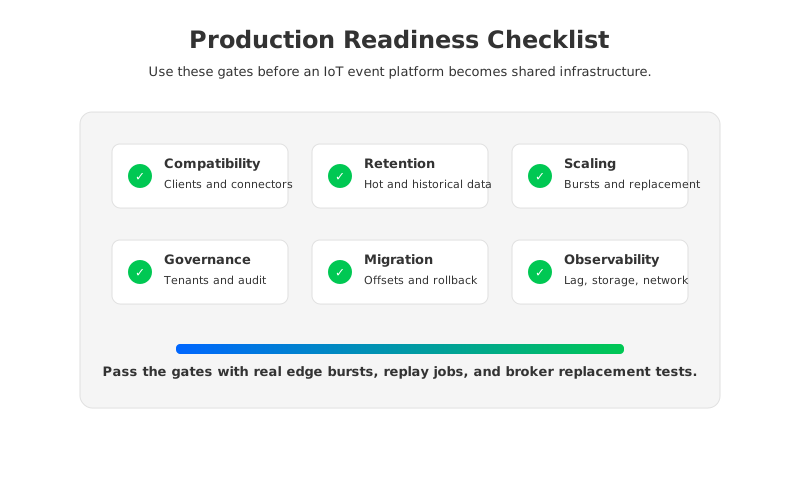
- Compatibility gate: run existing Producers, Consumers, stream processors, connectors, and security settings against the target platform before discussing migration timelines. Include error handling and rebalance behavior, not only happy-path tests.
- Retention gate: model hot retention, cold retention, replay windows, and storage growth separately. The design should make it clear which costs grow with ingest, which grow with retention, and which grow with historical reads.
- Scaling gate: test broker replacement, partition expansion, and burst ingest under realistic fleet behavior. The platform should be able to add compute without turning every scaling action into a long data-copy operation.
- Governance gate: define tenant boundaries, topic naming, schema ownership, ACL patterns, audit requirements, and break-glass access before the platform becomes a shared dependency.
- Migration gate: preserve offsets, validate rollback, and move traffic in controlled phases. A migration is not complete when data copies; it is complete when Producers, Consumers, and downstream stateful jobs can move with known recovery behavior.
- Observability gate: expose broker, client, connector, storage, network, lag, and replay metrics in one operational view. IoT incidents often span device firmware, gateway queues, network paths, and event platform internals.
The checklist gives platform teams a more precise conversation with vendors and internal stakeholders. Instead of asking whether a platform "supports Kafka," ask what happens when a large device group reconnects, a data science team launches a historical replay, and brokers need replacement during peak ingest. The answer reveals the operating model.
6How AutoMQ Changes the Operating Model
Once the evaluation reaches storage placement and scaling behavior, Kafka-compatible shared storage becomes relevant. AutoMQ is a Kafka-compatible cloud-native streaming system that keeps Kafka protocol and ecosystem compatibility while replacing broker-local durable storage with a Shared Storage architecture backed by object storage and WAL storage. In practice, this means brokers can focus more on compute, protocol handling, caching, and leadership while durable data is not permanently tied to local disks.
That distinction changes the IoT platform conversation in several ways. Compute can scale closer to traffic demand, while retention can grow in object storage. Broker replacement and partition reassignment no longer need to be dominated by moving large volumes of local partition data. Multi-AZ deployment can also be evaluated differently because AutoMQ's architecture is designed to reduce cross-AZ replication traffic.
AutoMQ is not a reason to skip the checklist. It is a reason to ask sharper questions. Which workloads need low-latency WAL options? Which topics are dominated by replay? Which environments require BYOC boundaries so data-plane workloads stay in the customer's cloud account? Which migration path preserves offsets and gives application teams a rollback plan? Those questions map naturally to AutoMQ's architecture, BYOC deployment model, and Kafka Linking migration path, but they still need workload validation.
For enterprise IoT, the useful architecture is often the one that reduces special cases. Edge gateways keep doing edge work. Kafka-compatible clients keep using Kafka APIs. Object storage carries durable history. Brokers scale around active compute and cache needs. The platform team gets a smaller operational surface area for retention and replay.
7A Practical Readiness Scorecard
Before committing to an enterprise IoT event platform, score the design against scenarios rather than a generic feature list. Simulate an edge reconnect storm and measure produce latency, broker saturation, client retries, and downstream lag. Expand retention for a high-volume topic and document the infrastructure actions required. Replay a historical window while live ingest continues. Replace compute capacity and observe whether the operation depends on large data movement.
The strongest designs make these scenarios procedural. They have known dashboards, runbooks, quotas, rollback paths, and ownership boundaries. The weakest designs rely on expert memory: one engineer knows which partitions are risky, another knows which connector can tolerate replay, and a third knows how much disk headroom remains. That does not survive an enterprise IoT rollout.
Use this compact scorecard during architecture reviews:
| Scenario | Passing signal | Warning signal |
|---|---|---|
| Edge reconnect storm | Backpressure is visible and controlled; live Consumers recover without manual intervention. | Producer retries hide queue buildup until downstream systems fall behind. |
| Retention expansion | Storage growth is predictable and does not force immediate broker reshaping. | Longer retention requires urgent disk, broker, or partition redistribution work. |
| Historical replay | Replay throughput is limited, observable, and isolated from hot-path ingest. | A replay job competes with production traffic without clear guardrails. |
| Compute replacement | Brokers can be replaced with bounded impact and clear recovery behavior. | Replacement triggers long partition movement and uncertain catch-up time. |
| Migration or rollback | Offsets, write path, read path, and rollback state are verified together. | The plan copies data first and leaves traffic cutover as a manual event. |
The architecture decision should now be less abstract. If the platform is mostly a short-retention operational bus, a conventional Kafka deployment may be enough. If the platform is a long-retention, replay-heavy, multi-tenant IoT backbone, the storage and scaling model deserves the same scrutiny as API compatibility. The cost of getting this wrong is the inability to replay, recover, or grow without turning normal product demand into infrastructure surgery.
If your team is evaluating Kafka-compatible infrastructure for an IoT event platform, validate the design with real retention, replay, and broker-replacement scenarios rather than a synthetic produce-consume demo. To explore how a shared-storage Kafka-compatible architecture behaves under those tests, start with AutoMQ and run the checklist against your own workload.
8References
- Apache Kafka documentation
- Apache Kafka Connect documentation
- Apache Kafka message delivery semantics
- KIP-405: Kafka Tiered Storage
- KIP-1150: Diskless Topics
- AWS Amazon S3 user guide
- AWS PrivateLink documentation
- AutoMQ architecture overview
- AutoMQ Kafka Linking migration and replication
9FAQ
9.1Is Kafka a good fit for an enterprise IoT event platform?
Kafka is a strong fit when the platform needs durable ordered logs, Consumer groups, offset-based replay, and broad ecosystem compatibility. The main evaluation point is not only the Kafka API; it is whether the storage, scaling, network, and governance model can handle uneven device traffic, long retention, and historical replay.
9.2What is the difference between tiered storage and shared storage for IoT workloads?
Tiered storage moves older log segments to remote storage to reduce pressure on broker-local disks. Shared storage makes remote durable storage part of the primary architecture, so durable data is less tied to individual brokers. For replay-heavy IoT workloads, that difference affects scaling, broker replacement, and how much data movement operations require.
9.3Where should replay logic live in an IoT architecture?
Replay should live in the event platform and downstream processing workflows, not inside every edge gateway. Gateways should handle authentication, buffering, protocol normalization, and controlled publishing. Centralizing replay semantics makes governance, observability, and recovery behavior easier to manage.
9.4How should teams test an IoT event platform before migration?
Test with production-like scenarios: edge reconnect storms, retention expansion, historical replay during live ingest, broker replacement, and phased client migration. A successful test should validate offsets, Consumer group behavior, connector behavior, network boundaries, and rollback procedures together.


