
Table of Contents
Table of Contents
An enterprise managed Kafka SLA usually enters the conversation as a percentage. Procurement sees an uptime number. SRE leaders see a credit table. CTOs see a business continuity risk. Those views are all valid, but none of them is enough to decide whether a production managed Kafka service can carry payment events, fraud signals, inventory changes, telemetry, or customer-facing application workflows.
Kafka reliability is not a single control plane endpoint staying alive. It is a chain: producers must be able to write, brokers must commit data durably, replicas or shared storage must survive failures, consumers must continue or recover with known semantics, and the provider must expose enough telemetry for customers to prove what happened. A managed Kafka SLA that reduces all of this to monthly availability can leave serious gaps.
The strongest enterprise reviews treat SLA as an evidence model. The question is not only "what percentage is promised?" The better question is: what technical and operational guarantees sit behind that promise, and what is excluded when the incident actually happens?
1Why a Kafka SLA Is More Than Uptime
Uptime is necessary, but Kafka is a stateful distributed log. A web API can be available while a topic is under-replicated. A control plane can answer requests while a consumer group is falling behind. A cluster can accept writes while retention, compaction, or partition imbalance is quietly moving the platform toward a capacity incident.
This is why enterprise teams should separate service availability from workload reliability. Provider SLA pages often define exactly which requests, regions, clusters, tiers, and failure causes count. AWS, for example, defines its Amazon MSK SLA around Multi-AZ deployments and a monthly uptime calculation, while also listing exclusions such as insufficient capacity, excessive partitions, not following operational guidance, customer-side failures, non-Multi-AZ deployments, and certain underlying engine failures. Google Cloud's Managed Service for Apache Kafka SLA is explicit that the covered service is cluster, location, and operation management methods; operations for topics and consumer groups are excluded from that covered scope.
That does not make those SLAs weak. It makes them contract documents, not architecture reviews.
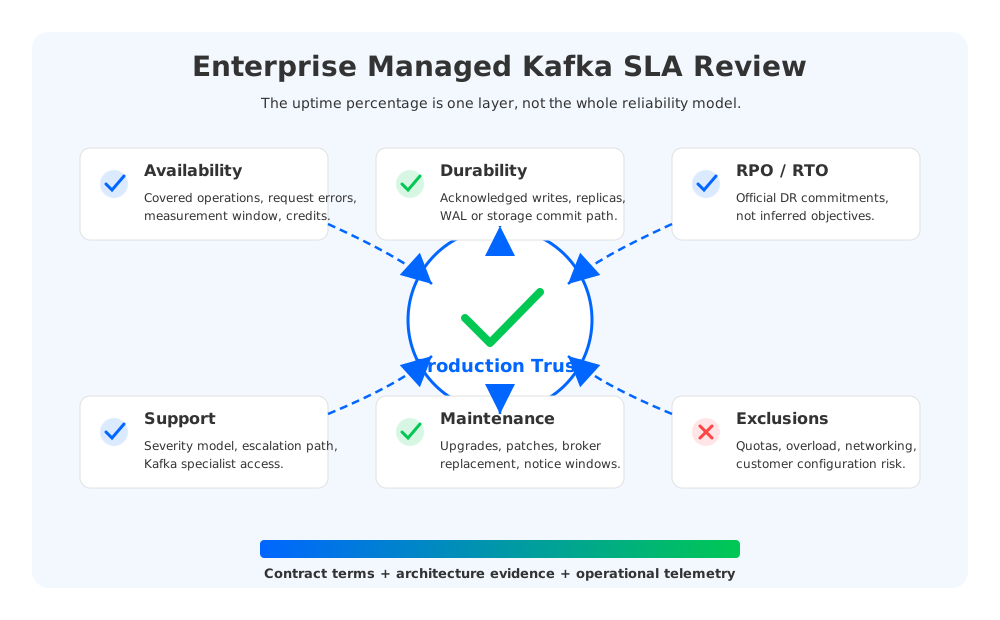
For production managed Kafka, the review has to include at least eight dimensions:
- Availability: which APIs and data plane operations are covered, at what scope, and how downtime is measured.
- Durability: what must happen before a write is acknowledged, and what conditions can still lose or reject data.
- RPO and RTO: what the provider commits to for disaster recovery, and what remains an application responsibility.
- Support response: who answers severity-one incidents, in which hours, through which escalation path.
- Maintenance: how upgrades, patches, broker replacement, and emergency changes are handled.
- Exclusions: which customer configurations, quotas, capacity limits, client behavior, and dependencies void credits.
- Observability: what metrics, logs, audit events, and incident artifacts the customer can export.
- Responsibility boundary: which parts are managed by the provider, the cloud account owner, platform engineering, and application teams.
An SLA that covers only the first item is incomplete for enterprise Kafka. A procurement team may accept it as a legal term, but SREs still need an operational agreement.
2Availability, Durability, RPO, and RTO Are Different Promises
Availability answers whether the service can process eligible requests. Durability answers whether acknowledged records remain recoverable. RPO asks how much data may be lost during a disaster. RTO asks how long the business should expect recovery to take. These terms are often discussed together, but they are not interchangeable.
Consider a Kafka producer configured for lower latency. It may receive faster acknowledgments, yet accept weaker durability semantics. Conversely, a producer using acks=all asks the leader to wait for in-sync replicas before considering a record committed. Confluent's durability guidance also points to min.insync.replicas, replication factor, idempotence, retries, and consumer offset handling as part of stronger delivery behavior. Those are client and topic semantics, not only provider uptime.
This distinction becomes important when comparing managed Kafka providers:
| SLA area | What to ask | Why it matters |
|---|---|---|
| Availability scope | Is it Kafka data plane, management API, connectors, schema registry, or only selected operations? | A credit may not apply to the operation that broke your application. |
| Durability path | What write acknowledgment, replication, storage, or shared storage path is assumed? | Availability without durable commit semantics is not enough for event-of-record streams. |
| RPO/RTO | Are cross-zone and cross-region recovery objectives explicitly documented? | DR expectations must be contractual or tested, not inferred from a diagram. |
| Maintenance | Are upgrades zero-downtime, rolling, customer-scheduled, or provider-scheduled? | Maintenance can be operationally benign or a recurring production risk. |
| Exclusions | Do quotas, partition counts, client overload, non-recommended configs, or customer VPC issues exclude credits? | Many Kafka incidents are blamed on the gray zone between service and workload. |
Enterprises should be careful with any generic "production ready" claim. Confluent Cloud documentation states a 99.99% uptime SLA for Standard, Enterprise, Freight, and Dedicated clusters for core Kafka operations. Google Cloud's Managed Service for Apache Kafka SLA states a Managed Kafka API uptime SLO of at least 99.95%, but its covered-service definition excludes topic and consumer group operations in a specific cluster. AWS MSK's SLA credit table starts below 99.9% monthly uptime for Multi-AZ deployments and defines a Multi-AZ deployment for provisioned clusters in terms of topic replicas across Availability Zones.
Those are useful facts, but they are not directly comparable without scope. A higher number with a narrower covered operation may not be stronger than a lower number with broader data-plane responsibility. The review should map the number to the operations that matter in the business workload.
3Support, Maintenance, and Exclusions Decide Incident Reality
During a Kafka incident, the question "who owns the next action?" matters as much as the official availability calculation. A managed service may own broker replacement, patching, platform software, control plane health, and cloud infrastructure integration. The customer may still own producer retry behavior, consumer offset commits, topic configuration, network reachability, quotas, schema compatibility, connector placement, and downstream dependency health.
That boundary should be written down before signature. Otherwise the first severe incident becomes a debate about whether the problem is provider unavailability, workload misconfiguration, cloud networking, client overload, or an application deployment.
Support terms need the same precision. Do not ask only whether support is available around the clock. Ask what severity definitions mean, whether Kafka specialists join the incident, whether escalation is available through the customer's support plan, and whether the provider will help interpret broker-side symptoms, consumer lag, under-replication, throttling, and quota behavior. If the provider's official support plan has response targets, use those official targets in the internal risk model. Do not convert marketing language into RTO.
Maintenance is another common blind spot. A provider may advertise zero-downtime upgrades, but the enterprise still needs to know:
- Whether upgrades are automatic, scheduled, customer-triggered, or provider-triggered.
- Whether patch windows differ across cluster tiers or deployment models.
- Whether customer clients must support broker rolling restarts cleanly.
- Whether certificates, PrivateLink endpoints, IAM policies, and DNS names can change.
- Whether maintenance events appear in audit logs, status pages, or customer metrics.
Exclusions are not legal trivia. They are a technical checklist. If a provider excludes incidents caused by insufficient capacity, excessive partition counts, quota violations, or customer network failures, then platform teams must monitor those conditions as SLA-critical signals. The SLA review should produce alert rules, not only an approval note.
4Architecture Signals Behind a Strong Managed Kafka SLA
Reliable Kafka services tend to show the same architecture signals. They do not prove a guarantee by themselves, but they make the guarantee more credible.
First, the design should avoid single-zone failure domains for production clusters. Multi-AZ or zone-redundant designs are table stakes for enterprise Kafka, but the details matter: how replicas are placed, how leaders move, how clients discover surviving brokers, and what happens when a zone returns. Azure Event Hubs documentation, for example, describes availability zones and geo-disaster recovery as separate concerns. The same distinction applies to Kafka services: zone resilience is not the same as regional disaster recovery.
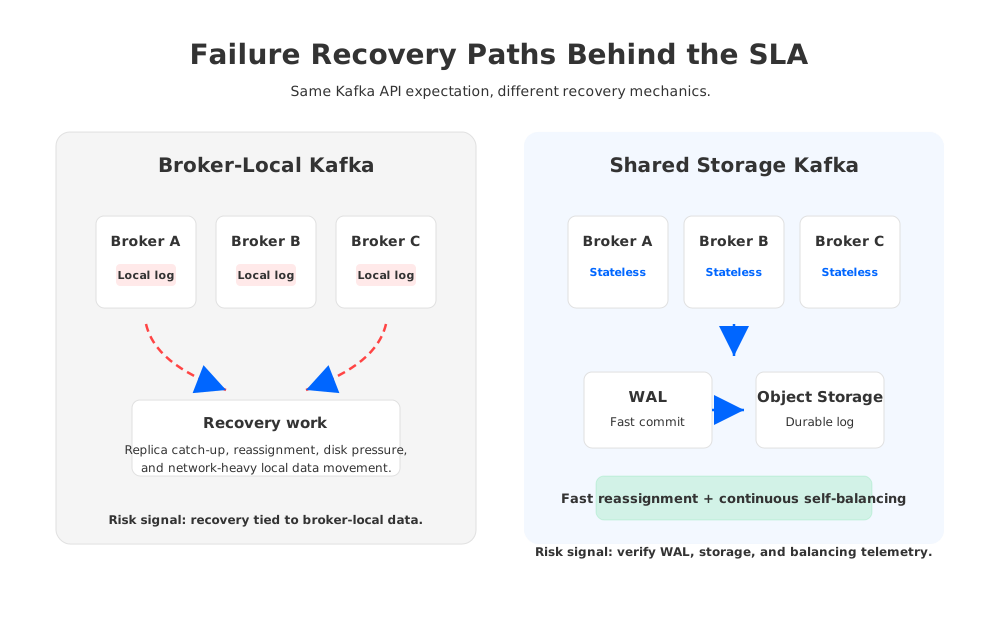
Second, the storage path should be explicit. Traditional Kafka uses broker-local logs and replication between brokers. That model is well understood, but it couples storage ownership to broker identity. Broker failure, scaling, and partition reassignment can become data movement events. A managed service can hide much of that work, but it cannot make the physics disappear unless the architecture changes.
Third, traffic balancing should be continuous rather than heroic. Kafka incidents are often caused by hot partitions, uneven broker utilization, follower lag, or overloaded disks. A provider that waits for manual reassignment is exposing the customer to a different operational risk than a provider that continuously balances traffic and has a fast reassignment path.
Fourth, observability must be customer-visible. Enterprise risk teams cannot accept "trust us" for a stateful platform. They need metrics for request failures, produce and fetch latency, consumer lag, partition health, broker saturation, quota throttling, storage behavior, maintenance events, audit logs, and incident history. For BYOC or private deployments, those signals should integrate with the customer's monitoring stack.
5Where AutoMQ Fits in the Reliability Discussion
AutoMQ is relevant to managed Kafka SLA reviews because it changes some of the architecture signals behind reliability. It is Kafka-compatible, but it replaces the traditional broker-local storage assumption with shared storage built around object storage and a WAL layer. In AutoMQ's architecture documentation, object storage is the primary data repository, while WAL storage handles low-latency persistence and failure recovery for data not yet uploaded to object storage.
That difference matters for enterprise managed Kafka because broker recovery is no longer dominated by rehydrating large local log directories. Brokers are closer to stateless compute nodes, with durable stream data living in shared storage. AutoMQ documentation describes this as enabling second-level partition reassignment, automatic scaling, and continuous traffic balancing because reassignment does not require copying the full local data set between brokers.
This should not be read as a claim that an SLA percentage is automatically higher. A contract still needs explicit availability, support, maintenance, and exclusion language. The architectural point is narrower and more useful: shared storage, WAL-backed persistence, stateless brokers, fast partition reassignment, and self-balancing are signals that recovery and scaling paths are less tied to broker-local disk movement.
For CTOs and SRE leads, that is the kind of evidence to request from any managed Kafka provider. Ask them to explain:
- What happens to acknowledged writes during broker, disk, node, zone, and network failures.
- Whether partition movement requires copying retained data between broker disks.
- How quickly the service can move traffic away from unhealthy or overloaded brokers.
- Which metrics prove that self-balancing or reassignment completed safely.
- Whether the customer can observe WAL, storage, broker, and partition health signals.
The value of AutoMQ's design is that it gives those questions concrete architectural answers. It keeps the Kafka protocol surface familiar while moving durability and recovery mechanics toward cloud storage primitives. In an enterprise SLA review, that is a stronger discussion than vendor comparison by uptime number alone.
6SLA Review Checklist for Enterprise Kafka Buyers
Before approving an enterprise managed Kafka service, build a review artifact that legal, procurement, platform engineering, SRE, security, and application owners can all read. The checklist should be short enough to use in vendor calls and precise enough to become an operating model after purchase.
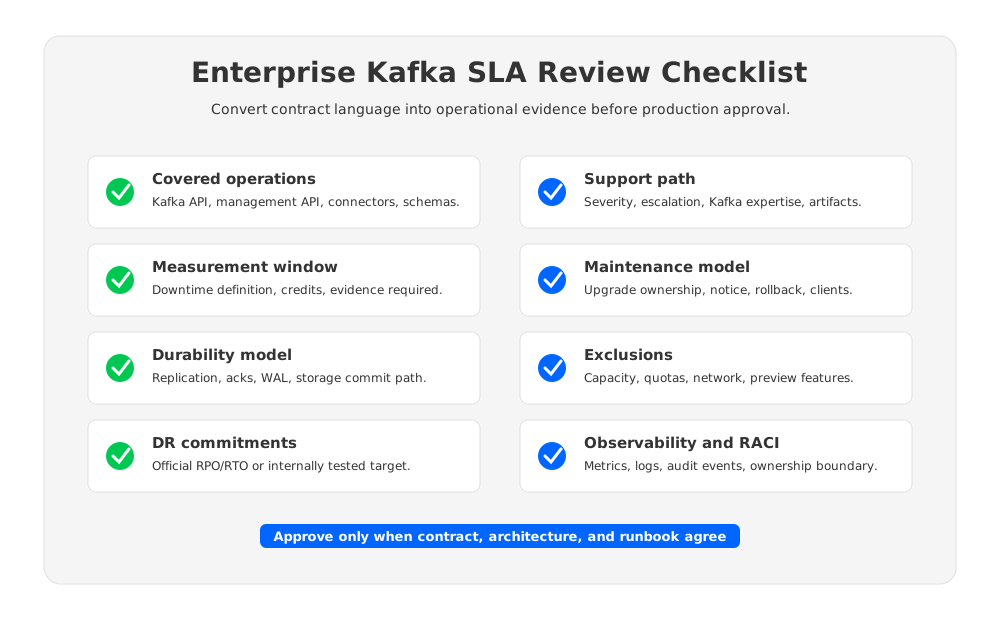
Use these questions as the baseline:
| Review area | Required evidence |
|---|---|
| Covered operations | Official SLA language listing covered Kafka, management, connector, schema, and networking operations. |
| Measurement window | Official definition of downtime, request errors, billing-cycle calculation, and credit claim process. |
| Durability model | Documentation for replication, acks, min.insync.replicas, storage backend, and write acknowledgment path. |
| DR commitments | Documented RPO/RTO only if officially stated; otherwise mark as customer-tested objective, not provider guarantee. |
| Support path | Support plan, severity definitions, escalation process, incident communication, and post-incident evidence. |
| Maintenance model | Upgrade ownership, emergency patching, customer notice, rollback approach, and client compatibility assumptions. |
| Exclusions | Capacity, partition count, quota, client, cloud networking, regional dependency, preview feature, and misuse exclusions. |
| Observability | Exportable metrics, logs, audit events, status page history, and integration with enterprise monitoring. |
| Responsibility matrix | Clear RACI for provider, cloud account owner, platform team, and application team. |
The most important output is not a pass or fail. It is a shared understanding of where the managed service ends and enterprise operations begin. That is where many Kafka programs get hurt: not by a missing SLA number, but by an unstated responsibility boundary.
7A Practical Evaluation Pattern
A good enterprise evaluation usually has three rounds. The first is contractual: collect official SLA, support, maintenance, and exclusion language. The second is architectural: map the service design to failure modes that matter for the workload. The third is operational: run a game day or production-like test that exercises producer retries, consumer recovery, broker failure, zone impairment, quota behavior, monitoring, and escalation.
Do not treat the test as a benchmark stunt. Treat it as a rehearsal for the operating agreement. If consumer lag grows during failover, who is paged? If a topic hits a partition limit, is that provider risk or customer capacity management? If PrivateLink routing breaks, does the managed Kafka provider participate or does the cloud networking team own it? If a regional disaster occurs, which replication or failover mechanism is actually in the runbook?
The strongest managed Kafka SLA is the one whose written terms, architecture, and operational evidence align. When those three layers contradict each other, believe the weakest layer. An uptime percentage is useful; a tested recovery path is better.
8References
- Amazon MSK Service Level Agreement
- Google Cloud Managed Service for Apache Kafka SLA
- Confluent Cloud Overview
- Confluent Cloud Client Durability Guidance
- Azure Event Hubs Availability and Consistency
- AutoMQ Architecture Overview
- AutoMQ WAL Storage
- AutoMQ S3 Storage
- AutoMQ Continuous Self-Balancing
- AutoMQ Technical Advantage Overview
9FAQ
9.1What should an enterprise managed Kafka SLA include?
It should include covered operations, availability calculation, durability assumptions, RPO/RTO only where officially stated, support response, maintenance process, exclusions, observability access, and a responsibility matrix. A percentage without scope is not enough for production managed Kafka.
9.2Is a higher Kafka availability SLA always better?
Not always. A higher percentage can cover a narrower set of operations, tiers, or regions. Compare the covered data plane behavior, exclusions, measurement window, and operational evidence before ranking providers by number.
9.3Does a managed Kafka SLA guarantee no data loss?
Usually not by itself. Data durability depends on write acknowledgment, replication, in-sync replicas, storage design, client retries, idempotence, consumer offset handling, and disaster recovery architecture. Treat durability as a separate review item.
9.4How should teams evaluate RPO and RTO for Kafka?
Use only official provider commitments as contractual RPO/RTO. If the provider does not publish them, document internal tested objectives based on cross-region replication, failover runbooks, client behavior, and business recovery requirements.
9.5Why mention AutoMQ in an SLA review?
AutoMQ is useful as an architecture reference point because it combines Kafka compatibility with shared storage, WAL-backed persistence, stateless brokers, fast partition reassignment, and continuous self-balancing. Those capabilities help teams ask better questions about the recovery mechanics behind any managed Kafka SLA.


