
Table of Contents
Table of Contents
A team usually searches for kafka developer sandbox after the shared development cluster has already become a negotiation surface. One application team wants to test a separate consumer group. Another needs to replay a topic from the beginning. A platform engineer is trying to keep ACLs, retention, connectors, and schema settings close enough to production that test results still mean something. The hard part is not creating a topic; the hard part is giving teams an environment they can break, reset, and delete without turning the platform team into a ticket queue.
That is why ephemeral Kafka test environments deserve more architectural attention than they usually get. A weak sandbox teaches developers the wrong lessons because it hides the production constraints that actually matter: partition ownership, committed offsets, transaction behavior, connector state, network boundaries, and operational recovery. A heavy sandbox has the opposite problem. It is faithful, but slow and expensive enough that teams ration access to it. The useful target sits between those extremes: production-like semantics with a lifecycle short enough for application teams to use every day.
1Why Teams Search for kafka developer sandbox
Most Kafka development starts with a local container, a shared lower environment, or a small cluster maintained by the platform team. Those options work while the application is still proving a producer or consumer loop. They start to bend when the team needs to validate behavior that depends on the cluster, not the client library. Consumer group rebalances, offset commits, idempotent producers, transactional writes, retention, compaction, Kafka Connect workers, and security policies all depend on broker-side behavior that a thin mock cannot represent.
The request usually sounds modest: "Can we get a Kafka sandbox for this service?" What the team actually needs is a place to answer a production question without touching production. Will the service resume from the expected offset after a deploy? Does a connector preserve ordering assumptions after a task restart? Will a stricter schema compatibility rule block the wrong producer? Can the team replay a small topic without disturbing a shared group? Those questions need isolation, but isolation creates a cost and governance problem when every team receives a long-lived cluster.
Three patterns show up again and again:
- Local-only testing is fast, but it rarely exercises real broker behavior, network controls, or operational failure modes.
- Shared development clusters are efficient, but they create noisy neighbors, stale topics, unclear ownership, and awkward reset procedures.
- Dedicated test clusters are faithful, but they often require capacity planning, broker lifecycle work, and cleanup discipline that application teams do not own.
The search for a kafka developer sandbox is a search for a better boundary. Developers want autonomy. Platform teams want repeatability. Security teams want controls that do not disappear outside production. Finance teams want environments that stop consuming budget after the test ends. A good sandbox design has to satisfy all four groups.
2The Production Constraint Behind the Problem
Traditional Kafka was built around a Shared Nothing architecture. Each broker owns local storage, partitions are assigned to brokers, and durability comes from replication across brokers. This model is a proven design, and it remains a good fit for many steady, well-operated clusters. The friction appears when the environment is treated as disposable. A disposable cluster is supposed to appear, absorb a test, and disappear. Broker-local state pushes in the other direction because data placement, partition movement, and capacity all remain tied to the broker lifecycle.
That coupling changes how teams design test environments. A platform team cannot think only about topic templates and user credentials. It also has to think about how much storage to attach, how many brokers to keep warm, how to restore seed data, how to clean offsets, how to isolate test traffic, and how to prevent one team from consuming capacity reserved for another. Kafka's own documentation describes consumer groups and offsets as broker-coordinated concepts, and the operations surface expands further when KRaft controllers, tiered storage settings, and Kafka Connect workers enter the picture.
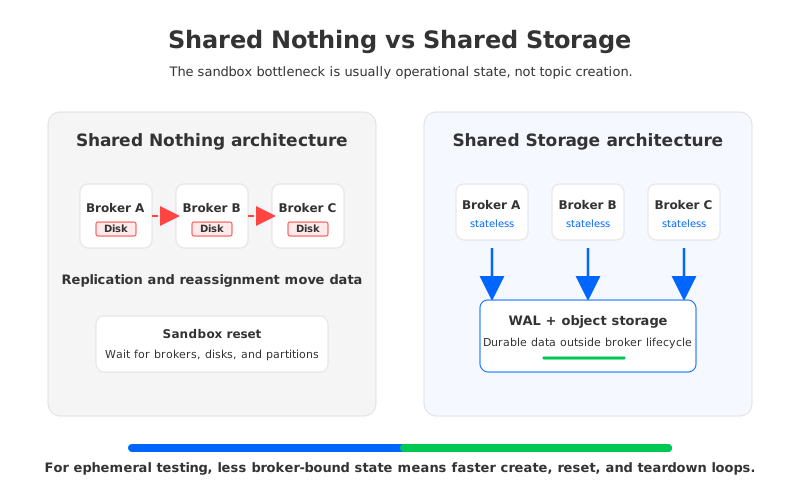
Tiered Storage helps with long retention by moving completed log segments to remote storage while retaining a local tier on brokers. That is valuable for backfill and retention-heavy workloads, but it does not make the broker stateless. The local tier still exists, broker roles still matter, and the platform team still has to reason about which parts of the test environment are durable, which parts are cache, and which parts must be recreated during teardown. For a long-lived production cluster, that may be acceptable. For an ephemeral environment, it is operational drag.
The same issue shows up in cost planning. A sandbox with production-like replication, multiple Availability Zones, private networking, observability, connector workers, and realistic retention is not a toy. Cutting those features makes the environment easier to fund but less trustworthy. Keeping them makes the environment trustworthy but harder to give to every application team. The architecture question is therefore not "Can we run Kafka for developers?" The better question is "Which parts of production must be represented, and which parts can be provisioned only for the duration of the test?"
3Architecture Options and Trade-offs
There is no universal sandbox shape. A payment service testing transactional producers has different needs from an analytics service validating a consumer replay. A platform team should pick the smallest environment that preserves the failure modes the application actually depends on. The mistake is treating every non-production Kafka environment as the same class of infrastructure.
| Option | Good fit | Main trade-off |
|---|---|---|
| Local container | Unit tests, client serialization, quick producer and consumer loops | Weak coverage of broker-side behavior, security, and operations |
| Shared dev cluster | Early integration across several services | Noisy neighbors, stale resources, and hard resets |
| Dedicated persistent cluster | High-fidelity staging and release qualification | Capacity, cleanup, and ownership overhead |
| Ephemeral production-like cluster | Feature branches, migration rehearsals, rollback tests, and team-owned validation | Requires automation, guardrails, and clear teardown rules |
The last option is the most interesting because it changes the operating contract. The platform team does not hand out a permanent cluster; it exposes a controlled way to create one. The environment can be seeded with topics, users, ACLs, connectors, and sample data, then destroyed after the test window. That is closer to how application teams already expect CI infrastructure to work, but Kafka adds stateful semantics that CI systems often ignore.
The strongest sandbox designs make those semantics explicit. They treat offsets as test artifacts, not incidental state. They decide which topics can be replayed and which must be generated from fixtures. They define how connector offsets are reset. They separate application credentials from administrative credentials. They attach observability from the first minute, because a test environment that cannot show lag, broker health, or failed requests is a poor rehearsal for production.
4Evaluation Checklist for Platform Teams
A kafka developer sandbox should be evaluated like a small product, not a spare cluster. The customers are internal application teams, and the product promise is reliable experimentation without production risk. That promise breaks when the platform team hides important constraints in manual runbooks. If a developer has to ask which offsets were reset, whether the connector task restarted, or whether ACLs match production, the sandbox is already leaking operational knowledge.
Use this decision map before choosing tooling or cluster shape:
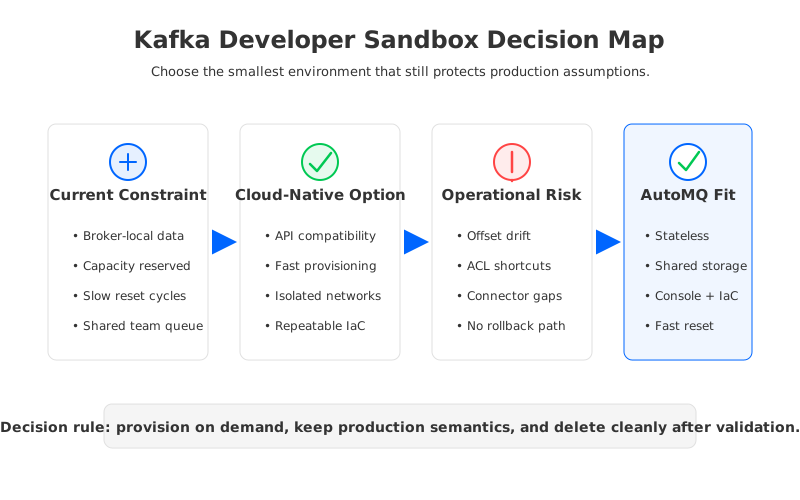
The checklist below is deliberately practical. It does not ask whether the sandbox is elegant. It asks whether a team can trust the result and whether the platform team can recover from misuse.
- Compatibility: Run the same Kafka clients, protocol assumptions, serializers, transactions, consumer group behavior, and connector patterns that production depends on. A sandbox that requires application code changes is a different platform.
- Lifecycle: Provision, seed, pause, expire, and delete the environment through automation. Manual cleanup turns every experiment into hidden platform debt.
- Cost controls: Set retention, broker size, connector capacity, object storage lifecycle, and idle-time policies at creation time. A sandbox should have a budget boundary before the first record is written.
- Governance: Apply production-like network boundaries, IAM, ACLs, audit logging, and naming conventions. The environment can be temporary without being informal.
- Recovery: Test broker restart, client reconnect, consumer group reset, connector restart, and rollback paths. The environment should make failure safe to practice.
- Observability: Expose broker metrics, storage signals, request errors, consumer lag, and connector status in the same place developers use during incidents.
The decision is rarely binary. Some teams only need a shared integration cluster with stricter ownership. Others need branch-level clusters for a few hours. Migration teams may need short-lived environments that mirror production topics, preserve offsets, and validate rollback before any production cutover. The important point is to score the environment against the work it is supposed to support, rather than against a generic idea of "Kafka testing."
5How AutoMQ Changes the Operating Model
Once the evaluation framework is clear, the architectural direction becomes easier to reason about. Ephemeral environments become easier when brokers are not the long-term home of data. That is where AutoMQ, a Kafka-compatible cloud-native streaming platform, changes the model: it keeps the Kafka protocol and semantics while moving the storage layer to a Shared Storage architecture backed by object storage and WAL storage.
In AutoMQ, Brokers are stateless because durable data is stored outside the broker lifecycle through S3Stream. WAL storage handles durable write acknowledgment and recovery, while S3 storage is the primary storage layer. That separation matters for sandboxes because provisioning and teardown no longer revolve around broker-local log ownership. Brokers can be added, replaced, or removed with less data movement, and the platform team can focus on environment policy rather than partition relocation as the dominant operation.
This does not remove the need for discipline. A test environment still needs topic templates, retention rules, credentials, connector configuration, and observability. It does, however, change the cost of being disciplined. AutoMQ Console and Terraform-based workflows give platform teams a clearer way to encode repeatable environment creation. Kafka compatibility keeps application teams on familiar clients and tools. Self-Balancing and Self-healing reduce the daily friction of keeping broker capacity aligned with traffic. For migration-oriented sandboxes, AutoMQ Linking can support byte-level message synchronization and offset consistency, which makes rehearsal and rollback planning more concrete.
The deployment boundary also matters. In AutoMQ BYOC, control plane and data plane components run in the customer's cloud account and VPC. In AutoMQ Software, they run in the customer's private environment. That is important for regulated teams because a sandbox is still an environment with data, credentials, and audit requirements. A temporary cluster should not mean a weaker boundary.
The point is not that every developer test needs a full platform instance. The point is that the storage architecture should not punish teams for creating production-like environments when they actually need them. If brokers are mostly compute and operational ownership is encoded in automation, an ephemeral Kafka environment becomes a normal platform workflow instead of an exception that waits for a senior operator.
6A Readiness Scorecard You Can Use
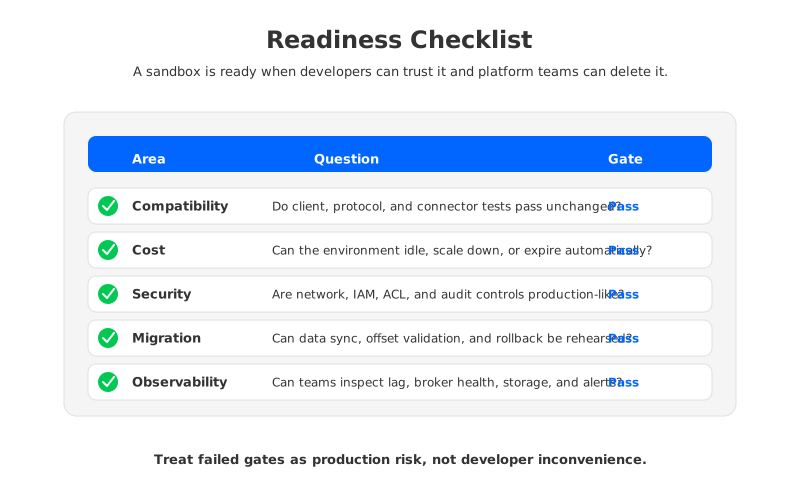
Before rolling out sandbox access broadly, score the design on five questions. A "no" answer is not a failure; it is a signal that the sandbox should be limited to narrower use cases until the gap is closed.
| Question | Pass condition |
|---|---|
| Can an application team create an environment without a platform ticket? | Provisioning is driven by a template, API, or Terraform workflow with guardrails. |
| Can the team reproduce production client behavior? | Clients, protocol assumptions, transactions, offsets, and connector patterns are unchanged. |
| Can the platform team delete the environment without investigation? | Ownership, TTL, storage lifecycle, credentials, and dependent resources are recorded at creation. |
| Can security review the environment class once? | Network, IAM, ACL, audit, and data boundary patterns are standardized. |
| Can a failed test explain itself? | Metrics, logs, lag, connector status, and broker health are visible without custom debugging. |
The highest-value sandbox is often the one that disappears quietly. Developers get a place to test risky changes, platform teams get a repeatable operating model, and production remains the place where validated behavior runs instead of the place where basic assumptions are discovered. If your shared development cluster has become a social contract, start by writing down which production constraints your teams are trying to test. The architecture follows from that list.
For teams evaluating Kafka-compatible streaming with cloud-native operations, the next useful step is to try the same sandbox lifecycle against a stateless broker model. Explore AutoMQ on GitHub through the short link here: https://go.automq.com/github?utm_source=blog&utm_medium=cta&utm_campaign=ephemeral-kafka-test-environments.
7FAQ
7.1Is a kafka developer sandbox the same as a local Kafka container?
No. A local container is useful for quick client checks, but a sandbox should validate broker-side behavior such as consumer group coordination, offsets, transactions, ACLs, retention, connectors, and observability.
7.2Should every application team get a dedicated Kafka cluster?
Not always. Shared clusters work for early integration, while ephemeral clusters are better for tests that need isolation, rollback rehearsal, migration validation, or production-like controls. The right answer depends on the risk of the change.
7.3Does Tiered Storage make Kafka brokers stateless?
No. Apache Kafka Tiered Storage moves completed log segments to a remote tier, but brokers still maintain a local tier and broker roles remain part of the operational model.
7.4Where does AutoMQ fit in a sandbox strategy?
AutoMQ fits when teams need Kafka compatibility with a cloud-native operating model. Its Shared Storage architecture and stateless brokers reduce the broker-local state that makes short-lived production-like environments hard to operate.
7.5What should platform teams automate first?
Start with environment creation and deletion. Include topic templates, users, ACLs, retention, connector configuration, metrics, TTL, and ownership metadata in the same workflow.


