
Table of Contents
Table of Contents
Teams do not search for customer controlled observability kafka because they want another dashboard. They search for it when Kafka has become part of the production control boundary: security teams want to know where metrics and logs go, platform teams want enough telemetry to debug incidents, and finance teams want a clearer line between workload growth and platform cost. The hard part is that observability is not a sidecar concern for streaming. It follows the same boundaries as storage, networking, identity, and failure recovery.
That is why the phrase matters. Customer-controlled observability means the organization can decide where operational data is collected, stored, retained, queried, and shared. In a Kafka-compatible platform, that includes broker metrics, client metrics, connector health, audit events, storage signals, network paths, and migration status. The thesis is simple: if the streaming data plane is customer-controlled, the observability plane should be evaluated with the same seriousness as the message path.
1Why Teams Search For customer controlled observability kafka
Kafka operations often start with familiar metrics: consumer lag, request latency, broker disk usage, network throughput, ISR health, partition count, and JVM pressure. Those metrics are useful, but they stop being enough once the platform becomes a shared service for many teams. A payment team, an AI feature pipeline, a CDC workload, and an audit log stream may all use the same Kafka layer while having different retention, recovery, and access requirements.
The search intent usually comes from one of four pressures:
- Security review. Teams need to prove that telemetry, logs, and metadata stay inside an approved account, VPC (Virtual Private Cloud), region, or observability backend.
- Incident response. Operators need high-cardinality signals close to the data plane without waiting on an external ticket path.
- Cost governance. Finance and platform teams need to connect storage, networking, broker capacity, and retention changes to the applications that caused them.
- Migration planning. Architects need to know whether existing dashboards, alerts, client metrics, and runbooks survive a move to a Kafka-compatible platform.
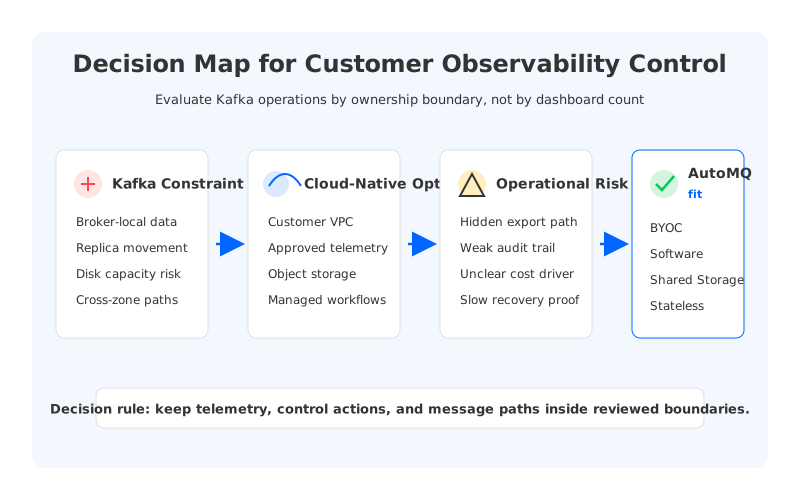
Those needs are reasonable. The mistake is to treat them as monitoring feature requests. They are architecture questions, because observability inherits the platform's deployment model. If the Kafka service is outside the customer's cloud boundary, observability often becomes a negotiated export path. If the service runs inside the customer's environment, observability can use the customer's own Prometheus, OpenTelemetry, log storage, IAM, network controls, and retention policies.
2The Production Constraint Behind The Problem
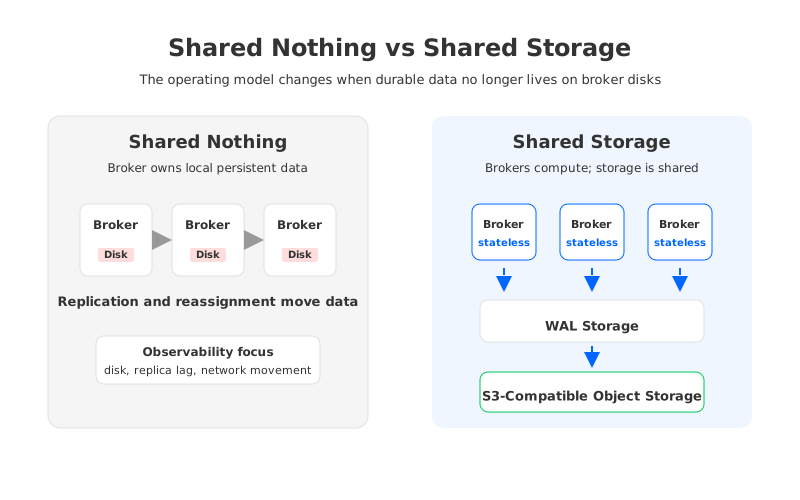
Traditional Kafka uses a Shared Nothing architecture. Each broker owns local storage, and partition replicas move through broker-to-broker replication. That design is mature and well understood, but it couples operational signals to broker-local state. Disk fullness is not merely a metric; it is a capacity risk. Partition imbalance is not merely a chart; it can imply data movement. Broker replacement is not merely a node lifecycle event; it may trigger replica catch-up, leadership shifts, and network load.
Observability must therefore cover more than service health. It must explain whether a slowdown comes from producer batching, broker request queues, page cache behavior, local disk saturation, replica fetch lag, consumer group rebalancing, or a noisy catch-up read. Apache Kafka's concepts - Topics, Partitions, Offsets, Consumer groups, KRaft metadata, transactions, and Tiered Storage - give teams the vocabulary, but the operating model determines which signals become urgent during a failure.
Cloud deployments sharpen the constraint. Local disk capacity is provisioned ahead of demand. Multi-AZ durability often means inter-zone replication traffic. Scaling brokers can create reassignment work. Long retention increases the amount of state tied to broker storage. Each of these is observable, but the platform team still owns the operational consequence. A dashboard can show the curve; it cannot change the architecture behind the curve.
For customer-controlled observability, the practical question is not "Can I see metrics?" The question is "Can I keep enough operational evidence in my environment to make and defend production decisions?" That evidence includes raw metrics, logs, alert rules, dashboard definitions, access logs, audit events, migration checkpoints, and capacity history. A platform that hides those details may still be managed well, but regulated teams will ask how they validate the service during incidents, audits, and vendor reviews.
3Architecture Options And Trade-Offs
There are three common ways to run Kafka-compatible streaming with different observability boundaries. None is automatically right. The right choice depends on who owns the data plane, who handles operations, and who must answer when an incident crosses security, cost, and application boundaries.
| Option | Observability boundary | Strength | Risk to test |
|---|---|---|---|
| Self-managed Kafka | Customer owns the full telemetry stack | Maximum control over metrics, logs, and runbooks | High operational burden, broker-local storage management, and upgrade ownership |
| Hosted service | Provider operates the platform and exposes selected signals | Less day-to-day platform work | Limited raw telemetry, export constraints, and data residency questions |
| Customer-owned data plane | Platform runs in the customer's environment with managed control workflows | Stronger data boundary plus managed lifecycle | Requires careful review of control plane permissions, telemetry export paths, and support model |
The observability evaluation should start from failure modes, not dashboard screenshots. If a broker fails, can the team see whether recovery is blocked by data movement, object storage access, metadata quorum health, or client retry behavior? If a consumer group falls behind, can the team distinguish application processing delay from broker-side fetch pressure? If a cloud bill changes, can the team connect the change to retention, replication, cross-AZ paths, or connector throughput?
The same approach applies to governance. A customer-controlled platform should let the organization decide which metrics leave the environment, which logs contain sensitive metadata, how long telemetry is retained, which identities can view operational data, and how alerts are routed. For many teams, the decisive issue is not whether a vendor has a nice monitoring page. It is whether the observability evidence can live in the same compliance and incident-response systems the company already trusts.
4Evaluation Checklist For Platform Teams
A useful checklist separates Kafka compatibility from operational control. Compatibility asks whether producers, consumers, Kafka Connect workers, serializers, transactions, offsets, and client versions behave as expected. Observability control asks whether teams can inspect and govern the running system without creating a second shadow platform.
Use this checklist during architecture review:
- Kafka semantics. Validate Topic, Partition, Offset, Consumer group, transaction, and client compatibility against your applications, not against a sample workload.
- Telemetry ownership. Confirm where broker metrics, client metrics, connector metrics, logs, and audit events are stored and who can access them.
- Network boundary. Map produce, fetch, control, metrics, log, object storage, and support paths separately. Private networking does not automatically mean every path stays in the same boundary.
- Cost signals. Track compute, storage, inter-AZ traffic, PrivateLink or endpoint charges, observability ingestion, and retention separately.
- Failure evidence. Test broker loss, zone loss, object storage permission failure, metadata quorum disruption, and consumer catch-up before production cutover.
- Migration proof. Preserve offsets, ACLs, client configuration assumptions, dashboards, and rollback checkpoints in the migration plan.
The checklist also prevents a common procurement mistake: scoring observability as a product feature while scoring data control as an architecture feature. The two are linked. If the data plane and the observability plane have different ownership boundaries, teams must document why that split is acceptable. If both run inside the customer's environment, the review can focus on permissions, support workflows, and data minimization.
5How AutoMQ Changes The Operating Model
After the neutral evaluation, the architecture pattern to examine is shared storage with stateless brokers. AutoMQ is a Kafka-compatible streaming platform that replaces broker-local persistent storage with a Shared Storage architecture backed by S3-compatible object storage and WAL (Write-Ahead Log) storage. The important shift is not cosmetic. Durable stream data is no longer bound to a specific broker disk, so broker lifecycle, partition ownership, scaling, and recovery become less dependent on moving large volumes of broker-local data.
That shift changes what observability has to explain. Instead of watching local disks as the center of the system, operators watch the interaction between stateless brokers, WAL storage, object storage, cache behavior, metadata, client traffic, and background compaction. The platform still needs Kafka-level metrics - request latency, consumer lag, partition leadership, throughput, and error rates - but it also needs storage-layer signals that make sense for an object-storage-backed system.
For customer-controlled deployment boundaries, AutoMQ BYOC places the control plane and data plane in the customer's cloud account and VPC. AutoMQ Software is designed for customer-managed private environments. In both models, the customer can align streaming operations with the organization's network, IAM, observability, and retention policies. That does not remove the need for review. It makes the review more concrete, because teams can inspect the resources, permissions, metric export paths, and operational workflows in their own environment.
The same architecture also affects cost and elasticity. In a broker-local model, scaling and balancing are tied to data placement. In AutoMQ's Shared Storage architecture, stateless brokers and object storage reduce the amount of broker-to-broker data movement required for reassignment and recovery. That matters for observability because fewer hidden data movement phases usually means fewer ambiguous incident states. When a broker is added or removed, the team can focus on traffic, leadership, cache warm-up, and WAL behavior instead of waiting for large local replicas to move.
AutoMQ should still be evaluated with production discipline:
- Confirm Kafka compatibility with the exact client libraries, authentication modes, transactions, and Kafka Connect patterns your estate uses.
- Choose the WAL storage option that matches latency, durability, and operating requirements.
- Connect metrics and logs to your approved observability backend, then test alert routes during failure drills.
- Rehearse migration with representative Topics, Consumer groups, retention settings, and rollback criteria.
That is the point of customer-controlled observability. It is not a promise that every incident becomes easy to diagnose. It is a design choice that gives the platform team direct access to the evidence needed to diagnose it.
6Readiness Scorecard
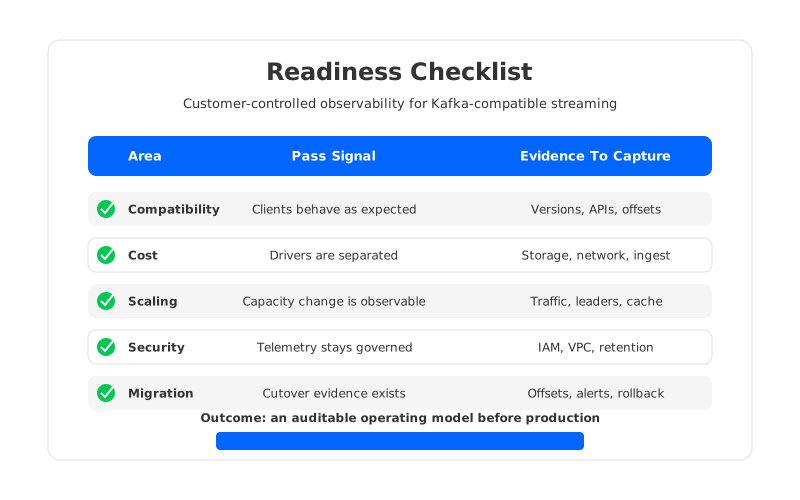
Before choosing a customer-controlled Kafka-compatible platform, score the design as an operating system, not a procurement line item. A strong design should make responsibility boundaries visible. Who can change configuration? Who can read logs? Where are metrics stored? Which support actions require customer approval? Which signals are needed to prove that a failover, migration, or rollback worked?
| Area | Pass signal | Warning signal |
|---|---|---|
| Compatibility | Existing Kafka clients and tools work with documented limits | Application teams need unplanned client rewrites |
| Observability | Metrics, logs, and alerts land in approved customer systems | Teams depend on screenshots or restricted exports |
| Cost | Storage, compute, network, and telemetry ingestion are separated | The bill cannot be traced to workload drivers |
| Security | IAM, network, and support paths are reviewed independently | Data, control, and telemetry paths are described as one path |
| Migration | Offsets, ACLs, dashboards, and rollback are rehearsed | Cutover plan focuses on replication but not operations |
The strongest platform choice is the one that makes production responsibility explicit. For some teams, that will mean self-managed Kafka and a large operations investment. For others, it will mean a hosted service with carefully accepted export limits. For teams that want Kafka compatibility, customer-owned infrastructure boundaries, and a more elastic operating model, a BYOC or Software deployment based on shared storage deserves a serious proof.
If your evaluation started with customer controlled observability kafka, end it with a test plan. Map the telemetry paths, break the cluster on purpose in a controlled environment, validate the evidence, and make the cost model explainable. To explore how AutoMQ fits that review, start a guided assessment through AutoMQ's BYOC evaluation path.
7FAQ
7.1What does customer-controlled observability mean for Kafka?
It means the customer can decide where operational data such as metrics, logs, alert rules, audit events, and diagnostic traces are collected, stored, retained, and accessed. For Kafka, that control matters because observability often exposes topic names, client identities, throughput patterns, and failure evidence.
7.2Is customer-controlled observability the same as self-managed Kafka?
No. Self-managed Kafka gives full control but also full operational responsibility. A customer-owned data plane model can keep telemetry inside the customer's environment while using managed workflows for deployment, scaling, upgrades, and support.
7.3Which Kafka metrics should be reviewed first?
Start with consumer lag, produce and fetch latency, request errors, broker throughput, partition leadership, storage pressure, controller health, and connector status. Then add architecture-specific signals, such as object storage access, WAL behavior, cache efficiency, and cross-zone network paths.
7.4How should teams evaluate AutoMQ for this requirement?
Validate Kafka compatibility, deployment boundaries, WAL storage choice, observability export, IAM permissions, and migration behavior with your own workload. The proof should include failure drills and rollback criteria, not only a happy-path benchmark.


