
Table of Contents
Table of Contents
Teams rarely search for customer managed encryption keys kafka because they want a glossary entry. They search because a security review, procurement process, or regulated workload has turned a familiar Kafka decision into a control-boundary question. Who can decrypt retained records? Which account owns the key policy? What happens if access is revoked? Can the platform team prove the answer during an audit without drawing a new architecture diagram from memory?
The hard part is that key ownership is only one layer of the decision. A streaming platform also has brokers, disks, object storage, metadata, networking, observability, migration tooling, and operational runbooks. If those layers stay tangled together, "bring your own key" can become a checkbox that hides a much larger operating risk. The better question is not whether a product page includes a key acronym. The better question is whether the whole Kafka-compatible platform can be operated under customer-controlled security, cost, and recovery boundaries.
1Why teams search for customer managed encryption keys kafka
The search intent usually starts with a compliance requirement. A financial services team may need evidence that production data is encrypted at rest with keys controlled by the customer's cloud account. A healthcare platform may need to restrict who can administer encryption policy, inspect audit events, and rotate keys. A SaaS company selling into enterprise accounts may need a cleaner answer to "where does our customer data live, and who can decrypt it?"
Apache Kafka complicates that conversation because it is not a passive database. Kafka records flow through producers, leaders, followers, consumers, offsets, transactions, Connect workers, and operational tooling. A key policy that looks adequate for one storage bucket may not answer where broker-local logs sit, how replicas are moved, or how a replacement broker catches up after failure. Governance teams do not only care that data is encrypted. They care whether the encryption model still holds during scaling, failover, rebalancing, backup, and migration.
That is why a serious evaluation needs two tracks. The first track is cryptographic control: key ownership, key rotation, key policy, audit logs, and revocation behavior. The second track is platform control: where the data plane runs, where durable bytes are stored, which network paths are used, and which team owns the recovery path. A strong design should make those two tracks reinforce each other rather than forcing the security team to trust an operational model they cannot inspect.
2The production constraint behind the problem
Traditional Kafka was built around a Shared Nothing architecture. Each broker manages local storage, and partitions are replicated across brokers through leader and follower replicas. This design is proven and still works well in many environments, but it makes storage placement part of broker identity. When a broker is replaced, when partitions are reassigned, or when capacity is added, operational work often involves moving durable data between machines.
That storage coupling matters for customer managed encryption keys because every data movement path becomes part of the governance surface. Broker-local disks need encryption. Replica traffic may cross Availability Zone boundaries. Reassignment can create temporary pressure on disk, network, and broker CPU. A team can configure encryption correctly and still struggle to answer a broader audit question: during an incident or capacity event, which components touched sensitive data, under which identity, and with which key policy?
The pressure is not limited to security. Local-storage Kafka also ties retention growth to broker fleet planning. If retained data grows faster than active throughput, teams may provision brokers for disk rather than compute. If a workload spikes, adding brokers is not only a compute event; it may trigger partition movement. If the cluster spans multiple Availability Zones, replication and recovery paths can become visible line items in the cloud bill. Key control then becomes one more requirement layered on top of capacity planning, network economics, and failure recovery.
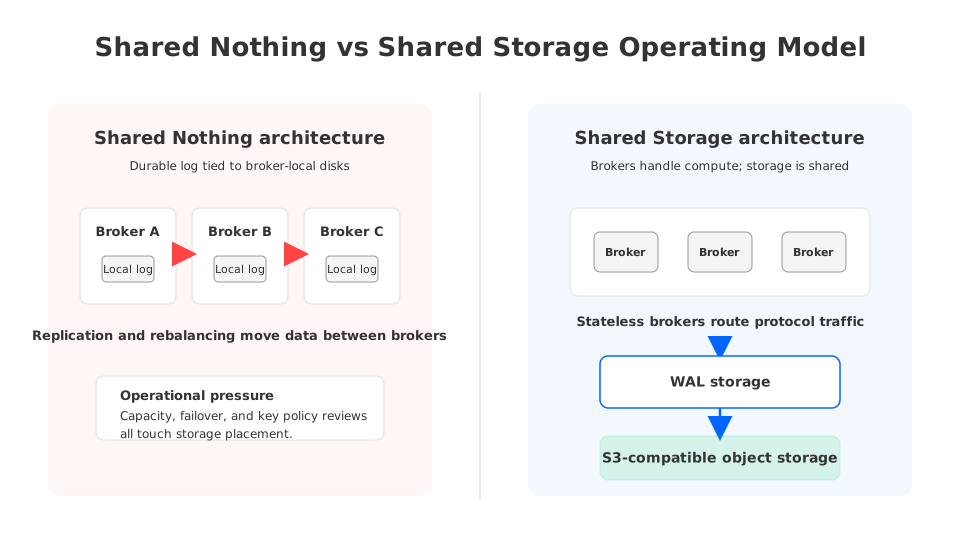
Tiered Storage changes part of this picture by offloading older log segments to remote storage while keeping the active log on broker-local storage. For teams whose primary pain is long retention, that can be a valid improvement. It does not fully remove the operational relationship between brokers and hot data, and it does not by itself answer whether the data plane, control plane, and encryption authority align with a customer's desired boundary. That distinction is important: a platform can use object storage and still leave critical operating concerns tied to broker-local state.
3Architecture options and trade-offs
When platform and security teams evaluate customer managed encryption keys for Kafka, they are usually comparing four operating models. Self-managed Kafka gives maximum infrastructure control, but the team owns every operational detail: broker hardening, disk encryption, network routing, upgrades, observability, rebalancing, and recovery. A fully managed Kafka service can reduce that operational load, but it may also move parts of the data plane or control plane outside the customer's direct administrative boundary. A BYOC model can keep data-plane resources in the customer's cloud account, though the exact control-plane relationship must be read carefully. A customer-operated software model can fit private data centers or stricter isolation requirements, but it requires more internal platform maturity.
The right comparison is not a generic "managed versus self-managed" debate. It is a matrix of control points:
| Evaluation area | What to verify | Why it matters |
|---|---|---|
| Key authority | Which KMS key protects durable data, who can change policy, and how rotation is handled | Encryption control must be operationally provable, not implied |
| Data-plane location | Whether brokers, storage, and network paths run in the customer's account or private environment | Data residency and incident response depend on this boundary |
| Kafka semantics | Compatibility for producers, consumers, offsets, transactions, Connect, and client tooling | Governance cannot come at the cost of application rewrites |
| Scaling behavior | Whether adding capacity moves data or mainly changes metadata and traffic ownership | Scaling events should not create hidden key and network exposure |
| Recovery behavior | How failed brokers, failed zones, and corrupted deployments are recovered | Key control must still hold during abnormal operations |
| Cost model | Compute, storage, WAL, object requests, networking, and operations | Security architecture that cannot be funded will not last |
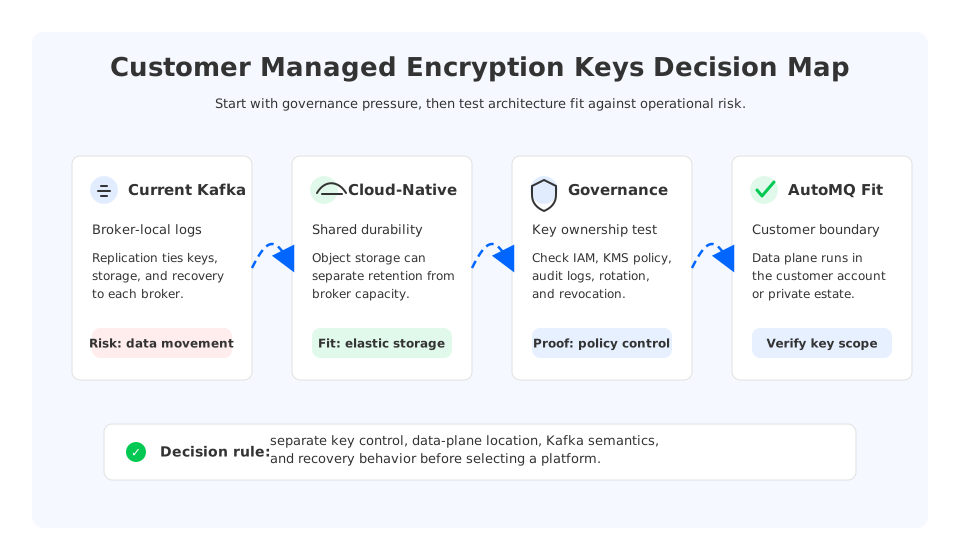
A useful rule is to separate "who owns the key" from "where the durable log lives." Customer managed encryption keys answer the first question. Storage architecture answers the second. Deployment model answers the third: who operates the components that read and write the data. Procurement teams often collapse these into one yes-or-no requirement, but production teams pay for the distinctions later.
Cloud infrastructure adds another layer. On AWS, for example, S3 server-side encryption with AWS KMS can use customer managed keys, and KMS policies can constrain use by principals, services, and conditions. That is helpful only if the streaming platform's storage path is actually mapped to the storage services and identities you intend to govern. Similar reasoning applies to private connectivity, VPC endpoints, object storage bucket policy, audit logging, and account separation. The architecture review should follow the data path, not the acronym.
4Evaluation checklist for platform teams
A practical review starts with evidence. Ask the vendor or internal platform owner for a diagram that separates management traffic from Kafka data traffic. Ask where records are persisted during the write path, where retained data lives after compaction or upload, and what identity is used for each storage operation. Ask which logs prove key usage, storage access, and administrative change. If the answer depends on a support ticket or an undocumented operator action, mark that as operational risk.
The same review should include application compatibility. Kafka is an ecosystem contract, not only a wire protocol. Producers rely on acknowledgments and idempotence. Consumers rely on group coordination and offsets. Stream processors may depend on transactions or stable partition ordering. Connect-based ingestion and sink pipelines may rely on connector behavior, authentication, and schema handling. A security-first platform that breaks these assumptions can create a migration project larger than the compliance problem it was meant to solve.
For cost and capacity, test the shape of the bill rather than one sample month. Key management can add request costs, audit storage, policy administration, and operational review steps. Kafka storage architecture can add or reduce cloud storage, broker disks, inter-zone transfer, PrivateLink or endpoint charges, and recovery capacity. The important question is whether each cost driver is visible enough for FinOps and platform teams to model before production.
Use this readiness checklist before narrowing the shortlist:
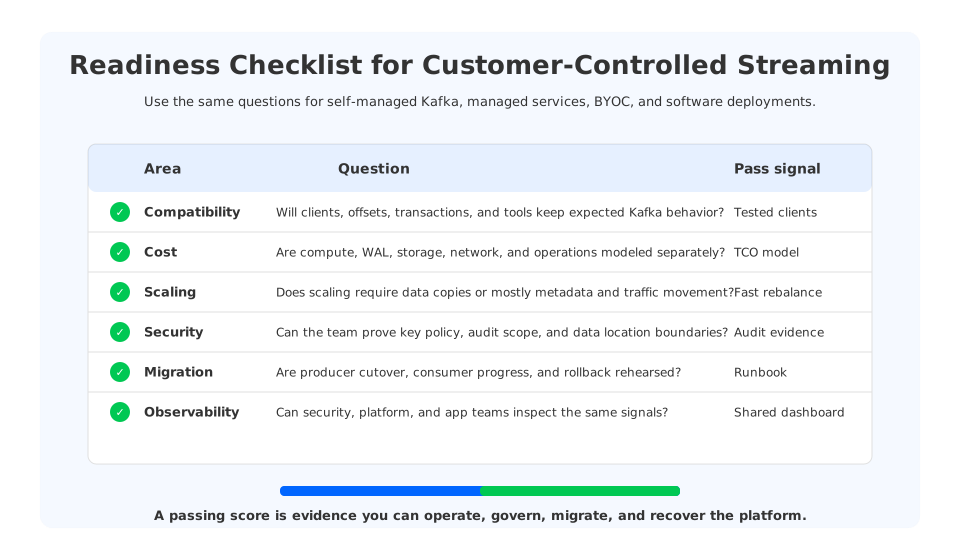
The checklist is intentionally broader than encryption. A team that passes only the key-policy section may still fail the platform decision. A team that can prove compatibility, cost, scaling, security, migration, rollback, and observability has a much better chance of operating the system under real production pressure.
5How AutoMQ changes the operating model
After the neutral framework is clear, AutoMQ belongs in the evaluation as a Kafka-compatible, cloud-native streaming platform that changes the broker storage model. AutoMQ preserves Kafka protocol and ecosystem expectations while moving durable stream storage into a Shared Storage architecture built around S3Stream, WAL storage, data caching, and S3-compatible object storage. The practical difference is that brokers are stateless: they focus on protocol handling, leadership, caching, and scheduling rather than owning the long-lived log on local disks.
That shift matters for customer-controlled platforms because it reduces the number of operations that require moving durable data between brokers. Partition reassignment, broker replacement, and scaling can be treated more as metadata and traffic placement events than as large storage-copy projects. It also changes the cost model. Retention, active compute, WAL choice, object storage, and network locality can be evaluated as separate levers instead of being bundled into "how many brokers and disks do we need?"
AutoMQ BYOC and AutoMQ Software are the relevant deployment boundaries for governance-heavy evaluations. In AutoMQ BYOC, the control plane and data plane run in the customer's cloud account or VPC, and customer Kafka traffic stays inside that environment. In AutoMQ Software, the platform runs in the customer's private environment. Those boundaries can simplify security and procurement reviews because the buyer can reason about their own accounts, networks, storage resources, IAM policies, monitoring, and operational procedures.
The encryption conversation still needs precision. AutoMQ's public documentation for AutoMQ BYOC data encryption at rest states that service storage encryption keys are managed by the cloud vendor and that custom BYOK keys are not supported for that service storage path. That is not a detail to bury. Teams evaluating customer managed encryption keys should verify the exact key support, storage scope, cloud provider, and product edition with AutoMQ before purchase or production design. The stronger AutoMQ argument is not pretending every key-control checkbox is identical across platforms; it is that customer-controlled deployment boundaries and Shared Storage architecture give teams a cleaner operating model to evaluate.
Migration planning should follow the same discipline. If an existing Kafka estate uses strict key policies, the target design must account for topic data, Consumer group progress, client authentication, network reachability, and rollback. AutoMQ Kafka Linking can be relevant when the migration requires byte-to-byte synchronization and offset consistency, but the runbook should still define who can pause, promote, roll back, and audit each step. A governance-friendly architecture is only credible when the migration path is governed too.
The decision comes back to the opening question. If the search for customer managed encryption keys kafka is really a search for customer control, then key ownership is one requirement inside a larger architecture review. Evaluate the encryption boundary, but do not stop there. Evaluate the storage model, deployment boundary, operational evidence, and migration path. To test whether AutoMQ BYOC or AutoMQ Software fits that control model, start with the product team through the AutoMQ technical evaluation path: talk to AutoMQ.
6FAQ
6.1What does customer managed encryption keys Kafka mean?
It usually means the customer wants Kafka-related durable data encrypted with keys controlled through the customer's key management system, such as cloud KMS customer managed keys. In practice, the review must also cover where Kafka data is stored, which identities can use the keys, how usage is audited, and what happens during failover, scaling, and migration.
6.2Is BYOK the same as BYOC Kafka?
No. BYOK is about encryption key ownership. BYOC is about where the platform runs, usually in the customer's cloud account. A platform can support one without fully satisfying the other, so architecture reviews should inspect key policy, data-plane location, control-plane access, and storage behavior separately.
6.3Does Shared Storage architecture remove the need for encryption review?
No. Shared Storage architecture changes where durable data lives and can reduce broker-local data movement, but the storage service, WAL storage, IAM roles, KMS policies, and audit logs still need review. It makes the review different, not optional.
6.4Should every Kafka workload require customer managed keys?
Not always. The requirement depends on regulatory scope, data sensitivity, internal policy, cloud account model, and customer contracts. For low-risk internal telemetry, cloud-provider managed encryption may be acceptable. For regulated customer data, the team may need stronger key ownership and audit evidence.
6.5How should teams evaluate AutoMQ for this requirement?
Start with Kafka compatibility and deployment boundary, then verify the exact encryption-at-rest and key-management scope for the chosen product edition and cloud environment. AutoMQ is especially relevant when the team wants Kafka-compatible APIs, a customer-controlled data plane, stateless brokers, and a Shared Storage architecture, but key support should be confirmed against current official documentation and the target deployment design.


