
Table of Contents
Table of Contents
A Kafka service can advertise 99.95 percent availability in its service-level agreement (SLA) and still leave a platform team with hard questions. What counts as downtime? Does the commitment apply to produce requests, fetch requests, the management API, or all of them? Are planned maintenance and customer network failures excluded? Does the service assume a multi-AZ deployment that your configuration does not have?
Those details are where a Kafka uptime guarantee becomes useful or decorative. Availability is a contractual measurement, while Kafka reliability is an end to end behavior involving clients, brokers, metadata, storage, replica placement, recovery, and the network path between them. A good Kafka SLA comparison therefore starts with the number, then works backward to the architecture and responsibility boundary that make the number possible.
1The percentage is a downtime budget
Availability is calculated as the time a covered service is available divided by the total time in the measurement window. The basic form is:
availability = (measurement window - eligible downtime) / measurement window
The word eligible carries much of the meaning. An SLA may count failed requests, unavailable minutes, or a defined set of service operations. It may use a monthly window for service credits even when a buyer is thinking about annual business impact. The formula is simple; the measurement definition is where two apparently similar commitments stop being comparable.
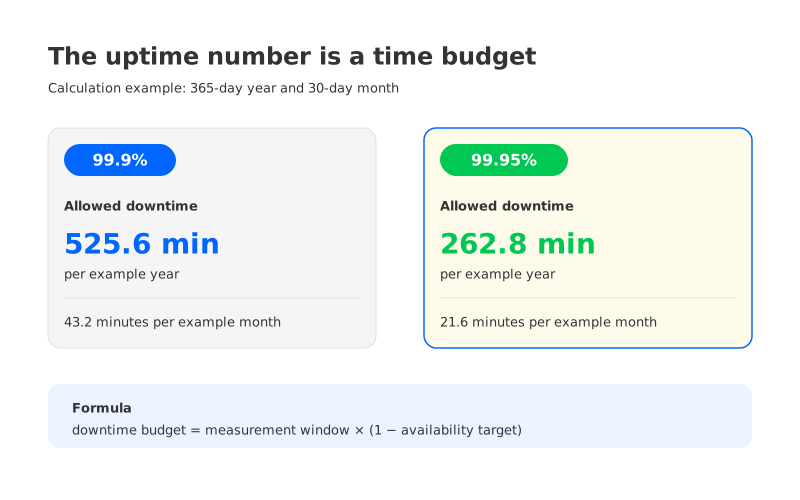
The following table is a calculation example using a 365 day year and a 30 day month. It is not a universal vendor promise. The minutes come from the stated time assumptions, and the downtime values are calculated from the percentage shortfall.
| Availability target | Allowed downtime in a 30 day example month | Allowed downtime in a 365 day example year |
|---|---|---|
| 99.9% | 43.2 minutes | 525.6 minutes, or 8 hours 45 minutes 36 seconds |
| 99.95% | 21.6 minutes | 262.8 minutes, or 4 hours 22 minutes 48 seconds |
The gap between 99.9 and 99.95 is 21.6 minutes in the example month and 262.8 minutes in the example year. That is half the allowed downtime, not a cosmetic change in the second decimal place. If a business assigns an internal exposure of 100 currency units per minute, the calculated annual exposure at 99.9 percent is 52,560 units, while the 99.95 percent example is 26,280 units. Those figures are arithmetic examples. Your estimate needs the value of the affected workload, the actual measurement window, and the provider's definition of downtime.
This is also why “kafka uptime guarantee” is an incomplete search question. A percentage tells you how much time may be lost under a stated formula. It does not tell you which client operation is covered, whether acknowledged records remain durable, or how quickly consumers recover after a leader or broker failure.
2Scope comes before comparison
Before ranking providers by availability, normalize the scope. Official service terms often define a covered service more narrowly than the product name suggests. For example, the Google Cloud Managed Service for Apache Kafka SLA states a 99.95 percent uptime commitment for a defined Managed Kafka API. That is useful evidence, but it is not a promise that every topic operation, consumer behavior, connector, or downstream dependency stays healthy under every failure.
A useful comparison records at least these fields for every candidate:
- Covered operation: produce, fetch, metadata, administration, connectors, schema services, or a named API method.
- Measurement rule: request success rate, unavailable minutes, monthly uptime percentage, or another formal calculation.
- Service boundary: a cluster, region, control plane, data plane, or a particular deployment tier.
- Eligibility conditions: multi AZ placement, supported versions, quotas, network configuration, and recommended client settings.
- Remedy: service credits, incident support, a target for recovery, or no contractual remedy.
The Amazon MSK SLA illustrates why eligibility matters. Its terms define availability and credit conditions for a managed Kafka service, and the conditions include deployment and service details that a buyer must read with the calculation. A single number copied into a spreadsheet loses the conditions that determine whether it applies to your cluster.
That is the first practical rule for a Kafka SLA comparison: compare covered behavior with covered behavior. A management endpoint uptime percentage should not be placed in the same column as a data plane request commitment without a note explaining the difference. If the scopes cannot be aligned, keep them as separate rows and say so.
3Availability zones, maintenance, and exclusions
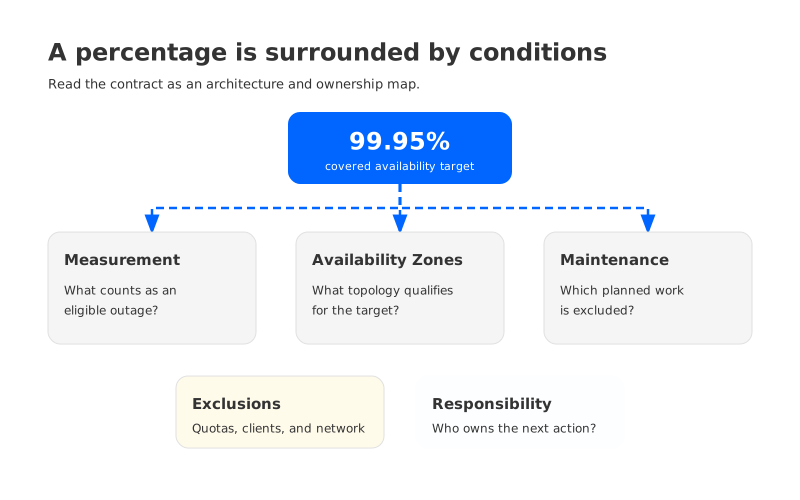
Availability zones are part of the SLA story because they define the failure domain the architecture is expected to survive. A service can be called multi AZ while leaving important questions unanswered: where leaders and replicas are placed, whether clients reconnect across zones, how metadata quorum behaves, and whether a zone failure changes the availability calculation or only the recovery objective.
Ask what the service assumes about your deployment:
- Must a production cluster use multiple Availability Zones to qualify for the commitment?
- Does the provider place replicas across zones, or does the customer choose the placement?
- What happens to produce and fetch requests when one zone is impaired?
- Is regional disaster recovery covered by the same SLA, or is it a separate design and contract?
- Are client endpoints, private networking, DNS, and identity dependencies inside the covered path?
Maintenance needs the same treatment. Planned work may be excluded from downtime, but the exclusion only helps if the maintenance process fits the workload. Ask whether maintenance is provider initiated or customer scheduled, how notice is delivered, whether rolling changes preserve client traffic, and which actions remain with your team. A maintenance window can be harmless for a client that reconnects cleanly and disruptive for one that pins connections, mishandles retries, or depends on a single endpoint.
Exclusions are often more revealing than the headline percentage. Look for insufficient capacity, excessive partition counts, quota violations, unsupported configurations, customer network failures, client errors, third party dependencies, and events outside the provider's control. These clauses do not make a service unacceptable. They define the operating work you must own if the service is to remain eligible for the commitment.
4What the uptime number does not promise
An uptime percentage does not automatically guarantee durability, recovery point objective, recovery time objective, or consumer freshness. Those are separate properties with separate failure modes.
A producer may receive an acknowledgment only after the configured durability condition is met. In Apache Kafka, the replication documentation explains how leaders, followers, and in sync replicas participate in the data path. The min.insync.replicas broker configuration is one of the controls that shapes when a write can succeed under acks=all. A service can be reachable while a topic is under replicated, and a topic can retain its data while consumers remain unable to make progress.
The provider interview should separate these questions:
| Property | Question to answer |
|---|---|
| Availability | Which operation is unavailable, and how is the interval measured? |
| Durability | What must happen before an acknowledgment is returned? |
| Recovery point | After a failure, what acknowledged data may be missing, and who owns that outcome? |
| Recovery time | What is a documented commitment, and what is only a tested internal objective? |
| Consumer continuity | How are offsets, rebalances, lag, and client reconnects handled? |
For downtime cost, use the availability formula only as a first exposure estimate. A better internal model multiplies the eligible downtime budget by the cost of the affected workload, then adds the operational cost of replay, delayed consumers, manual intervention, and downstream reconciliation. Do not turn that model into a vendor claim. It is a way to decide whether a tighter availability commitment changes your business decision.
5Architecture sets the ceiling
The contract can promise only what the service architecture and operating process can repeatedly deliver. Traditional Kafka deployments tie durable log segments to broker-local storage and use replica placement to keep data available when a broker or zone fails. That model can work well, but recovery and scaling are connected to the data held by each broker. Replacing a broker, moving a hot partition, or recovering after a storage failure may involve restoring state and moving retained data before the cluster is healthy again.
A credible high availability design needs a short path between failure detection and useful service. It should preserve the write acknowledgment semantics, keep durable data reachable, move traffic away from unhealthy capacity, and expose evidence that recovery completed. Multi AZ placement alone does not prove those properties. Neither does a large replication factor if client routing, metadata, storage, or recovery procedures become the bottleneck.
That leads to a more useful architecture question: how much durable state must move when compute fails? If the answer is “the full retained log on a broker,” the SLA review should examine recovery duration, throttling, replica health, and capacity headroom. If durable stream data is in shared storage and the broker retains only the state needed for the active write path and cache, the recovery design has a different set of constraints. It still needs testing, but it has more room to replace compute without first rebuilding the entire storage identity of the failed node.
This is the point where AutoMQ, a Kafka-compatible cloud-native streaming platform, becomes a useful architecture example. AutoMQ's Shared Storage architecture uses S3Stream, a write-ahead log (WAL) storage layer, and object storage to move durable stream data away from the traditional broker-local log model. The WAL documentation describes low latency persistence and recovery of data that has not yet reached object storage. Its stateless broker documentation explains why broker replacement and scaling can be considered separately from retained stream data.
That does not turn an architecture into an SLA. It changes the questions behind the SLA. For an AutoMQ evaluation, ask how the chosen WAL type, object storage, broker placement, client routing, KRaft metadata, and monitoring behave under the failures that matter to your workload. The architectural benefit is design space: a failed broker can be treated more like failed compute when the durable data and recovery state remain accessible elsewhere. The actual availability outcome still depends on the deployment and the test.
6Questions for a supplier interview
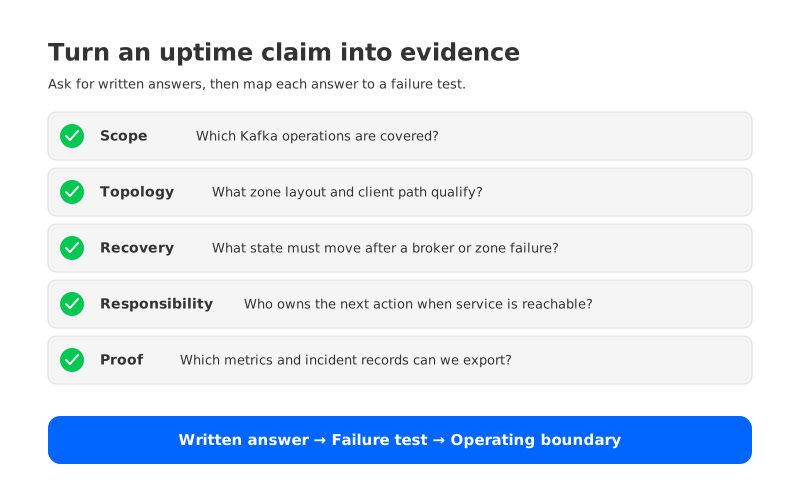
Bring the following questions to the provider call. Ask for written answers or links to the exact service terms, then map each answer to a failure test.
- What exact Kafka operations are covered by the availability commitment?
- How is downtime measured, rounded, and aggregated during the billing period?
- Which maintenance activities, upgrades, and emergency actions are excluded?
- What deployment topology is required for the commitment to apply?
- How are brokers, partition leaders, replicas, and metadata quorum distributed across Availability Zones?
- What happens to acknowledged writes during broker, disk, zone, network, and storage failures?
- Which durability settings are assumed for producers and topics?
- Are RPO and RTO contractual commitments, tested objectives, or customer responsibilities?
- Does recovery require copying retained partition data between broker-local disks?
- What evidence shows that failover, reassignment, and consumer recovery have completed?
- Which quotas, partition counts, client settings, or capacity conditions can void the commitment?
- Which team owns the incident when the service is reachable but the workload is stalled?
- What logs, metrics, audit events, and incident records can customers export?
- How are service credits requested, and what evidence must the customer provide?
The questions are deliberately operational. A supplier that can answer them precisely gives you material for a runbook and an architecture review. A supplier that answers only with a higher percentage has given you a number without a failure model.
7Read the number, then test the boundary
Return to the 99.95 percent claim. In the annual calculation example, it leaves 262.8 minutes of eligible downtime, while 99.9 percent leaves 525.6 minutes. That difference may matter, but only after you know which operations count, which maintenance is excluded, which topology qualifies, and which recovery work belongs to your team.
Use the contract to define the boundary, the architecture to explain the failure path, and a production-shaped exercise to test the gap between them. If your current Kafka design spends too much recovery time rebuilding broker-local state, evaluate a shared-storage architecture with the same producer, consumer, zone, durability, and observability requirements. Start an AutoMQ evaluation with those requirements written down, so the result measures your availability design rather than a headline number.
8References
- Apache Kafka replication
- Apache Kafka
min.insync.replicasconfiguration - Amazon MSK Service Level Agreement
- Google Cloud Managed Service for Apache Kafka SLA
- AutoMQ architecture overview
- AutoMQ WAL storage
- AutoMQ stateless broker
9FAQ
9.1What does 99.9 percent Kafka availability mean?
In a calculation example using a 365 day year, 99.9 percent availability allows 525.6 minutes of eligible downtime. The real meaning depends on the provider's measurement window, covered operations, exclusions, and deployment conditions.
9.2How much better is 99.95 percent than 99.9 percent?
Using the same calculation assumptions, 99.95 percent allows 262.8 minutes per year instead of 525.6 minutes. It cuts the allowed downtime in half. That comparison says nothing about scope, so read the service terms before treating the number as a ranking.
9.3Does a Kafka uptime guarantee cover data loss?
Usually, uptime and durability are separate commitments. Review producer acknowledgment settings, in sync replicas, storage behavior, recovery point objectives, and client retry semantics alongside the availability clause.
9.4What should I ask about Kafka maintenance windows?
Ask who initiates maintenance, how notice is delivered, whether the work is excluded from downtime, how clients reconnect, and whether the same process applies to emergency patches and routine upgrades.
9.5Can architecture change the practical Kafka availability ceiling?
Yes. Failure domains, metadata quorum, storage placement, WAL behavior, client routing, and recovery work all shape how quickly the service returns to useful operation. Architecture does not replace a contract, but it determines how much of the contract is repeatable under failure.


