
Table of Contents
Table of Contents
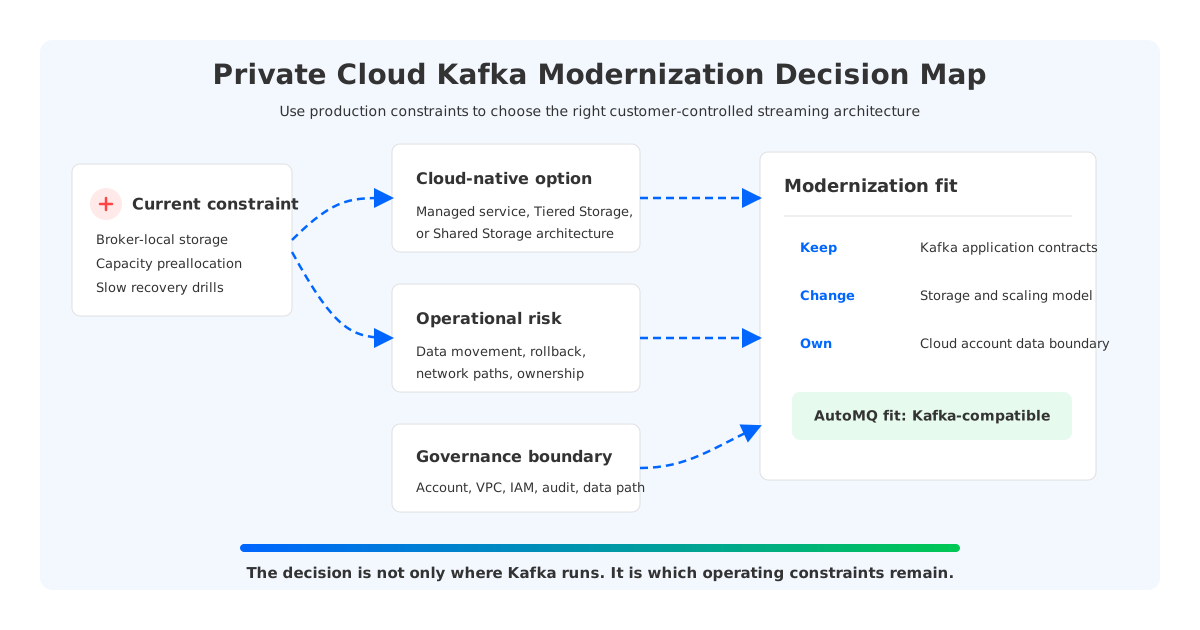
Teams search for private cloud kafka modernization when the Kafka estate is still important, but the operating model around it has started to fight the business. Applications work, clients speak Kafka, and the data platform team knows the incidents and runbooks. Yet every capacity review, security review, and migration discussion circles back to the same question: can the organization keep Kafka behavior while changing where the operational burden sits?
That question is different from "Should we replace Kafka?" Most teams asking it are not trying to abandon Topics, Partitions, Offsets, Consumer groups, Kafka Connect, or existing producer and consumer code. They are trying to reduce the cost and risk created by broker-local storage, long partition reassignment, cloud network exposure, capacity preallocation, and unclear control boundaries. Private cloud Kafka modernization is therefore an architecture decision first and a vendor decision second.
1Why Teams Search for private cloud kafka modernization
The search intent usually starts with a contradiction. Platform teams want a more cloud-native streaming platform, but security and compliance teams still want customer-controlled infrastructure. Procurement wants clearer ownership and predictable spend, while application teams want Kafka compatibility instead of a rewrite.
Those pressures show up in different language during reviews. The cloud platform lead asks whether the system can scale without moving terabytes of broker-local data. The security architect asks where credentials, business records, audit logs, object storage, and support access live. The FinOps team asks why storage, replication, cross-Availability Zone traffic, and idle capacity appear in separate parts of the bill. The application owner asks the simplest question of all: will my clients keep working?
Private cloud modernization has to answer all of those questions together. A platform that reduces operations but breaks client assumptions is not a practical migration target. A platform that keeps client behavior but leaves the same storage and recovery bottlenecks intact may not be modernization. The useful frame is to separate the application contract from the infrastructure contract.
The application contract is what existing systems depend on: Kafka protocol behavior, admin APIs, Consumer group coordination, offset commits, transactions if used, topic configuration, ACLs, Connect tasks, stream processing jobs, and monitoring signals. The infrastructure contract is what operators have to own: brokers, disks, replication, placement, network paths, recovery procedures, cloud permissions, observability, and lifecycle automation. A good modernization plan preserves the first while deliberately changing the second.
2The Production Constraint Behind the Problem
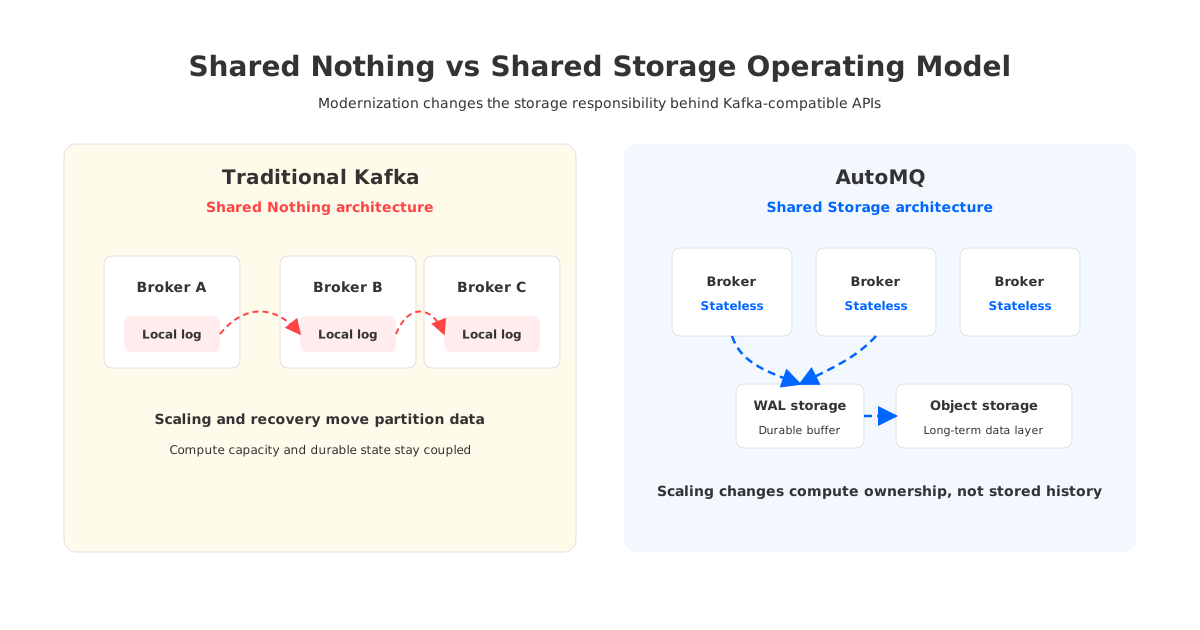
Traditional Kafka uses a Shared Nothing architecture. Each broker owns local log data for the partitions assigned to it, and durability is achieved through replication across brokers. This design is proven and still valid when the team wants direct control over local storage, predictable broker behavior, and a familiar operational model.
The constraint appears when the workload runs in cloud or private cloud environments where compute, storage, and network are priced and governed separately. Broker-local storage couples durable data to broker placement. Adding brokers helps only after partition ownership and data placement catch up. Replacing a failed broker is also a data recovery and replica catch-up event. Increasing retention affects disk capacity, rebalancing windows, backup expectations, and failure-domain planning.
That coupling creates four recurring modernization drivers:
- Capacity planning becomes defensive. Teams reserve storage and broker capacity for peak traffic, retention growth, recovery headroom, and rebalancing windows, even when average usage is lower.
- Scaling depends on data movement. More compute is useful only when partition leadership, replica placement, and local log state reach a healthy distribution.
- Recovery competes with production traffic. Replica catch-up, partition reassignment, and broker replacement consume the same network and storage resources that clients need.
- Governance is hard to explain. Security reviewers need a clear map of where the data plane, control plane, administrative access, metrics, logs, and object storage live.
These are not signs that Kafka is poorly designed. The mismatch comes from running a broker-owned commit log model in environments where storage elasticity, account boundaries, private networking, and audit evidence are first-class buying criteria.
3Architecture Options and Trade-Offs
There are several ways to approach private cloud Kafka modernization, and each one preserves a different part of the old system. The stronger evaluation starts with the constraint the team is trying to remove.
| Option | What it preserves | What still needs scrutiny |
|---|---|---|
| Keep and tune existing Kafka | Maximum familiarity for operators and applications. | Broker-local storage, replication, partition movement, and capacity buffers remain the core model. |
| Move to managed Kafka | Less direct infrastructure work, familiar Kafka interfaces, and vendor-operated lifecycle tasks. | Data-plane location, private networking, pricing shape, feature coverage, and security review boundaries. |
| Add Tiered Storage | Longer retention can rely more on remote storage while keeping Kafka's log model. | Recent segments, broker hot path, reassignment, and recovery still depend on local log behavior. |
| Adopt Shared Storage architecture | Kafka-compatible APIs with durable data separated from broker-local disks. | WAL design, object storage behavior, cache policy, metadata scale, and migration tooling. |
Tiered Storage can reduce pressure from long retention by moving older log segments to remote storage. For teams whose main pain is historical data growth, that may be enough. It does not fully change the operating model for hot data, broker replacement, or partition reassignment because the broker still has a local log path that matters.
Shared Storage architecture changes a deeper assumption. Durable stream data is no longer treated as long-term broker-local state. Brokers still process Kafka requests, lead partitions, route traffic, and serve reads, but durable storage moves into shared object storage with a write path designed around WAL storage and caching. That shifts modernization from "how do we operate the same broker-disk model in a private cloud?" to "how do we keep Kafka behavior while making brokers more replaceable?"
The trade-off is real. Shared Storage architecture asks teams to evaluate object storage latency, WAL type, cache behavior, metadata handling, and failure recovery differently from a local-disk Kafka cluster. A serious proof of concept has to test hot reads, catch-up reads, produce latency, broker failure, object storage access, and rollback.
4Evaluation Checklist for Platform Teams
A private cloud Kafka modernization review should use one checklist across platform engineering, security, procurement, and application owners. Separate checklists tend to hide risk: an application test can pass before the control path is approved, or a throughput test can pass before rollback is rehearsed.
Start with the evidence that protects production:
- Kafka compatibility. Test the exact client versions, security mechanisms, serializers, admin clients, Consumer group behavior, offset commits, transactions, Kafka Connect jobs, Kafka Streams applications, and monitoring integrations in use.
- Storage and scaling. Ask whether broker expansion requires moving durable partition data, how retention growth is handled, how rebalancing works under load, and what a broker replacement actually does.
- Cost shape. Include compute, storage, network transfer, private connectivity, load balancers, object storage requests, observability, migration overlap, support, and operator time. Avoid evaluating only the subscription line item.
- Governance boundary. Draw the data path and the control path. Identify where customer records, credentials, metadata, logs, metrics, admin APIs, and support access live.
- Failure recovery. Run broker failure, storage access interruption, network policy change, scale-out, scale-in, and rolling upgrade drills before production cutover.
- Migration and rollback. Treat Topics, ACLs, schemas, offsets, connectors, producers, consumers, dashboards, and alert rules as one migration system.
This checklist also clarifies procurement's role. The contract should match the architecture: who owns the cloud resources, who can access the runtime, which telemetry leaves the environment, how support sessions are approved, and what happens when the subscription ends.
Security teams should ask for evidence instead of slogans. A platform can run inside a customer environment and still create unclear access paths. A control plane can be useful and still need strict permission scoping. The winning design is the one where each component has a clear owner, location, identity, and failure mode.
5How AutoMQ Changes the Operating Model
After the neutral evaluation is complete, AutoMQ fits a specific modernization pattern: a Kafka-compatible cloud-native streaming platform built around Shared Storage architecture. It keeps Kafka protocol compatibility while replacing Kafka's broker-local persistent storage with S3Stream, WAL storage, data caching, and S3-compatible object storage. The operating unit changes from "broker plus durable local history" to "compute brokers backed by shared durable storage."
In AutoMQ, AutoMQ Brokers handle Kafka request processing, leadership, routing, and cache behavior. Durable data flows through WAL storage and is stored in S3 storage. WAL storage acts as the durable write buffer and recovery layer, while object storage becomes the long-term storage layer. Because durable stream data is not permanently tied to a broker's local disk, broker replacement and capacity changes can be evaluated as compute operations rather than full data relocation events.
That matters for private cloud modernization because application teams can keep Kafka clients and Kafka semantics while platform teams evaluate a different storage, scaling, and recovery model underneath. The migration plan still has to be tested with real workloads, especially for Consumer group behavior, offset handling, transactions, connectors, hot reads, catch-up reads, and rollback.
AutoMQ BYOC and AutoMQ Software address different customer-controlled boundaries. AutoMQ BYOC is designed for public cloud customers that want the control plane and data plane deployed in the customer's cloud account and VPC. AutoMQ Software is designed for private data centers or private cloud environments where the customer operates the software within its own infrastructure. In both cases, the review should distinguish the data plane from the management plane and verify what data, metadata, logs, and metrics move across any operational channel.
A customer-controlled deployment can align Kafka-compatible streaming with existing cloud controls such as IAM, VPC routing, encryption, audit logging, object storage policy, and private connectivity. A shared-storage design can also change the cost conversation by reducing dependence on over-provisioned broker-local disks and large data-copy windows. Those benefits still depend on workload shape, deployment design, and WAL choice, so they should be validated rather than assumed.
AutoMQ is most relevant when the decision criteria are Kafka-compatible APIs, customer-controlled deployment boundaries, shared durable storage, stateless brokers, and lower operational friction during scaling and recovery. Teams that value the exact traditional Kafka operating model may stay with self-managed Kafka, while teams that want a fully external service boundary may choose a managed SaaS model.
6A Readiness Scorecard Before Cutover
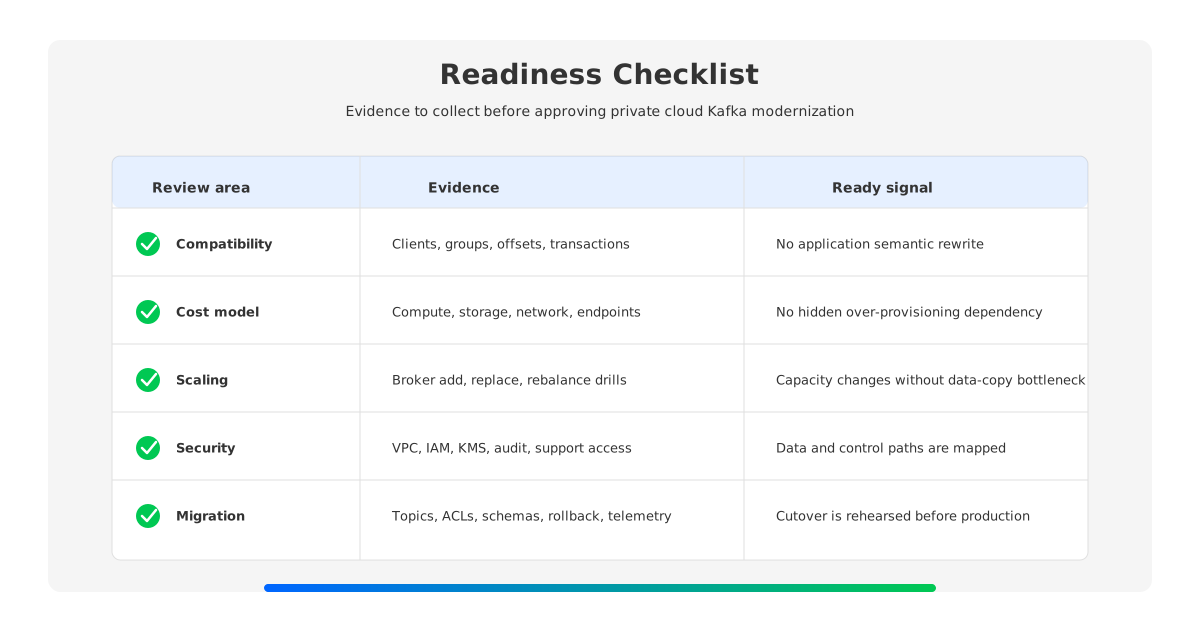
The final gate should be a scorecard that multiple teams can sign, not a demo recap. Give each category a 1 to 5 score and require written evidence for any score above 3.
| Category | What to verify | Ready signal |
|---|---|---|
| Compatibility | Clients, admin APIs, Consumer groups, offsets, transactions, Kafka Connect, Kafka Streams, and monitoring tools. | Existing applications move without semantic changes. |
| Cost model | Compute, storage, network, private connectivity, observability, migration overlap, and support. | The target model is explainable under expected and peak workloads. |
| Scaling and recovery | Broker add, broker replacement, rebalancing, failure drills, and rolling upgrades. | Capacity changes do not depend on long broker-local data migration. |
| Security and governance | VPC, IAM, encryption, audit logs, object storage, telemetry, and support access. | Data and control paths are documented and approved. |
| Migration and rollback | Topics, ACLs, schemas, offsets, producers, consumers, connectors, dashboards, and alerts. | Cutover and rollback are rehearsed before production traffic moves. |
| Observability | Broker metrics, storage metrics, client lag, WAL behavior, object storage errors, and SLOs. | Operators can detect the failure modes introduced by the new architecture. |
The scorecard usually reveals the real decision. If compatibility is weak, fix the application test plan. If governance is weak, map the deployment boundary before running another benchmark. If scaling and recovery are weak, compare storage architectures instead of vendor labels. If migration and rollback are weak, the project is not ready, even if every throughput test passes.
Back where the search began, private cloud kafka modernization is not a request for a fresher Kafka label. It is a request for a streaming platform that keeps what Kafka applications depend on while changing the parts that make operations, governance, and cost harder than they need to be. If your team is evaluating a customer-controlled Kafka-compatible architecture, build the scorecard around your own workloads and include security, procurement, migration, and rollback from the first test. To evaluate AutoMQ in a BYOC or private infrastructure model, talk to the AutoMQ team.
7FAQ
7.1What is private cloud Kafka modernization?
Private cloud Kafka modernization means changing the deployment, storage, scaling, governance, or operating model around Kafka while preserving the behavior applications rely on. For many teams, the goal is to keep Kafka-compatible APIs while improving control over infrastructure, cost, recovery, and security boundaries.
7.2Is BYOC Kafka the same as private cloud Kafka?
No. BYOC usually means the streaming platform runs in the customer's public cloud account or VPC. Private cloud Kafka can also refer to software deployed in a private data center or customer-operated cloud environment. The shared theme is customer control over the data plane and infrastructure boundary.
7.3Does Kafka compatibility remove migration risk?
No. Kafka compatibility reduces application rewrite risk, but migration still requires testing client versions, Consumer groups, offsets, transactions, connectors, schemas, ACLs, monitoring, cutover, and rollback.
7.4When is Shared Storage architecture a better fit?
Shared Storage architecture is most relevant when the main constraints come from broker-local durable data: slow reassignment, expensive recovery windows, storage over-provisioning, retention pressure, or scaling events that wait on data movement.
7.5How should security teams evaluate a customer-controlled streaming platform?
Security teams should map where data, metadata, credentials, logs, metrics, admin APIs, object storage, and support access live. The review should also cover IAM scope, encryption, private networking, audit evidence, operational access approval, and what telemetry can leave the customer environment.
8References
- Apache Kafka Documentation
- Apache Kafka Consumer Groups and Offsets
- Apache Kafka Message Delivery Semantics
- Apache Kafka KRaft Documentation
- Apache Kafka Tiered Storage Documentation
- Apache Kafka Connect Documentation
- AutoMQ Compatibility with Apache Kafka
- AutoMQ Architecture Overview
- AutoMQ S3Stream Shared Streaming Storage
- AutoMQ WAL Storage
- AutoMQ Continuous Self-Balancing
- AWS PrivateLink Documentation
- AWS Data Transfer Pricing
- AWS Marketplace Buyer Guide


