
Table of Contents
Table of Contents
Most Kafka platform teams discover the need for a topic catalog after the cluster has already become important. A payments service owns a topic, a risk pipeline depends on it, an analytics job reads from it, and another application team asks whether it can reuse the same event stream. Nobody wants to block the application. Nobody wants another undocumented topic with unknown retention, unclear schema ownership, and a consumer group that becomes business-critical before the platform team knows it exists.
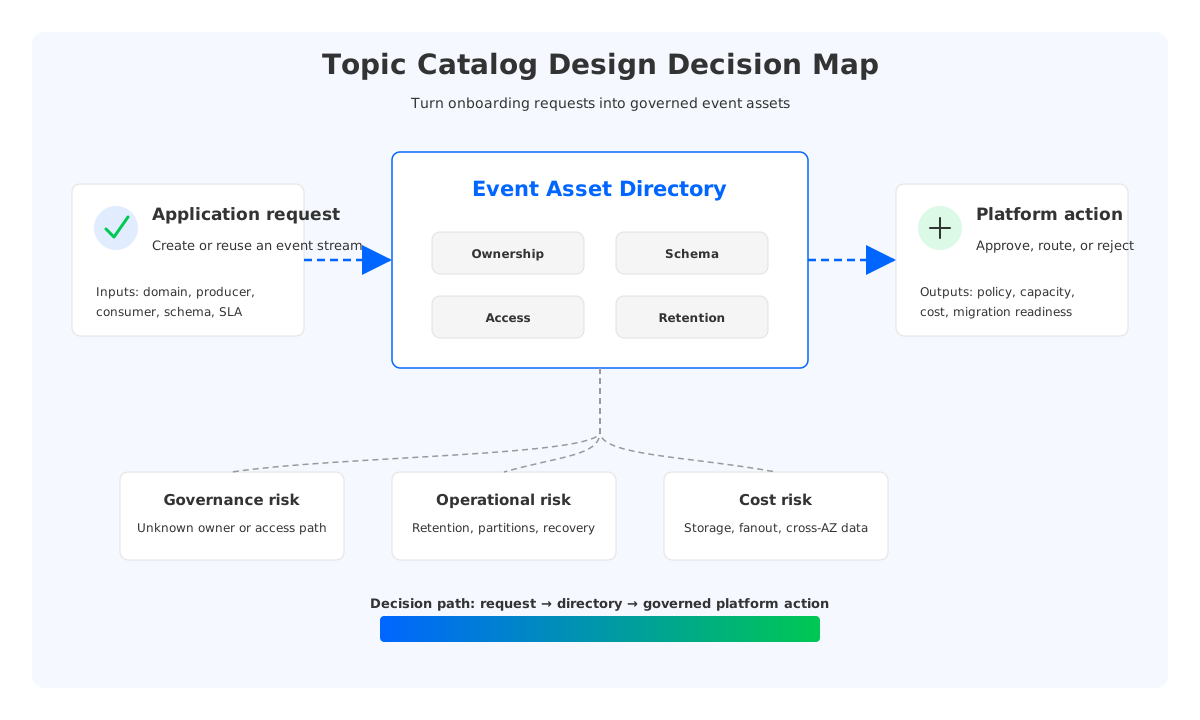
That is the real search intent behind kafka topic catalog design. Teams are not looking for a prettier list of topics. They need an event asset directory that helps applications onboard safely: which event streams exist, who owns them, what schemas and access policies apply, what service-level expectations are realistic, and what operational cost each decision creates. The hard part is that Kafka governance is not only metadata governance. It is also storage, networking, tenancy, migration, and failure recovery governance.
1Why teams search for kafka topic catalog design
A topic catalog starts as a simple inventory problem. Platform teams want a searchable directory of topic names, schemas, owners, retention settings, access control rules, and consumer relationships. Application teams want to know whether an event already exists before they create a duplicate stream. Security teams want to know who can read personally identifiable information. Finance wants to understand why a topic with low business visibility keeps growing the cloud bill.
The catalog becomes more valuable when it joins those questions instead of storing them separately. A topic named orders.events.v1 is not enough. The onboarding workflow needs to know whether the producer owns schema evolution, whether consumers can tolerate breaking changes, whether the topic is compacted or time-retained, and whether the data crosses Availability Zone (AZ) boundaries. That is why a useful catalog is closer to an event asset directory than a wiki page.
There are three common failure modes when the directory is designed too narrowly:
- It records assets after the fact. Teams create topics first, then add documentation when an audit or incident forces cleanup. The catalog becomes a graveyard of stale metadata.
- It ignores operational cost. Retention, replication, read fanout, and cross-AZ traffic are treated as broker settings, even though they shape the lifetime cost of every event stream.
- It separates governance from onboarding. Access review, schema review, production readiness, and migration checks happen in different tools, so no one sees the whole risk profile before launch.
The better pattern is to make the catalog part of the onboarding path. A new application should not ask, "Can I create a topic?" It should answer a richer question: "What event asset am I creating or consuming, and what does that asset require from the platform?"
2The governance pressure behind shared streaming platforms
Kafka makes event streams easy to create, which is one reason it became the default backbone for real-time systems. That ease creates a second-order problem. As more applications onboard, the cluster stops looking like a messaging system and starts looking like shared infrastructure with hundreds or thousands of data products. Each topic has a producer contract, consumer dependencies, retention logic, security policy, and recovery expectation.
Traditional Kafka operations amplify that governance pressure because metadata decisions are tied to infrastructure decisions. A topic's partition count affects throughput and consumer parallelism. Its replication factor affects durability and storage. Its retention policy affects disk growth. Its read fanout affects broker network and cache behavior. In a multi-AZ deployment, replication and client placement can also affect data transfer cost. A catalog that stores only owner and schema information misses the parts of the decision that wake up SREs later.
This is where Shared Nothing architecture matters. In traditional Kafka, each broker stores local partition replicas, and durability is provided by replicating data across brokers. The model is proven, but it means storage placement, recovery, and rebalancing remain part of the operational surface for every important topic. If an onboarding workflow approves a long-retention, high-fanout topic without checking capacity and placement implications, the cost lands on the platform team after the application is already live.
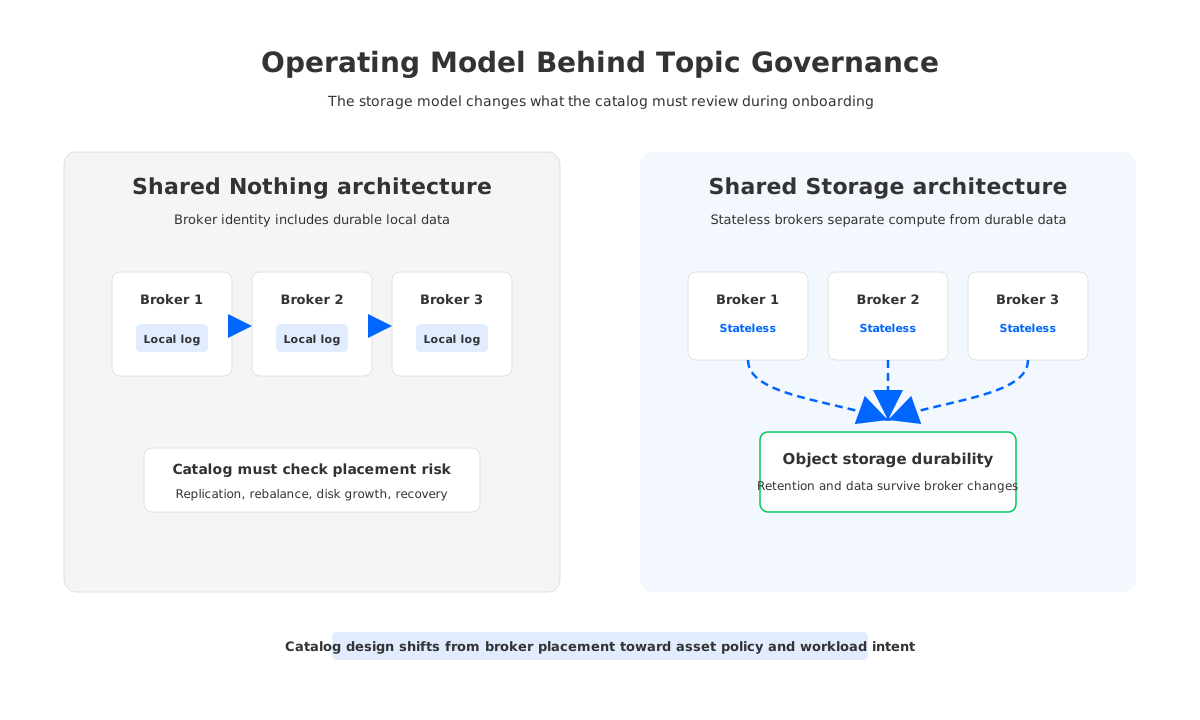
The catalog should therefore treat every topic as a governed asset with two sides. The application-facing side describes meaning: business domain, event type, schema, ownership, consumers, and lifecycle. The platform-facing side describes behavior: throughput, partitions, retention, durability, placement, access, observability, and migration readiness. Missing either side creates blind spots.
3Contracts, ownership, access, and audit trade-offs
The most useful event asset directories make ownership explicit before they make search beautiful. Search helps teams find existing streams, but ownership decides what happens when a schema changes, a consumer falls behind, a retention policy needs review, or a regulator asks who had access to a field. The directory should name a producing team, a data steward when needed, a platform contact, and the escalation path for production incidents.
Schema governance belongs in the same workflow. Apache Kafka does not require a schema registry, but many production environments use one because event contracts need to evolve without breaking consumers. The catalog should not duplicate the registry. It should point to the canonical schema, record compatibility expectations, and show which applications depend on each version. For onboarding, the practical question is not "Is there a schema?" It is "Can this producer change the event without breaking the consumers that already exist?"
Access control needs similar treatment. Kafka ACLs, TLS, SASL, network boundaries, and application identity systems can enforce policy, but the catalog should explain the policy in human terms. A platform reviewer needs to know whether the topic contains regulated data, whether access is time-bounded, whether consumers are service accounts or humans, and whether the access path stays inside approved cloud boundaries. The catalog becomes an audit map, not the enforcement engine.
That distinction keeps the design realistic. The event asset directory should coordinate with runtime systems instead of trying to replace them.
| Directory field | Runtime system it should connect to | Onboarding question it answers |
|---|---|---|
| Topic owner and steward | Team registry, service catalog, incident ownership | Who approves changes and handles production escalation? |
| Schema and compatibility mode | Schema Registry or CI validation | Can this event evolve without breaking existing consumers? |
| ACL and identity mapping | Kafka ACLs, IAM, SSO, network policy | Who can read or write, and through which identity path? |
| Retention and partition policy | Kafka topic configuration, capacity policy | What storage, scaling, and recovery obligations does this topic create? |
| Consumer dependencies | Consumer group inventory, lineage, observability | Which applications are affected by schema, retention, or migration changes? |
The table also shows why a topic catalog is not a one-time documentation project. The directory has to stay close to systems that change. If topic configuration, schema versions, and consumer groups drift away from the catalog, the catalog loses trust. Once engineers stop trusting it, they return to Slack archaeology and cluster inspection during every onboarding review.
4Evaluation checklist for platform teams
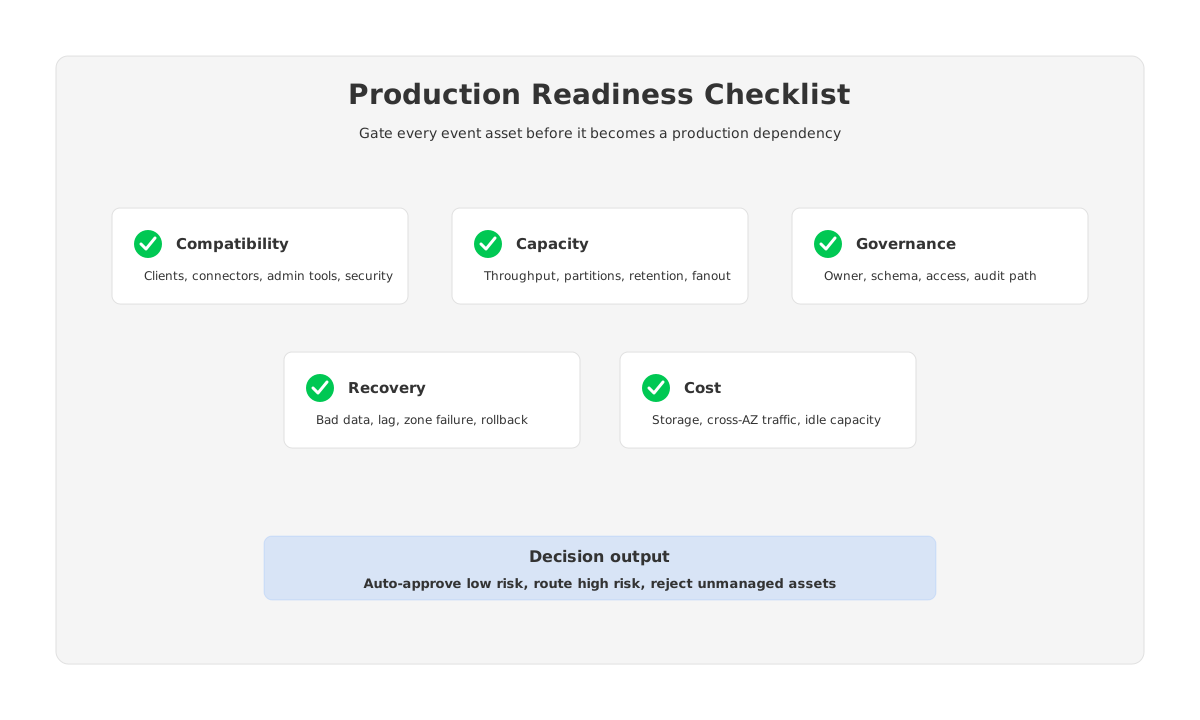
The right checklist depends on platform maturity, but the baseline is consistent. Each event asset should pass a small set of reviews before it becomes a production dependency. The review should prevent future ambiguity without pushing application teams around the process.
Start with the asset definition. The topic name should encode domain meaning without becoming a policy language. The event description should explain what happened in the business or system, not how a downstream consumer happens to use it. A topic created for one reporting job often becomes the accidental interface for five applications; the catalog should discourage that by separating event meaning from consumer purpose.
Then test the operational shape:
- Compatibility. Confirm that producers, consumers, admin tooling, Kafka Connect jobs, observability agents, and security integrations rely only on Kafka protocol behavior that the platform supports.
- Capacity. Estimate write throughput, read fanout, partition count, retention, compaction needs, and burst behavior. The goal is not perfect forecasting. It is to avoid approving a topic with hidden storage or network consequences.
- Governance. Record ownership, schema compatibility, data classification, access path, audit requirements, and review cadence. These fields should be required before production access.
- Recovery. Decide what happens if a producer publishes bad data, a consumer falls far behind, a zone fails, or the platform needs to move the topic during migration.
- Cost. Map retention, replicas, cross-AZ traffic, object storage if used, and idle capacity to the cost model. Cost belongs in onboarding because topic decisions are the unit where cost becomes actionable.
This checklist should produce a decision, not a pile of notes. For low-risk topics, the platform can approve automatically when defaults are satisfied. For regulated or high-throughput topics, the directory can route reviews to security, data governance, or SRE. For topics that violate naming, ownership, or retention policy, the application team should get a specific rejection reason and a path to fix it.
5How AutoMQ changes the operating model
The neutral evaluation comes first because an event asset directory should not be designed around a single platform logo. Still, the infrastructure underneath Kafka changes what the catalog has to govern. If brokers own durable local replicas, the catalog must treat storage placement, rebalance impact, and broker capacity as recurring onboarding concerns. If the platform separates compute from durable storage, the catalog can shift more attention toward contracts, access, and workload intent.
AutoMQ fits the second category. It is a Kafka-compatible streaming platform built around a Shared Storage architecture, with stateless brokers and object-storage-backed durability. The point for catalog design is not that governance disappears. It is that some governance checks move from broker-local data placement toward workload policy: what the topic means, how it is accessed, how much data it keeps, and what service level the application expects.
That distinction matters during application onboarding. In a Shared Nothing Kafka cluster, a high-retention topic can imply more broker-local disk, more replica movement during rebalancing, and a heavier recovery path. In AutoMQ's model, durable stream data is stored in S3-compatible object storage, while brokers handle compute and request processing. Platform teams can reason about compute, storage, and retention as more independent dimensions, which makes the catalog's capacity and cost fields easier to connect to real platform behavior.
AutoMQ also gives the catalog a clearer migration story when teams need to move existing workloads. Kafka Linking, compatibility with Apache Kafka clients, Self-Balancing, and customer-controlled deployment models such as AutoMQ BYOC and AutoMQ Software are relevant because event assets rarely move alone. Topics, offsets, ACLs, schemas, connectors, and consumer cutover plans have to move as a coordinated unit. A directory that already tracks those relationships becomes a migration control plane for humans, even if the data movement itself is handled elsewhere.
Teams should still test client versions, security settings, admin operations, connector behavior, and latency under their own workload. The catalog does not replace a benchmark or a migration rehearsal. It makes sure those checks happen for the topics that carry the most risk.
6A practical implementation sequence
Teams often try to build the perfect catalog schema before they wire it into onboarding. That order slows the project down. Start with the decisions that are already painful, then grow the directory around those decisions.
First, capture the minimum viable asset record: topic name, business domain, owner, schema link, data classification, retention, expected throughput, approved producers, approved consumers, and production status. These fields answer most onboarding questions and expose missing ownership. Avoid adding dozens of optional fields that nobody reviews.
Second, connect the catalog to systems of record. Topic configuration should come from Kafka admin APIs or infrastructure-as-code state where possible. Schemas should link to the registry or repository that owns compatibility checks. Access should connect to ACL or identity policy review. Consumer relationships can start from observed consumer groups, then become richer as teams add service ownership and lineage.
Third, add review paths. A small internal topic with default retention should not wait for a committee. A regulated event stream with many consumers should require explicit review from the data owner and platform team. A high-throughput topic should trigger capacity and cost review. This is the point where the catalog stops being documentation and becomes an onboarding workflow.
Fourth, make drift visible. If a topic exists in the cluster but not in the directory, mark it as unmanaged. If a schema changes without catalog review, flag it. If a consumer appears without an approved access record, route it to the owning team.
If your next onboarding review is really a storage, access, and migration review in disguise, model the workload with AutoMQ before you approve another unmanaged event stream.
7References
- Apache Kafka Documentation
- Apache Kafka Operations
- Apache Kafka Security
- KIP-405: Kafka Tiered Storage
- KIP-1150: Diskless Topics
- AWS Architecture Blog: Overview of data transfer costs for common architectures
- AutoMQ architecture overview
- AutoMQ compatibility with Apache Kafka
- AutoMQ migration overview
8FAQ
8.1Is a topic catalog the same as a schema registry?
No. A schema registry manages event schemas and compatibility rules. A topic catalog or event asset directory connects schema information to ownership, access, retention, consumers, operational cost, and onboarding status. The two systems should integrate, but they solve different problems.
8.2What is the minimum metadata for Kafka topic catalog design?
Start with topic name, owner, business domain, schema link, data classification, approved producers, approved consumers, retention policy, partition policy, expected throughput, and production status. Add migration readiness, cost fields, and audit fields once the basic ownership model is trusted.
8.3Should application teams be allowed to create Kafka topics directly?
That depends on platform maturity and risk. Self-service topic creation works well when guardrails are enforced through templates, policy checks, naming rules, quota defaults, and catalog registration. Direct creation without ownership, schema, and access review usually creates cleanup work later.
8.4Where does AutoMQ fit in an event asset directory strategy?
AutoMQ fits when the platform team wants Kafka compatibility while reducing the operational weight of broker-local storage. Its Shared Storage architecture and stateless brokers can make capacity, retention, and migration planning easier to reason about, while the catalog continues to govern ownership, contracts, access, and onboarding decisions.


