
Table of Contents
Table of Contents
The first production lesson of AI systems is uncomfortable: model quality is not only a model problem. A retrieval pipeline can use a strong embedding model, a tuned reranker, and a clean vector index, yet still answer from stale context because the data path around the model moves too slowly. A support agent misses a policy update. A fraud model reacts after the transaction pattern has already shifted. A personalization system recommends from yesterday's inventory because the batch job completed, but the world changed again.
That is why searches for event driven ai pipeline are becoming more specific. Teams are no longer asking whether streaming is useful in the abstract. They are asking how to build a production AI data path where context, governance, cost, and reliability survive real traffic.
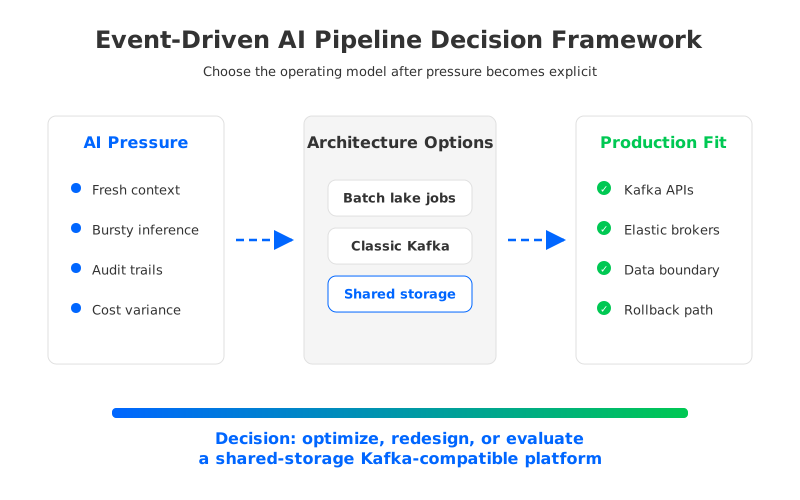
Batch processing still belongs in AI infrastructure. Model training, offline evaluation, historical feature backfills, compliance exports, and large-scale data quality checks all fit batch well. The problem begins when batch becomes the default for operational context that changes while the AI system is making decisions.
1Why Event-Driven AI Pipelines Matter Now
AI applications compress the tolerance for stale data. In a classic analytics workflow, a dashboard that is one hour behind may still be useful. In an AI workflow, the same delay can become a wrong answer, an unsafe action, or an expensive human escalation. The more an AI system acts on behalf of a user, the less acceptable it is for the system to reason over a frozen snapshot.
An event-driven AI pipeline treats relevant business changes as events that flow through the system as they occur. A customer record update, document change, payment event, or access-policy change can move through a streaming backbone into processors, feature stores, vector indexes, monitoring systems, and audit logs. The goal is not to make every component synchronous. The goal is to give every component a current, ordered, replayable source of truth.
For platform teams, that changes the architecture question. A batch AI pipeline asks, "How often should we refresh context?" An event-driven pipeline asks, "Which decisions require fresh context, and what guarantees does each decision need?"
Several constraints tend to appear together:
- Freshness pressure. Retrieval-augmented generation, fraud detection, real-time personalization, and operational assistants lose value when they consume context after the decision window has closed.
- Elasticity pressure. AI traffic is bursty. A product launch, incident, promotion, or agent workflow can shift throughput patterns faster than manually sized infrastructure can follow.
- Governance pressure. AI systems need lineage, replay, access control, and auditability because their outputs increasingly affect customer-facing or regulated workflows.
- Migration pressure. Most enterprises already have Kafka clients, lakehouse tables, data warehouses, and operational systems. A production event-driven AI pipeline has to meet the existing estate, not pretend it starts from a blank page.
This is where Kafka-compatible streaming remains attractive. Apache Kafka gives teams durable topics, consumer groups, offsets, transactions, and a mature client ecosystem. Those primitives map naturally to AI data flows because they separate the arrival of business facts from the pace of downstream processing. A vector indexer can lag and catch up, while a feature pipeline can replay from an offset.
2The Production Constraints Behind the Search
The hard part is not drawing a pipeline with producers on the left and consumers on the right. The hard part is operating it when retention, replay, and AI traffic all grow at once.
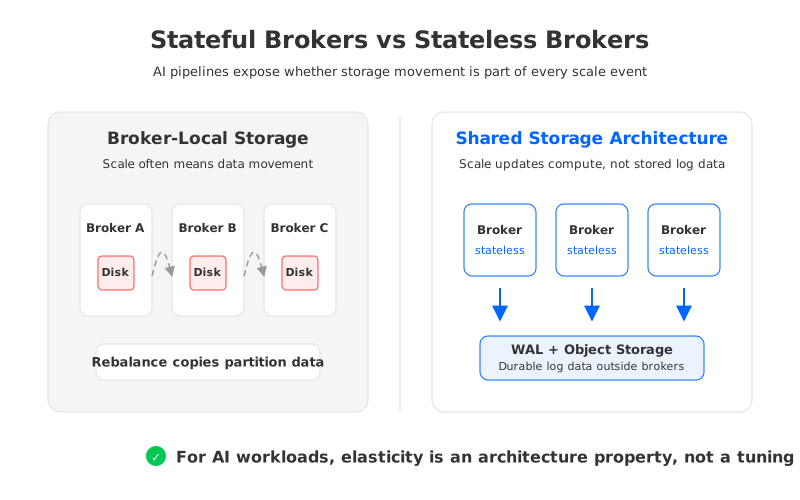
Traditional Kafka clusters are built around broker-local storage. A broker owns partitions, stores log segments on local or attached disks, and participates in replication. This design is proven, but it also means storage placement and compute placement are tightly coupled. When a cluster scales, rebalances, or recovers, the platform may need to move partition data, reserve disk capacity ahead of demand, and coordinate replication across brokers. AI pipelines make those mechanics more visible.
Consider a real-time RAG pipeline. Source events update documents, enrich metadata, compute embeddings, and refresh search indexes. The same event stream may feed audit logs, analytics, and model-quality evaluation. Retention matters because teams need replay, and consumer lag matters because index freshness affects answer quality. If the streaming backbone is slow to scale or expensive to overprovision, the AI platform inherits those limits.
There is also a governance wrinkle. AI systems often need a historical explanation of what data was available at the time of a response. That pushes teams toward event logs, offsets, and replayable data paths rather than opaque point-to-point integrations. A pipeline that is technically real-time but operationally ungoverned will fail in security review long before it fails a benchmark.
The architecture conversation should therefore begin with constraints, not vendors:
| Constraint | Question to answer | Why it matters for AI |
|---|---|---|
| Data freshness | How quickly must context reach the decision path? | Stale context becomes incorrect model behavior. |
| Ordering and replay | Which events must be ordered, and who needs replay? | Debugging and audit require more than raw throughput. |
| Elasticity | Can the platform scale without long data-movement windows? | AI traffic can spike faster than manual operations. |
| Cost shape | Does retention or replication dominate the bill? | AI pipelines often keep more history for replay and evaluation. |
| Data boundary | Where does data live, and who controls the environment? | Enterprise AI reviews focus on control planes, networks, and access paths. |
| Migration path | Can existing clients and processors move incrementally? | Big-bang rewrites increase risk and delay production value. |
If a platform cannot answer these questions clearly, it is not ready to be the backbone for production AI context.
3Architecture Patterns Teams Usually Compare
Most teams evaluate three patterns before they commit.
The first pattern is batch-first lakehouse refresh. Data lands in object storage or a warehouse, scheduled jobs transform it, and AI systems read refreshed tables or indexes. This works for training data, analytics, offline evaluation, and backfills. It struggles when the data's useful life is short. Running the same batch more frequently helps for a while, but at some point the architecture becomes a collection of small batch jobs pretending to be a stream.
The second pattern is classic Kafka as the operational event backbone. Producers publish business events, stream processors transform them, and consumers update downstream stores. This is the default choice for many teams because Kafka's semantics are familiar and its ecosystem is broad. The trade-off is operational: broker-local storage, replication, partition movement, and capacity planning remain part of the platform team's life. For bursty AI context pipelines with long retention, it can become a drag.
The third pattern is Kafka-compatible streaming with shared storage. In this model, the platform preserves Kafka APIs and semantics for clients, but separates broker compute from durable log storage. Brokers can become more stateless because log data lives in shared storage such as object storage, often with a write-ahead log layer for low-latency writes. Scaling compute no longer has to imply moving retained partition data between brokers.
Each pattern optimizes for a different bottleneck. Batch optimizes for large offline work. Classic Kafka optimizes for a mature event log with local broker ownership. Shared-storage Kafka-compatible systems optimize for cloud elasticity, retention economics, and separation between compute and storage.
4Evaluation Checklist for Platform Teams
Before choosing an event-driven AI pipeline architecture, platform teams should test it against production gates rather than feature lists.
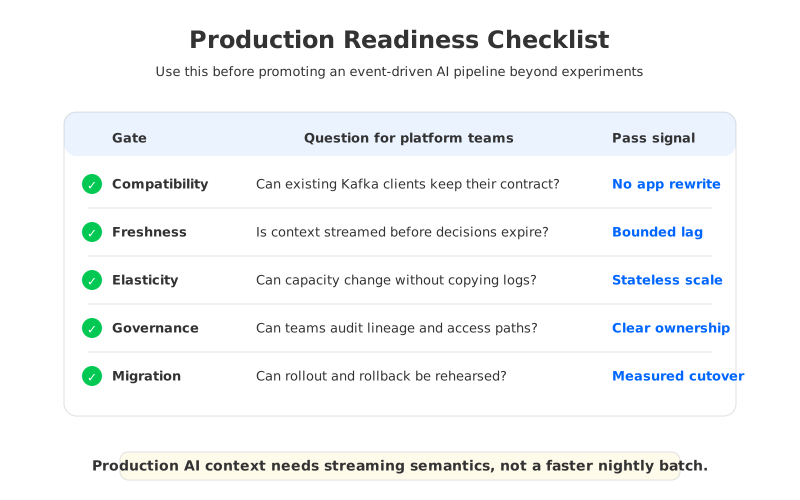
Start with compatibility. If the organization already depends on Kafka clients, Kafka Connect, Flink jobs, schema tooling, or consumer-group semantics, compatibility is not a convenience. It is the difference between an incremental migration and a rewrite.
Then test freshness as a measurable service objective. "Real time" is too vague for architecture work. A fraud feature, a document index, and an observability assistant may each need different lag bounds. The platform should expose lag, throughput, failed events, and replay status so teams can reason about the full context path, not only broker health.
Cost deserves the same specificity. AI pipelines tend to increase retained data because teams want replay for model evaluation, incident analysis, and compliance. They also increase fan-out because the same facts feed retrieval, features, analytics, monitoring, and audit. If the architecture depends on repeated replication, peak-sized disks, or cross-zone data movement, those costs become part of the AI platform.
Governance should be designed into the event path. A production system needs to know who produced an event, which processors consumed it, what data was available to an AI action, and how access policies apply across environments. Private connectivity, VPC boundaries, identity, encryption, and object-storage policies define whether the platform can pass enterprise review.
Migration is the final gate. A good event-driven AI architecture can be adopted by workload, topic, domain, or pipeline stage. Teams should be able to mirror data, validate consumer behavior, measure lag, rehearse rollback, and move clients without rewriting application logic.
5Where AutoMQ Changes the Operating Model
Once those gates are clear, AutoMQ becomes relevant as an architecture category rather than as an opening pitch. AutoMQ is a Kafka-compatible, cloud-native streaming platform that uses shared storage to decouple broker compute from durable log data.
For event-driven AI pipelines, the distinction matters in three places.
First, shared storage changes scaling behavior. In a broker-local model, scaling often has to respect where partition data lives. In a shared-storage model, brokers can be treated more like compute capacity because durable data is outside the broker. That can reduce friction when AI traffic has sharp peaks and uneven fan-out.
Second, object storage changes the retention conversation. AI systems need replayable history for evaluation, debugging, and audit. Keeping more history on broker-local disks can force infrastructure to grow around retention. A shared-storage architecture can align durable log storage with cloud object storage while using a WAL layer for the write path. The operating principle is straightforward: do not make every retained byte dictate broker capacity.
Third, deployment boundaries matter for enterprise AI. AutoMQ supports customer-controlled deployment models such as BYOC, where the data plane runs in the customer's cloud environment. That is important for teams that want cloud-native elasticity without moving sensitive operational data into a vendor-owned network boundary. It also gives platform teams a practical migration story: preserve Kafka client behavior, keep data control aligned with existing cloud governance, and evaluate one workload at a time.
This does not remove the need for engineering judgment. Teams still need topic design, schema governance, backpressure handling, processor idempotency, vector-index update semantics, and observability. AutoMQ does not make event-driven AI architecture automatic. It changes the streaming substrate so that elasticity, retention, and cloud cost are less constrained by broker-local disks.
6Decision Table: Optimize, Redesign, or Replatform
| Situation | Reasonable move |
|---|---|
| Offline model training, periodic analytics, historical backfills | Keep batch-first processing and improve data quality, lineage, and scheduling. |
| Existing Kafka works, workload is stable, retention is modest | Optimize current Kafka operations, observability, topic design, and consumer lag management. |
| AI context freshness is critical, but migration risk is high | Add event-driven stages incrementally and validate lag, replay, and rollback before broad rollout. |
| Broker storage, rebalance windows, or retention cost block AI growth | Evaluate Kafka-compatible shared-storage architecture such as AutoMQ. |
| Data control and cloud boundary are board-level requirements | Prefer deployment models where the data plane stays in the customer's cloud environment. |
The strongest event-driven AI platforms do not chase novelty. They make the data path ordered where ordering matters, replayable where replay matters, elastic where traffic is unpredictable, and governable where AI actions need an audit trail.
If your current AI pipeline still waits for the next batch refresh before it can see what happened, the first step is to map the decisions that become wrong while waiting. From there, evaluate the streaming backbone with the same seriousness you apply to the model stack. To explore how Kafka-compatible shared storage changes that backbone, start with the AutoMQ architecture documentation and test the design against one high-freshness workload before expanding.
7References
- Apache Kafka documentation: design and implementation
- Apache Kafka documentation: consumer groups and distribution
- Apache Kafka KIP-405: Kafka Tiered Storage
- Apache Flink: event-driven applications
- AutoMQ documentation: compatibility with Apache Kafka
- AutoMQ documentation: architecture overview
- AutoMQ Cloud documentation: BYOC overview
- AWS documentation: Amazon S3 user guide
- AWS documentation: AWS PrivateLink
8FAQ
8.1What is an event-driven AI pipeline?
An event-driven AI pipeline is a data architecture where business changes flow as events into AI-related systems such as feature pipelines, vector indexes, retrieval systems, monitoring, and audit logs. The goal is to keep operational context fresh, ordered, and replayable instead of relying only on scheduled refresh jobs.
8.2Does an event-driven AI pipeline replace batch processing?
No. Batch processing remains useful for training, backfills, historical analytics, and offline evaluation. Event-driven architecture is most important for context that becomes less valuable or incorrect when it waits for the next scheduled job.
8.3Why is Kafka often used for event-driven AI architecture?
Kafka provides durable topics, consumer groups, offsets, replay, and a broad client ecosystem. Those primitives help AI platform teams decouple source events from downstream processors while keeping a recoverable position in the event log.
8.4When should teams consider Kafka-compatible shared storage?
Shared storage becomes worth evaluating when broker-local storage, partition movement, retention cost, or slow scaling starts to limit AI context freshness and platform elasticity. It is especially relevant when teams want Kafka compatibility but need a more cloud-native operating model.
8.5How does AutoMQ fit into an event-driven AI pipeline?
AutoMQ fits as a Kafka-compatible streaming backbone with shared storage and more stateless brokers. It is most relevant after a team has confirmed that the AI workload needs fresh context, replay, elastic capacity, and customer-controlled deployment boundaries.


