
Table of Contents
Table of Contents
Teams searching for event driven api backend kafka are usually past the first architecture sketch. They already know that direct request-response integration breaks down when payment services, order services, fraud models, notification workers, and analytics pipelines all need to react to the same business fact. The harder question is what kind of contract should sit between those services. If the contract is only an HTTP endpoint, the producing service remains responsible for every downstream timing problem. If the contract is an event written to a durable log, the backend gains a different property: downstream systems can fall behind, recover, and replay without asking the source API to re-create history.
That property is why Kafka keeps showing up in API backend design. It is not because every API call should become a message, or because events are more fashionable than REST. It is because an event log turns a one-time integration into a replayable operational boundary. The API publishes a fact once; consumers read at their own pace; platform teams can inspect offsets, enforce retention, add new consumers, and rebuild derived state when a schema, model, or business rule changes.
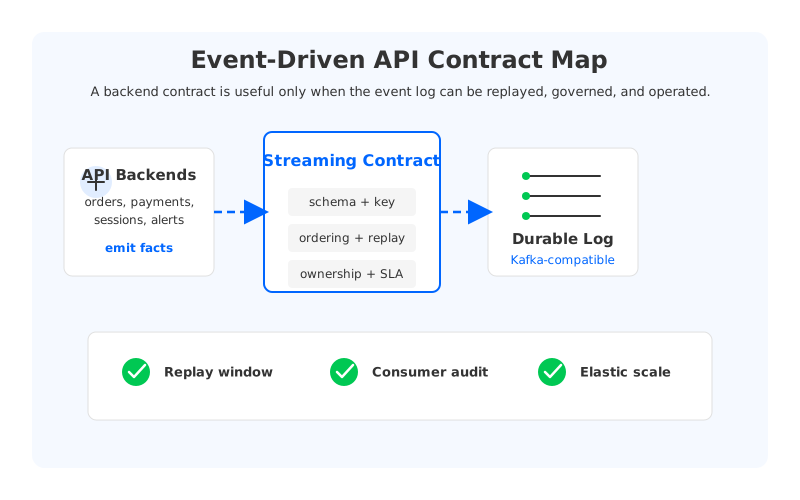
The catch is that replayable contracts make the streaming platform part of the API system's reliability story. A slow consumer, a short retention window, or a broker capacity mistake can decide whether API workers recover cleanly or block under pressure. The design conversation moves from "Should we use Kafka?" to "Can our Kafka-compatible platform preserve contract semantics in production?"
1Why API Backends Need More Than Event Notifications
An event notification says that something happened. A streaming contract says what happened, how it is keyed, how long it can be replayed, what ordering the backend promises, which fields are stable, and how consumers prove progress. During normal operation, both designs can deliver messages. During recovery, only the contract tells teams whether they can replay from an earlier offset, rebuild a materialized view, or safely run two consumer versions during a migration.
Kafka gives teams the raw materials for this contract. Topics create named streams, partitions provide ordered lanes within a keying strategy, consumer groups track independent application progress, and offsets make replay concrete rather than aspirational. Producer idempotence and transactions can help applications reason about duplicate writes and atomicity when the workload requires those semantics. None of these features removes application design work, but together they give backend teams a shared language for state movement.
The practical contract has five parts:
- Event identity. The backend needs a stable event key and a clear rule for whether an event is a fact, a command, or a state change. Mixing these casually makes replay dangerous because consumers cannot tell whether reprocessing is safe.
- Ordering scope. Ordering is rarely global. Most API systems need ordering by account, cart, device, tenant, or payment instrument. The partitioning plan should match that scope.
- Replay window. Retention must be long enough for consumer outages, data quality repair, and model rebuilds. Short retention can silently convert an event log into a notification queue.
- Consumer progress. Offsets are an operational signal. They should be observable, alertable, and tied to service ownership rather than hidden inside one team's dashboard.
- Schema evolution. A replayable log preserves older events. That means consumers must tolerate field additions, deprecations, and versioned interpretation.
These rules are the difference between a backend that can recover from mistakes and a backend that can only hope every consumer was online at the right moment.
2The Production Constraint Behind the Problem
Traditional Kafka deployments were designed around brokers that own local storage. That shared-nothing model is coherent: each broker stores log segments on attached disks, replicates data to other brokers, and serves producers and consumers from its local state. It also means storage, compute, and failure recovery are tightly coupled. When an API backend grows, broker disk headroom, partition placement, rebalancing, replication traffic, and recovery time become one capacity problem.
That coupling becomes visible in cloud production. API traffic rarely grows in a straight line: launches create write spikes, consumer bugs create lag, model retraining triggers replay, and regional incidents force teams to reason about availability zones and recovery boundaries. In a broker-local architecture, these events can require data movement inside the cluster at exactly the moment operators would prefer the cluster to stay quiet.
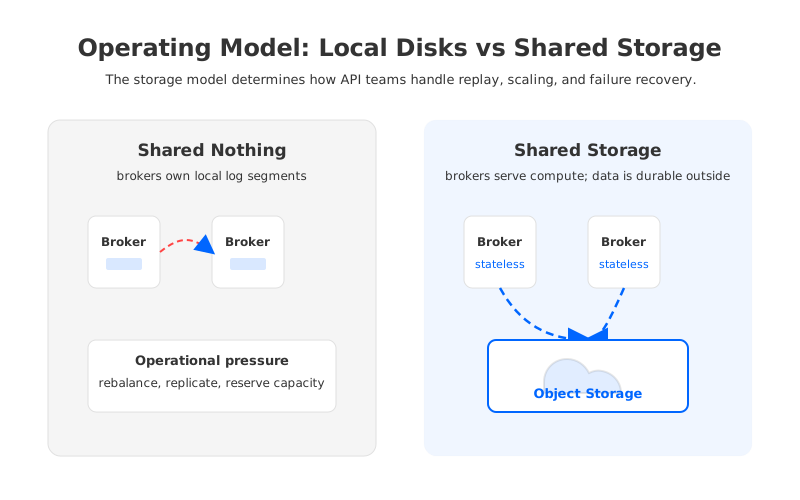
The issue is not that shared-nothing Kafka is broken. Many teams run it well. The issue is that event-driven API backends make the log a live part of service design, so the infrastructure has to absorb application-level volatility. If scaling and recovery both depend on broker-local state, platform teams will be tempted to shorten retention, limit replay, or centralize consumer ownership to keep operations manageable. Those choices make the contract weaker.
Cloud cost follows the same pattern. Durable event streams consume storage, network bandwidth, and reserved capacity. Cross-zone architecture improves availability, but it also changes how replication and consumer traffic appear on the bill. Exact numbers must be checked against current cloud provider pages before procurement; the stable lesson is that a replayable API contract has a cost model.
3Architecture Options and Trade-Offs
There are three common paths for event-driven API backends. The first is to keep events inside the application tier with queues, background jobs, and service-specific retry logic. This can work for local workflows, but it usually fails the replay test once multiple consumers need independent progress, retention, and rebuild capability.
The second path is a conventional Kafka-compatible cluster with broker-local storage. This gives teams mature client compatibility and a rich ecosystem, especially when the organization already has Kafka expertise and stable traffic. The trade-off is continued responsibility for local disk capacity, partition distribution, broker recovery, and the link between storage growth and compute scaling.
The third path is a cloud-native Kafka-compatible architecture that separates compute from storage. In this model, brokers serve protocol, scheduling, and data access work, while durable log data is backed by shared cloud storage. This does not remove the need for careful topic design or consumer discipline. It changes the operating model: broker replacement, compute scaling, and storage durability are less tied to a single machine's local disks.
| Decision area | Broker-local Kafka | Shared-storage Kafka-compatible platform |
|---|---|---|
| Replay design | Strong semantics, but retention depends on local disk planning | Strong semantics with storage capacity planned outside broker disks |
| Scaling | Compute and storage often scale together | Compute and storage can be reasoned about separately |
| Recovery | Broker state and log placement matter during replacement | Stateless or lighter-weight brokers reduce local recovery pressure |
| Cost model | Disk, replication, network, and headroom interact tightly | Object storage and network design become central cost levers |
| Migration risk | Existing tools and client behavior are familiar | Compatibility and cutover testing decide adoption risk |
The table is a forcing function, not a universal ranking. If your backend produces low-volume events and the organization already operates Kafka comfortably, a conventional deployment may be enough. If your API contract depends on long replay windows, elastic backend traffic, many independent consumers, and frequent service evolution, the storage model becomes a first-class design decision.
4Evaluation Checklist for Platform Teams
The cleanest way to evaluate infrastructure is to start with the contract you want the API backend to expose. Do not begin with broker counts. Begin with questions application teams can answer: how far back must a consumer replay, which consumers may lag, which keys preserve ordering, which services tolerate duplicates, and which schema changes are backward compatible? These questions reveal required platform behavior before vendor or deployment details enter the conversation.
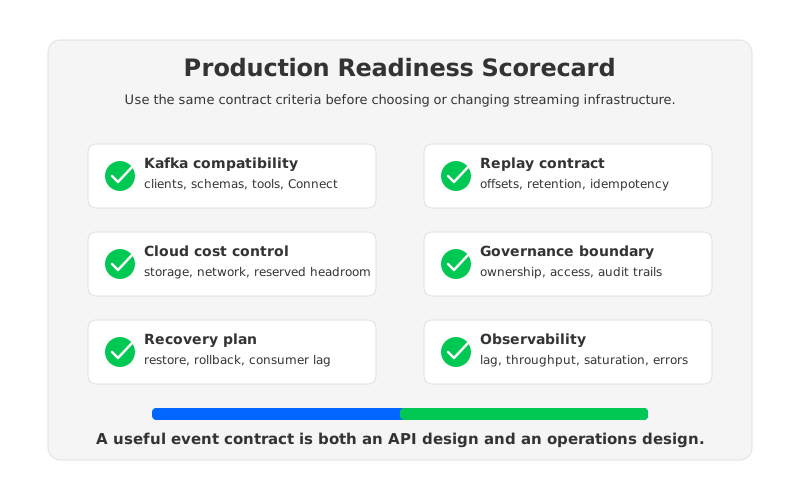
From there, platform teams can translate contract requirements into infrastructure checks. Kafka compatibility should include clients, authentication patterns, monitoring tools, Kafka Connect usage, schema tooling, and operational scripts. Replay readiness should include retention, offset reset procedures, lag alerting, and a tested process for rebuilding derived state. Governance should clarify topic ownership, schema ownership, access control, audit trails, and who approves new consumers.
Recovery checks expose weak contracts quickly. A replayable backend should have a documented answer for four scenarios: a consumer deploys bad code and needs to rewind; a new consumer bootstraps from historical events; a broker fails during a traffic spike; and a schema migration runs while old consumers still exist. If the answer depends on undocumented tribal knowledge, the contract is not production-ready yet.
Observability closes the loop. API owners should not need to become storage engineers to know whether consumers are healthy, but they do need clear signals: lag, throughput, error rate, partition skew, request latency, and saturation. A streaming contract that cannot be observed will eventually become a blame boundary.
5How AutoMQ Changes the Operating Model
Once the evaluation framework is clear, AutoMQ fits into a specific architectural category: it is a Kafka-compatible, cloud-native streaming platform that uses a shared storage architecture to reduce the operational coupling between brokers and durable log data. The important point is that the backend contract can stay centered on Kafka semantics while the platform team changes how storage durability, broker replacement, and elasticity are operated.
AutoMQ's documentation describes compatibility with Apache Kafka and an architecture built around compute-storage separation. For event-driven API backends, existing Kafka clients and ecosystem expectations can remain central to the contract discussion while platform teams evaluate a different infrastructure shape underneath. Object-storage-backed durability changes the capacity question from "Which broker owns these segments?" to "How do we size durable storage, write-ahead logging, and read paths for this workload?"
This distinction matters during replay. A replay storm is both a consumer behavior and an infrastructure event. If several teams rebuild state at the same time, the platform has to serve old data without destabilizing current API writes. A shared storage model gives operators a different set of levers because storage capacity and broker compute are not fused in the same way. Teams still need to test throughput, latency, and failure modes for their workload, but the operating question becomes more precise.
AutoMQ also supports deployment models that keep infrastructure under customer-controlled cloud boundaries, which matters for regulated or platform-owned environments. Event-driven API backends often carry sensitive business facts. Access control, auditability, private networking, and data location need to be part of the streaming platform review.
The natural adoption path is not a big-bang rewrite. Choose one event contract with real replay pressure, define its current pain in operational terms, and run a compatibility and recovery test. Keep the application contract stable. Validate client behavior, offsets, retention, consumer lag, rollback, and observability before extending the model to more API domains.
6Migration and Readiness Scorecard
A useful migration plan treats the event contract as the asset being protected. The platform may change, but producers and consumers should not lose their ability to reason about order, replay, schema, and progress. Start with an inventory of topics, owners, retention requirements, consumer groups, schema dependencies, peak traffic patterns, and recovery procedures. This inventory usually reveals which streams are safe to move early and which ones need more design work.
The second milestone is a replay drill. Pick a consumer, reset it in a controlled environment, and measure whether it can rebuild state from the retained log while normal write traffic continues. This exposes hidden assumptions about idempotency, ordering, throttling, and downstream databases.
The third milestone is a rollback plan. Event-driven systems can fail in subtle ways because consumers may process some events before an issue is detected. Rollback must define producer behavior, consumer offset handling, schema compatibility, and duplicate side-effect prevention. Kafka gives teams the offset and transaction primitives to design these controls, but the application still needs explicit rules.
For teams evaluating AutoMQ, the scorecard should include the usual Kafka checks plus architecture-specific questions: how compute and storage scale independently, how write-ahead logging is configured, how object storage is secured, how cross-availability-zone traffic is handled, and how observability maps to existing SRE dashboards. These are not marketing details. They decide whether the backend contract becomes easier to operate after migration.
The original search query, event driven api backend kafka, sounds like an application architecture question. In production it becomes a platform contract question. The useful design is the one that lets an API publish durable facts, lets consumers recover without panic, and lets operators scale the log without weakening the contract.
If that is the contract you are trying to build, review AutoMQ's Kafka-compatible cloud-native architecture and test it against one real replay-heavy backend path. A focused demo is the fastest way to find out whether the operating model matches your API platform constraints: request an AutoMQ demo.
7References
- Apache Kafka documentation: https://kafka.apache.org/documentation/
- Apache Kafka consumer configuration: https://kafka.apache.org/documentation/#consumerconfigs
- Apache Kafka message delivery semantics: https://kafka.apache.org/documentation/#semantics
- AWS Availability Zones documentation: https://docs.aws.amazon.com/whitepapers/latest/aws-fault-isolation-boundaries/availability-zones.html
- AWS S3 data durability documentation: https://docs.aws.amazon.com/AmazonS3/latest/userguide/DataDurability.html
- AutoMQ architecture overview: https://docs.automq.com/automq/architecture/overview?utm_source=blog&utm_medium=reference&utm_campaign=rpb-0153
- AutoMQ compatibility with Apache Kafka: https://docs.automq.com/automq/what-is-automq/compatibility-with-apache-kafka?utm_source=blog&utm_medium=reference&utm_campaign=rpb-0153
- AutoMQ and Apache Kafka differences: https://docs.automq.com/automq/what-is-automq/difference-with-apache-kafka?utm_source=blog&utm_medium=reference&utm_campaign=rpb-0153
8FAQ
Is Kafka required for every event-driven API backend?
No. Kafka is most useful when the backend needs durable streams, independent consumers, replay, high fan-out, and visibility into consumer progress. A queue can be enough for short-lived jobs or single-consumer workflows.
What makes a streaming contract different from an event schema?
A schema defines event shape. A streaming contract also defines keying, ordering scope, retention, replay expectations, consumer ownership, offset handling, and operational responsibilities.
How long should API event retention be?
Base retention on recovery needs: consumer outage tolerance, bad-release detection time, and whether teams rebuild derived state or machine learning features from historical events.
Where does AutoMQ fit in an event-driven API architecture?
AutoMQ fits where teams want Kafka compatibility but prefer a cloud-native shared storage operating model for replay windows, elastic traffic, broker recovery, storage growth, or cloud cost control.
What should teams test before migrating an API event stream?
Test client compatibility, producer behavior, consumer offsets, schema evolution, replay throughput, rollback, lag monitoring, and security boundaries. Preserving the event contract matters more than proving messages can move clusters.


