
Table of Contents
Table of Contents
Teams search for event native audit logs when ordinary audit trails stop matching how their systems actually work. A user changes a payment limit, an operator updates an access policy, an AI workflow reads regulated context, and an incident team later needs to reconstruct the chain of decisions. The old pattern is to write application logs, collect service logs, export cloud logs, and hope a SIEM can stitch the story together after the fact. That works until the evidence is fragmented across systems with different clocks, retention periods, identities, and replay behavior.
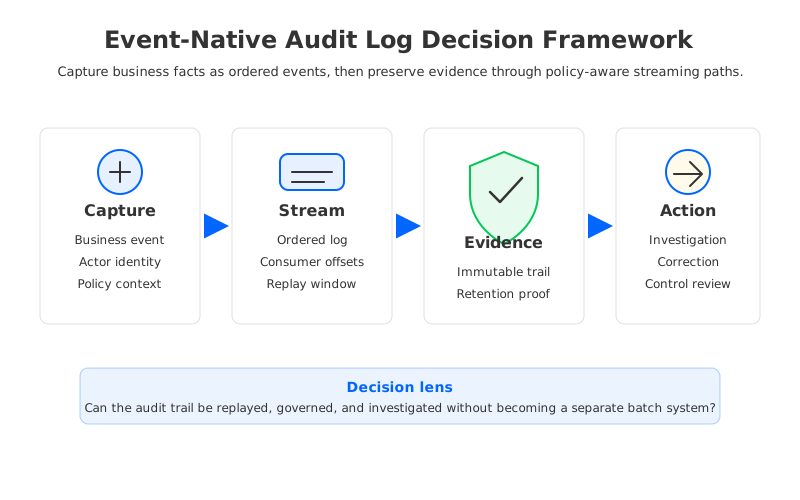
An event-native audit log treats audit evidence as part of the streaming architecture itself. The audit record is not a side file emitted after the business event. It is an ordered, replayable event with actor identity, policy context, payload classification, and downstream processing evidence attached to the same platform contract that carries operational data. For regulated streaming platforms, that shift changes the question from "do we have logs?" to "can we prove what happened while the system was moving?"
1Why event native audit logs matters now
Audit requirements used to be dominated by administrative actions: who changed a configuration, who created an account, who deleted a record. Those actions still matter, but streaming systems expanded the evidence surface. A regulated data platform may need to show which identity produced an event, which consumer group read it, which schema version applied, which policy allowed the read, which processor transformed it, and which downstream system received the derived result.
Kafka-compatible platforms are attractive for this work because they already expose durable logs, topics, partitions, offsets, consumer groups, timestamps, and replay. Those concepts map naturally to evidence. If an investigation needs to revisit a time range, offsets provide a concrete position. If a derived decision is wrong, replay can reconstruct the input stream. If a consumer was unauthorized, the platform can reason about identity and access around the same data flow.
The risk is assuming that Kafka's log abstraction automatically creates a compliance-grade audit trail. It does not. Kafka gives the platform a durable event backbone, but auditability depends on design choices around schema, identity, retention, authorization, storage, observability, and operational change control. A valid record can still be missing the actor context reviewers need. A retained topic can still be too costly to replay during an investigation. A consumer group offset can still be difficult to connect to the human or machine identity behind it.
2The production constraints behind the search
Event-native audit logs create pressure in places that look unrelated in a prototype. The data model looks easy: define an audit event, publish it to a topic, retain it, and let security tools consume it. Production makes the design less tidy because audit events are not passive records. They are evidence that must survive failures, migrations, policy changes, and incident response.
The first constraint is identity continuity. Producers, consumers, connectors, stream processors, administrators, and support operators should act through principals that can be reviewed later. Shared credentials weaken the entire model because the audit log can describe an action without proving who or what performed it.
The second constraint is retention without operational distortion. Regulated evidence often needs longer retention than ordinary operational streams. If that retention lives entirely on broker-local disks, audit policy turns into broker capacity planning. Teams either overprovision storage for evidence or narrow retention until the audit trail becomes less useful.
The third constraint is replay under control. Replaying an audit stream can be necessary during an investigation, a policy review, a migration, or a downstream correction. Replay is also sensitive because it can re-expose old data to current systems. A production design needs approval paths, throttling, isolation, and observability around replay rather than treating it as a normal consumer restart.
These constraints meet in one practical question:
Can the platform retain, replay, and explain audit evidence without creating a second batch system beside the streaming platform?
When the answer is no, teams often end up with duplicated evidence: Kafka topics for runtime processing, object storage files for archival retention, SIEM indexes for investigation, data warehouse tables for reporting, and tickets for approvals. Each copy may be useful, but every copy creates a reconciliation problem. Event-native audit logs try to keep the evidence path closer to the event path while still exporting to the systems that security teams already use.
3Architecture patterns teams usually compare
The baseline pattern is the traditional Kafka Shared Nothing architecture. Brokers own local log storage, partitions are replicated across brokers, and durability depends on in-sync replicas. This model is proven and operationally familiar. It also means retention, partition growth, reassignment, recovery, and catch-up reads are tied closely to the broker fleet. For audit-heavy workloads, that coupling becomes visible because the workload is retention-rich and replay-sensitive.
Tiered storage is often the next pattern in the discussion. Apache Kafka Tiered Storage, introduced through KIP-405, moves older log segments to remote storage while preserving Kafka's log model. That can improve long-retention economics and reduce pressure on local disks. It is especially useful when most audit reads are cold and infrequent. The trade-off is that the hot path, broker ownership model, and operational behavior still need workload-specific testing. Tiered storage extends the traditional model; it does not make the broker fleet stateless by itself.
A third pattern is Kafka-compatible Shared Storage architecture. In this model, brokers continue to serve Kafka protocol traffic, but durable stream data is placed in shared storage rather than being permanently bound to broker-local disks. The platform still needs a low-latency write path, cache behavior, metadata management, and failure recovery. The difference is ownership: durable audit history can be governed as shared storage while brokers scale and recover more like compute.
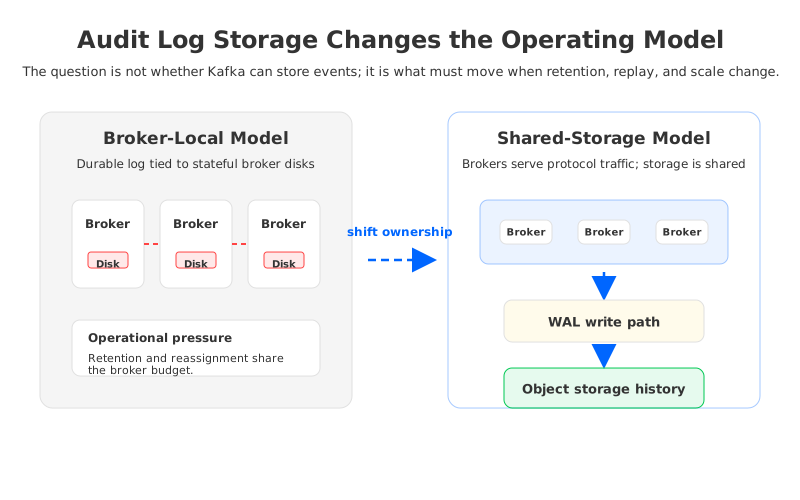
That distinction matters for audit logs because evidence has a different workload shape from many application topics. It is often write-heavy during normal operation, read-light during calm periods, and read-intensive during investigations or migrations. A platform that handles this shape well should let tail traffic, historical replay, and broker scaling coexist without turning every audit review into a storage emergency.
4Evaluation checklist for platform teams
Before selecting tooling, choose one real audit path and walk it end to end. A generic "user action" event is too easy. Pick a stream that includes sensitive data, multiple actors, policy decisions, and a downstream system that must prove why it acted. The design should answer how the event is captured, how it is governed, how it is replayed, and how it is exported for investigation.
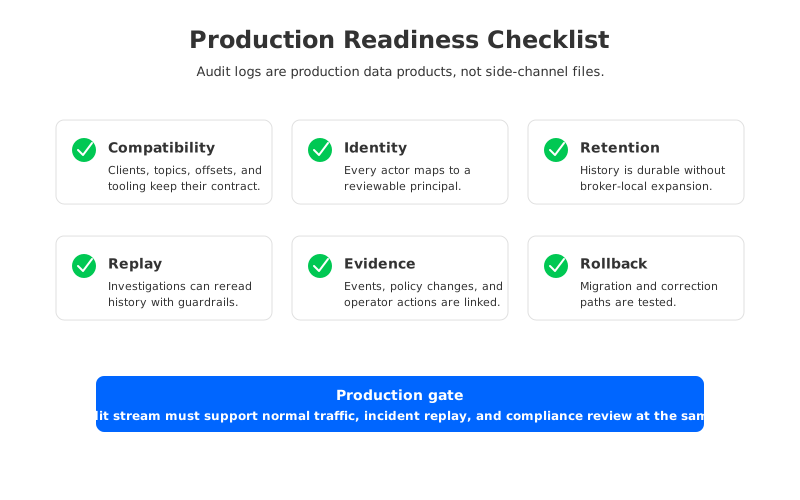
Use the following checklist as a production gate:
| Evaluation area | What to verify |
|---|---|
| Event model | Audit events include actor, action, target, timestamp, source system, policy context, schema version, and correlation identifiers. |
| Identity | Producers, consumers, connectors, processors, operators, and automation use reviewable identities rather than shared credentials. |
| Retention | Retention periods match policy needs without making broker-local storage the limiting factor. |
| Replay | Historical reads have approval, throttling, isolation, and rollback expectations. |
| Evidence export | SIEM, lakehouse, and incident tools receive evidence without becoming the sole source of truth. |
| Migration | Topic configs, ACLs, schemas, offsets, dashboards, and audit exports have a cutover and rollback plan. |
The checklist is deliberately broader than audit event schema. A schema tells reviewers what the event means. It does not prove that the event was retained, that the right identity consumed it, that replay was controlled, or that a migration preserved evidence. Those properties belong to the streaming platform and the operating model around it.
5Where AutoMQ changes the operating model
After the evaluation separates evidence requirements from ordinary logging, AutoMQ becomes relevant as a Kafka-compatible, cloud-native streaming platform built around Shared Storage architecture. AutoMQ keeps Kafka protocol compatibility for producers, consumers, and ecosystem tools while using S3-compatible object storage as the durable storage layer through S3Stream. WAL storage provides the low-latency persistence path before data is uploaded to object storage, and brokers are designed to be stateless.
For event-native audit logs, the important point is not that storage alone creates compliance. It does not. Teams still need schema governance, identity providers, authorization rules, security monitoring, incident process, and export paths into their evidence systems. The architectural change is that durable event history is no longer owned primarily by broker-local disks. That can make long retention, broker replacement, scaling, and replay-heavy investigations easier to reason about as separate concerns.
The deployment boundary also matters. In AutoMQ BYOC, platform components run in the customer's cloud account and VPC, so Kafka data paths, object storage policies, encryption controls, private networking, and cloud audit evidence can align with the customer's existing governance model. AutoMQ Software addresses private deployment scenarios where both control and data boundaries must remain in a customer-operated environment. For regulated teams, those boundaries are not procurement details; they are part of the evidence package.
The cleanest way to evaluate AutoMQ is to test it against the same audit-log checklist applied to any Kafka-compatible candidate. Validate client behavior, topic configuration, offsets, authentication, authorization, retention, replay, observability, migration, and rollback. A shared-storage architecture changes the storage and elasticity assumptions, but production trust still comes from evidence gathered under the workload that will run in production.
6Decision table for regulated audit streams
Different teams will land on different answers. A self-managed Kafka cluster may be right when the team already has mature operations, moderate retention, and limited replay pressure. Tiered storage may be right when the main problem is cold history cost. A shared-storage Kafka-compatible platform becomes more interesting when the audit stream is long-retention, replay-heavy, cloud-governed, and sensitive to broker operational churn.
| Situation | Likely direction |
|---|---|
| Audit events are short-retention and mostly used for debugging | Improve schema, identity, and export discipline on the existing platform. |
| Retention is long but replay is rare and controlled | Evaluate tiered storage and object-storage archival paths. |
| Investigations require frequent historical replay beside live traffic | Test a shared-storage Kafka-compatible architecture. |
| Security review requires customer-account storage and cloud-native evidence | Include BYOC or private deployment boundaries in the platform evaluation. |
| Migration risk is high because many applications already use Kafka APIs | Prioritize protocol compatibility, offset planning, ACL mapping, and rollback proof. |
Event-native audit logs are useful because they keep evidence close to the systems that produce operational truth. They are risky when teams treat that closeness as automatic compliance. The platform has to preserve the Kafka contract, attach identity and policy context, retain history at the right cost profile, and make replay a governed workflow.
If your audit trail is becoming a collection of after-the-fact exports, model one regulated stream as an event-native audit path and test it under failure, replay, and migration conditions. For teams evaluating Kafka-compatible shared storage as part of that design, the next practical step is to compare the operating model against your own retention and evidence requirements: review AutoMQ for regulated streaming workloads.
7References
- Apache Kafka Documentation: https://kafka.apache.org/documentation/
- Apache Kafka Tiered Storage: https://kafka.apache.org/39/operations/tiered-storage/
- Apache Kafka KIP-405: https://cwiki.apache.org/confluence/display/KAFKA/KIP-405%3A+Kafka+Tiered+Storage
- AWS CloudTrail User Guide: https://docs.aws.amazon.com/awscloudtrail/latest/userguide/cloudtrail-user-guide.html
- AutoMQ Docs, Architecture Overview: https://docs.automq.com/automq/architecture/overview?utm_source=blog&utm_medium=reference&utm_campaign=event-native-audit-logs-regulated-streaming-platforms
- AutoMQ Docs, S3Stream Shared Streaming Storage: https://docs.automq.com/automq/architecture/s3stream-shared-streaming-storage/overview?utm_source=blog&utm_medium=reference&utm_campaign=event-native-audit-logs-regulated-streaming-platforms
- AutoMQ Docs, Compatibility with Apache Kafka: https://docs.automq.com/automq/what-is-automq/compatibility-with-apache-kafka?utm_source=blog&utm_medium=reference&utm_campaign=event-native-audit-logs-regulated-streaming-platforms
- AutoMQ Cloud Overview: https://docs.automq.com/automq-cloud/overview/what-is-automq-cloud?utm_source=blog&utm_medium=reference&utm_campaign=event-native-audit-logs-regulated-streaming-platforms
8FAQ
8.1What are event native audit logs?
Event native audit logs are audit records modeled as ordered, replayable events rather than side-channel log files. They carry actor identity, action context, policy metadata, timestamps, schema information, and correlation identifiers through the streaming platform so investigations can connect evidence to the operational data flow.
8.2Is Kafka enough for compliance-grade audit logging?
Kafka provides useful foundations such as durable topics, partitions, offsets, consumer groups, timestamps, and replay. Compliance-grade audit logging also needs schema governance, identity, authorization, retention policy, evidence export, operational controls, and documented procedures for replay and migration.
8.3How do event-native audit logs differ from application logs?
Application logs usually describe what a service observed from its own point of view. Event-native audit logs are designed as shared evidence records with stable schemas, governed retention, replay expectations, and platform-level identity context. Most regulated architectures still export both into security tools, but they should not be treated as the same artifact.
8.4When should teams evaluate shared-storage Kafka architecture for audit logs?
Evaluate shared-storage Kafka architecture when audit streams require long retention, frequent historical replay, customer-controlled cloud boundaries, and elastic broker operations. The architecture is most relevant when broker-local storage is becoming a constraint on evidence retention or investigation workflows.
8.5Where does AutoMQ fit in an audit-log architecture?
AutoMQ fits as a Kafka-compatible shared-storage streaming platform. It can preserve Kafka client and ecosystem behavior while moving durable stream storage to S3-compatible object storage with WAL-backed writes and stateless brokers. Teams should still validate governance, security, observability, and migration behavior against their own regulated workload.


