
Table of Contents
Table of Contents
Every serious stream processing change eventually asks the same uncomfortable question: what happens when the changed logic meets yesterday's production events? Unit tests answer whether a function behaves against selected inputs. Staging tests answer whether services can talk to each other. Event replay testing answers a different question: whether the pipeline still behaves when it is forced to process the messy, ordered, skewed, delayed, duplicated, schema-evolving event history that production already created.
That is why teams search for event replay testing kafka after they have felt the limits of lighter test layers. The change might be a Flink job refactor, a Spark Structured Streaming upgrade, a fraud rule update, a CDC schema evolution, or a migration to a Kafka-compatible platform. The risk is not that the code fails to start. The risk is that a replay exposes a bad assumption about offsets, event time, compaction, transactional writes, side effects, or downstream idempotency after deployment.
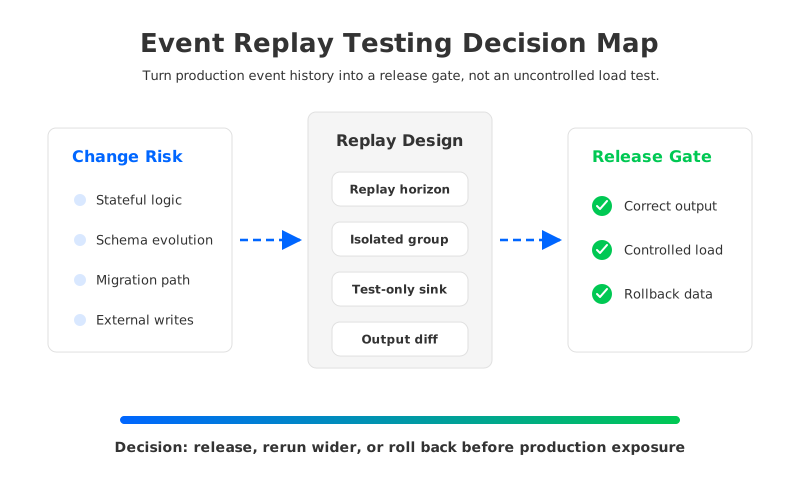
Kafka is a natural foundation because it stores ordered event logs and lets different consumers read the same topics at different positions. That does not make replay testing automatic. A production-grade replay still has to protect shared clusters, isolate consumer groups, control side effects, preserve governance boundaries, and keep enough retained history available for the test window. The architecture under Kafka matters as much as the application code above it.
1Why teams search for event replay testing kafka
Replay testing is most valuable when the logic being changed is stateful. Stateless transformations can often be validated with fixtures and contract tests. Stateful stream processors accumulate windows, joins, deduplication tables, materialized views, fraud scores, feature vectors, or enrichment caches. A small difference in event ordering or offset commit behavior can produce a large difference in output after a long replay, even when each individual record looks valid.
The high-risk cases tend to share a pattern:
- The pipeline uses event time and late-arriving records, so correctness depends on watermark and window behavior rather than arrival order alone.
- The processor writes to an external system, so replay can accidentally create duplicate payments, alerts, tickets, notifications, or database updates.
- The job stores offsets outside Kafka, such as in a stream processing checkpoint, and the replay boundary has to align Kafka position with processing state.
- The input topic has compacted records, tombstones, schema changes, or retention gaps, so the replayed history may not equal the original write stream.
- The platform team is changing brokers, storage, networking, or deployment topology, and wants to separate infrastructure risk from application risk.
These are not edge cases. They are the normal shape of production streaming once Kafka becomes the backbone for operational systems. Replay is useful because it exercises old events through changed code without pretending production traffic is tidy.
2The production constraint behind the problem
A replay test needs three things at the same time: enough historical data, enough isolated compute, and enough operational control to keep the test from disturbing live consumers. Traditional Kafka deployments can provide all three, but the cost and operational friction rise quickly because brokers own both compute and local persistent storage. The moment replay becomes heavy, the cluster has to serve ordinary traffic and historical reads from the same broker-local data layout.
That coupling shows up in several ways. Long retention increases disk requirements even before a replay starts. A burst of replay consumers can compete with live consumers for broker network and page cache. If the platform team adds brokers to create headroom, partitions may need reassignment before the extra capacity is useful. In multi-Availability Zone deployments, replication and client traffic can also become a material part of the cloud bill, especially when tests read large volumes across zones.
The hardest part is that replay testing is intermittent. Teams do not run full replays every minute of the day. They run them before major releases, during incident analysis, after schema changes, and around migration rehearsals. A platform that has to reserve local disk and broker capacity for those peaks can leave infrastructure idle between tests. A platform that does not reserve capacity risks turning a validation run into a production stability event.
That is the real architecture question behind event replay testing: can the streaming platform make historical reads, temporary consumers, and isolated validation capacity feel routine, or does every replay become a capacity planning meeting?
3Architecture options and trade-offs
Most teams choose one of three patterns. None is universally wrong. The useful comparison is about where each pattern puts pressure: on application code, on Kafka operations, or on infrastructure cost.
| Replay pattern | How it works | Strength | Operational risk |
|---|---|---|---|
| Consumer group rewind | Run the changed processor with a separate group ID or reset offsets for a controlled group. | Close to real Kafka semantics and straightforward to compare against committed offsets. | Side effects must be isolated, and heavy reads share broker resources with live traffic. |
| Topic copy or shadow topic | Copy selected production records into a test topic and run processors against that copy. | Strong isolation from production consumers and clearer test ownership. | Copying can lose context, cost storage, and drift from the original partitioning or timestamps if handled poorly. |
| Dual-run comparison | Run old and changed logic in parallel, then compare outputs before switching. | Strong signal for behavioral differences before release. | Requires output diffing, state management, and careful handling of external writes. |
The right answer often combines these patterns. A developer may use a shadow topic, a platform team may run a controlled consumer group replay before a release, and an SRE team may use dual-run comparison during migration. The shared requirement is a clean boundary between test reads and production side effects.
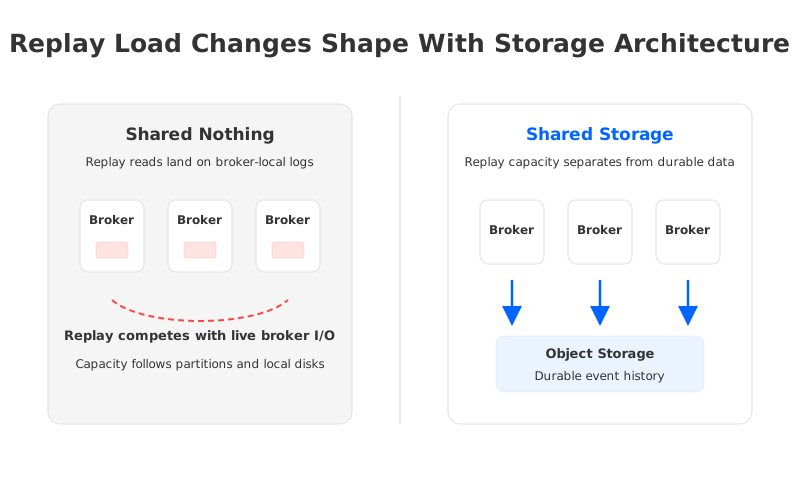
Storage architecture changes that boundary. In a shared-nothing Kafka layout, each broker owns local log segments and replicas. Historical reads are served by the brokers that own those partitions, and broker capacity is tied to stored data placement. Tiered Storage can offload older data, which helps retention economics, but the broker still participates in the active serving path and local storage remains part of the operating model. Replay is possible, yet capacity planning is still attached to broker-local responsibilities.
A shared-storage architecture starts from a different premise. Durable log data lives in object storage, while brokers focus on protocol handling, caching, networking, and coordination. The practical effect is that replay pressure can be treated more like temporary compute demand and less like a reason to reshape local disks. That does not remove the need to design test isolation, but it changes the blast radius of running the test.
4Evaluation checklist for platform teams
Replay testing should not start with a command. It should start with a release boundary. The team needs to know what outcome would block a release, what output will be compared, which side effects are disabled, which offsets are safe to move, and how far back the input history must go. Without that boundary, a replay becomes an expensive way to rediscover that the system has no definition of correctness.
Use this checklist before choosing the mechanics:
- Define the replay horizon. Pick the timestamp, offset range, or business interval that represents the risk being tested.
- Isolate consumer identity. Use a dedicated group ID or an explicit offset reset plan so production committed offsets are never part of the experiment.
- Freeze side effects. Route external writes to a test sink, a dead-letter topic, a comparison table, or a disabled adapter.
- Preserve event semantics. Keep partition keys, timestamps, headers, schema IDs, tombstones, and transaction visibility aligned with production expectations.
- Measure both correctness and load. A replay that proves logic but saturates broker I/O is still telling the platform team something important.
- Record rollback inputs. Capture the code version, configuration, offsets, schemas, and checkpoint references required to rerun or invalidate the test.
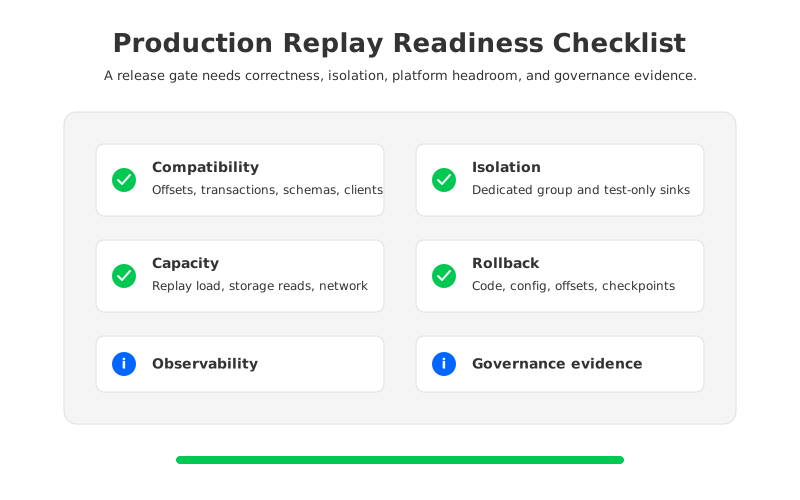
This checklist also exposes a governance issue. Historical events often contain regulated or customer-sensitive data. A replay environment that feels like "test" may still be processing production data. Access controls, audit trails, encryption boundaries, masking policies, and retention rules should follow the data, not the label on the cluster. For platform teams serving multiple business units, this is where event replay testing crosses from developer workflow into data governance.
5How AutoMQ changes the operating model
If the root problem is the coupling of broker compute, local storage, and replay peaks, the architectural requirement becomes clearer: keep Kafka protocol behavior familiar while making storage and compute scale along separate axes. AutoMQ is a Kafka-compatible streaming system built around shared storage, stateless brokers, and object-storage-backed durability. That places it in the category of platforms designed to keep Kafka APIs and ecosystem behavior while changing the infrastructure model underneath.
For replay testing, the important point is not a marketing claim about test speed. The important point is operational shape. When brokers are stateless and durable data is offloaded to shared object storage, platform teams can reason about replay capacity as a temporary serving and caching problem instead of a broker-local disk ownership problem. Retained history can live in the storage layer, while broker capacity can scale around workload pressure.
That changes several day-to-day decisions:
- Longer replay horizons become easier to consider because retention is less tightly bound to broker-local disks.
- Temporary validation capacity can be added without waiting for large data movement across brokers.
- Multi-AZ deployments can reduce unnecessary replica traffic when the architecture avoids broker-to-broker replication for durability paths.
- Migration rehearsals can focus more on application compatibility, offsets, and output comparison rather than on whether the test cluster was sized for a rare peak.
AutoMQ still requires disciplined replay design. A bad test that writes duplicate records to a payment service is still a bad test. A consumer group reset without an owner is still dangerous. The architectural difference is that the platform has fewer reasons to discourage serious replay testing because of storage coupling.
6A practical replay workflow
Start with a narrow replay that proves the harness before testing the business change. Pick one topic, one consumer group, one output sink, and one comparison rule. The first run is not about finding every bug; it is about proving that offsets, schemas, state, and output capture are wired correctly. When that works, expand the window and add the topics that carry the highest business risk.
A mature workflow usually looks like this:
- Capture the release hypothesis: which logic changed, and what output should remain equivalent or intentionally differ.
- Select the replay range using offsets or timestamps, then record the exact mapping by topic and partition.
- Start the changed processor with isolated identity and test-only sinks.
- Compare outputs against a baseline using deterministic keys, watermarks, and acceptable tolerance rules.
- Observe broker load, consumer lag, storage reads, checkpoint behavior, and downstream write rates during the replay.
- Decide whether to release, rerun with a wider range, or roll the change back before production traffic sees it.
The comparison step deserves more attention than it usually gets. "No exceptions in logs" is not a correctness signal. A replay test should produce artifacts: counts by key range, late-event behavior, rejected records, output diffs, state size, and records that changed classification. Those artifacts turn a replay from an act of faith into a release gate.
7What to measure during replay
The most useful replay metrics connect correctness to infrastructure pressure. Application teams care whether outputs match. Platform teams care whether replay steals capacity from live workloads. Leadership cares whether the release process reduces risk without creating a standing infrastructure tax.
Track these signals together:
- Input coverage: topics, partitions, offset ranges, timestamps, schemas, and retained history gaps.
- Processing behavior: throughput, lag, checkpoint duration, restart behavior, late-event handling, and state growth.
- Output quality: record counts, deduplication results, diff categories, rejected records, and idempotency violations.
- Platform load: broker CPU, network, storage reads, cache hit rate, object storage request patterns, and cross-zone traffic where applicable.
- Governance evidence: who ran the replay, which data was processed, and when test artifacts expire.
The goal is not to collect every possible metric. It is to make a release decision defensible. When a replay fails, the team should know whether the failure belongs to application logic, harness design, platform capacity, or data governance.
8Closing the loop
Event replay testing does not replace unit tests, integration tests, or canary deployments. It fills the gap between synthetic confidence and production exposure. For Kafka-based systems, that gap is where many stream processing failures live: offsets, ordering, state, retention, side effects, and operational load all interact there.
If your team is using replay tests to evaluate a Kafka migration or to make stream processing releases more repeatable, the infrastructure beneath Kafka should be part of the test design. AutoMQ's shared-storage architecture is worth evaluating when replay peaks, retention needs, and cloud operating cost become release constraints. Start with the AutoMQ architecture overview and map these ideas to your replay workflow.
9References
- Apache Kafka Documentation
- Apache Kafka Design: Using Transactions
- Apache Kafka Kafka Connect
- AutoMQ Architecture Overview
- AutoMQ WAL Storage
- AutoMQ Technical Advantage
- AutoMQ Eliminate Inter-Zone Traffics Overview
10FAQ
10.1What is event replay testing in Kafka?
Event replay testing runs historical Kafka events through changed stream processing logic or a changed platform path to validate behavior before production exposure. It is most useful where real event ordering and retained history matter.
10.2Should I replay production topics directly or copy records to test topics?
Use direct replay with isolated consumer identity when you need the closest match to production Kafka semantics. Use copied or shadow topics when side-effect isolation, governance, or test ownership matters more than perfect fidelity.
10.3How do I avoid duplicate side effects during replay?
Disable production adapters, write to test sinks, use idempotency keys, and compare outputs before external action is allowed. Consumer group isolation protects offsets, not external systems.
10.4Why does Kafka storage architecture matter for replay tests?
Replay reads historical data at a different shape from live traffic. When brokers own local storage, replay load can compete with production work on the same broker resources. Shared-storage designs separate durable data from broker-local disks, which can make replay capacity easier to reason about.
10.5Where does AutoMQ fit in an event replay testing strategy?
AutoMQ fits when a team wants Kafka-compatible behavior while reducing the operational coupling between retained history, broker-local storage, and temporary replay capacity. It does not remove the need for careful test design, but it can make the platform side of replay testing less dependent on disk-heavy capacity planning.


