
Table of Contents
Table of Contents
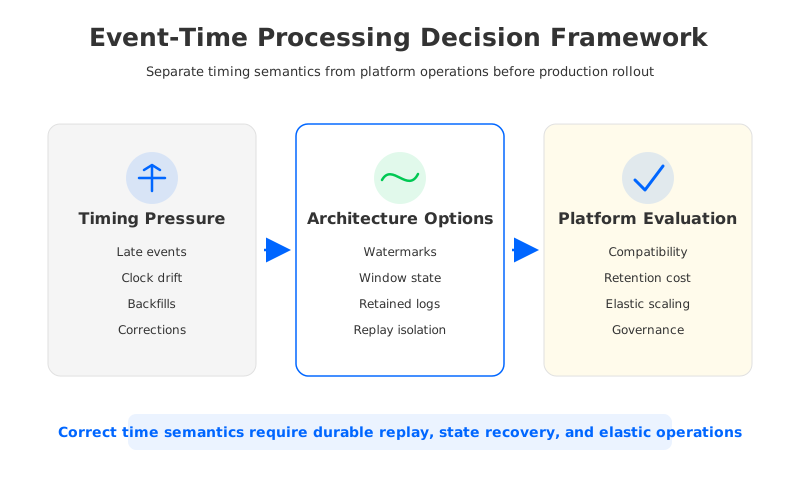
Teams search for event time processing kafka when processing-time dashboards start lying in subtle ways. A payment event arrives late after a network retry and lands in the wrong fraud window. An IoT device buffers readings offline, reconnects, and makes the current anomaly count spike with events that actually happened an hour ago. A customer journey pipeline joins clicks, orders, and support tickets by arrival order, then discovers that the most important signal was not late by seconds; it was late by an entire mobile session.
Kafka can carry all of those events durably, but Kafka alone does not decide what time means. Event-time processing is the discipline of computing by the timestamp embedded in the event, rather than by the time a broker receives it or a processor reads it. The production question is bigger than a timestamp field. Platform teams have to decide how much disorder to tolerate, how long to wait for late data, how to replay corrections, and whether the underlying Kafka-compatible architecture can absorb the storage, scaling, and recovery patterns that event-time workloads create.
1Why event time processing kafka matters now
The gap between event time and processing time used to be a specialist concern for stream processing teams. It is now visible to product teams because real-time systems drive customer-facing decisions, machine learning features, fraud checks, compliance evidence, and operational automation. When the time basis is wrong, the output may still look precise. That is the dangerous part: the chart has a number, the model has a feature, the alert has a threshold, but the system is answering the wrong temporal question.
Kafka gives architects a strong foundation because records can carry timestamps, partitions preserve order within a key, consumers track offsets, and retained logs can be replayed. Stream processors such as Kafka Streams and Apache Flink build on that foundation with windowing, state, watermarks, and late-event handling. The hard work starts when the clean model meets production traffic: events arrive out of order, clocks drift, producers change schemas, and backfills run beside live streams.
Three timing concepts need to stay separate:
- Event time is when the business fact occurred, such as when a transaction was authorized or a sensor recorded a temperature. This is the time basis most analytics, feature, and compliance workloads actually care about.
- Ingestion time is when the event reached the streaming platform. It is useful for operational measurement, but it can hide upstream buffering and network delays.
- Processing time is when a stream processor executed the computation. It is the easiest clock to use and the easiest clock to misuse.
If a pipeline computes a five-minute fraud window by processing time, a delayed authorization can be counted in the wrong window. If it computes by event time, the system needs a policy for how long to keep the window open, how to update results when late data arrives, and how to make those updates visible downstream. That policy is not only a stream processor configuration. It also depends on the durability and replay behavior of the Kafka layer underneath it.
2The production constraints behind event-time correctness
Event-time processing is often described as a logical problem: assign timestamps, define windows, emit watermarks, handle late events. That description is correct but incomplete. The moment a team has to recover from a missed source connector, rebuild a state store, or replay a week of corrected events, event-time correctness becomes an infrastructure problem as well.
The pressure points are easy to miss in a prototype:
| Constraint | Why it matters for event-time workloads | What platform teams should test |
|---|---|---|
| Disorder tolerance | Real sources rarely arrive in perfect event order. | Watermark strategy, allowed lateness, and late-result updates. |
| Retention | Replays and corrections need the original event log. | Storage cost, catch-up read performance, and compaction policy. |
| State growth | Windows and joins keep state open while waiting for late data. | State backend sizing, checkpoint behavior, and recovery time. |
| Backfills | Historical reprocessing can compete with live traffic. | Consumer isolation, throttling, and broker read capacity. |
| Governance | Correcting time semantics may expose lineage and deletion needs. | Audit trail, schema evolution, access control, and data residency. |
The table also shows why event-time processing cannot be evaluated only inside the stream processor. A Flink or Kafka Streams job can express windows and watermarks, but the job still reads from topics, tracks offsets, writes intermediate state, and depends on retained data when it reprocesses. If the Kafka cluster treats replay as an exceptional workload, event-time correction becomes operationally expensive. If replay is cost-effective but governance is vague, the architecture may fail the security review before it reaches production.
3Architecture patterns teams usually compare
The classic Kafka architecture is shared-nothing: brokers own local log storage, partitions are replicated across brokers, and durability comes from in-sync replicas. This model is mature, widely understood, and still a sound choice for many workloads. Its friction appears when event-time pipelines need long retention, frequent replay, and elastic read capacity at the same time. More retention means more broker storage. More replicas mean more cross-zone traffic in cloud deployments. Broker changes can trigger partition movement, which is exactly the kind of background work that competes with catch-up reads.
Tiered storage can reduce pressure from older log segments by moving cold data to object storage. That helps retention economics, especially when event-time jobs need a long correction horizon. The distinction is that tiered storage usually keeps the hot path centered on broker-local storage. For workloads that frequently replay recent data, rebuild windows, or run backfills beside live processing, the coupling between broker ownership and log data can still shape operational behavior.
Kafka-compatible Shared Storage architecture takes a different path. Brokers continue to expose Kafka APIs and preserve Kafka semantics, but durable stream data is placed in shared storage rather than being permanently bound to broker-local disks. The broker becomes closer to a stateless protocol and scheduling layer, while the durable data plane lives in object storage with a write-ahead log for low-latency writes. For event-time systems, the practical benefit is not a different definition of time. It is a more elastic place to keep and reread the event history that makes time correction possible.
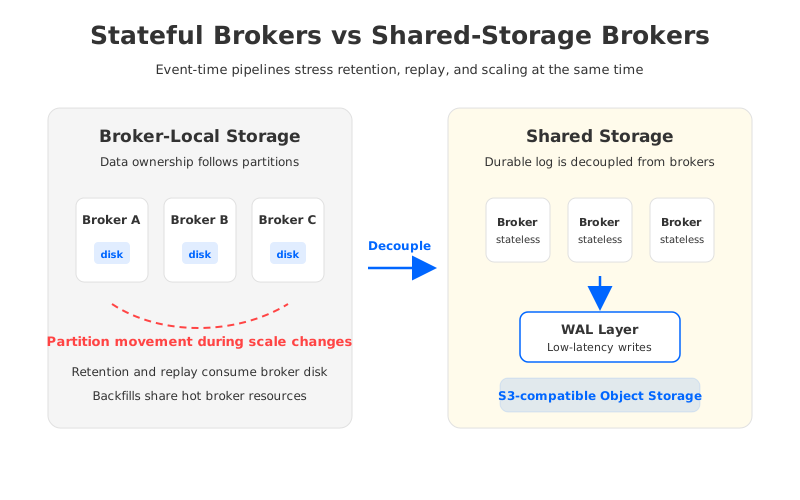
This distinction matters most when teams run mixed workloads. Live consumers need fresh tail reads. Stream processors need stateful window updates. Backfills need sustained historical reads. Auditors may need replayable evidence. A broker-local storage model can support those needs, but it often asks SREs to plan disk, partitions, replicas, and rebalance windows with care. A shared-storage model shifts more of the durability and retention burden to cloud storage, which changes the scaling conversation.
4Evaluation checklist for platform teams
The cleanest way to evaluate event-time architecture is to start from a wrong answer and work backward. Suppose a daily revenue window is wrong because late events arrived after the first result was emitted. Can the pipeline identify which records were late, update the output, and replay the affected period without pausing unrelated workloads? Suppose a source connector dropped messages for 30 minutes. Can the team backfill that gap and keep processing-time lag from masquerading as event-time truth?
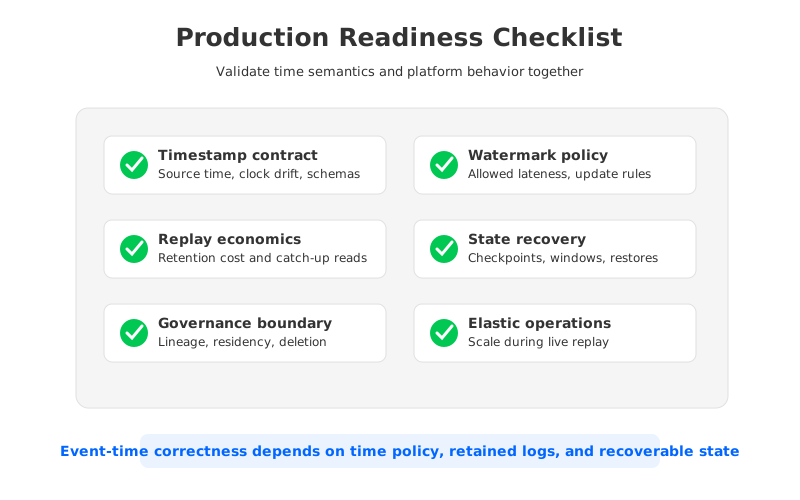
Compatibility comes first. Kafka compatibility should include producer and consumer behavior, record timestamps, topic and partition semantics, offsets, consumer groups, idempotent writes where needed, transactions for exactly-once processing paths, Kafka Connect integrations, and observability conventions. Event-time systems are usually assembled from existing data producers and stream processors. Rewriting the client ecosystem while changing time semantics makes the migration harder than it needs to be.
Next, test replay as a routine operation. Replaying a topic from an old offset should not be treated as an emergency maneuver. It is how teams rebuild windows after a watermark policy change, reprocess events after a schema correction, and validate historical output after fixing a bug. The platform should make retention cost predictable and make catch-up reads observable enough that backfills do not surprise live consumers.
Watermarks and late-event policy deserve their own design review. A tight watermark gives faster results but risks missing late facts. A loose watermark improves correctness but increases state duration and delays final output. There is no universal setting because payment authorization, fleet telemetry, clickstream attribution, and compliance evidence all have different tolerance for lateness. The architecture should let each domain express that policy without forcing every topic into one global compromise.
Finally, include operations in the test. Add brokers or capacity while a backfill runs. Restore a stream processor from checkpointed state. Change a schema with timestamp fields. Run a late-event correction path and inspect downstream idempotency. The result will show whether event-time processing is a first-class platform capability or a fragile job-level trick.
5Where AutoMQ changes the operating model
Once the evaluation frame is clear, AutoMQ becomes relevant as a specific architecture option rather than a generic product claim. AutoMQ is a Kafka-compatible, cloud-native streaming platform that uses S3Stream, a shared streaming storage architecture built on WAL storage and S3-compatible object storage. It keeps the Kafka protocol and ecosystem path familiar while changing how durable stream data is stored and how brokers scale.
For event-time workloads, that storage model maps directly to operational pain points:
- Replay-heavy processing becomes a storage design choice. Event-time corrections, backfills, and window rebuilds depend on retained history. AutoMQ's Shared Storage architecture places durable stream data in S3-compatible object storage, making long retention less tied to broker-local disk expansion.
- Stateless brokers reduce data-movement friction. When brokers do not permanently own local log data, scaling the broker layer is less dominated by partition data copying. That matters when catch-up consumers or historical reprocessing create temporary load.
- Kafka-compatible APIs preserve the application surface. Event-time pipelines often involve Kafka Streams, Flink, Kafka Connect, CDC tools, and existing producers. Keeping Kafka protocol compatibility helps teams change infrastructure without forcing every application team into a different client model.
- Customer-controlled deployment boundaries support governance. AutoMQ BYOC and AutoMQ Software are designed for teams that need control over the cloud account, network, storage, and operational boundary. Event-time systems often touch regulated facts, so deployment control can be part of the architecture decision.
The point is not that every event-time workload requires a platform replacement. If a current Kafka deployment has enough retention, predictable rebalancing, manageable cloud traffic, and a clear replay process, tuning the existing stack may be the right move. AutoMQ becomes more interesting when the same symptoms keep repeating: broker disks sized for rare backfills, rebalances scheduled around business hours, long retention negotiated topic by topic, and late-data corrections treated as special projects.
6Decision table: optimize, redesign, or evaluate AutoMQ
Event-time processing is a correctness problem first, but correctness has a physical footprint. Windows keep state. Watermarks create delay. Replays read history. Corrections produce updates. The right platform decision depends on whether those behaviors are occasional edge cases or the normal operating pattern of the business.
| Situation | Best next move | Why |
|---|---|---|
| One stream processing job with modest lateness and short retention | Optimize the current Kafka and processor configuration. | Focus on timestamp extraction, watermark policy, lag alerts, and output idempotency before changing infrastructure. |
| Several teams need long event-time replay windows | Redesign retention and storage economics. | Broker-local disk can become the limiting factor when history is reread often. |
| Backfills compete with live consumers during business hours | Isolate replay and scale read capacity. | Correctness repairs should not degrade fresh event processing. |
| Kafka clients, connectors, and processors are already embedded | Prefer Kafka-compatible infrastructure changes. | Preserve application contracts while changing the storage and operations layer. |
| Capacity changes trigger heavy partition movement | Evaluate Shared Storage architecture. | Stateless brokers can reduce the operational cost of scaling around replay-heavy workloads. |
The next time a late event makes a supposedly real-time result wrong, resist the temptation to treat it as a narrow job bug. Ask which layer failed the time contract: the source timestamp, the watermark, the retained log, the replay path, the state store, or the broker operating model. If the answer keeps pointing back to storage, scaling, and replay, explore AutoMQ as a Kafka-compatible path toward Shared Storage architecture and more elastic event-time operations.
7References
- Apache Kafka Streams Core Concepts
- Apache Kafka Documentation
- Apache Flink Event Time
- Apache Flink Event Time and Watermarks
- AutoMQ Architecture Overview
- AutoMQ S3Stream: Shared Streaming Storage
8FAQ
8.1Is event-time processing the same as Kafka message ordering?
No. Kafka preserves order within a partition, but that is not the same as global event-time order. If two producers send related events to different partitions, or if a device buffers events before reconnecting, the order in which processors see records may differ from the order in which business facts occurred. Event-time processing uses timestamps, watermarks, state, and late-event policy to compute by business time rather than arrival order.
8.2Should every Kafka pipeline use event time?
No. Operational metrics such as broker request rate or ingestion throughput often make sense in ingestion time or processing time. Event time is most important when the business question depends on when the fact happened: fraud windows, SLA measurement, IoT telemetry, journey attribution, ML features, compliance evidence, and financial aggregation.
8.3How do watermarks relate to Kafka?
Watermarks are usually implemented by stream processors, not by Kafka brokers. Kafka provides the durable records, timestamps, partitions, offsets, and replayable log. Stream processors interpret those records, estimate how complete an event-time window is, and decide when to emit or update results. The Kafka layer still matters because retention, replay, and read scalability determine how practical corrections and backfills are.
8.4When should a team evaluate AutoMQ for event-time workloads?
Evaluate AutoMQ when event-time correctness is repeatedly constrained by Kafka operations: long retention stresses broker disks, backfills compete with live consumers, capacity changes require heavy data movement, or governance requires customer-controlled infrastructure. If the current Kafka deployment already handles those pressures cleanly, start with configuration and process improvements before changing the platform.


