
Table of Contents
Table of Contents
Teams search for failback readiness kafka when the disaster recovery plan has reached the uncomfortable part. Failing over to another region is hard, but it is still a forward motion: declare an incident, protect writes, move clients, recover consumers, and keep the business running. Failback asks a less dramatic but more dangerous question: after the primary region is repaired, can the platform return traffic without corrupting ordering, losing consumer progress, widening cost exposure, or leaving governance controls split across two places?
Kafka makes this question sharper because an event streaming platform is not a stateless API tier. Producers, topics, partitions, offsets, consumer groups, transactions, connectors, schemas, ACLs, quotas, and monitoring all become part of the recovery surface. A team can restore a cluster endpoint and still fail the real test if consumers resume from the wrong point, a connector writes duplicate data, or the network path quietly keeps paying for cross-region movement after the incident is over.
Failback readiness is therefore not a checkbox after failover. It is a production capability that should be designed before the incident. The useful test is whether the organization can explain which region is authoritative, which writes are accepted, which consumers are active, how offsets are preserved or remapped, and what evidence proves that returning to normal will not create a second outage.
1Why teams search for failback readiness kafka
The search usually starts after a successful failover rehearsal exposes a gap. The backup cluster received data, applications could connect, and dashboards showed traffic. Then someone asks how the system returns to the primary region, and the runbook becomes vague. Does the primary region catch up from the secondary? Do producers switch first or consumers? Which cluster owns connector offsets? Can the team roll back the failback if validation fails?
Those questions are not academic. Event streams often sit between systems that disagree about time. A payment service may publish an authorization event in one region while a fraud service consumes derived signals from another. A data lake sink may continue ingesting from the disaster recovery cluster while an analytics job expects the primary cluster to become authoritative again. If the failback sequence treats all consumers as interchangeable, the recovery can preserve infrastructure while damaging business state.
The hard part is that "Kafka is available" is too broad a success condition. Failback requires more specific evidence:
- Write ownership: At any point in the sequence, the platform must define which cluster accepts producer writes for each topic or workload class.
- Read progress: Consumer group offsets, stream processing checkpoints, and connector positions need an explicit continuity plan rather than a hopeful restart.
- Data direction: Replication or synchronization paths must have a clear direction during failover, steady disaster recovery operation, failback, and cleanup.
- Governance parity: ACLs, network controls, encryption settings, audit logs, and retention policy should not drift while traffic runs in the secondary region.
- Cost containment: Cross-region transfer, duplicate capacity, private connectivity, and validation reads should be treated as part of the failback design, not an afterthought.
This is why a failback plan belongs in architecture review, not incident improvisation. The goal is not to make failure pleasant. The goal is to keep recovery from becoming a migration under pressure.
2The production constraint behind failback
Most Kafka disaster recovery discussions begin with replication. That is understandable because records need to exist somewhere else before a region-level event. Replication alone, however, does not define application correctness. A replica can be caught up while consumer ownership, transactional boundaries, connector offsets, schema compatibility, and access controls remain unresolved.
Apache Kafka's consumer group model makes the issue visible. Consumers commit progress as offsets, and those offsets are part of the contract between an application and the log. During a regional failover, consumers may advance on the disaster recovery cluster. During failback, the primary cluster must either receive an equivalent view of that progress or the application must restart from a deliberately chosen point. Neither choice should be hidden inside an operator's memory.
Connectors add another layer. Kafka Connect tasks may store offsets and write to external systems such as databases, object storage, or search indexes. If failback replays a range that the sink has already applied, the correctness question shifts from Kafka to the downstream system. A serious readiness plan classifies which sinks are idempotent, which can deduplicate by key, and which turn a duplicate event into a duplicate action.
Cross-region networking is the quiet constraint behind all of this. A multi-region streaming topology can carry replication traffic, validation reads, monitoring exports, schema registry calls, and client traffic across regions. AWS disaster recovery guidance frames recovery around objectives such as recovery time and recovery point, but streaming platforms also need a cost and ownership objective: how long can dual-region operation run, and who decides when it ends?
3Architecture options and trade-offs
A practical architecture review should separate three patterns that are often mixed together: backup, failover, and failback. Backup protects data for later recovery, failover keeps service running when a region is impaired, and failback returns the system to the preferred operating state. Each pattern needs different evidence.
The first option is active-passive disaster recovery. The primary cluster accepts writes, while a secondary environment receives replicated data and remains ready for promotion. This is straightforward when workloads can tolerate a controlled cutover and measurable lag. Its weakness appears during failback: the secondary cluster may become the source of truth during the incident, so returning to the primary requires reverse synchronization, offset handling, and a clean decision point.
The second option is active-active or multi-site operation. Different regions may accept writes for different workload partitions, tenants, or topic families. This can reduce recovery time, but it raises the bar for conflict control and ownership. Kafka ordering is scoped to partitions, not to a global business process. If the application cannot define which region owns which keys or actions, active-active becomes a correctness problem wrapped in an availability label.
The third option is a cloud-native Kafka-compatible platform with a shared-storage operating model. This does not remove the need for replication design across regions. It changes the local recovery model inside each region. When durable stream data is not tied to broker-local disks, broker replacement, scaling, and post-incident cleanup are less likely to require large partition-log movement inside the cluster.
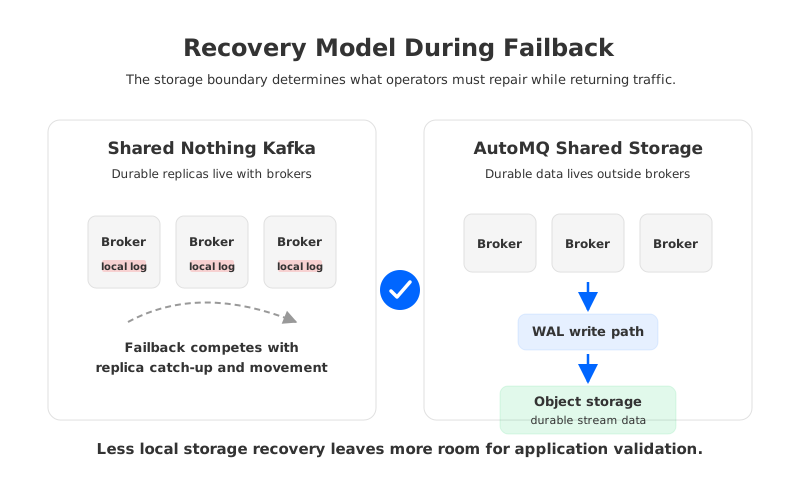
The storage model is especially important during drills. Traditional Kafka's shared-nothing design makes each broker responsible for local partition replicas. This model is mature, but it couples durable data ownership to broker lifecycle. Adding capacity, replacing brokers, and recovering from local disk problems can involve partition reassignment, replica catch-up, and network movement. During regional recovery, those mechanics compete with failback work.
Shared storage moves the boundary. Brokers still handle Kafka protocol processing, leadership, caching, scheduling, and client traffic, but durable log storage is no longer treated as broker-local state. A write-ahead log path protects the write path, while object storage holds the durable stream data. The architecture does not make cross-region recovery automatic. It gives the platform team a less stateful cluster substrate on each side of the regional plan.
4Evaluation checklist for platform teams
Failback readiness should be scored by workload class. A telemetry topic, a payment command topic, a CDC stream, and a data lake sink should not share the same recovery assumptions. The more useful review starts with business consequence, then maps that consequence to Kafka mechanics.
| Readiness area | What to verify | Failure signal |
|---|---|---|
| Write authority | Producers have a documented region and topic ownership rule for every phase | Both regions accept writes for the same keys without conflict control |
| Offset continuity | Consumer groups, stream processors, and connector offsets have a tested resume plan | Consumers restart from default behavior or operator guesswork |
| Replication direction | Data movement direction is explicit during failover, disaster operation, failback, and cleanup | Replication remains bidirectional after the incident without an owner |
| Compatibility | Producer, consumer, transaction, and connector behavior are tested against the target platform | The failback plan depends on application code changes during the incident |
| Governance | ACLs, secrets, network paths, audit logs, and retention policies match the production boundary | The secondary region becomes a weaker control plane |
| Cost control | Duplicate capacity, cross-region transfer, validation reads, and private connectivity are budgeted | The team discovers the recovery bill after traffic is already moving |
| Rollback | The failback sequence has a stop point and a return path | Operators must continue because halfway back is undefined |
This table is deliberately operational. It avoids the false comfort of a single disaster recovery status. A platform can be ready for failover and unready for failback. It can be ready for stateless services and unready for stateful stream processors. It can be ready for data replication and unready for connector side effects.
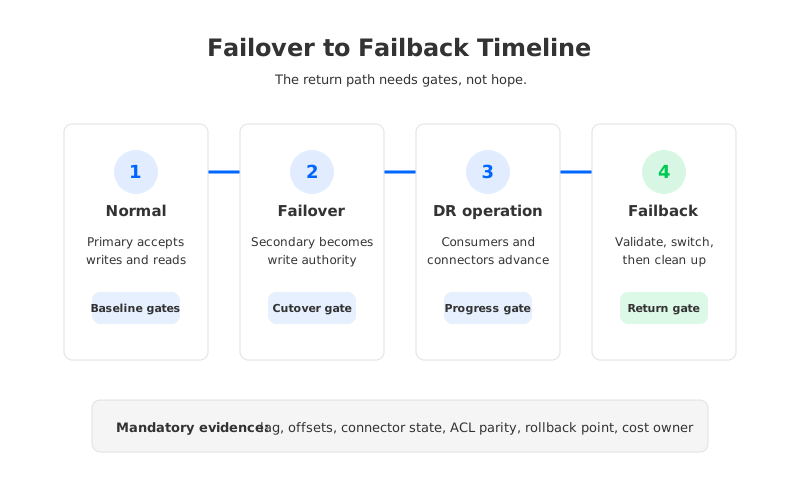
The strongest signal is a rehearsal that includes both directions. Run the forward failover, hold the system in the disaster recovery state long enough for consumers and connectors to advance, then execute failback with validation gates. Measure lag, unavailable partitions, offset continuity, duplicate behavior, access parity, and cleanup time. If a step requires an engineer to infer intent from a dashboard, the runbook is not ready.
5How AutoMQ changes the operating model
After the neutral review, the architectural requirement becomes clearer: the platform needs Kafka-compatible behavior, explicit migration and recovery controls, and a cluster model that does not make every operational change a broker-local storage project. AutoMQ fits this category as a Kafka-compatible cloud-native streaming platform built on a Shared Storage architecture. It keeps the Kafka protocol surface familiar while changing where durable stream data lives.
In AutoMQ, Brokers are designed to be stateless for durable data ownership. The storage layer uses S3Stream with object storage as the durable base, while WAL storage protects the write path. Broker lifecycle actions can focus more on compute, cache, metadata, and scheduling behavior instead of copying retained partition logs between machines.
For failback readiness, that distinction matters in three ways. Regional recovery drills can spend more attention on producer routing, consumer offsets, connector state, and governance parity. Capacity planning can separate retained history from broker disk sizing. Migration workflows can be evaluated against Kafka compatibility and offset continuity without inheriting the same broker-local storage bottleneck.
AutoMQ Kafka Linking is relevant when failback planning overlaps with migration or cluster replacement. The documented migration flow focuses on moving from Apache Kafka or other Kafka distributions to AutoMQ while preserving the Kafka-facing contract, including topic replication and consumer group progress. That does not make it a complete disaster recovery policy by itself. It is a tool that should be placed inside a larger readiness framework covering authority, rollback, governance, and validation.
The practical question is not whether a vendor can draw two regions with an arrow between them. The question is whether the operating model reduces the number of things that must be repaired at the same time. A failback plan already needs to reason about which side is authoritative. It should not also depend on slow broker storage recovery, unmanaged capacity buffers, or manual reassignment work that competes with application validation.
6A failback readiness scorecard
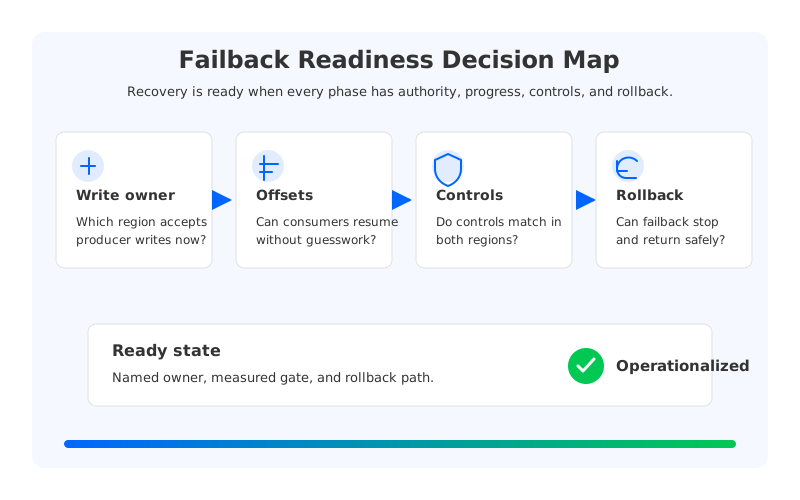
The scorecard should be simple enough to run before every major architecture change. For each critical topic family, assign a status for four phases: normal operation, failover, disaster recovery operation, and failback. A topic family is ready when every phase has a named owner, a tested runbook, a measured signal, and a rollback point.
Use four readiness levels. Unwritten means the behavior exists in diagrams but not in a runbook. Documented means the sequence is clear but has not been rehearsed with realistic clients. Rehearsed means the team has executed the sequence in a staging or controlled production-like environment. Operationalized means the runbook, metrics, alerts, access controls, and post-incident cleanup are part of normal platform practice.
The jump from documented to rehearsed is where most gaps appear. Producers may need a different DNS or bootstrap strategy. Consumers may need explicit offset reset rules. Connectors may need sink-specific idempotency checks. Security and finance teams may discover that the secondary region changes control and cost assumptions.
None of these findings mean the design is wrong. They mean the failback plan is becoming real. A streaming platform carries the memory of the business, and returning that memory to its preferred home deserves the same discipline as moving it away during the incident.
If you are reviewing whether your Kafka-compatible platform can support regional recovery without turning failback into a manual migration, compare your runbook against AutoMQ's shared-storage architecture and migration documentation. The AutoMQ architecture overview is a useful starting point for evaluating how stateless brokers, S3Stream, WAL storage, and object-storage-backed durability change the recovery model: read the AutoMQ architecture overview.
7References
- Apache Kafka documentation
- Apache Kafka consumer documentation
- Apache Kafka message delivery semantics
- Apache Kafka Connect documentation
- AWS Well-Architected Reliability Pillar: disaster recovery objectives
- AWS Architecture Blog: multi-site active/active disaster recovery
- AutoMQ architecture overview
- AutoMQ S3Stream shared storage overview
- AutoMQ WAL storage documentation
- AutoMQ migration overview
8FAQ
8.1What does failback readiness mean for Kafka?
Failback readiness means a team can return Kafka-compatible workloads from a disaster recovery region to the preferred operating region with controlled write ownership, offset continuity, connector behavior, governance parity, cost visibility, and rollback.
8.2How is failback different from failover?
Failover moves service away from an impaired region. Failback returns service after the region is repaired, without creating duplicate writes, offset mistakes, connector side effects, or governance drift.
8.3Can replication alone solve Kafka failback?
No. Replication can move records, but failback also needs decisions about write authority, consumer group progress, connector offsets, transactions, schemas, ACLs, and downstream idempotency.
8.4Why does shared storage matter for cross-region readiness?
Shared storage does not replace regional disaster recovery design. It changes the local cluster operating model by reducing broker-local durable data ownership. That can make broker replacement, scaling, and post-incident cleanup less dependent on partition-log movement, giving teams more room to focus on application-level failback correctness.
8.5Where should AutoMQ appear in a failback architecture review?
AutoMQ should be evaluated after the team defines the neutral requirements: Kafka compatibility, storage ownership, offset continuity, migration path, governance boundary, cost model, and rollback. It is relevant when the team wants a Kafka-compatible platform with stateless brokers and object-storage-backed durability rather than a broker-local storage model.


