
Table of Contents
Table of Contents
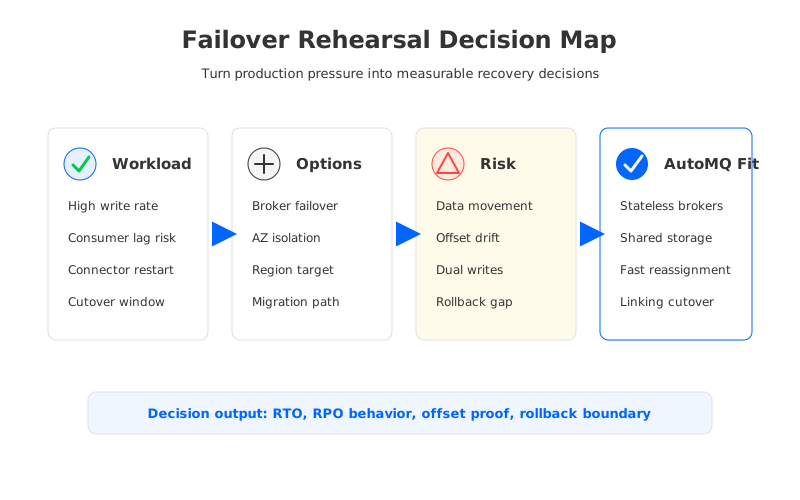
A kafka failover rehearsal search starts after someone finds a gap between the diagram and the runbook. The cluster is replicated, brokers span availability zones, producers use acknowledgments, consumers commit offsets, and dashboards look healthy. Yet the team still cannot answer the outage question that matters: if this broker, zone, region, or migration path fails, who moves first, what data is authoritative, and how do we prove consumers resume correctly?
That is the point of a failover game day. It is a controlled rehearsal that turns hidden coupling into evidence: storage ownership, client routing, offset continuity, connector restart order, capacity headroom, cost, and rollback boundaries. For Kafka-compatible event platforms, those details decide whether failover is routine or a long meeting with production traffic waiting outside.
1Why Teams Search for kafka failover rehearsal
Kafka often becomes the shared nervous system of a company before the operating model catches up. Payments, analytics, fraud signals, observability, lake ingestion, and customer-facing workflows may all depend on the same streaming backbone. The platform team can tolerate many things during a failure, but not ambiguity about message loss, duplicate processing, consumer lag, or when a standby path may become primary.
The first rehearsal exposes basic but expensive questions. Does the team fail over a broker, an availability zone, a region, or a managed service endpoint? Are producers pinned to happy-path bootstrap addresses? Do consumers rely on committed offsets, external checkpoints, or application state outside Kafka? Are sink connectors idempotent enough to restart against the target? Can rollback distinguish a false alarm from split brain?
These questions are uncomfortable because Kafka looks like a replicated system from the outside, while many operational risks live inside the interaction between replication and local state. A broker is not merely a compute process. In traditional Kafka, it owns partition replicas on local or attached disks, participates in leader election, catches up from peers, and consumes network bandwidth while it recovers. A failover rehearsal therefore has to test the physical work the platform must do before the cluster is healthy again.
2The Storage Model Behind Failover Risk
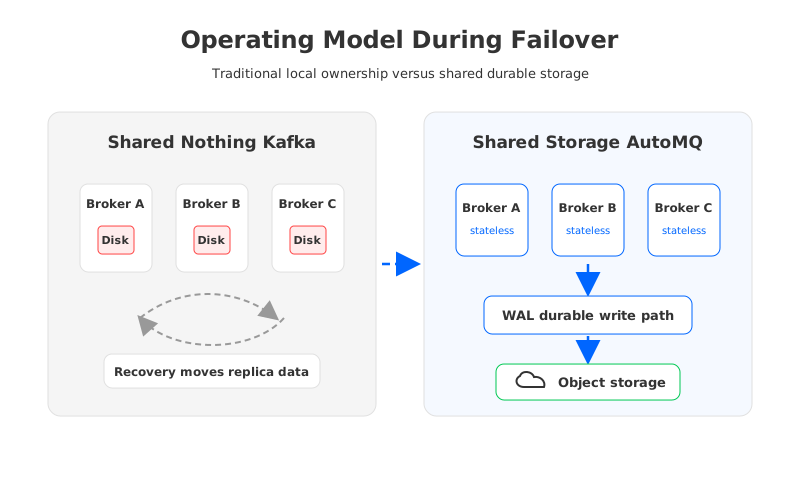
Traditional Kafka follows a Shared Nothing architecture. Each broker owns local storage, and durability comes from replicating partition data across brokers. That design is robust, but it turns recovery into a data movement problem. When a broker fails, a partition is reassigned, or a node is replaced, the platform has to know where authoritative replicas are, how much data must move, and whether remaining brokers have enough headroom.
Tiered storage reduces part of this pressure by moving older log segments to remote storage, but it does not remove the hot-path ownership model. Recent data, leader election, ISR health, and recovery time still depend on primary storage. A cluster may read history from object storage while broker-local replicas still catch up before failover is safe.
The practical failure modes are familiar to Kafka operators:
- Broker-local storage extends recovery time. A failed or drained broker leaves behind partition replicas that must be recreated or caught up elsewhere.
- Replication consumes the same network you need for customers. Replica catch-up competes with producer writes, consumer reads, and connector traffic, and may add cross-zone data transfer cost.
- Capacity headroom becomes a reliability dependency. The rehearsal must prove spare capacity exists before the incident, not after it.
- Rollback is harder than cutover. Moving clients is visible; proving the original path is still a valid recovery baseline is harder.
A strong game day treats these as architecture properties, not operational mistakes. The team is trying to discover which parts of the platform require data movement, which parts require coordination, and which parts are safe to automate.
3Compatibility, Replication, Rollback, and Observability Trade-Offs
The most useful evaluation framework starts with compatibility, because Kafka failover is rarely limited to brokers. Producers may use idempotence, batching, compression, custom partitioners, transactions, ACLs, quotas, or framework-specific behavior. Consumers may depend on group rebalancing, offset commits, processing patterns, or external state stores. Kafka Connect, MirrorMaker 2, stream processors, and observability agents each add recovery assumptions.
Compatibility should be tested as behavior, not as a checkbox. A platform can accept the Kafka protocol and still surprise teams if a client library, admin operation, connector, or transaction path behaves differently under failover. The rehearsal needs a representative client matrix: high-throughput producers, latency-sensitive consumers, batch consumers, source connectors, sink connectors, and incident admin scripts. The goal is to identify the client behaviors that define the blast radius.
Replication strategy comes next. Some teams use intra-cluster replication for broker and zone failures, then a separate replication tool for region-level recovery or migration. Others maintain an active-passive cluster, use MirrorMaker 2, or run a linking feature that preserves offsets. Each model has a different answer to the same four questions:
| Evaluation area | What the game day must prove | Failure signal to watch |
|---|---|---|
| Write authority | Which side accepts fresh writes during failover | Dual writes without conflict rules |
| Offset continuity | Where each consumer group resumes | Lag resets, skipped offsets, replay spikes |
| Connector safety | Whether sinks can restart without corrupting targets | Duplicate rows, partial files, non-idempotent writes |
| Rollback boundary | When the old path is safe to use again | Unknown divergence between source and target |
Observability should be designed around decisions, not dashboards. During a rehearsal, a platform owner needs to know when to declare the source unhealthy, promote the target, pause producers, restart consumers, and close rollback. Under-replicated partitions, consumer lag, request latency, produce errors, connector failures, and network throughput are useful when tied to those decisions.
That is why a game day should produce artifacts, not memories. The output should include recovery time, recovery point behavior, offset validation, client errors, connector restart outcomes, capacity impact, and runbook changes. A platform that cannot explain its last rehearsal in these terms is still relying on confidence rather than evidence.
4Evaluation Checklist for Migration Teams
Migration projects add pressure because the team is rehearsing failover while changing the platform. A Kafka-to-Kafka migration, ZooKeeper-to-KRaft transition, managed service move, or shift from local-disk Kafka to a cloud-native Kafka-compatible platform can look safe in a static review. Risk appears when source and target systems run together and real clients start moving.
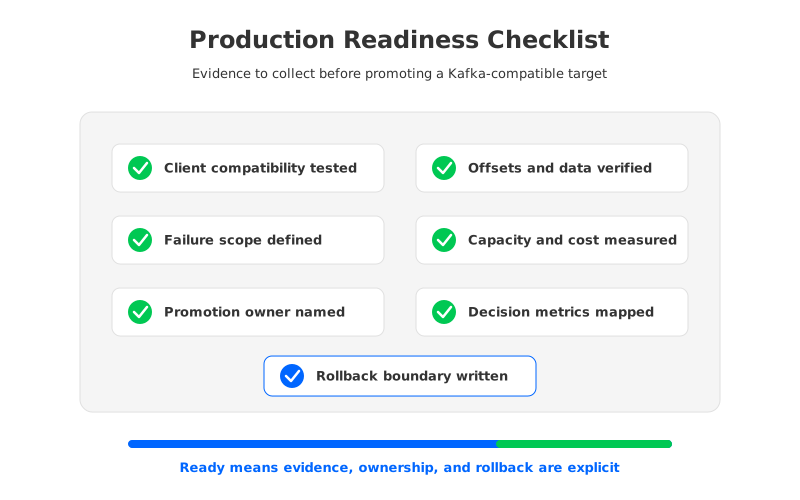
Use the checklist below before a production cutover. A good answer should name the owner, the evidence, and the rollback action.
| Readiness dimension | Questions to answer before production |
|---|---|
| Client compatibility | Which producer, consumer, admin, Connect, and stream processing clients are in scope? Which versions were tested against the target? |
| Data and offset movement | How are topics, configs, ACLs, committed offsets, and consumer group state moved or mirrored? How is correctness verified? |
| Failure scope | What is the smallest and largest failure the runbook covers: broker, AZ, region, cloud account, network path, or platform endpoint? |
| Cost and capacity | How much spare compute, storage, and network capacity does failover require? Which costs increase during recovery traffic? |
| Governance | Who can promote the target, pause writes, change DNS, update ACLs, or declare rollback closed? |
| Observability | Which metrics and logs trigger each decision? Which dashboards are useful during the incident bridge? |
| Rollback | What exact condition makes rollback safe, and what exact condition makes it unsafe? |
The scorecard should be boring by design. If a dashboard answers a question only after three people interpret it together, the dashboard is not an incident tool yet. If rollback depends on someone remembering which connector is idempotent, rollback is not an engineered path.
5How AutoMQ Changes the Operating Model
Once the evaluation framework is clear, the architecture question becomes sharper: how much of the failover procedure exists because brokers own persistent local data? If the hardest parts are partition data movement, broker disk headroom, cross-AZ replication traffic, and slow reassignment, then a Kafka-compatible platform with Shared Storage changes the problem.
AutoMQ is a Kafka-compatible cloud-native streaming system that keeps Kafka protocol semantics while replacing broker-local storage with shared storage. Its brokers are stateless, durable stream data is backed by object storage, and a WAL layer handles the immediate durable write path. During failover, a replacement broker does not need to inherit a failed broker's local disk before serving the partition. Recovery shifts from copying local replicas to reassigning ownership over data already stored outside the broker.
This does not remove the need for game days. It changes what the game day should measure. Instead of waiting for replica movement, teams can focus on client behavior, promotion decisions, application idempotence, offset validation, governance, and observability. AutoMQ's shared storage model also supports faster partition reassignment, reducing the operational weight of broker replacement and traffic redistribution.
The cost model changes as well. In traditional multi-AZ Kafka, server-side replication and client placement can generate cross-AZ traffic that grows with throughput. AutoMQ's zero cross-AZ traffic guidance depends on shared object storage and multi-point writes under specific deployment conditions, so teams should validate it against cloud provider, region, AZ layout, and client placement. Cost does not disappear; the dominant drivers become explicit design inputs.
For migration teams, AutoMQ Linking for Kafka is relevant because failover and migration share the same core concern: move clients without losing the relationship between records and consumer progress. A rehearsal should still validate topic configuration, group offsets, producer cutover, consumer resume behavior, connector safety, and rollback. The architectural advantage is that steady-state operations no longer depend on the local-disk balancing model that made the source cluster hard to operate.
6A Practical Game Day Runbook
A useful failover game day is small enough to repeat and realistic enough to hurt a little. Pick one representative workload, then include a production-like producer, a consumer group with meaningful offset commits, and a connector or stream processor that writes externally.
Start with a baseline period. Record throughput, latency, consumer lag, broker CPU, network throughput, storage behavior, connector status, and application metrics. Then inject one failure at a time: broker termination, AZ isolation, target promotion, connector restart, or client endpoint change. During each phase, freeze the decision log: who declared the event, which signal they used, and what moved the runbook forward.
Validate the data path before celebrating. Compare produced records, consumed records, committed offsets, sink-side counts, duplicate rates, and replay windows. Close with rollback: define whether the source can become primary again, remain read-only, require reconciliation, or be abandoned.
7Decision Matrix
The right platform choice depends on which risks dominate the business. A team with a small cluster and strict application-level idempotence may need a better runbook more than a different architecture. A team operating high-throughput clusters across zones, carrying expensive recovery headroom, or planning a migration may need to change the storage and operating model.
| Situation | Traditional Kafka focus | Shared storage focus |
|---|---|---|
| Broker failure | Replica health, leader election, disk catch-up | Fast ownership reassignment |
| AZ failure | ISR placement, client routing, spare capacity | Client routing, WAL/object storage durability, deployment constraints |
| Region migration | Replication tooling, offset sync, cutover timing | Linking path and offset validation |
| Cost pressure | Tune retention, broker size, and replica placement | Separate compute/storage scaling and reduce replication-driven traffic where supported |
| Governance pressure | Tighten runbooks around manual broker operations | Move runbooks toward promotion policy, client movement, and data validation |
The most important result of a kafka failover rehearsal is not a pass or fail label. It is a clearer map of which risks belong to Kafka semantics, application behavior, and the storage architecture underneath the platform. Once those categories are separate, technical buyers can evaluate options without mixing product claims and incident anxiety.
If your next game day is also a platform evaluation, start with the checklist, measure the recovery work your current architecture requires, and compare it with a Kafka-compatible shared storage design. AutoMQ's documentation on shared storage, Kafka compatibility, and cross-AZ traffic control is a practical next step: review the architecture docs.
8References
- Apache Kafka documentation: Kafka documentation
- Apache Kafka documentation: Consumer configuration
- Apache Kafka documentation: Kafka Connect
- Apache Kafka documentation: KRaft
- Apache Kafka wiki: KIP-405: Kafka Tiered Storage
- AutoMQ documentation: Architecture overview
- AutoMQ documentation: Native compatibility with Apache Kafka
- AutoMQ documentation: Partition reassignment in seconds
- AutoMQ documentation: Save cross-AZ traffic costs with AutoMQ
- AWS documentation: Data transfer in Amazon EC2 pricing
9FAQ
9.1What is a Kafka failover rehearsal?
A Kafka failover rehearsal is a controlled production-readiness exercise that tests how a Kafka or Kafka-compatible platform behaves when brokers, zones, endpoints, replication paths, clients, or migration targets fail. The goal is evidence about recovery time, recovery point behavior, client impact, offset continuity, connector safety, and rollback.
9.2How often should teams run Kafka failover game days?
Teams should run them whenever the risk profile changes: before a major migration, after a Kafka version upgrade, after changing replication or storage architecture, before onboarding a critical workload, and on a recurring schedule for critical clusters.
9.3Is MirrorMaker 2 enough for Kafka disaster recovery?
MirrorMaker 2 can be part of disaster recovery or migration, but it is not the whole operating model. Teams still need to validate topic configuration, offset synchronization, producer cutover, consumer resume behavior, connector idempotence, target capacity, observability, and rollback.
9.4How does shared storage affect Kafka failover?
Shared storage separates durable data from broker-local disks. In a Kafka-compatible architecture such as AutoMQ, stateless brokers can take over partition ownership without first copying large local replicas from a failed broker. That reduces data movement in broker replacement, reassignment, scaling, and recovery.
9.5Does a shared storage architecture eliminate the need for failover rehearsals?
No. It reduces some broker-local storage risks, but teams still need to test client behavior, application idempotence, offset validation, connector restart order, governance, alert thresholds, and rollback decisions. Architecture can make recovery simpler; rehearsals prove execution.


